
Midweek Review
Truth and Reconciliation Commission: Achieving accountability or betrayal of military

In response to a query raised by Major General (retd.) Ashok Mehta who had served as the IPKF’s commander in Batticaloa and Ampara in 1987, US Defence Attaché Lawrence Smith defended the Sri Lanka Army. The man in uniform told a seminar in Colombo: “Hello, may I say something to a couple of questions raised. I’ve been the defence attaché here at the US Embassy since June 2008. Regarding the various versions of events that came out in the final hours and days of the conflict — from what I was privileged to hear and to see, the offers to surrender that I am aware of seemed to come from the mouthpieces of the LTTE — Nadesan, KP — people who weren’t and never had really demonstrated any control over the leadership or the combat power of the LTTE.
So their offers were a bit suspect anyway, and they tended to vary in content hour by hour, day by day. I think we need to examine the credibility of those offers before we leap to conclusions that such offers were in fact real.
“And I think the same is true for the version of events. It’s not so uncommon in combat operations, in the fog of war, as we all get our reports second, third and fourth hand from various commanders at various levels that the stories don’t seem to all quite match up.
But I can say that the version presented here so far in this is what I heard as I was here during that time. And I think I better leave it at that before I get into trouble. “
The US State Department tried to disassociate itself with Lt. Col. Smith’s statement. The State Department’s Deputy Spokesman Mark. C. Toner declared at the regular media briefing: Well, just to clarify, the U.S. did decline invitations to participate in that conference as either a conference speaker or panelist. My understanding is that the defense attaché was there as an observer and a note taker. His comments reflected his personal opinions. There’s no change in the policy of the United States, and his remarks do not reflect any change in our policy.
By Shamindra Ferdinando
Sole Communist Party (CP) MP Weerasumana Weerasinghe broke ranks with dissident SLPP MPs on January 09 to vote for the Office for National Unity and Reconciliation (ONUR) Bill.
Having contested the last general election on the SLPP ticket, the Matara District MP aligned himself with the Uththara Lanka Sabhagaya (ULS) strongly opposed to the Wickremesinghe-Rajapaksa government. However, the CP had absolutely no qualms in backing the controversial Bill, suspected by many in the South to be a Trojan Horse.
In addition to lawmaker Weerasumana Weerasinghe, Sarath Kumarasiri (Anuradhapura District SLPP) voted for that Bill. In spite of being a member of the SLPP rebel group, that included MP Dullas Alahapperuma, Kumarasiri threw his weight behind the government.
Both MPs told the writer that the pivotal possibility of the ONUR law to facilitate the post-war reconciliation process couldn’t be denied. They stressed the responsibility on the part of Parliament to take whatever measures necessary to achieve reconciliation.
MP Weerasinghe underscored two critically important issues specifically (a) tangible measures to change the education system to ensure understanding among different communities and (b) Jaffna District MP M.A. Sumanthiran’s defeat at the January 21 ITAK (Illankai Thamil Arasu Kadchi) leadership contest. The CP member asserted that President’s Counsel Sumanthiran’s election could have facilitated reconciliation efforts.
But, Jaffna District MP Sivagnanam Shritharan comfortably won the race. The election was conducted in Trincomalee about two weeks after the enactment of the ONUR law.
MP Kumarasiri said that regardless of his affiliation with the rebel group, he wouldn’t hesitate to stand up with the government on issues he felt would be beneficial to the country. The MP said that he was out of the country on the date the vote on the Online Safety Bill was taken up. The SLPPer said that he would have definitely voted for the much disputed law, as well, though his colleagues opposed it.
Commenting on the forthcoming national elections – presidential later this year and parliament in early 2025, as announced by President Ranil Wickremesinghe’s group, MP Kumarasiri said that their alignment with the main Opposition Samagi Jana Balawegaya (SJB) could be finalized within weeks.
Both Weerasinghe and Kumarasiri declared their wholehearted commitment to the ongoing reconciliation process, spearheaded by the incumbent government. Addressing Parliament during the debate on the ONUR Bill, the CP member appreciated the role played by Justice Minister Dr. Wjeyadasa Rajapakse, PC, to streamline the process by strengthening the new ONUR management.
In addition to the two dissident SLPP MPs, Weerasumana Weerasinghe and Sarath Kumarasiri, only one SJB MP Vadivel Suresh (Badulla district) voted with the government parliamentary group. Unfortunately, the vast majority of government members skipped the vote. Therefore, out of the 225 MPs in Parliament, only 48 voted for the Bill, seven voted against, whereas a staggering 169 were absent at the time of the vote.
Among those who voted for the Bill was Sivanesathurai Chandrakanthan alias Pilleyan (SLPP Batticaloa district), a former LTTE cadre and one-time sidekick of their celebrated commander Vinayagamoorthy Muralitharan alias Karuna. Pilleyan is the leader of Tamil Makkal Viduthalai Pulikal (TMVP). Only one other Tamil MP Kulasingham Thileepan (EPDP/Vanni district) backed the Bill.
Why did 176 lawmakers (seven voted against and 169 skipped the vote) felt they shouldn’t support the government initiative? Did they fear catastrophic consequences if they took a stand on ONUR?
The UNP owed an explanation as to why its only MP Wajira Abeywardena (National List) conveniently failed to vote for the crucial Bill.
Among those who skipped the vote were M.A. Sumanthiran and Sivagnanam Shritharan, both vied for ITAK leadership and the latter won.
The following lawmakers voted for the Bill: Premier Dinesh Gunawardena, Susil Premajayantha, Bandula Gunawardena, Wijeyadasa Rajapakse PC, Madura Vithanage, Prasanna Ranatunga, Anuradha Jayaratne, Gunatilleke Rajapaksa, Pramitha Bandara Tennakoon, Rohana Dissanayake, Nalaka Bandara Kottegoda, Geetha Kumarasinghe, Mahinda Amaraweera, Cader Masthan, Kulasingham Thileepan, Sivanesathurai Chandrakanthan alias Pilleyan, A.L.M. Athaulla, D. Weerasinghe, Kapila Nuwan Athukarale, U. K. Sumith Udukumbura, Samanpriya Herath, Sanath Nishantha Perera (his last vote before the fatal accident on the Colombo-Katunayake expressway in the early hours of January 25), Ashoka Priyantha, Chinthaka Amal Mayadunne, S.M. Chandrasena, Jagath Samarawickrema, H. Nandasena, Nimal Siripala de Silva, Thenuka Vidanagamage, Maj. Sudarshana Denipitiya, Vijitha Berugoda, Dr. Gayashan Nawanandana, Kumarasiri Ratnayake, Pavitradevi Wanniarachchi, Janaka Wakkumbura, Muditha Prishanthi, Ranjith Siyambalapitiya, Udayakantha Gunatilleke, Dr. Seetha Arambepola, Jayantha Ketagoda, Sagara Kariyawasam, Yadamini Gunawardena, Manjula Dissanayake, Mohamed Faleel (all members of the government group), Weerasumana Weerasinghe and Sarath Kumarasiri (SLPP dissidents) and Vadivel Suresh (SJB).
Lawmaker Weerasumana Weerasinghe didn’t mince his words when he declared that extremists on both sides always opposed reconciliation efforts. The CP representative stressed that the ONUR should have been properly implemented immediately after the successful conclusion of the war in May 2009. The first time entrant to Parliament found fault with the top management of ONUR that had been established during the Yahapalana administration in terms of the 2015 Geneva Resolution for its failure to achieve desired results.
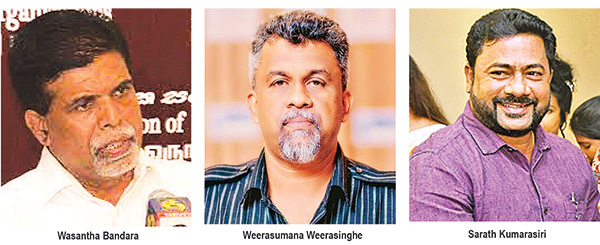
Dr. Wasantha Bandara issues warning
None of the Sinhala lawmakers critical of ONUR and the planned next step to setting up of an independent Commission for Truth, Unity and Reconciliation conveniently failed to vote against the Bill. Perhaps the most prominent among those who skipped the vote were National Freedom Front (NFF) leader Wimal Weerawansa, Pivithuru Hela Urumaya (PHU) leader Udaya Gammanpila and former Public Security Minister Rear Admiral Sarath Weerasekera. May be they, too, still have a flicker of hope in the latest reconciliation effort, despite having their hopes dashed repeatedly, especially when the West was mollycoddling the LTTE and its ardent backers, while paying lip service to fighting terrorism here.
They, too, however owed the public an explanation regarding their decision to miss the vote. If they really felt that ONUR would pave the way for a fresh disaster, they should have voted against the Bill. Their strategy remains unclear.
The likes of Weerasumana Weerasinghe and Sarath Kumarasiri, are certain to vote for the Bill meant to establish the proposed commission at its final reading.
The Wickremesinghe-Rajapaksa government can quite easily set up the Commission, through an Act of Parliament, as the main Opposition and a section of the SLPP wouldn’t, under any circumstances, vote against the relevant Bill.
Since the SLPP-led Parliament elected UNP leader Ranil Wickremesinghe in the third week of July 2022 as the eighth President to complete the remainder of the term of the people’s elected President Gotabaya Rajapaksa, unceremoniously ousted through violent street protests, the government quite comfortably enacted a spate of new laws.
There cannot be a better example than the pathetic performance of the Opposition at the debate and the vote on the ONUR Bill. Those who made bombastic statements and issued warnings over impending catastrophe in case the Parliament established an independent Commission for Truth, Unity and Reconciliation, conveniently failed to take a stand in Parliament.
However, Dr. Wasantha Bandara, on behalf of nationalist organisations in a spate of statements and articles, has explained the circumstances under which the Yahapalana government establishing the ONUR in 2015. We don’t blame nationalists’ fears here, knowing very well what happened to the legitimate demand of the Palestinians for a two state solution even at this late stage, after they were robbed of much of what they had by the arrogant British and placed them at the mercy of Israel, and, thereafter, being lied to them with the above promise for so long by the West, to appease their own consciences for having ill-treated Jews throughout history. And also knowing especially how Mr. Wickremesinghe signed the secret one sided Ceasefire Agreement with the LTTE after it was prepared by the Norwegians without any inputs from our military.
According to Dr. Bandara, the then Premier Ranil Wickremesinghe took the lead in the setting up of that office. The enactment of ONUR law recently is meant to strengthen the process.
Dr. Bandara has explained how the UNP, at the behest of Western powers and in consultation with the TNA, over the years, pursued an agenda severely inimical to the national interest, finally leading to the finalisation of Geneva Resolution on Oct 01, 2015.
Of the eight new laws required to be in place in terms of the Geneva Resolution, with the passage of the ONUR Bill on January 09, 2024, seven Acts are now in place. The enactment of the proposed Bill on the independent Commission for Truth, Unity and Reconciliation will complete the process as demanded by Geneva.
Dr. Bandara asserted that the UNP leader had succeeded in resurrecting the Geneva process and was proceeding rapidly. The SLPP ended up facilitating the process detrimental to the war-winning country.
The following are the laws that were enacted since 2015: (1) Yahapalana government (2015-2019) presented a Bill to establish the Office on Missing Persons (OMP) in Parliament on June 22, 2016 and the Office on Missing Persons (Establishment, Administration and Discharge of Functions) Act, No. 14 of 2016 (OMP Act) was passed in Parliament on August 11, 2016. The then President Maithripala Sirisena operationalised the OMP on Feb 28, 2018 by appointing seven commissioners, headed by Saliya Pieris P.C.
(2) The Yahapalana government in 2017 incorporated the provisions of the ‘International Convention for the Protection of All Persons from Enforced Disappearances’ into the law of Sri Lanka. Clause 8 of the relevant Bill enabled foreign countries to seek the extradition of a Sri Lankan who is suspected, accused or convicted of having caused enforced disappearances in Sri Lanka. In terms of the law Sri Lanka is obliged to inform foreign governments of the measures it intends taking to prosecute or extradite those persons wanted by them. Clause 21 empowered the executive arm of the State to oversee the full implementation of this international convention in Sri Lanka and according to Clause 23 new law superseded all other written law.
(3) Sri Lanka established an Office for Reparations. The then Speaker Karu Jayasuriya certified ‘Office for Reparations Act, No. 34 of 2018 on Oct 22, 2018.’
(4) Parliament on March 7, 2018 passed an Act No 5 of 2018 to give effect to the International Convention for the Protection of All Persons from Enforced Disappearances.
(5) Sri Lanka passed ‘Mutual Assistance in Criminal Matters (Amendment) Act No 24 of 2018. Speaker Jayasuriya certified it on Aug 15, 2018. The Yahapalana administration amended the Mutual Assistance in Criminal Matters Act No 25 of 2022.
The failed constitutional coup in late Oct 2018, followed by the Easter Sunday carnage in April 2019 and the change of government at the Nov 2019 presidential poll sort of derailed the Geneva project. However, the return of Ranil Wickremesinghe to power in the wake of Gotabaya Rajapaksa’s removal in July 2022 paved the way for the resumption of the Geneva agenda.
(6) After a lapse of several years Sri Lanka in August 2023 enacted ‘Assistance to and Protection of Victims of Crime and Witness Act of 2023.’
(7) In January 2023 Parliament adopted the ‘Office for National Unity and Reconciliation (ONUR) Bill’ thereby bringing the overall process much closer to a successful conclusion from their point of view.
Now only the independent Commission for Truth, Unity and Reconciliation remains to be established.
The UNP, SLFP, UPFA and SLPP have fully cooperated to advance the Geneva agenda and within a matter of months the Commission for Truth, Unity and Reconciliation, too, will be established. However, Tamil political parties and civil society groups haven’t been satisfied with the process. They have said so openly.
Dr. Bandara alleged that Tamil political parties, as well foreign-funded civil society groups, pretended that the enacted laws didn’t meet their aspirations. The passage of the Bill that would deal with the proposed independent Commission for Truth, Unity and Reconciliation would be the eighth law and the final.
Grave lapses on Sri Lanka’s part
In spite of much advertised Sri Lanka’s declaration of withdrawal from the Geneva accord of Oct 01, 2015, the Parliament sustained the project.
The then Prime Minister Mahinda Rajapaksa announced on the afternoon of Feb 19, 2019 that Sri Lanka would withdraw from the process of implementing UN Human Rights Council resolution 30/1, which was co-sponsored by the treacherous UNP-led government. The announcement was made close on the heels of the US declaration of a travel ban on then Army Commander Lt. Gen. Shavendra Silva and his family.
Just a week later, then Foreign Relations Minister Dinesh Gunawardena announced Sri Lanka’s withdrawal from the Geneva process. The declaration was made at the high-level segment of the 43 session of Geneva-based United Nations Human Rights Council (UNHRC). The Mahajana Eksath Peramuna (MEP) leader’s declaration pertained to UNHRC resolution 40/1 and the preceding resolutions 30/1 and 34/1.
Having promised what lawmaker Gunawardena called “homegrown solutions to contemporary challenges,” and declared its intention to work toward the closure of the resolution in conjunction with all members of the UN, Sri Lanka, though slowly has adhered to Geneva dictates. The MEP leader in his capacity as the Premier voted for the ONUR Bill. So did his son, Yadamini, an SLPP National List MP and first time entrant to Parliament. The only other MEP member who entered Parliament on the SLPP ticket, Sisira Jayakody, was not in Parliament at the time of the vote. None of the Rajapaksas, in Parliament, voted against the ONUR Bill.
It would be pertinent to mention that the Yahapalana partners, the UNP and the SLFP never bothered to consult Parliament before Sri Lanka co-sponsored the Geneva Resolution that actually betrayed the war-winning military. The treacherous act took place five years after the Tamil community cleared the military of war crimes allegedly perpetrated during Eelam War IV (Aug 2006-May 2009) by overwhelmingly voting for the warwinning Army Commander then General Sarath Fonseka at the 2010 presidential poll. Fonseka comfortably won all predominantly Tamil speaking districts in the de-merged Northern and Eastern Provinces, but was routed in the South, where the majority lives.
The writer once in the presence of senior Presidential Advisor Lalith Weeratunga and Director General of the President’s Media (PMD) Mohan Samaranayake at a formal meeting at the Presidential Secretariat (Old Parliament) told President Gotabaya Rajapaksa of the need to highlight TNA backing for Fonseka at the 2010 presidential poll and him securing all electorates in the Northern and Eastern Provinces and Tamils dominated major plantation regions. President Rajapaksa’s government never bothered to examine the accountability issue afresh.
The war-winning Mahinda Rajapaksa’s government nor any of the post-war administrations made a genuine effort to counter the false propaganda meant to drag Sri Lanka before the proposed hybrid war crimes court as recommended by Geneva. Sri Lanka could have easily built its defence on the basis of wartime US Defence Attache Lt. Colonel Lawrence Smith’s disclosure at the first Defence Seminar held in 2011 in Colombo that Sri Lanka did not commit any atrocities during the final phase of fighting and those made by wartime British defence Advisor Lt. Colonel Anthony Gash in his secret cables to London in Oct 2017. Those revelations alone could have been used to counter the American led allegations against the country about the closing stages of the war.
But Sri Lanka conveniently ‘missed’ both opportunities while Parliament advanced the Geneva agenda. The bottom line is that Sri Lanka allowed the Geneva operation to continue with the executive, legislature and judiciary extending their fullest support. But still, the same process could have been used cleverly to set the record straight beginning with the Indian terrorism project that ruined Sri Lanka.
What we would like to ask from our estranged Tamil brothers and sisters is whether they realise that by continuing to insist on a pound of flesh they will only help all of us to become a vassal state of India that we have already become more or less with the current leadership that is only interested in their personal survival? Instead as we have said before let us think nationally out of the box and perhaps settle among ourselves for a solution more akin to what we had under the Donoughmore constitution, where all share the pie at the centre instead of perennially fighting over petty issues at the periphery and exacerbating them in the process.



The Commission to Investigate Allegations of Bribery or Corruption (CIABOC) on 12 June questioned former President Mahinda Rajapaksa regarding the USD 2 Mn bribe allegation directed at the late SriLankan CEO Kapila Chandrasena, whose body was found on 8 May in a close relative’s home in Kollupitiya. Chandrasena’s alleged suicide sent shock waves through political circles and interested parties questioned the circumstances leading to him being granted bail on 6 May on cash bail of Rs. 500,000 with three sureties of Rs. 10 million each. The Colombo Magistrate court also imposed a travel ban. The issue at hand is as to how Mohamed Riswan and Mohamed Irshan stood as sureties for Chandrasekera. Of all the investigations undertaken by the CIABOC, the USD 2 Mn bribe case is the most politically charged probe.
Of the Rajapaksas, former State Minister Shasheendra Rajapaksa is so far the last to be indicted. CIABOC on 19 June filed indictments before the Colombo High Court against him and two others Sepalika Saman Kumari and Keerthi Bandara Kotagama. According to the charges, the accused are alleged to have committed the offence of corruption and aided and abetted the commission of the offence by using official influence to pressure certain government officials, attached to the Office for Reparations, to obtain compensation amounting to Rs. 8.85 million for a property built on a state land by Shasheendra and destroyed by marauding Aragalaya mobs.

By Shamindra Ferdinando
The ruling National People’s Power (NPP) government last week emphasised, in no uncertain terms, that it wouldn’t tolerate the growing Opposition challenge.
Amidst the growing controversy over the continuing detention of retired Maj. Gen. Suresh Sallay. in terms of the draconian Prevention of Terrorism Act (PTA), under humiliating conditions, in connection with the ongoing investigations into the 2019 Easter Sunday carnage, police arrested Sugeeshwara Bandara, leader of the New People’s Front (NPF). The Central Crime Investigation Bureau (CCIB) apprehended him on 18 June and the Fort Magistrate’s Court remended him till 1 July..
The CCIB also apprehended Binoy Hettiarachchi who was accompanying Bandara. Hettiarachchi served as a media coordinator at the former President Ranil Wickremesinghe’s Flower Road Office. Police intercepted their vehicle at Kollupitiya where the arrests were made like in an action-packed movie. Hettiarachchi was freed four hours later.
But, it would be better to identify Bandara as the former private secretary to President Gotabaya Rajapaksa as well as the Director General of Special Projects at the Presidential Secretariat in the wake of Ranil Wickremesinghe taking over the presidency.
Accused of receiving two salaries simultaneously, under the President’s Expenditure Head, Bandara who managed the media for Gotabaya Rajapaksa, in the run-up to the 2019 presidential election, is under investigation for abuse of government vehicles and employing government workers for political work.
Having launched his political career as the Colombo District organiser of the alliance New People’s Front, a breakaway faction of the UPFA, in February, 2024, Bandara contested the November, 2024, parliamentary polls on the New Democratic Front (NDF) ticket. But, of late, Bandara, as the leader of NPF, became one of the most active opposition activists, aligned with the political grouping, dubbed People’s United Opposition, operating from Ranil Wickremesinghe’s Flower Road Office.
Bandara drew the wrath of the government when he launched a noisy protest outside Finance Secretary Dr. Harshana Suriyapperuma’s residence at Akuregoda, Pelawatta, on 26 April, where he and his protesting supporters were given a shower of excreta. The group, led by Bandara, demanded the Finance Secretary’s resignation over the theft of USD 2.5 mn from the Treasury. No less a person than President Anura Kumara Dissanayake reacted angrily to Bandara’s actions.
Acknowledging the right for legitimate protests, the President warned against protests directed at residences of officials. On 18 April, Bandara led a protest outside Agriculture Minister K.D. Lal Kantha’s recently built luxury residence at Weliwita, Kaduwela, where he questioned how the JVPer managed to build such a home as he was on record as having repeatedly said that he lived a difficult life.
The police apprehended Bandara as he was returning from a meeting between senior representatives of the People’s United Opposition and the IMF Colombo at the Tiki Bar, Shangri-La. In spite of negligible parliamentary presence, with those elected on the NDF ticket at the last parliamentary election not really speaking in one voice, the Flower Road project has become a headache for the government.
In fact, the Flower Road operation has been causing continuous harassment to the NPP, while the Samagi Jana Balawegaya (SJB) struggled to play its anticipated role as the main Opposition. Instead of conducting a cohesive campaign against the cocky NPP government, members of the SJB seem to be pulling in different directions at the expense of the common opposition front.
Regardless of the Wickremesinghe-led grouping vowing to press ahead with its campaign, the arrest of Bandara is obviously meant to have a detrimental impact on the activities of the Opposition.
It would be pertinent to mention that Bandara had been among those who stayed with President Gotabaya Rajapaksa at the President’s House, in Colombo, as a massive protest erupted on 9 July, 2022. Bandara was among the last to flee the President’s House as the military withdrew, amidst mounting pressure on their positions.
The police arrested Bandara as former President Gotabaya Rajapaksa moved the Court of Appeal in terms of Article 140 of the Constitution to prevent him being arrested under the PTA. The wartime Defence Secretary sought the court intervention in the wake of police probing the 2019 Easter Sunday carnage and obtaining a travel ban against him.
The court heard Romesh de Silva PC’s submissions on behalf of the ex-President on 18 June. The court deferred the hearing to 24 June. The crux of the matter is that the ex-President fears that the CID is about to arrest him on the basis of a statement made by fugitive Azad Moulana, in Paris, linking Sallay directly with the Easter Sunday carnage.
NPP intensifies pressure
The NPP seems confident of its current course of action meant to pin down the Opposition. In spite of unbridled corruption being the major issue on the post-war election platform, no political party succeeded in going flat-out against the political opposition.
However, the NPP allowed the judicial process to continue. The first major sentencing was announced on 2 April, 2025, just six months after the parliamentary polls, handsomely won by the NPP. The Commission to Investigate Allegations of Bribery or Corruption (CIABOC) moved the Colombo High Court successfully against the former Chief Minister of the North Central Province S.M. Ranjith Samarakoon.
Colombo High Court No. 01 Judge Adithya Patabendige sentenced him in terms of Section 70 of the Bribery Act. The HC declared the former CM perpetrated malpractices by ordering fuel to his personal secretary’s vehicle. The personal secretary happened to be Shanthi Chandrasena, wife of his brother S.M. Chandrasena, a former Cabinet Minister and one of the most powerful Ministers to represent the North Central province.
The ex- Chief Minister and the second accused, his personal secretary, were convicted guilty of two charges. Both were sentenced to 16 years rigorous imprisonment and were also ordered to pay a fine of Rs. 200,000/- with an additional two-year prison term in case of default.
Deputy Director General Asitha Anthoney appeared on behalf of the Commission to Investigate Allegations of Bribery or Corruption.
There had never been any really coordinated CIABOC campaign against corruption. No political party, or a particular family, felt threatened by CIABOC. Both those in and outside Parliament acted with impunity. They feared no one. There was no need to be because the powerful and the influential operated above the law.
Just a couple of weeks after sentencing of S.M. Ranjith Samarakoon and Shanthini Chandrasena, the CIABOC arrested the latter’s husband, one-time Deputy Economic Development Minister and Special Projects Minister, S.M. Chandrasena. The CIABOC took him into custody on 4 July, 2025.
The CIABOC accused the former Minister of causing loss to the government by distributing seed corn, imported at a cost of Rs 25 mn, in 2024, among the farmer community in the Anuradhapura district, at a subsidised price. The distribution had taken place ahead of the 2015 presidential election contested by Mahinda Rajapaksa and estranged former SLFP General Secretary Maithripala Sirisena. The CIABOC alleged that Chandrasena exerted undue influence on the Director (Planning) and other officers of the District Secretariat and distributed seeds through his political allies to gain an advantage in the 2015 presidential election and incurred a loss to the government.
Chandrasena was granted bail on 1 August, 2025. He was indicted on 12 June before the Colombo High Court.
Before further discussing the ongoing anti-corruption campaign, let me introduce the top leadership of CIABOC. The Commission consists of Justice W.M.N.P. Iddawela (Chairman), K.B. Rajapakse and Chethiya Goonesekera P.C, with High Court judge R.S.A. Dissanayake as its Director General.
The sentencing of the S. M. Ranjith Samarakoon didn’t really bother his side. The arrest of his brother S.M. Chandrasena, too, didn’t really upset those facing charges. But, sentencing of former Minister Mahindananda Aluthgamage and former Sathosa Chairman and former Trade Minister Nalin Fernando on 29 May, 2025, sent shock waves through the Opposition.
The Colombo High Court Trial-at-Bar sentenced Aluthgamage and Fernando for committing the offence of corruption by purchasing 14,000 carrom boards and 11,000 checkers boards through Sathosa, allegedly to distribute to schools and sports clubs selected by the Sports Ministry, and distributing them to party offices of the government, during the 2015 presidential election campaign thereby, causing a loss of over 53 million rupees to the government, stunned the Opposition.
Aluthgamage was sentenced to 20 years of rigorous imprisonment, Fernando received a sentence of 25 years of rigorous imprisonment. Additionally, a fine of Rs. 100,000 (hundred thousand) was imposed for each count.
The CIABOC’s Assistant Director General Mrs. Anuththara Jayasinghe and Assistant Director General Mrs. Thushari Dayaratne conducted the prosecution.
During the Yahapalana government Aluthgamage spearheaded a high profile anti-corruption campaign, dubbed ‘Yahapalana Top 10 kamba horu’. The then Joint Opposition (JO) group, led in Parliament by Dinesh Gunawardena, published a 750-page book, targeting the Yahapalana ministers. Mahindananda, who spearheaded that campaign, is now serving a long sentence.
The JO group consists of UPFA lawmakers who declined to throw their weight behind the then President Sirisena aligned with the UNP.
Let me mention the names of those against whom the accusations were made by the JO.
Yahapalana corruption
The JO dealt with 10 major cases. (1) The Treasury bond scams perpetrated in 2015 and 2016. Accusations were directed at Ranil Wickremesinghe, Ravi Karunanayake and Governor Central Bank Arjuna Mahendran. The losses were estimated at Rs 26 bn. (2) causing losses amounting to Rs 10 bn through the fraudulent import of vehicles. Ravi Karunanayake was named the chief culprit (3) Misappropriation of Mahapola funds to the tune of Rs. 1 bn. Allegations were directed at Malik Samarawickrema (4) Stealing from an insurance scheme implemented for the benefit of those going for employment in West Asia. The JO accused Thalatha Atukarale of misappropriating funds amounting Rs 1.5 bn (5) Receiving Rs 1.5 bn through the leasing of Hambantota port to China on a 99-year lease. Ranil Wickremesinghe, Malik Samarawickrema and R. Paskaralingam were named the offenders (6) Kabir Hashim was accused of causing a loss of Rs 54 bn by cancelling aircraft ordered from Airbus Industries for the national carrier (7) fraudulent activities pertaining to the release of paddy stocks held by the government. The JO estimated the losses caused to the government at Rs 10 bn. (8) Scam in vehicle parts. Ravil Karunanayake was accused of causing losses amounting to Rs. 6.5 bn, (9 A) Dr. Rajitha Senaratne was accused of leasing of the Modera fisheries harbor and procurement of eight vessels to catch fish, fraudulently, and thereby causing losses up to Rs 1 bn, (9B) The JO also found fault with Dr. Senaratne for perpetrating Rs 1.5 bn fraud in the procurement of medicine and lastly (10) Ranil Wickremesinghe, Malik Samarawickrema, R. Paskaralingam and Charitha Ratwatte were blamed for a massive fraud in the procurement of coal for the Norochcholai coal-fired power plant. That particular fraud was estimated at Rs 5 bn.
Although the JO transformed itself to Sri Lanka Podujana Peramuna (SLPP) later, to successfully contested the 2019 presidential election, none of the above-mentioned cases were investigated. As far as we know, none of those cases had been dealt with during the SLPP rule, from November, 2019, to July, 2022. Faced with an externally backed regime change operation, the SLPP invited Wickremesinghe, who had been named by them in three major corruption cases, to accept the premiership in May, 2022, and presidency in July same year.
So far, there is no indication whether the mentioned JO allegations had received the attention of the CIABOC or the Attorney General of the government. As far as we know of all the politicians and officials, Wickremesinghe is the only one facing imminent threat due to the ongoing case pertaining to him visiting the UK in September, 2023, to join his wife Prof. Maithree at the University of Wolverhampton at her graduation ceremony.
Wickremesinghe has been accused of squandering nearly 17 mn rupees at a time the country was in deep economic turmoil. The Fort Magistrate’s court is scheduled to take up the case on 8 July.
SLPP parliamentary group leader Namal Rajapaksa is also facing a major legal challenge. The former Minister has been indicted on charges of criminal misappropriation of Rs. 70 mn in connection with the controversial Krrish project. The indictments have been forwarded to the Colombo High Court by the Attorney General, alleging that Namal Rajapaksa misappropriated funds by receiving Rs. 70 million from the Indian real estate company for the development of rugby in Sri Lanka.
Yoshitha Rajapaksa, too, has been dealt with by the CIABOC. The Rajapaksas have been accused of lowering qualifications required to join the executive branch of the Navy and then sending him to the Royal Naval Academy in the United Kingdom at taxpayers’ expense. Produced before the Colombo Additional Magistrate, Yoshitha was released on three personal bail bonds of Rs. 5 million each.
Producing Yoshitha before court on 17 June, Deputy Director General of the Bribery Commission, Ruvini Wickramasinghe declared: “”Your Honour, the complaint regarding this incident was received on June 25, 2016. Accordingly, the Commission initiated investigations. The complaint states that the suspect had participated in naval training programmes held in England and Ukraine by misusing government funds, while depriving qualified applicants of such opportunities. At that time, this individual, who is a civilian in the dock today, was also a civilian in 2006 when he was deemed eligible for the Royal Navy Young Officer training at the Royal Naval Academy in the United Kingdom. The opportunities to receive this training are extremely limited. Your Honour, selection to this prestigious course is usually based on being the most outstanding cadet officer during a two-year training period or based on performance during training. However, this suspect, although a civilian in 2006, was proposed and included in the list and was sent for the course in haste.”
The Deputy Director General also stated that Yoshitha Rajapaksa had undergone medical examinations required for overseas training even before being officially recruited into the Navy.
The court was also told that though Sri Lanka previously received scholarships from the UK the Rajapaksa government funded Yoshitha to the tune of Rs 6.2 mn.
Opp. attacks CIABOC
The Opposition has repeatedly attacked the CIABOC with its Director General Ranga Dissanayake being the primary target. Accusing Dissanayake of being a JVPer, the Opposition has repeatedly questioned the conduct of the High Court judge demanding that the CIABOC inquired into the top official’s conduct, especially with regard to the alleged suicide of former Sri Lankan CEO Kapila Chandrasena who had been under investigation pertaining to the receiving of USD 2 mn bribe to facilitate procurement aircraft from Airbus Industrie during Mahinda Rajapaksa’s second term.
Former Foreign Minister Prof. G. L. Peiris, a regular speaker at Flower Road media briefings, alleged that the CIABOC was a political tool in the NPP’s hands.
A section of the Opposition to question the circumstances one-time JVP heavyweight Nandana Gunatilleke died in January this year at the Ragama Teaching Hospital after accusing Dissanayake of pursuing an agenda beneficial to the JVP, a charge denied by the High Court judge. When the writer raised the allegations with Dissanayake, he emphatically denied any wrongdoing on his part https://island.lk/ciaboc-dg-denies-jvp-link/.
The CIABOC has simply ignored accusations directed at its DG who proved through his actions that he really meant high profile public pronouncements against corruption.
Former Deputy Minister and ex-MP Sarana Gunawardena was sentenced to a total of 16 years rigorous imprisonment by the Colombo High Court on June 8, 2026.
During the Yahapalana administration many cases, filed by the CIABOC as well as the Attorney General, were either dismissed or dropped due to lapses on their part. The accused in such cases were ex-MP Sajin Vass Gunawardena, ex-EP Chief Minister Sivanesathurei Chandrakanthan alias Pilleyan, ex-Ministers Johnston Fernando, Rohitha Abeygunawardena, Basil Rajapaksha, Mahindananda Aluthgamage and Janaka Bandara Tennakoon and former AG and CJ Mohan Peiris.
Regardless of Opposition protests, the public appreciate tangible action against corruption. However, the NPP has not been free from serious allegations against it since the last general elections. The release of suspicious 323 containers, plus two containers filled with ice, in January, 2025, followed by the massive coal scam perpetrated in September 2025, loss of over USD 2.5 mn from the Treasury and controversial Aswesuma payments, as well as wealth, accumulated by NPP Ministers as revealed by declarations made to CIABOC, shocked the electorate.
The NPP has failed to counter allegations. The circumstances under which Energy Minister Kumara Jayakody resigned, along with Energy Secretary Udayanga Hemapala, on 17 April, just a week after the NPP defeated the no-confidence motion moved by the Opposition against the Energy Minister. dealt a devastating blow to the NPP’s much touted integrity. The NPP couldn’t explain as to why a person under investigation by the CIABOC for an alleged fraud perpetrated during the Yahapalana government was accommodated in President Dissanayake’s first Cabinet. Indicted before the Colombo High Court, Jayakody’s case commenced last week.
Asset declarations of some NPP Ministers have shocked the country. The SJB has called for CIABOC to investigate them without delay and prove that CIABOC was not only going after the Opposition. Ministers Lal Kantha and Wasantha Samarasinghe are two of the top JVPers who have attracted attention as the Opposition hits back at the government.
SJB MP Mujibur Rahuman said that the JVP/NPP owed an explanation as to how their members amassed so much wealth since 2024 as they repeatedly claimed their inability to meet even their basic needs. But, their asset declarations exposed their blatant lies.

Listening to the Winds, Reading the Waves:
Prof. Gamini Keerawella’s latest publication, Winds and Waves: Geopolitical Currents in the Indian Ocean since 1945 will be launched on 5 August at the Auditorium of the Bandaranaike Centre for International Studies (BCIS). The keynote address will be delivered by Prof. T. V. Paul, James, McGill Professor of Political Science at McGill University, Canada and the former President of the International Studies Association (ISA).
Prof. Keerawella, Professor Emeritus of History at the University of Peradeniya, has dedicated hisbook to the memory of Dr. Newton Gunasinghe, the eminent sociologist and Marxist theoretician who encouraged him to venture beyond disciplinary frontiers. In many respects, this work represents a successful realization of that intellectual endeavour. In her testimonial to back cover of the book, Dr. Radhika Coomaraswamy observes that “Gamini Keerawella offers a nuanced and layered account of the Indian Ocean region’s strategic evolution from the era of decolonization to the contemporary phase of intensifying great-power rivalry. Its distinctive analytical perspective makes it an important contribution to the study of international relations, maritime geopolitics, and regional strategic dynamics.” This assessment accurately captures the significance of the work, and I fully endorse her judgement.
This volume constitutes the final publication of a trilogy that explores the evolving dynamics of international relations from a distinctly Sri Lankan perspective. The first study examined the trajectory of Sri Lanka’s defence and foreign policy, while the second revisited the origins, evolution, and principal constituent elements of international relations as an academic discipline from a Global South perspective. The present work broadens the analytical canvas by tracing the shifting geopolitical contours of the Indian Ocean since 1945 and examining the evolving interplay between great-power competition and regional agency.
Indian Ocean not merely maritime transit space
At the heart of Prof. Keerawella’s analysis is the argument that the Indian Ocean is not merely a maritime space of transit but a living archive whose language is inscribed in tides, trade, and collective memory. To uncover the deeper structures that have shaped the region, he draws on Michel Foucault’s concept of the archaeology of knowledge, probing beneath the visible layers of historical experience to reveal successive strata of thought, exchange, and power. This approach enables him to trace the multiple origins of the Indian Ocean’s geopolitical significance through the sedimented traces of how the ocean has been known, governed, and imagined across time. Complementing this perspective is Fernand Braudel’s concept of the longue durée, which provides the framework for understanding the long-term evolution of Indian Ocean geopolitics. As Keerawella notes, for Braudel, history unfolds not as a single linear sequence but as a layered field of continuity and change, revealing the deeper architecture of the past—the slow yet powerful currents that shape political and economic developments beneath the surface of events (Keerawella 2026: xxiii).Prof. Keerawella further notes that later historians such as K. N. Chaudhuri and M. N. Pearson drew on Braudel’s insights and adapted them to understand the Indian Ocean as a polycentric world.
Prof. Keerawella argues that the terms employed in the title of this work—Winds, Waves, and Currents—evoke the ocean’s dual language of surface movement and underlying structure. In his reading, winds and waves signify motion: the visible and often turbulent forces that carry ships, peoples, commodities, and ideas across shifting maritime frontiers. Currents, by contrast, refer to the deeper and less visible forces that shape historical trajectories and connect coasts and continents through enduring patterns of interaction. As he observes, while winds and waves represent the restless dynamics of the ocean’s surface, currents embody the slower yet more consequential energies that operate beneath it, binding disparate regions into a larger maritime system (2026: xx).
Metaphors and Conceptual Foundation
Building on this conceptual foundation, the author employs winds, waves, and currents not merely as metaphors but also as analytical categories. Winds represent changing strategic directions and geopolitical realignments; waves denote recurring cycles of commerce, conflict, and interaction; and currents symbolize the deep structural forces that connect societies across space and time. Viewed from a distinctly Sri Lankan perspective, the volume demonstrates how a strategically located small state at the centre of the Indian Ocean perceives and navigates this maritime space through its own strategic lens. The book opens by situating Sri Lanka within the intersecting forces of history, geography, and power that have shaped the Indian Ocean world. It advances the notion of a dual strategic consciousness that has informed Sri Lanka’s external engagements: a persistent sense of vulnerability, rooted in colonial experience and geographical exposure, coexisting with a cosmopolitan outlook forged through centuries of maritime exchange. Prof. Keerawella contends that this dual consciousness constitutes the underlying framework through which Sri Lanka has historically interpreted and responded to developments in its external environment.
Winds and Waves is a comprehensive study comprising eleven chapters and an extensive introduction that establishes the analytical foundations of the work by treating the ocean simultaneously as text and method. The opening chapter situates Sri Lanka within the wider Indian Ocean system, tracing the island’s navigation through shifting configurations of power while emphasising the agency of small states. The Indian Ocean is presented not merely as a strategic arena but also as a moral and political space, linking Sri Lanka’s historical experience to the broader aspirations and consciousness of the Global South.
Revisiting British withdrawal
The book revisits Britain’s withdrawal from the Indian Ocean, arguing that it was not simply a consequence of post-war decline but the culmination of deeper structural transformations in the international system. Decolonisation, Afro-Asian nationalism, and the emergence of bipolarity fundamentally altered the regional order and created the conditions for Britain’s retreat. In turn, this withdrawal opened the way for superpower competition, particularly between the United States and the Soviet Union, transforming the Indian Ocean into major theatre of Cold War geopolitics.
A substantial portion of the volume is devoted to examining the policies and strategic trajectories of the major powers. The author traces American engagement from Cold War containment through post-Cold War maritime predominance to contemporary Indo-Pacific formulations, demonstrating that U.S. strategy has evolved through the interaction of structural imperatives and changing strategic discourses. Particular attention is paid to the 2026 U.S.–Iran War, which is interpreted as a transformative event that exposed the limits of military hegemony and accelerated patterns of strategic hedging and multi-alignment among regional actors. The book also explores the Soviet Union’s entry into the Indian Ocean in 1968 and the subsequent re-emergence of Russia under Vladimir Putin through selective naval deployments, arms transfers, and strategic partnerships, illustrating what the author characterises as the recurrent rhythms of great-power engagement in the region.
The rise of China receives extensive treatment as one of the most significant structural developments of the twenty-first century. Through the Belt and Road Initiative, port development projects, and naval modernisation, China has translated growing economic power into expanding strategic influence. The author contrasts Beijing’s assertive posture in the South China Sea with its relatively restrained approach in the Indian Ocean, where economic diplomacy and cooperative security initiatives have assumed greater prominence. Equally significant is the discussion of India’s transformation from a regional power into an emerging global strategic actor. The evolution of Indian maritime strategy—from Nehruvian custodianship to contemporary blue-water ambitions—demonstrates how a rising power navigates structural constraints while expanding its strategic reach. Initiatives such as SAGAR, naval modernization, and deepening partnerships with the United States, Japan, and Australia have positioned India as a central actor in the evolving Indo-Pacific order.
Roles of Japan and EU examined
The volume also examines the roles of Japan and the European Union in shaping the contemporary maritime order. Japan’s transition from post-war restraint to proactive strategic engagement, embodied in the Free and Open Indo-Pacific (FOIP) vision, illustrates how middle powers adapt to changing geopolitical realities through coalition-building and maritime capacity enhancement. The European Union’s engagement is portrayed through less visible but nevertheless significant mechanisms, including trade, development cooperation, maritime governance, and norm diffusion, contributing to what the author terms a form of “quiet-making multipolarity” that encourages restraint, stability, and pragmatic cooperation.
Moving beyond conventional geopolitics, the book broadens the analytical framework to address a range of non-traditional security challenges confronting South Asia in general and Sri Lanka in particular. Climate change, piracy, illegal fishing, maritime terrorism, public health vulnerabilities, and digital insecurity are examined as transnational challenges that transcend the capabilities of individual states. The author argues that these issues reveal the limits of unilateral action and underscore the growing importance of cooperation, collective action, institutional innovation, and middle-power leadership in maritime governance.
Prof. Keerawella further situates the Indian Ocean within the wider context of the emerging Asian Century. Asia’s resurgence—driven principally by China and India and reinforced by the dynamism of Southeast Asia—is presented as a major reconfiguration of global power. In this transformation, the Indian Ocean functions as a vital maritime artery connecting energy resources, manufacturing centres, and consumer markets. At the same time, the author cautions against deterministic interpretations, emphasising that the realisation of the Asian Century remains contingent upon how the region responds to persistent inequalities, environmental challenges, governance deficits, and intensifying strategic competition.
Assessing how SL has navigated shifts
The book concludes by returning to Sri Lanka and assessing how the country has navigated contemporary shifts in the regional and global balance of power under the National People’s Power (NPP) government that emerged in the aftermath of the Aragalaya of 2022. The author demonstrates how economic crisis, demands for accountability, and aspirations for a new political culture have reshaped the domestic context within which foreign policy is conducted. Under President Anura Kumara Dissanayake, Sri Lanka is portrayed as pursuing a carefully calibrated strategy that combines engagement with international financial institutions, enhanced cooperation with India in defence and energy sectors, continued economic engagement with China, and functional security relations with the United States. The government’s response to the 2026 U.S.–Iran War—rejecting military access requests from all parties while extending humanitarian assistance—serves as an illustration of the author’s broader argument that strategic flexibility, principled neutrality, and diplomatic agility remain essential for small states navigating an increasingly complex Indian Ocean order.
Taken together, the book advances several interconnected propositions. First, the Indian Ocean is entering an increasingly multipolar era in which power is exercised through complex networks of cooperation, competition, and interdependence rather than rigid alliance structures. Second, small states are neither passive spectators nor mere proxies of great powers; they possess strategic agency and navigate competing pressures through hedging, diversification, and calibrated diplomacy. Third, Sri Lanka’s strategic behaviour—characterised by navigating asymmetry through flexibility and ambiguity—reflects a historically rooted dual consciousness that combines vulnerability with cosmopolitan engagement. Fourth, non-traditional security challenges and environmental governance are no longer peripheral concerns but central components of the evolving regional order.
Need for adaptive navigation
Prof. Keerawella argues that contemporary statecraft in the Indian Ocean requires adaptive navigation rather than rigid alignment. In a fluid and contested maritime environment, survival and influence depend less on resisting structural change than on understanding and responding to it with prudence, flexibility, and strategic clarity. The book therefore offers important insights into how small states can transform structural vulnerability into strategic agency and convert exposure into opportunities for engagement within a changing regional order.
Combining historical depth with contemporary analysis, it provides a nuanced understanding of the interaction between great-power competition, regional transformation, and the strategic choices of smaller states. The book will be of considerable value to students and scholars of international relations, political science, strategic studies, and maritime affairs, while also offering useful perspectives to policymakers, diplomats, and practitioners. Equally important, it opens several promising avenues for future research on the Indian Ocean and the emerging Indo-Pacific order.
Hermeneutic approachs
Methodologically, the study draws upon hermeneutic approaches to examine the geopolitical and maritime environments that shape relationships among states, societies, and historical processes. The result is a work that is both analytically rigorous and intellectually engaging. This review has sought less to evaluate the book in a conventional sense than to introduce its central themes and encourage a wider readership to engage with its arguments. Having highlighted the many merits of the volume, it is worth noting one technical shortcoming: the absence of an index. Given the book’s wide thematic scope and rich empirical content, the inclusion of an index would have significantly enhanced its value as a reference tool for researchers and students alike.
In sum, Prof. Keerawella listens attentively to the winds, reads the waves with analytical precision, and traces the deeper currents that shape the Indian Ocean world. The outcome is Winds and Waves: Geopolitical Currents in the Indian Ocean since 1945, a timely and thought-provoking contribution published by the Bandaranaike Centre for International Studies.
Reviewed by
Dr. Ramesh Ramasamy
Department of Political Science, University
of Peradeniya

‘The Flying White House’,
Lavished on ‘the most powerful man’,
Is entirely in a class of its own,
And smacks of a space fiction wonder,
But there’s more than meets the eye here,
Because on the one hand we have,
A novel projection of super power,
And on the other hand a costly deal,
Where a conscience that matters,
Is being mindlessly bartered.
By Lynn Ockersz

Should not drop someone just to give Sooryavanshi an opportunity: Sitanshu Kotak

Hetmyer, Stoinis and Jasdeep combine to hand Freedom 88-run defeat

Row over alleged theft of donations from India’s landmark Ram temple

Over 40 persons injured in head on crash at Talalla

Turkiye beat US 3-2 with stoppage-time goal in dead rubber

Japan draw 1-1 with Sweden at World Cup to finish second in Group F

‘Dates have the highest sugar content to fight Coronavirus’

Sunday Island 27 December – Headlines

#SundayIsland 17th December – Headlines

Sunday Island – 28th March

Sunday Island Headlines – 21 March

Sunday Island – 21st February – Headlines
-

 News7 days ago
Creditor not yet paid
-
 News7 days ago
Consumers bearing 22% tax burden despite 18% VAT claim: Dr. Harsha de Silva
-

 Features6 days ago
Nanda Pethiyagoda Wanasundara as three generations of family saw her
-

 Features5 days ago
Sri Lanka developing independent hydrographic capabilities
-

 Editorial6 days ago
Fuel crisis: Beyond price debate
-
 Opinion4 days ago
Ranasinghe Premadasa: The man who would not take ‘No’ for an answer
-

 Latest News5 days ago
Sooryavanshi thumps fastest List A fifty as India A win tri-series
-

 News3 days ago
US Assistant Secretary of State for South and Central Asian Affairs meets President