
Opinion
The Walk for Peace in America a Sri Lankan initiative: A startling truth hidden by govt.

When we come to it
We, this people, on this wayward, floating body
Created on this earth, of this earth
Have the power to fashion for this earth
A climate where every man and every woman
Can live freely without sanctimonious piety
Without crippling fearWhen we come to it
We must confess that we are the possible
We are the miraculous, the true wonder of this world
That is when, and only when
We come to it.
· Concluding lines of the poem ‘A brave and startling truth’
(1995)
– Maya Angelou
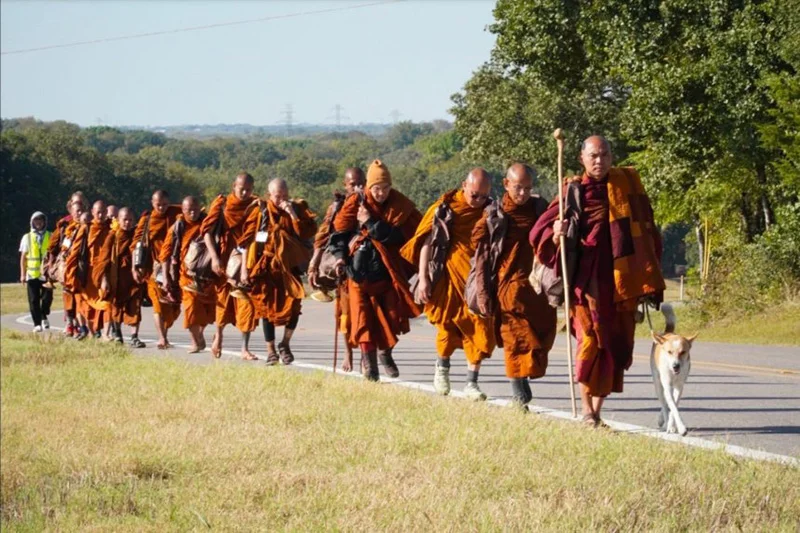
Ven. Dr Melpitiye Wimalakitti Nayake Thera, Head Monk of the Wijesundararamaya, Asgiriya, Kandy, and the Chief Incumbent of the Gotama Viharaya Monastery, Fort Worth, Texas, USA, claims that the ongoing Texas to Washington Walk for Peace march led by the American monk of Vietnam origin Ven. Pannakara is ‘an initiative of ours’ (ape wedak). He made this claim during a recent podcast hosted by the well-known YouTuber and journalist Chamuditha Samarawickrema (CNB/February 5, 2026). The Huong Dao Monastery of Bhante Pannakara, who is leading the peace walk is close to the Gotama Viharaya Monastery of Wimalakitti Thera, who tells us that he has had a strong connection with Vietnamese monks and has already collaborated with them in many Buddhist activities.
Talking about Ven. Pannakara, Ven. Wimalakitti says that he is a pupil of senior Vietnamese bhikkhu Ven. Ratanaguna of the same Huong Dao Monastery in Fort Worth Texas. He is leading a team of 24 Buddhist monks from different countries in the (Southeast Asian) region including Vietnam, Cambodia, Thailand, Bangladesh, Laos, etc., taking part in the Walk for Peace (from Fort Worth in Texas to Washington D.C.). It is going to be 2723 miles long according to Wimalakitti Thera. The Walk for Peace started on October 26, 2025 and is due to pass through 4 time zones and 10 states, braving extremes of weather and trekking through patches of harsh terrain.
It was 40 degrees Celsius in Texas, when they started. In seven days, the Peace Walkers reached Georgia in Atlanta. It was raining there. Then, they arrived in South Carolina, where it was cold, the temperature usually being under 20 degrees Celsius. By the time of the podcast with Chamuditha, the Walk for Peace was proceeding through the even colder North Carolina, the temperature barely rising above 1 or 2 degrees Celsius. Then, they reached Virginia with heavy snowfall, but the Walk went ahead nonstop.
The original plan was to walk 8 hours and cover 20 miles in a day. Now they want to do 10 hours a day and cover a targeted 40 miles. They hoped to have at least 20 participants in the Walk at any time. The whole Walk is expected to take 120 days and end on February 13, 2026.
America is a big democratic country, the monk says. The ordinary people are more interested in inner peace than in politics. There are 125 Sri Lankan Buddhist pansalas in America, 15 of which stand on the route of the continuing Walk for Peace. Sri Lankan monks resident in these monasteries, in partnership with monks from other countries, provide the Walkers with essential food, temporary lodgings, and hygienic facilities. They also work out security arrangements for the peace-walking monks in coordination with government and municipal authorities and Police.
Ven. Wimalakitti provides this information as a member and a director of the organising committee responsible for the Walk for Peace project. According to him, Ven. Pannakara takes part in an annual walk in India from Buddha Gaya to Kolkata (the capital city of India’s West Bengal state) as a dhutanga practice (one of the 13 strict ascetic practices recommended for bhikkhus in Theravada Buddhism that aim at perfecting austerity, mental purification, and renunciation). About 200 Buddhist monks join Bhikkhu Pannakara on this walk.
The dog now celebrated as Aloka started following Ven. Pannakara at Buddha Gaya and reached Kolkata with him. He followed the monk even to the airport. Bhikkhu Pannakara could not leave the dog behind in India and fly back to America. So, he canceled his flight and stayed back in India for eight months, during which he trained the dog and completed the paperwork necessary to take him to America with him. Once in America, Aloka sometimes started growling at people at first, because he was not used to the new environment. So, they put a pet cone around his neck to calm him while on the move. Now he participates in the Walk without the pet cone and walks beside Bhikkhu Pannakara at the head of the column of Walkers. The monk usually takes Aloka on a leash and occasionally, off-leash. Aloka had a paw injury during the walk and had to be hospitalised for a few days for surgery. He has rejoined the walk now. The dog has a car reserved for him to move with the walking party whenever he is unable to walk.
Ven. Wimalakitti Thera says he took part in six discussions held at the Huong Dao pansala when the peace walk was being planned. They had to discuss security matters with the Police. Concerns were raised about possible assassination attempts on Bhikkhu Pannakara. The dedicated monk said that he was ready to lay down his life for the cause of the Walk. Wimalakitti Thera said Bhikkhu Pannakara is only 37 years old.
At the beginning of the fourth week into the Walk, there was a serious traffic accident. The monks were walking along the shoulder of the road (near Dayton, Texas, east of Houston, on November 19, 2025) guided by a slow-moving escort vehicle (with hazard lights on). A truck hit the rear of the pilot car pushing it into the monks. The impact left two monks injured, one of them (Phra Ajarn Maha Dam Phommasan, aka Bhante Dam Phommasan) very seriously. The injured monks were airlifted to Houston for medical attention. Bhante Dam Phommasan had to undergo multiple surgeries, including the amputation of his leg. (The information given within parentheses in this piece of writing is added by me for clarity.)
On another occasion (in early January 2026, in Walton County, near Good Hope, Georgia) an unidentified protestor accompanied by a group of his supporters blocked the monks’ path (holding signs like ‘JESUS SAVES’, ‘Turn to Christ’; WARNING: ‘walking to hell’, ‘Hell awaits’, etc., but the people gathered there cheered on the monks, and asked the protestors to just move on). Ven. Wimalakitti (who was presumably on the scene) says that the police diverted them onto an alternative route. The unperturbed monks did not react to the disruptors and continued their walk in silence. The night routes were decided by the Police. The initial hostility petered out gradually, as thousands gathered on the roadsides to watch the monks walking and to listen to the sermons in the night.
(On Christmas Day 2025, the monks stopped at a church in Alabama, before entering into Georgia the next day.) Ven. Wimalakitti says that when Bhikkhu Pannakara made an address in the church that evening, it was filled to capacity, and his speech had to be broadcast on outdoor screens.
The Walk actually began as a dhutanga (please, see above) observance as Ven. Wimalakitti explains during the discursive podcast, which forms the basis of this essay. But, on the third day, the name was changed to ‘Walk for Peace’. Its purpose is non-religious and non-political. ‘Today is my day of peace’ is the theme. (Ven. Pannakara exhorts) “When you get up in the morning, say to yourself ‘Today is going to be my day of peace’”. When Wimalakitti Thera says “Ordinary Americans are really interested in Meditation (bhavana). They are much less interested in the dhamma”, he is making an obvious oversimplification that seems to be limited exclusively to the current Walk for Peace context.
WimalakittiThera claims that a single Pakistani individual from Texas ‘provides security for the Walk’. However much I tried, I couldn’t catch his name as the monk pronounced it. So I sought AI help. AI clarifies that ‘Based on the results of the 2025-2026 Walk for Peace from Texas to Washington D.C., the security and the logistics for the Buddhist monks are primarily handled by local law enforcement agencies (sheriffs and police departments) who secure the roads as the group walks’.(So, there is no mention of a Pakistani (American) providing security for the walk). The monk might be mistaken about the matter. But that piece of information is not so important. Though the monks have absolutely no political motives, the Sri Lankan monk thinks they expect (US President Donald) Trump to be there when they reach Washington, near the White House. A reception for the monks is scheduled to take place on that occasion with the participation of the Sri Lankan ambassador.
The highlight of the Chamuditha News Brief (CNB) podcast featuring Ven. Dr Melpitiye Wimalakitti uploaded on February 5, 2026 is his revelation of a well-kept secret, which is that the Sri Lankan monks living in America played the major pioneering role in organising the Walk for Peace across America project and that they wanted the Sri Lankan government to support it. The 17-member organising committee under the leadership of Ven. Wimalakitti, including the Vietnamese American bhikkhu Ven. Pannakara (who is now leading the Walk for Peace march) visited Sri Lanka in this connection in May 2025, that is, nine months ago. Ven. Wimalakitti showed the group photographs that the visiting monks took with prime minister Harini Amarasuriya, some ministers and other dignitaries. Still, ordinary Sri Lankans are unaware of this momentous event, it seems.
Unfortunately, there had not been any response to the monks’ request up to the day that Chamuditha did the podcast with Ven. Wimalakitti. The monk said that he broke off his participation in the Walk in order to visit Sri Lanka again for the express purpose of urging the Sri Lankan government’s participation in the Vesak celebration at Walk team leader Ven. Pannakara’s monastery in Texas in May. Ven. Wimalakitti said he gave the president and the prime minister (as I think he claimed) formal invitation cards requesting them to arrange for government delegates to attend the Vesak ceremony set to be held at the Huong Dao Monastery of Ven. Bhante Pannakara in Dallas, Fort Worth, Texas on May 26 this year (2026). He also wants them to grace the transport of relics from Sri Lanka. The monk was due to leave for America the night following the day of the programme with Chamuditha; but he had still got no reply from those important invitees. However,the Sri Lankan Ambassador in Washington is taking a great interest in this event, according to Ven. Wimalakitti.
At the end of the podcast, Ven. Wimalakitti voiced two important messages: “I want to say a word of diplomatic importance. This is a great opportunity for Sri Lanka, diplomatically speaking. This is a moment of awakening, not only for America but also for the whole world. All of you citizens of the Democratic Socialist Republic of Sri Lanka as a Theravada Buddhist state, can make your contribution to this global awakening. I urgently request that this great opportunity be not missed”. (The Walk for Peace, the peace pilgrimage across America, from Texas to Washington D.C., is performed by a group of Theravada Buddhist monks. It showcases the key Buddhist spiritual values of compassion, loving-kindness, non-violence, and peace that underlie Sri Lanka’s dominant religious culture. These values are a source of soft power for Sri Lanka in its diplomatic and cultural relations with the powerful United States of America.)
“Secondly, as Buddhists of Sri Lanka, please don’t criticise our monks or the Buddhist religion, simply because others do so. Please, think about this (insulting the monks and the Dhamma) with great equanimity. Both Buddhist monks and laypersons must keep updated about current trends. Some of our monks often attract criticism because they fail to adjust to changing times.”
By Rohana R. Wasala



by Geedreck Uswatte-aratchi,
B.A.(Cey.), Ph.D. (Cantab.)
In my first year at Peradeniya, I lived in Room 54 on the ground floor of the first quadrangle of Ramanathan Hall. In room 55 lived the prize-winning short story writer Somapala Wijesinghe, in his second year. On the first night, I walked a bit late to dinner to avoid the fierce raggers. As my luck would have it, there was a short man who barked out, ‘You fresher, what school do you come from?’ ‘From Kuliyapitiya Central School’, said I, meekly. The short man laughed loud derisively, ‘Where the hell is that? You have no business to come to this hallowed place. You look starved. Go and eat, I will deal with you in time.’ I was scared and hungry. So did I meet my first and long-lasting friend in Peradeniya. Haris read history under Ray Chaudhry, Sinha, G. C. Mendis and Lakshman Perera. The brilliant historians of Peradeniya were yet to come. I read Economics in the Takaran Shed School on the embankment across the road from the Arts Building.
Haris had an irresistible impish sense of humour. It did not spare friend or foe. When he came to Peradeniya, he brought his decrepit bicycle by rail. It had no bell, no lights, front or tail and no breaks but he never hurt himself or another except once and that grievously when he was very young in Panadura; he lost one eye in a road accident. The offending party was not Haris. That in no way spoiled the fun he had on his bicycle in Peradeniya or later. He was wildly popular and much admired. There was hardly any student in Peradeniya who did not know Haris. Among other things, I learnt from him to wear my shoe, making a slipper of it by beating down the heel.
There were several student’s societies in Peradeniya. It was usual for some of these societies to organise a bus tour to some place of interest. Usually, they came back late at night having shouted themselves hoarse and dead tired. One of our mutual friends joined a trip that year. In the evening, after dinner, Haris came to my room glistening with mischief. We both went in to our friend’s room and systematically dismantled his bed, put the mattress atop the closet, undid the springs and left them all over the floor. Our friend came back eager to hit the pillow but there was no bed. We came solicitously to help him re-assemble his bed and dismount the mattress. Our friend was furious with us till next morning. He bided his time. I joined a trip to Mahiyangana, mainly to go down the 18 bends. I came back dog tired fearing the worst. There might be a bucket of water ready to drench me as I opened my door. There wasn’t but my mattress was atop the closest. Never mind, mi pan rai, as I learnt to say in Bangkok, much later.
Vernugopal, who played hockey and later was a Certified Public Accountant in New Jersey, Haris and I nearly fell into serious trouble in our second year. Norman, son of Weerasuriya, QC, came to see Peradeniya, where he was scheduled to come into residence next year. I did not see him but he had come in a Mercedes Benz and had worn an expensive warm jacket that he had bought in London, earlier in the year. Vernu, for one reason or another, had lifted it and given it to Haris for safe keeping. Ever out for mischief, Haris rushed it to my room and asked me to keep it with me and, the next morning, move it out of the Campus, unobserved. He pressed me the next morning and I complied and forgot about it all. Not for long. One day the Warden knocked on my door; very unusual, I thought. ‘Do you have in your possession an expensive jacket belonging to a visitor to our Hall?’, he asked. ‘I have a jacket but I don’t know whom it belongs to. I will have to consult Haris who gave it to me a few days ago.’ ‘No matter all that. I want the jacket in my quarters before 6, this evening.’. I learnt about the episode later. Nicholas Attygalle had succeeded Ivor Jennings as Vice Chancellor. Attygalle and Weerasurya (Snr.) were pals. We all would have been in trouble if the jacket went missing. I was mighty relieved when all was settled.
Harris had a long string of cousins who lived mostly along Galle Road. They were his mother’s siblings’ children. I lived in a boarding house in Bambalpitiya to go to work. One Saturday morning Haris and I set out in his car to go to Hikkaduva (not the Hikkaduva of today) for the weekend. We visited one cousin in Moratuva, several in Panadura, another in Kalutara and so on and reached Ambalangoda about four in the afternoon. I declined the offer to ride back with him and took the 3.15 next day afternoon train to the Fort.
Haris’ hobby was carpentry. He parked his car on the lawn and the garage turned into a workshop. He had a good collection of tools. Some of the furniture in his house was made by him. He insisted on repairing his roof. One morning someone called from his home that Haris had fallen from the roof and we rushed much concerned. The turf had received him gently and he was none the worse for the accident. He kept on mending his roof.
Hema was a fitting companion to Haris: joyful and a perfect host. Mali and I spent many happy days with them, especially after the two children were born. Haris did a tremendous job bringing up the two of them by himself to be distinguished and highly productive citizens of this country. One of them lived with her family in the father’s house and Haris took great pleasure as the grandchildren went to good universities and eventually took up interesting work.
A hallmark of Haris’ life was the simplicity in which he lived it. The lives of Haris and family were almost stoic. Their home, the furniture in it, the clothes they wore and the occasions in life that they celebrated were all lessons in simplicity. One of the children, who was in a learned profession, once worked in Polonnaruva. She came to her home in Colombo, when she could, by bus. She later worked in Panadura and similarly often came back to Colombo by bus. Among a people who notoriously exhibit wealth they do not fully possess (read the ratio of household debt to household income), here was an oasis of serenity and simplicity. I respected him and his family very much.
Haris came to Peradeniya with some familiarity with research work. At Ananada Sastralaya, Kotte where Haris studied to enter university, young Amaradasa Virasinghe was a teacher. Virasinhge had been much inspired by Professor M.D.Ratnasuriya, who came from London University. The world of English literature was rocked by F.R.Leavis’ journal Scrutiny. Gananath Obeysekere had graduated from the English Department which was headed by E.F.C. Ludowyk who had graduated from Cambridge and was familiar with that work. The two young graduates decided to publish a quarterly Sinhala literary review and the first issue of Samskrti appeared in 1953. Haris had a hand in putting the first issue together in Obeysekere’s home in Lauries Road in Bambalapitiya. Virasinghe and his colleagues published Samskrti for about 20 years when Virasinghe decided to go to Pennsylvania. Amaradasa Gunewardena (Sinhala, Ramanathan, 1954) heroically carried on the journal for several years irregularly, until when it ceased publication. Virasinghe came back in 2000 or so and wanted to revive samskrti. With time, much had changed. The original enthusiasts all had moved, except two: Susil Siriwardena from Oxford and Usvatte-aratchi, who had come back after 25 years overseas.. They revived the journal to survive till 2015. Although the university population had multiplied several-fold and the Sinhala readding public even more, publishable material was scarce. And the journal spurted on for a year or two and died.
When Haris joined the Department of Government Archives under Amaravamsa Devaraja, the Department was in Nuvara Eliya. It had been moved from Colombo when there was a risk that Japanese might bomb the capital and the archives might be lost. Further, the cooler and slightly drier climate in Nuvara Eliya was likely to preserve the documents at lower cost. Peradeniya which turned out to be a major user of Archives was in the neighbourhood. However, Colombo had many users who could not afford the delays and the cost of driving to Nuvara Eliya. As time went on three universities had sprung up in and near Colombo and there emerged many users. President Jayewardene himself was a keen reader of Sri Lanka’s history. And there was an excellent site in Independence Square. It fell to Haris who was Deputy Director then to take care of the project to put up the new building and equip it. They could not have found a better person, had they searched the world for years. His integrity in the management of funds was rock solid. He had the cheque ready the day before payment was due and the builder had his first day of surprise when he was so informed. With many young students of history, law, economics and anthropology, there was a heightened interest in Archives and they found an excellent archivist in Haris.
Haris himself enjoyed the work immensely. As time permitted, he wrote two well-researched and data rich valuable works, as I recollect. He never lost interest in history and archives and we regularly chatted about what we were reading, thinking or writing. I dared not make a mistake in history. Haris’ red pen would find employment.
Haris was the first friend I made in Peradeniya and he is the last to whom I bid adieu. You made history and history will treat you splendidly.
Opinion
Handcuffs without consequences: Why Sri Lanka’s anti-corruption drive keeps missing the target
By Mahil Dole, SSP (Retd.)
Senior Security Analyst | Former Head of Counter-Terrorism, State Intelligence Service | Managing Director, Smart Security Solutions Pvt. Ltd.
The daily procession of arrests has become one of the most familiar rituals of public life in Sri Lanka. Politicians, senior officials, state enterprise executives and private-sector figures are regularly produced in court. Some are remanded. Others walk free on bail. A number simply disappear beyond effective reach. The pattern is so constant that many now regard it as evidence of a deeper national failure. One recent comment captured the prevailing mood: corruption has become mind-boggling, damaging the country’s image and sending damaging signals to investors, international financial institutions and those who still provide aid.
That observation is not unfair. Visibility of wrongdoing is high. Yet Sri Lanka is not without formal safeguards. Stringent laws exist. Specialised agencies operate. Disciplinary procedures are written down. An often aggressive media continues to expose scandals. Religious and cultural traditions across communities teach honesty, selflessness and restraint of greed. Places of worship are numerous, and large numbers of citizens participate actively in religious life.
At this very moment, Parliament is engaged with further legislative efforts to strengthen the anti-corruption framework. The Anti-Corruption (Amendment) Bill, already gazetted, seeks to tighten the 2023 Act by introducing heavier financial penalties (including a mandatory additional penalty of not less than three times the value of property gained through corruption), fuller recovery of losses caused to the State, and stricter bail provisions for serious offences. These moves are timely. They also make the questions raised in this discussion more urgent: will stronger laws on paper finally change outcomes, or will the same incentive problems and selective application continue to blunt their effect?
Why, then, does the country continue to be widely regarded, both at home and abroad, as significantly corrupt?
The answer does not lie in the absence of rules or moral instruction. It lies in the gap between formal architecture and lived outcomes.
As Lord Acton observed more than a century ago, “Power tends to corrupt, and absolute power corrupts absolutely.” When power is weakly constrained by institutions, and when the practical incentives facing those who wield it reward extraction rather than stewardship, even the best-written laws struggle to hold.
The Limits of Formal Safeguards
Laws and procedures create the possibility of accountability. They do not automatically produce it. Enforcement is carried out by people and organisations that respond to the rewards, risks and constraints they actually face. When the expected benefit of corrupt behaviour remains high and the expected cost, legal, career, social or material, is low or selectively applied, formal rules lose force.
Detection and prosecution are frequently reactive. Media exposés and agency raids often occur after significant damage has already been done. Prevention, the reduction of opportunities and the raising of risks before the act, remains weaker. Court processes are slow. Asset recovery is incomplete. Absconding continues to be possible. The result is a cycle of arrest theatre that generates temporary political credit while leaving the underlying incentive structure largely intact.
It is essential, however, to state a foundational principle with clarity. Every person accused of wrongdoing is presumed innocent until proven guilty through a proper judicial process. Sri Lanka maintains this position with utmost confidence. The presumption of innocence is not a technicality; it is a cornerstone of the rule of law. Any anti-corruption effort that abandons this principle, or appears to do so, risks transforming a legal process into something closer to political retribution. Transparency, not opacity, is therefore indispensable. The public must be able to see that investigations and prosecutions are conducted according to law, applied equally to every alleged wrongdoer, and free from the taint of selective targeting or “witch-hunting.” The new legislative proposals now before or approaching Parliament will be judged by precisely this standard: whether they strengthen genuine legal accountability or merely add new tools that can still be applied unevenly.
Religious and cultural values are sincerely held by many. Yet they are frequently compartmentalised. Ethical teachings against greed can coexist with different standards of behaviour in political and bureaucratic life. When public office is widely perceived as a platform for resource allocation rather than stewardship, personal devotion does not automatically translate into institutional integrity.
How Incentives Shape Enforcement
Enforcement agencies and the individuals within them operate under multiple, often conflicting, incentives.
Career progression in many public institutions has historically depended more on political reliability or bureaucratic loyalty than on the successful pursuit of complex, high-value cases. Investigating powerful figures can bring transfer, sidelining or delayed promotion. Pursuing lower-level or politically convenient targets is safer and still produces visible statistics. Performance metrics that prioritise the number of arrests or cases filed over the quality of convictions and the recovery of proceeds encourage quantity over substance.
Political incentives cut both ways
Governments gain short-term popularity from high-profile actions, especially against previous regimes or opponents. The same governments face strong incentives to shield their own networks. Selective enforcement therefore becomes rational from a political-survival perspective. Long-term institutional credibility is a public good that individual political actors may undervalue when their time horizon is short.
As the saying reminds us, “Laws are like cobwebs: they catch the weak and small, but the strong and powerful break through.” When the powerful face different practical consequences from ordinary citizens, the deterrent effect of even the most severe punishments collapses. The same danger arises when enforcement appears driven by political convenience rather than consistent application of the law. Opacity in process fuels precisely this suspicion. Transparency in investigation, charging decisions and court proceedings is the surest way to demonstrate that the system is engaged in a legal anti-corruption effort, not a campaign of selective persecution.
Personal risk also matters. Investigators and judges who pursue well-connected targets can face threats, legal harassment or professional isolation. Where institutional protection is weak, rational self-preservation leads to caution. Material conditions reinforce the problem: relatively modest public-sector salaries alongside large discretionary powers create opportunities for compromise.
The Critical Role of Whistleblowers
In this environment, whistleblowers become especially important. Most serious corruption is not visible from the outside. It occurs inside procurement processes, regulatory decisions, financial flows and internal communications. Insiders who see the documents, attend the meetings or handle the payments are often the only people positioned to raise the alarm early enough for evidence to be preserved.
Whistleblowers supply leads and evidence that agencies may lack the incentive or capacity to generate independently. Credible tips can shorten investigations, strengthen cases and raise the political cost of inaction. The mere possibility that an insider may speak alters the risk calculation of potential wrongdoers.
Sri Lanka’s Anti-Corruption Act contains explicit protections for informers, whistleblowers and witnesses. These include confidentiality of identity, immunity from civil and criminal liability when information is provided in good faith, protection from disciplinary action and reprisal, and criminal penalties for those who retaliate. Such provisions are necessary. Their effectiveness depends on consistent implementation: rapid response to threats, genuine confidentiality in practice, accessible reporting channels, and visible consequences for those who punish disclosures.
Without credible protection, the rational calculation for most potential whistleblowers remains silence. Strong protection changes that calculation and thereby improves the information environment in which enforcement agencies operate.
Principal Contributors to Persistent Corruption
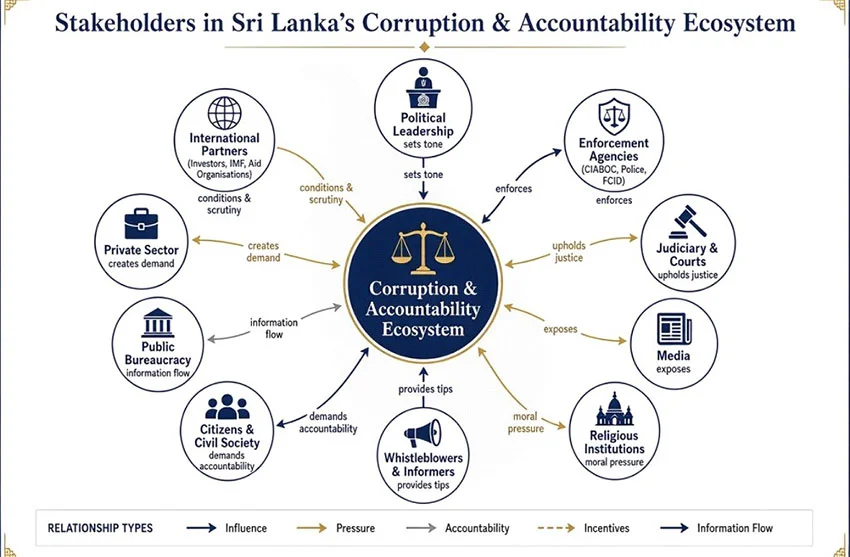
Corrupt political leadership is often decisive. When those at the apex of power treat public office as a vehicle for personal or factional enrichment, they set the tone for the system. Leadership that tolerates, participates in or protects corruption signals that rules are optional for the powerful. It also tends to appoint loyalists rather than professionals to sensitive posts, further politicising the institutions charged with enforcement.
Politicisation of government agencies follows. When appointments, transfers, promotions and operational priorities in the police, revenue departments, regulatory bodies, state-owned enterprises and anti-corruption agencies are driven by political loyalty rather than competence and integrity, professional incentives collapse. Officers who resist improper pressure face retaliation; those who comply advance.
Politicisation of the media weakens an important external check. When significant sections of the media become aligned with political or commercial interests, coverage becomes selective. Scandals involving favoured actors are downplayed; those involving opponents are amplified. This distorts public information and reduces the reputational cost of misconduct for the protected.
Politicisation of religious platforms and organisations can compromise their moral authority. Religious traditions teach restraint and honesty. When those platforms become vehicles for political mobilisation or the defence of partisan interests, their capacity to uphold ethical standards against corruption is reduced.
Poverty amplifies vulnerability. Low relative salaries and economic insecurity create material pressure on officials and make ordinary citizens more susceptible to paying bribes for basic services. Competition and demand for scarce opportunities, licences, contracts, regulatory approvals, jobs, land, school places, combined with discretionary decision-making create intense pressure for preferential treatment. Where formal processes are slow or opaque, people and firms compete by offering inducements.
These factors reinforce one another. Corrupt leadership accelerates the politicisation of agencies and media. Politicised institutions reduce the risk of detection and punishment. Poverty and scarcity increase both the supply of and demand for corrupt exchanges. Together they create a self-reinforcing system in which formal laws and ethical teachings struggle to gain traction.
Consequences Beyond Reputation
The costs are not merely reputational. Investor risk perception rises, increasing the cost of capital and deterring higher-quality foreign direct investment. International financial institutions and aid partners attach governance conditions that become harder to meet when enforcement appears selective or incomplete. Public trust in institutions erodes, weakening the social cooperation necessary for effective policing, intelligence and community resilience.
Corruption is also a national-security vulnerability. It hollows out the integrity of the institutions that protect the state and the public. When police, customs, prisons or regulatory bodies become permeable to illicit money, organised crime and narcotics networks gain operational space. Parallel power structures emerge. In a country that has experienced prolonged conflict and remains exposed to hybrid and transnational threats, the loss of institutional legitimacy carries strategic risk.
Prevention
: Changing the Incentive Structure
Arrests and court productions are necessary. They are not sufficient. Lasting progress requires shifting the practical risk-reward calculation that public officials, political actors and private intermediaries face every day.
C.S. Lewis captured an essential truth when he wrote that “Integrity is doing the right thing, even when no one is watching.” Systems that make integrity the safer and more rewarding path are the only ones that endure
First , reduce opportunities. Transparent digital procurement systems with automatic red flags, real-time beneficial-ownership verification, meaningful sanctions for non-declaration of assets, and clearer limits on discretionary power lower the returns to corruption. The expansion of digital asset declarations covering a large cadre of officials is a step in this direction; verification and enforcement must follow.
Second , realign incentives inside enforcement agencies. Successful high-quality prosecutions and asset recovery should be the clearest path to career advancement. Institutional independence and protection for investigators must be strengthened so that pursuing powerful targets carries lower personal risk.
Third , protect and encourage whistleblowers in practice, not only on paper. Accessible, confidential reporting channels, rapid response to threats, and visible punishment of retaliators change the calculation for potential insiders.
Fourth , reduce politicisation of key institutions. to anti-corruption bodies, regulatory agencies and senior investigative posts should be insulated from partisan control to the greatest extent possible.
Fifth , address the demand side where feasible. Streamlining and digitalising routine citizen-facing services reduces the points at which ordinary people feel compelled to pay. Greater transparency in the allocation of scarce opportunities narrows the space for preferential treatment.
Sixth , and critically, the entire process must remain transparent and firmly anchored in due process. Every accused person is entitled to the presumption of innocence until guilt is established in a court of law. Sri Lanka upholds this principle with confidence, and it must be seen to do so. Opacity breeds suspicion of political motive. Transparency, clear procedures, reasoned decisions, equal application of the law, and open judicial proceedings, demonstrates that the effort is a genuine legal anti-corruption process applied to wrongdoers regardless of status or affiliation, and not a campaign of selective targeting.
The new amendment proposals now moving through the legislative process will succeed or fail by this measure: whether they reinforce even-handed legal accountability or simply add sharper tools that can still be used selectively.
Sustained political commitment beyond electoral cycles remains indispensable. Short bursts of visible action generate headlines. Durable change requires consistency across governments and a willingness to accept that effective, even-handed enforcement will sometimes inconvenience allies as well as opponents
Conclusion
Sri Lanka possesses many of the formal and cultural instruments that theory suggests should restrain corruption. The persistence of the problem demonstrates that instruments alone are not enough. The decisive variables are the incentives that shape behaviour inside political, bureaucratic and enforcement institutions, the opportunities created by discretionary power and opaque processes, and the degree of politicisation of the bodies meant to uphold the rules.
The current intensity of arrests and investigations, together with the latest legislative efforts to tighten the Anti-Corruption Act, is preferable to previous patterns of near-impunity. It is not yet a sufficient condition for lasting improvement. Moving from reactive enforcement to systemic prevention requires changing the risk-reward calculation that makes corruption rational for too many actors. It also requires that the process itself remain visibly fair, transparent, and faithful to the presumption of innocence. Only then can the public, and the wider world, be confident that what is underway is a serious legal effort against corruption, and not a politicised exercise in selective retribution.
Until these deeper shifts become visible and sustained in outcomes, fewer large-scale leakages, higher rates of asset recovery, reduced absconding, consistent due process, and rising public and investor confidence, the perception that Sri Lanka remains a high-corruption environment will continue to be a reasonable reading of the evidence. The daily drama of arrests will remain a symptom rather than a cure. The harder, quieter work of realigning incentives, protecting institutional integrity, and conducting the fight against corruption with both firmness and fairness is the only reliable path beyond it.
(This analysis is offered in the interest of national security, institutional reform, and public safety)
Writer – Mahil Dole
Senior Superintendent of Police (Retd.)
Former Head of (Counter Terrorism), State Intelligence Service, Former Director, Police Special Branch and former First Secretary (defense) Sri Lanka Embassy – Thailand and former investigation consultant of the Sri Lanka Police Financial Investigation Division.
Handcuffs without consequences: Why Sri Lanka’s corruption fight keeps missing the target
By Mahil Dole, SSP (Retd.)
Senior Security Analyst | Former Head of Counter-Terrorism, State Intelligence Service | Managing Director, Smart Security Solutions Pvt. Ltd.

I venture to make this appeal because I am increasingly concerned about what appears to be an inexplicable silence surrounding one of the most consequential challenges confronting Sri Lanka, the country’s emerging demographic crisis.
Nearly a year has elapsed since the official release of the latest Census population findings by the Department of Census and Statistics. The demographic signals revealed by the Census deserve far greater public scrutiny than they have received. An ageing population, declining fertility and a contraction of the working-age population are not merely statistical observations. Together, they have profound implications for the future economic, social and institutional sustainability of the country.
Yet, remarkably, the subject has not generated the level of informed public debate one would reasonably expect from a matter of such national importance.
What concerns me even more is the apparent reticence of those who are best placed to enlighten the public, the planners, demographers, academics and scholars attached to our universities and other institutions of national importance. Their silence is difficult to understand when the demographic trajectory of a country can influence virtually every aspect of its future: economic growth, labour-force availability, pension obligations, healthcare expenditure, education planning, family structures and the sustainability of social protection systems.
This is not an issue that can safely be postponed until the consequences become unmistakable. Demographic change is notoriously slow to reverse. By the time its consequences become visible in the form of labour shortages, an excessive dependency burden or an unsustainable ageing population, the policy options available to governments may already have narrowed considerably.
The public therefore has a legitimate right to ask some fundamental questions.
Where is the national demographic strategy? What are the projections for the next 20, 30 and 50 years? How rapidly is the working-age population expected to decline? What will be the implications for economic growth and productivity? How will Sri Lanka finance the needs of an ageing population? What measures are contemplated to address declining fertility? And, perhaps most importantly, has the country begun preparing now for a demographic reality that is already taking shape?
These are not questions that should be confined to academic journals or government reports. They deserve to be debated openly in the national press and explained to the ordinary citizen in language that everyone can understand.
At the same time, I would urge our demographers, economists, planners and scholars to come forward with evidence-based assessments rather than remain silent. If my interpretation of the demographic trends is misplaced, I would welcome a scholarly rebuttal. If the situation is more serious than is generally recognized, the public deserves to know that as well.
Silence is not a demographic policy.
Sri Lanka has already experienced the consequences of failing to anticipate several national crises. We should not allow demographic change, which operates quietly but relentlessly, to become another crisis that we recognise only when it is too late to manage.
The time to discuss Sri Lanka’s demographic future is not when the crisis arrives. The time is now.
Athula Ranasinghe

Voting closes in Iceland’s knife-edge EU referendum

Showers in the Sabaragamuwa, Western and North-western provinces and in Galle, Matara, Kandy and Nuwara-Eliya districts

Sun directly overhead Mannar, Periyamadu, Puliyankulam, Welioya and Pulmoddai about 12.11 noon today (30)

Lanka tracks 11 US-sanctioned Iranian tankers off coast

House to debate abolition of Chief of Defence Staff post

Mass graves tragic evidence of failed states – Rathnayake

‘Dates have the highest sugar content to fight Coronavirus’

Sunday Island 27 December – Headlines

#SundayIsland 17th December – Headlines

Sunday Island – 28th March

Sunday Island Headlines – 21 March

Sunday Island – 21st February – Headlines
-

 News5 days ago
Missing doctor’s body found in Mahiyanganaya
-
 News5 days ago
Australia declines to release Finance Secy Suriyapperuma’s citizenship details
-
 News5 days ago
22A: BASL suggests CJ recuse himself from hearing petitions
-

 News2 days ago
Eight politicians in drug kingpin probe
-

 Editorial6 days ago
Govts. drag feet as undergrads age
-
 Features4 days ago
Insights from Chieftains of Uva: Genealogy of two Kandyan Families – Part II
-

 Features4 days ago
Export diversification: Missing the wood for the trees – Part I
-

 Business2 days ago
Sri Lanka opens up: A new season of direct connectivity