
Life style
The poem Neruda never wrote

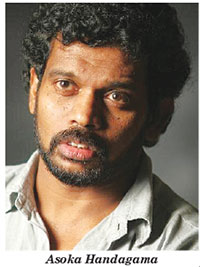
In an exclusive interview with the Sunday Island, film maker Asoka Handagama shares the story behind his latest film- Alborada (The Dawning of the Day) inspired by the celebrated poet Pablo Neruda’s stay here as the Chilean Consul. The film is to be internationally premiered at the 34th edition of the Tokyo International Film Festival opening on October 30.
by Randima Attygalle
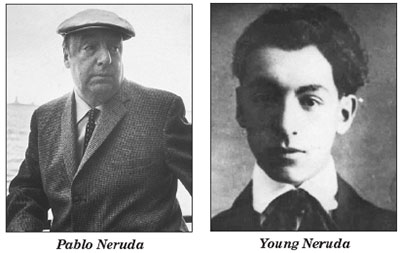
It is the year 1929. Young Chilean poet and diplomat Pablo Neruda whose fame preceded him arrives in the British-occupied Ceylon as the Chilean Consul. By then Neruda, had already become an international literary celebrity. His work, Twenty Love Poems and Song of Despair was among the bestselling books of poetry in the 20th century. He was called ‘the poet of the people, the oppressed and the forgotten.’
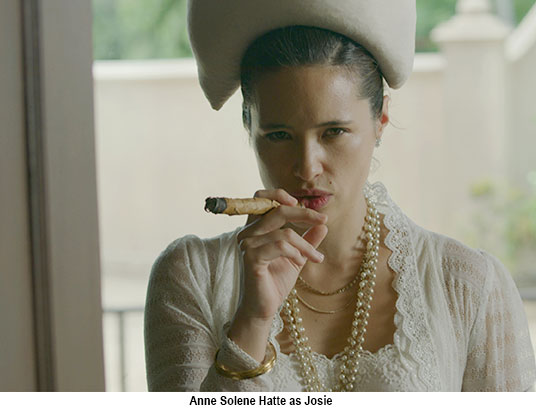
 The activist-Consul arrives in Ceylon, barely 25 and empty-handed except for his memory of the disengaged relationship with his former Burmese lover, Josie Bliss. She was obsessively devoted to Neruda and possessed by an overwhelming jealousy. Neruda who called Josie ‘a love terrorist’ and ‘a species of Burmese Panther’ would document in his memoir: (completed shortly before his death in 1973) ‘Sometimes a light would wake me, a ghost moving on the other side of the mosquito net. It was Josie, flimsily dressed in white, brandishing her long, sharp knife. It was she, walking round and round my bed, for hours at a time, without quite making up her mind to kill me. When you die, she used to say to me, my fears will end.’
While his ‘Bliss’ was turning into a taunting jealousy, Neruda receives a cable from Santiago informing him of his immediate transfer to Ceylon. Welcoming his emancipation from his lover, Neruda settles in a beach-front cottage in Wellawatte and is taken care of by a man servant.
He attempts to bury his memories in the vast tropical shores and takes refuge in an atmosphere of solitude he creates for himself. In his memoir is a chapter dedicated to his stay in Ceylon titled Luminous Solitude where he writes: ‘each morning I was overpowered by the miracle of newly cleansed nature.’
Neruda was soon found in the artistic inner circles of Colombo. He was acquainted with Lionel Wendt and George Keyt. The young Chilean poet had a bevy of female admirers whom he called ‘dusky and golden girls of Boer, English and Dravidian blood.’ They bedded him ‘sportingly, asking for nothing in return,’ as he documents.
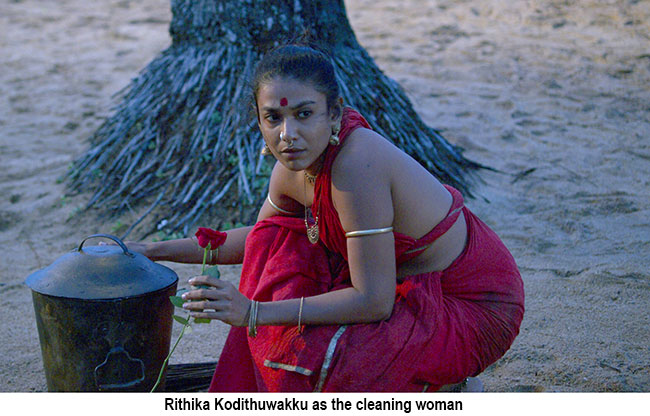
The young diplomat was infatuated with a Tamil woman of a low caste who came every day at dawn to clean his outdoor latrine. He found her to be the most beautiful woman he had seen in Ceylon. To win her attention, Neruda left her gifts of fruit or silk on the path leading to the latrine, but she took no notice of them. One day he gripped her by the wrist and stared into her eyes. ‘Unsmiling, she let herself be led away and soon was naked in my bed. Her waist, so very slim, her full hips, the brimming cups of her breasts made her like one of the thousand-year-old sculptures from the south of India. … She kept her eyes wide open all the while, completely unresponsive. She was right to despise me. The experience was never repeated.’
The act became a subject of international scrutiny in later years, even prompting a reassessment of the Nobel Laureate’s merit. Neruda who was celebrated as ‘the greatest poet in the 20th century in any language’ by Gabriel Garcia Marquez was even labeled a ‘rapist’. Activists challenged his documentation of ‘she let herself be led away’ as a blatant lie. The decision to rename Chile’s busiest Santiago International Airport after Neruda was met with outrage from human rights activists who argued that the honour was inappropriate for a man who admitted to rape in his own memoirs.
 “Although there are many accounts of Neruda’s life portrayed in fiction and film, this part of the story is often carefully left out. Though his poems about love outwardly sound romantic, they hide within them the eroticization and objectification of women and particularly, women of colour,” reflects the film-maker Asoka Handagama whose latest film Alborada (The Dawning of the Day) is an elaboration of Neruda’s controversial sexual assault.
The film which is to hold its world premiere in Tokyo (Oct. 30 – Nov. 8) is a fictionalized account of Neruda’s stay in Sri Lanka (then Ceylon) from 1929 to 1931 as the Chilean Consul. The film explores the psychological and the emotional factors behind Neruda’s attraction to a woman bound by her caste: a woman considered to be ‘untouchable’, unknown to her playing a part in a bizarre fantasy that ended in a sexual assault.
A fan of Neruda’s poetry, Handagama found the poet’s mixed element of art and controversy a tempting subject for a film script. The script which was inspired by Neruda’s Memoirs is a fruit of 10 years of research on the poet. Handagama left his position as a Deputy Governor of the Central Bank three years before his formal retirement age to complete what he calls his ‘dream film.’
A rebel himself with his cinematic expression, Handagama intrepidly unearths the famed poet’s often interred infamous chapter in what he calls an ‘ironic act.’ “It is ironic that an Asian film-maker, coming from a so called restrained cultural landscape is throwing light on Neruda’s sexual antics when all the while Western cinema makers and fiction writers chose to leave them out in the exposition of him,” smiles Handagama.
Reference to Neruda’s Burmese lover Josie Bliss in his poetry is plenty although she is widely regarded as a figment of the poet’s imagination, notes the film maker. “The depiction of her as a perceived threat, a desire and barbarity in his poem Widower’s Tango, combined with his confession show Neruda’s complicated relationship with women and race.” However, no poem of Neruda’s alludes to the ‘untouchable woman’ by whom he was smitten, despite being described as the ‘most beautiful Ceylonese woman’ or one resembling a ‘thousand-year-old sculpture’ from South India. Handagama’s tagline for his film, The poem Neruda never wrote validates this exclusion. It is also an allegorical reminder of the poet’s element which many tended to discount.
Alborada reinvents the rustic west coast of the island Neruda saw in the 1930s. This was no easy task says its creator. “We had to recreate Wellawatta of his time and this was not possible within Colombo due to the changing skyline. We set it up in Nonagama and in Ranminithenna Tele-Cinema Village.”
Lending a cinematic interpretation to an isolated incident at home which is unfamiliar to the authentic Sri Lankan film print, Alborada is to be a refreshing new experience for the local audience. The film also hopes to spur a public discourse, says its director. Starring Spanish actor Luis J Romero as Neruda and French actress Anne Solene Hatte as Josie, the dialogues are in English with Sinhala and Tamil subtitles. The film also debuts several artistes. The main cast comprises Rithika Kodithuwakku (Tamil woman), Malcolm Machado (Neruda’s man servant), Dominic Keller (Lionel Wendt), Nimaya Harris (Patsy), Thusitha Laknath, Kaushalya Mendis, Samantha Balasuriya, Kasun Perera and Kanchana Nandani. Edited by Ravindra Guruge, the film is produced by H.D. Premasiri.
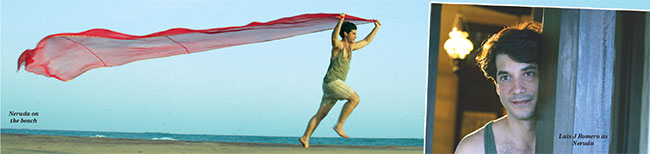
The Tokyo International Film Festival (TokyoIFF) which will feature Alborada is among the invited films for its ‘international competition’ which is the highlight of the festival. Multi-award winning French screen and stage actress Isabelle Huppert will chair the competition jury. This year’s theme of TokyoIFF is ‘Crossing Borders’. “There are plenty of international film festivals today. But only 14 of them are regarded as ‘A-Grade film festivals. TokyoIFF is one of them and the only Asian festival to get this recognition so far,” remarks Handagama. This year’s festival will be opened with the world premiere of Clint Eastwood’s latest film Cry Macho.


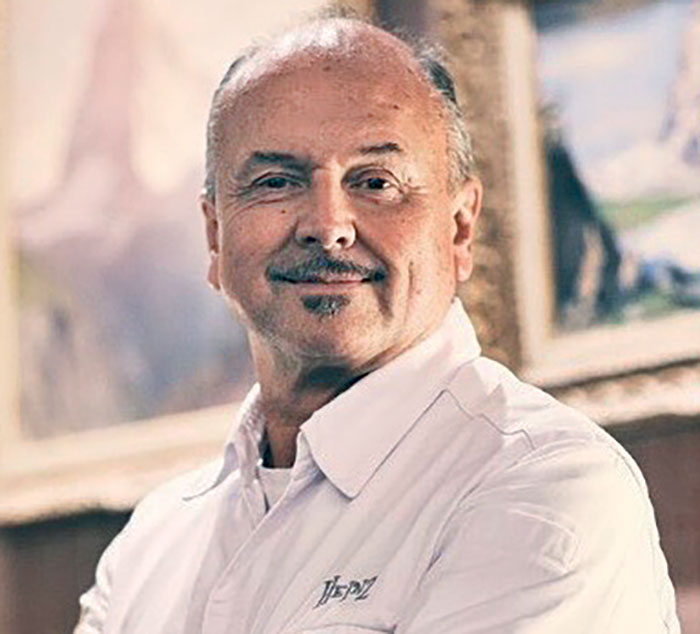
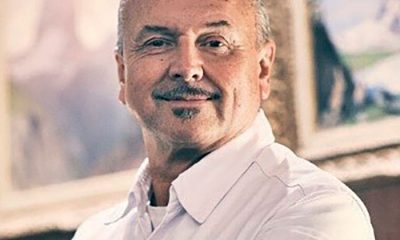
High in the Swiss Alps, where mountain landscapes shape both life and cuisine, Chef Heinz Rufibach spent more than four decades mastering the art of Alpine cooking. From the grand hotels of St. Moritz and Gstaad to the peaks of Zermatt, his career has been defined by a deep respect for tradition, local flavours and the quiet precision of Swiss craftsmanship.
Now, the chef. affectionately known as Le Cuisinier de Zermatt. brings that remarkable culinary heritage to Colombo for an exclusive Swiss dining experience at Bistro des Marées, Cinnamon Life at City of Dreams Sri Lanka.
From 23 to 26 July, guests will have the opportunity to experience a specially curated menu by Chef Rufibach, celebrating the authentic flavours of Switzerland’s Alpine regions and the dishes that have shaped his lifelong connection with the mountains.
A former Executive Chef of the Grand Hotel Zermatterhof, Chef Rufibach has built a reputation as one of Switzerland’s celebrated culinary figures. Named Swiss Chef of the Year and a holder of a Michelin star for six consecutive years, his cooking reflects the balance between fine dining precision and the warmth of the traditional Alpine table.
For Chef Rufibach, Swiss cuisine is more than a collection of recipes. It is a reflection of place, people and generations of culinary heritage.
“Swiss cuisine is built on tradition, seasonality and a deep connection to the land. Through this menu, I hope to share the flavours and stories of the Alps with guests in Colombo and offer them a true taste of Switzerland,” he said.
The menu at Bistro des Marées takes guests on a journey through Switzerland’s diverse culinary regions, beginning with elegant starters, such as dried meat tartare with green asparagus and Parmesan, marinated salmon with mustard sauce and herbs, and the traditional Gommer Cholera, a Valais speciality of apple, leek and cheese baked in puff pastry.
The experience continues with comforting Swiss classics, including Valais white wine soup with dried apricots and Bündner barley soup, before moving into signature dishes, such as Swiss cheese fondue with bread cubes and potatoes, raclette with traditional accompaniments, and Zürcher Geschnetzeltes with rösti. Other highlights include Basel-style salmon with papet vaudois and fried onions, saffron-infused lamb ragout with mashed potato, and Ghackets mit Hörnli, a beloved Swiss comfort dish of braised beef mince, pasta and apple sauce.
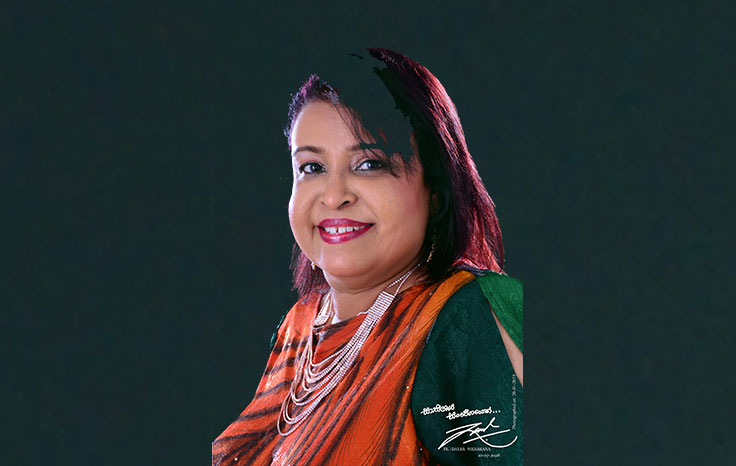
My dearest Maria. I never thought I would have to write this, this soon but then I realised, I owe it to you.
Remember the very first day I met you ? It was way back in 1981. I was 19, working at Lake House and writing to the Sunday Observer’s “Sat Mag” magazine. You were 23.
I made a prior appointment with you on the old rotary dial phone and arrived at Ekanayake Mawatha, Nugegoda, sharp on time. I waited and waited. There were (either) dogs or cats playing around me, with their fur flying all around me. That irritated me. I waited and waited. I wanted to, but could not walk out because the Editor was waiting for the article.
You sailed in one wretched hour late. I was furious. You never apologised either. That’s how we began our friendship. Rather a rocky start wasn’t it ?
What struck me most was NOT the fact that you were the highly celebrated Kandy Lamissi at that time, but rather the sparkle in your eyes and the warmth of your smile. It came from the depths of your heart and radiated outwards to everyone you came into contact with – both those who liked you and those who did not like you.
You radiated that sparkle and smile during the best of times and even the most difficult of times. You had your fair share of both in your 68 years. That smile was your trademark. It stayed on until the end.
We were neighbours, too, in Nugegoda. You were on that side of the junction and I was on this side of the junction. Remember in the mid-1990s when fitness fever hit us and we ambitiously started those 6.00 am early morning walks. They were alas short lived when children in passing school vans began shouting “Aunty Aunty” or “Kandy Lamissiiiiii”. That put an end to our walks and we reverted back to being unfit.
You also had a very, very wicked sense of humour which I loved to bits. Remember that evening when, with dead pan faces, you and I walked into the Metro Cinema Nugegoda and bought two balcony tickets for the 6.30 pm show. The man at the ticket counter couldn’t not believe his eyes. And how we, again with dead pan faces, slowly crept upstairs and sat in the (last row) middle seats much to the shock of all those lovers around us.
You were the Star. I was much lesser known to them than you. They were shocked and looked at you in great disbelief. I remember at one intense moment of the film, we asked the couple next to us, “Meh, excuse me. Aney welaawa keeyada?”. They only didn’t slap us.
And then, during the movie we crunched on and made a helluva din with the prawn crackers, much to the irritation of those around us.
We hadn’t come to watch the film. We just wanted to shock and annoy those lovers. Mission accomplished, we sailed out in the Interval, our sides splitting with laughter. We could not remember the movie either.
Remember those incessantly chats we used to have on a variety of topics? You could hold forth on practically any topic. Those chats sometimes went on till well past midnight and we hadn’t finished talking either.
Teshan your son was the apple of your eye, to use a cliché. How proud you were of him and how very much you used to talk about him. You took pride in his academic success and the fine young man he has turned out to be.
In our 46-year friendship, you and I have had our misgivings, too. Remember Mariazelle how we didn’t speak to each other for about three years?
And then in December 2015 you were a guest artiste and I the emcee at the Break-Away New Year’s Eve Ball organised by (your cousin) Sohan Weerasinghe and Corrine Almeida. We were still not talking to each other, but then, just after the countdown to midnight, you came up to me, hugged me and wished me with tears in your eyes. My respect for you hit the ceiling that night. Our friendship became rock solid from that day onwards.
We last met over dinner at Harpos Commons in Kotte, just before illness dragged you down. You had medical problems but you never complained. Remember the stories we traded and how much we laughed and laughed, at times much to the displeasure of the other diners. Harpo might have got the complaints but he never told me either.
And now you’re gone. Gone just like that. Before I close, I’d like to quote a few lines from your dear friend Aruna Siriwardhana’s tribute :
“I take a moment to mention two special beings in Mariazelle’s life. One is surgeon Prof. Srinath Chandrasekera (a musician himself) who for the past six months or so, together with his team at the Kalubowila Hospital, took indescribably attentive care of her. The other is singer Dinu, who virtually placed her life and work on hold, to care for Mariazelle”.
It was heart-breaking to see you lie in that coffin at Barney Raymonds last Monday (13 July). You were dressed in ivory and gold. You looked peaceful. You were free from suffering and free from pain.
“Kandy Lamissi” will ALWAYS be sung at parties and weddings and home comings and dinner dances and batch get-togethers. “Kandy Lamissi” and You have an unlimited life span. You will both go on forever!
And I will always remember that sparkle in your eyes and the warmth of your smile. That to me was You.
Goodbye my dearest Maria. May your journey in Samsara be speedy.
by Kumar de Silva ✍️
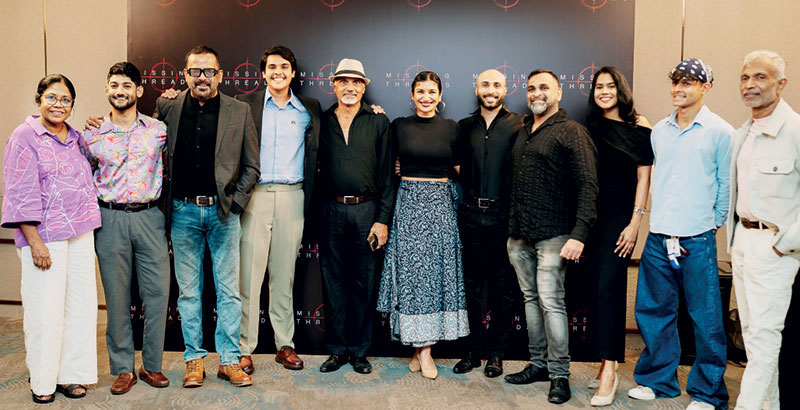
Production has officially begun on Missing Threads, marking it the first time a Sri Lankan production has been aimed first and foremost at an American audience. On Tuesday the 7th of July, a dinner was held bringing together the cast, crew, funders, and friends and family to mark the occasion.
The evening opened with guests arriving to chatter and press photography. Talavou Alailima opened proceedings, and a selection of Director Joshua Alailima’s previous films were screened, between speeches from key figures behind the production. The night closed with a large buffet and the signing of contracts.
Missing Threads
is an investigative crime thriller compared to films such as Zodiac and Se7en. The film follows journalist Maya Perera as she unravels a string of lies, all tying back to the mega corporation Verdeon, leading to a far more sinister truth about the internal affairs of the country at large.
This marks a significant milestone for Sri Lanka. It is the first time a Sri Lankan film has targeted primarily the USA Hollywood audience. This will further foreign relations, opening the door to industry expansion and significant economic potential.
Missing Threads
brings together a standout cast of actors, including Kaushalya Fernando (The Forsaken Land), Buddika Jayaratne (Sunny’s Mansion), Dharmapriya Dias (Machan), and Shyam Fernando (Paradise). It is led by international Sri Lankan actress Rebecca Munasinghe and leading social media influencer “Neesh.” Missing Threads is produced by Talavou Alailima, founder of Power World Gyms and Edge Nutrition.
Director Joshua Alailima is currently studying at one of the top film universities in America, Biola University, whose alumni network includes Doctor Strange director Scott Derrickson and world famous influencer Zach King.
Joshua has been directing since he was a young teenager. He is now 20 and directing his feature debut, a rare feat by Hollywood industry standards.
Missing Threads
brings in an international crew, with people from the USA, Sri Lanka, and Australia flying in to work on the project. Post production will take place in Sri Lanka, India, and the USA. The film is shot on the Arri Alexa LF, the same camera used for the movie Dune. It is the only one currently in Sri Lanka.

India’s education minister resigns after weeks of ‘Cockroach’ protests

ICC prosecutor Karim Khan removed over ‘political’ sex abuse claims

A few showers will occur in the Western, Sabaragamuwa and North-western provinces and in Galle and Matara districts

Govt. urged to withdraw Media Professionals Bill

Fort Magistrate orders arrest of MP Archchuna

Dengue rages with average of 2,391 new cases detected daily

‘Dates have the highest sugar content to fight Coronavirus’

Sunday Island 27 December – Headlines

#SundayIsland 17th December – Headlines

Sunday Island – 28th March

Sunday Island Headlines – 21 March

Sunday Island – 21st February – Headlines
-
 Features6 days ago
Two memorable excerpts from a former SLAF commander’s memoir
-
 Business6 days ago
‘Giving up was never an option’: The fisherman who fought back after losing millions in SL
-
 Life style6 days ago
Taste of the Swiss Alps comes to Colombo
-

 Features6 days ago
Erdoğan’s New Republic
-
 Midweek Review3 days ago
Three high-profile alleged suicides shaping key investigations
-

 News3 days ago
Customs asked to resume probe or face legal action
-

 Editorial4 days ago
Welcome bid to tackle rolling death traps
-

 Foreign News7 days ago
Iran accuses US of striking critical infrastructure as war intensifies