
Editorial
The games they play


A lot remains unsaid about IGP Chandana Wickramaratne’s two three-month extensions of office since he retired on March 26 this year upon attaining the age of 60-years. Appointing a successor was problematic for very good reasons. The three most senior contenders for the job, Senior DIG Nilantha Jayawardena, Senior DIG Lalith Pathinayake and Senior DIG Deshabandu Tennakoon have been found culpable of negligence of their duties by the Presidential Commission of Inquiry (PCOI) that investigated the 2019 Easter Sunday attacks. In their final report, the PCOI recommended that the Attorney General should consider prosecuting Jayawardena, who served as Director of State Intelligence Services at the time of the Easter carnage, under suitable provisions of the Penal Code. A disciplinary inquiry against Tennakoon, who had other problems relating to the attack on aragalaya protestors on Galle Face green on his plate, has also been recommended by the Commission.
No wonder then that the government resorted to the convenience of extending Wickramaratne, a decision endorsed by the Constitutional Council, as a time buying exercise. This also offered a window to the various prospective IGPs to sort out their legal problems. It is widely perceived in police circles that Tennakoon enjoys the confidence of Public Security Minister Tiran Alles who is in charge of the police and is pushing for this appointment which the president is resisting. In fact it has been reported that Wickramaratne and Alles had a meeting a few days ago before the second three-month extension, subject to Constitutional Council (CC) approval, was made.
Whether such approval will be forthcoming must await the next meeting of the 10-member Council comprising of both politicians and civil society representatives. Although the extension recommendation has been sent to the CC and acknowledged, no date has yet been set for a meeting. As it is, the CC is under pressure not to rubber stamp the president’s executive decision with former External Affairs Minister GL Peiris publicly demanding this last week. Matters are getting “curiouser and curiouser” as Alice had it in Wonderland.
Added to all this is the lacuna between the end of Wickramaratne’s first extension on June 26 and the second on July 9. For this fortnight’s period the country had no Inspector General of Police and no acting appointment was made. So does that mean that Wickramaratne’s second extension is a new appointment? The answer to this very valid question remains hanging in the air.
In this context it is worth remembering that there are two precedents on the police appointing IGPs from outside the service. The first was the appointment of Sir. (then Mr.) Richard Aluwihare to succeed Sir. Herbert Dowbiggin who was the British colonial IGP of then Ceylon from 1913 to 1937 – the longest serving police chief this country ever had.
Aluwihare, was a member of the then coveted Ceylon Civil Service to which he was appointed in consideration of his service to the British empire during World War 1. This appointment, at a time there was no suitable Ceylonese for the job was made because of his military and administrative experience. Several years later, Prime Minister SWRD Bandaranaike appointed Mr. MWF Abeykoon, a senior administrator, as IGP as he wanted a Buddhist holding that position. None of the then serving four (not dozens as at present) Deputy Inspectors General of Police (DIGs) qualified on that score. Bandaranaike reportedly told the then most senior serving DIG CC ‘Jungle’ Dissanayake: “Oh, Jungle, if only you were a Buddhist.” Abeykoon was IGP at the time of the abortive coup d’etat of 1962.
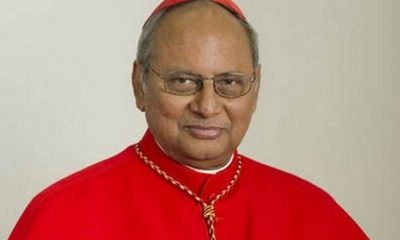
Apart from issues pertaining to the various contenders for the top job in the police, the Archbishop of Colombo, His Eminence Malcolm Cardinal Ranjith and the country’s entire Catholic community hold the strongest views that nobody even in the slightest way tainted with negligence over the Easter massacre be appointed to head the police force.
Not only Catholics but also other Lankans of all faiths horrified by what happened that fateful Sunday, and acutely aware that available intelligence on the impending terror was ignored at the highest levels of the government and the police, are of that view. Any government ignoring such pervasive public opinion does so at its peril. Although we are supposedly notorious for having short memories, nobody is likely to forget what happened that day.
Added to the unfolding comedy of appointing a new IGP, another matter that has grabbed public attention is the ongoing attempt by the government, or a section of it, to have defunct local bodies reconvened without elections. This would mean that the former councilors will return to office empowered to serve as storm troops at any future election. This sordid attempt is by way of a Private Member’s Motion was presented to Parliament by an SLPP backbencher, Jayantha Ketagoda, widely believed to be a loyalist of Basil Rajapaksa.
It was reported last week that the Attorney General is of the view that the proposal involves a matter concerning the franchise of the people and would need a referendum in addition to passage in parliament by a two thirds majority. Already this has been taken to court. Yet we must not forget that when former President Mahinda Rajapaksa sought to abolish the two term limit on the presidency, this was permitted without a referendum by the then Chief Justice who argued that the measure enhanced, rather than diminished, the franchise.
What happened to MR who sought a third term in 2015 is now history.









Saturday 3rd Junuary, 2026
The Electricity Consumers’ Association (ECA) has said the government is planning to pass the cost of the voluntary retirement scheme for the employees of the Ceylon Electricity Board (CEB), which is to be restructured, on to the public in the form of a power tariff hike. A proposal to this effect has been submitted to the Public Utilities Commission of Sri Lanka (PUCSL), the ECA has said.
The proposed tariff hike is said to be 11.57% for the first quarter of the current year. Speculation is rife that the PUCSL will grant the CEB’s request, and the public will be made to bear the cost of the voluntary retirement of about 2,500 CEB employees thanks to the cost reflective pricing mechanism. The problem is not going to end there; there are bound to be some more power tariff hikes.
One of the reasons given for Sri Lanka’s rupee crisis was the country’s legacy of below-cost pricing for utilities, such as electricity and fuel, by way of a ‘blanket’ type relief to consumers irrespective of their income level. These subsidies took their toll on the state-owned business enterprises (SOBEs) including the CEB and the Ceylon Petroleum Corporation (CPC), according to the Central Bank, which in its Annual Economic Review 2024 has noted that the banking sector financed the liquidity shortages of these SOBEs at the expense of productive investments. Hence the determination of the prices of electricity and fuel strictly in keeping with the cost reflective pricing mechanism. In fact, the IMF gave the previous government Hobson’s choice, by making cost-reflective pricing one of its bailout conditions.
The cost reflective pricing has not gone down well with the public, as is obvious, but it makes economic sense and goes a long way towards preventing the country facing another rupee crisis. Heavy subsidies are a drain on the state coffers and become unviable in the long run. In fact, it is a case of swings and roundabouts for the public where such subsidies are concerned; the state uses taxes to recover the costs of subsidies and legacy debts it assumes. However, it is nothing but unfair to make consumers bear the cost of massive overheads, waste and corruption that SOBEs, like the CEB and the CPC, are notorious for. The costs of the utilities must therefore be properly calculated in a transparent manner to prevent the exploitation of the public.
If the government goes ahead with its plan to pass the cost of restructuring the CEB on to the public through power tariff hikes, as the ECA has alleged, then the price of electricity will soar, taking a heavy toll on the economy.
In March 2023, this newspaper quoted energy expert Dr. Tilak Siyamabalpitiya, who went on to become CEB Chairman, as having said at an event organised by the CEB engineers, that Sri Lanka had the second highest electricity prices in Asia. Thus, power tariff increases are very likely to stand in the way of the government’s efforts to attract foreign investors and retain the ones who are already here. One of the factors that determine the competitiveness of investment destinations is the cost of electricity. The government must not lose sight of this fact.
The government has chosen to remain silent on the ECA’s allegation. But the truth will soon come out.

Friday 2nd Junuary, 2026
The SJB yesterday called upon the NPP government to hold the much-delayed Provincial Council (PC) polls soon. Its call is bound to go unheeded, for the JVP/NPP is not ready for an election. Having suffered a string of defeats in the cooperative society elections during the past several months, the government is trying every trick in the book to postpone the PC elections further. The outcome of last year’s local government polls is not something the JVP/NPP can be really proud of; its efforts to sweep the polls did not reach fruition although it managed to bag a majority of local councils.
A midterm electoral setback could be the undoing of a government however powerful it may be. The fate that befell the Mahinda Rajapaksa government following the Uva PC polls in September 2014 is a case in point. The UPFA won the Uva PC, but the number of its seats dropped from 25 to 19. The number of UNP’s seats increased from 7 to 13. The JVP, which had only one seat in the previous council, secured 02 in 2014. President Rajapaksa, in his wisdom, advanced a presidential election, and lost the presidency to Maithripala Sirisena in January 2015.
So, it is highly unlikely that the NPP government will hold the PC polls anytime soon. The Opposition is not strong enough to pressure the government politically to take a huge electoral gamble by holding an election.
It is doubtful whether the Opposition is really keen to face an election at this juncture despite its rhetoric. The SJB and other Opposition parties have closed ranks and defeated budgets in a considerable number of NPP-controlled local councils and won cooperative society elections. But their fragile unity is not going to survive an election that they will have to contest separately. A split in the anti-government vote will stand the JVP/NPP in good stead. However, the situation is likely to change if the UNP and the SJB come together to contest future elections.
What enabled the UNP to improve its electoral performance in the Uva Province in 2014 and gain a strategic opening to topple the Rajapaksa government a few months later was a rapprochement between two factions led by Ranil Wickremesinghe and Sajith Premadasa.
The SJB leaders who are demanding that the PC polls be held soon ought to tender an apology to the public for the role they played in postponing the PC elections indefinitely in 2017 while they were in the UNP-led Yahapalana government. The UNP and the SLFP, as Yahapalana allies, were wary of facing an election in 2017 and therefore amended the PC Elections Act to delay the PC polls. None of the political parties represented in Parliament at the time, including the UNP, the SLFP/UPFA, the ITAK, the SLMC, and the JVP, opposed the obnoxious amendment to the PC Elections Act. The current SLPP leaders were dissident members of the UPFA. The original amendment Bill was to provide for a quota of 30% for female candidates on the nomination papers submitted for the PC elections, but it was changed beyond recognition at the committee stage to facilitate the postponement of the PC polls. Article 78 (3) of the Constitution says, “Any amendment proposed to a Bill in Parliament shall not deviate from the merits and principles of such Bill.” But the aforesaid political parties took the bad amendment for granted; the PC polls were made to disappear, as it were.
The incumbent government has said the PC polls will be held under the Mixed Proportional (MP) system. The delimitation of electoral boundaries, which is a prerequisite for holding the PC polls under the MP system, will take about one year, according to the Election Commission. The only way to hold the PC election soon is to legislate for it to be conducted under the existing Proportional Representation system. If the SJB is serious about having the PC polls held soon, it should campaign for amending the PC Elections Act, in Parliament. Let it be urged to fish or cut bait.
Thursday 1st Junuary, 2026
The CID arrested EPDP leader and former minister Douglas Devananda last Thursday in connection with an ongoing investigation into a pistol issued to him by the Army way back in 2001 allegedly ending up in the underworld. It has claimed that information elicited from Makandure Madush, a notorious criminal, led the police to the weapon hidden in a shrub in Weliweriya.
Devananda is one of the battle-scarred ex-Tiger combatants who courageously stood up to the LTTE and helped defeat it. He survived several assassination attempts, including one inside the Kalutara Prison. Devananda’s predicament has gladdened the hearts of pro-LTTE groups beyond measure, as evident from their social media posts.
The pistol in question was reportedly issued to Devananda at the height of LTTE terror; Madush was arrested in 2019 and killed in October 2020, while in police custody. Curiously, the serial number of the weapon remained intact while it was in the underworld.
Madush is long dead, and there is no way the CID’s claims about the firearm at issue can be checked. The CID, which is under two members of the Retired Police Collective of the JVP/NPP, has become the JVP’s rottweiler. The police are all out to protect the interests of the JVP/NPP government; they suddenly ran out of breathalysers when a government MP caused a road accident the other day. A policeman, assaulted by a government MP and his backers recently for conducting a raid on a cannabis plantation, was arrested and interdicted! The police have not arrested a deputy minister and an NPP mayor, charged with fraud.
Now that the CID is busy probing Devananda’s pistol, let it be urged to launch an investigation into thousands of weapons issued by the Defence Ministry to politicians in the second JPV uprising in the late 1980s, and the arms seized by the JVP during that period.
In January 2019, the then Defence Secretary Hemasiri Fernando disclosed that about 4,700 9mm pistols and revolvers had been licensed, but there was no information about those who had obtained them and, worse, some individuals possessed as many as 15 small firearms each! In 2023, the then State Minister of Defence Premitha Bandara Tennakoon revealed in Parliament that the defence authorities had issued about 700 firearms to 154 politicians in the late 1980s, when the JVP went on a killing spree, but none of them had been returned. This figure, we believe, is a gross underestimate.
The National Commission against the Proliferation of Illicit Small Arms, appointed by President Chandrika Bandaranaike Kumaratunga in 2004, dealt extensively with the issue of illegal weapons in circulation in Sri Lanka, as we pointed out in a previous editorial comment. Its survey report contains valuable information, which, however, needs to be updated. Defence authorities should study this document thoroughly and commission a fresh survey on illicit firearms.
The police must go all out to find the illegal firearms used by the JVP during its second uprising. Most of the JVP’s arms caches have not been traced. SJB MP Dayasiri Jayasekara told Parliament on 27 February 2025 that more than 2,000 firearms seized by the JVP between 1987 and 1989 had not been recovered. One may recall that the JVP attacked several police stations and military camps and grabbed many weapons. In April 1987, it seized the arsenal of the Pallekele army camp. Now that the JVP-led NPP has formed a government and launched a campaign to eliminate gun violence, the Defence Ministry and the CID may be able to ascertain information about the firearms used by the JVP in the late 1980s.
Hardly a day passes without incidents of gun violence. Two shooting incidents were reported from the Western Province yesterday. The proliferation of illicit firearms in Sri Lanka can be attributed to several key factors, according to researchers; they include gunrunning, illegal operations carried out by rogue elements in the police and the armed forces, local arms manufacturing, and criminals gaining access to arms caches of the LTTE and the weapons that went missing in the late 1980s.
The police produced 12 suspects before the Colombo Chief Magistrate on March 22, 2019, for having supplied weapons retrieved from some buried LTTE arms caches in Kilinochchi to criminal gangs elsewhere. The LTTE seized firearms from the police, the armed forces and the rival militant groups like the EPDP. It is incumbent upon the police to make a serious effort to trace all illegal firearms. Let that be their New Year resolution.

Tri-Forces donate LKR. 372 million, a day’s pay of all ranks to ‘Rebuilding Sri Lanka’ Fund

Rabada to lead strong South Africa pace attack at T20 World Cup

Showes about 75 mm are likely at some places in the Eastern and Uva provinces and in Matale, Nuwara-Eliya and Polonnaruwa districts.

CEB demands 11.57 percent power tariff hike in first quarter

Health Minister sends letter of demand for one billion rupees in damages

One killed, two injured in shooting at Kaduwela

‘Dates have the highest sugar content to fight Coronavirus’

Sunday Island 27 December – Headlines

#SundayIsland 17th December – Headlines

Sunday Island – 28th March

Sunday Island Headlines – 21 March

Sunday Island – 21st February – Headlines
-

 Sports5 days ago
Gurusinha’s Boxing Day hundred celebrated in Melbourne
-
 News3 days ago
Leading the Nation’s Connectivity Recovery Amid Unprecedented Challenges
-

 Sports6 days ago
Time to close the Dickwella chapter
-

 Features4 days ago
It’s all over for Maxi Rozairo
-

 News6 days ago
Environmentalists warn Sri Lanka’s ecological safeguards are failing
-
 News4 days ago
Dr. Bellana: “I was removed as NHSL Deputy Director for exposing Rs. 900 mn fraud”
-
 News3 days ago
Dons on warpath over alleged undue interference in university governance
-
 Features6 days ago
Digambaram draws a broad brush canvas of SL’s existing political situation