
Latest News
Sri Lankan territory will not be used for any purpose that could undermine India’s security or regional stability – President

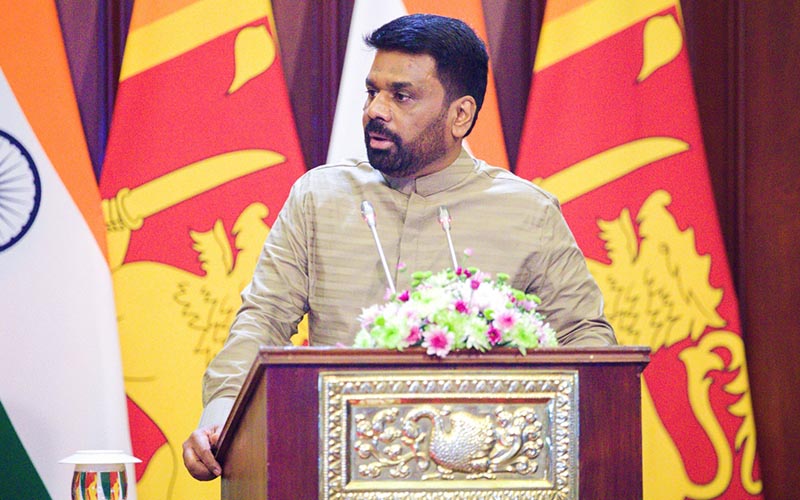
President Anura Kumara Dissanayake issuing a joint press statement on Saturday [05] reaffirmed that Sri Lankan territory will not be used for any purpose that could undermine India’s security or regional stability.
The full text of President Anura Kumara Dissanayake’s statement:
“His Excellency Prime Minister Shri Narendra Modi,
Her Excellency Prime Minister Dr. Harini Amarasooriya,
Honourable Ministers, Distinguished Representatives,
Ladies and Gentlemen, Friends from the Media,
Ayubowan, Vanakkam, Namaste, and Good Morning!
I warmly welcome His Excellency the Prime Minister of India, Shri Narendra Modi, and the distinguished delegation, as the first Head of State to visit Sri Lanka since the formation of our government. I consider it as a historic occasion to recognize the achievements of Prime Minister Shri Narendra Modi, who assumed office with a strong public mandate to transform the political culture and overcome long-standing prejudices that had hindered his country’s progress toward becoming a modern, developed nation.
This visit reflects the deep-rooted closeness and friendship that have existed between Sri Lanka and India for ages. It is worth noting that the bond between our two countries separated by a narrow stretch of ocean less than 50 kilometers wide, is even closer than this physical proximity suggests.
India, a land of rich diversity, has made significant contributions to the world’s cultural and spiritual heritage throughout history, and it continues to play a prominent role on the global stage today. We have witnessed India’s remarkable rise and success. We sincerely applaud the way India has positioned itself not only as a regional power but also as a global leader. It is important to emphasize that our admiration is genuine and heartfelt. Like India, Sri Lanka firmly believes in the potential of South Asia to rise and shine on the world stage, a goal that we must strive to achieve together.
Sri Lanka and India share far more than geographical proximity. We are neighbours bound by deep historical, religious, and cultural ties that span over two thousand five hundred years. Our enduring relationship that has withstood the test of time is founded on shared values, mutual respect, and common aspirations. As civilizational partners, Sri Lanka and India have grown close across every sphere, including history, language, religion, ethics, art, culture, architecture, and beyond, reflecting the richness and dynamism of our two nations.
One of the closest and most enduring examples of friendship that we fondly recall is India’s gesture during the 1996 Cricket World Cup, when India joined Sri Lanka in an exhibition match after two teams declined to tour our country due to security concerns. We take this opportunity to once again express our heartfelt gratitude for that act of solidarity.
Sri Lanka’s foreign policy is firmly guided by national interests, with a focus on promoting peace and respecting the sovereignty of all nations, principles that form the foundation of our diplomatic roadmap. Just prior to this event, Prime Minister Modi and our delegation held bilateral discussions.
We conducted a broad review of the current state of our bilateral cooperation and exchanged views on ways to further strengthen our relations in areas of mutual interest.
Recalling my successful visit to New Delhi, I conveyed to Prime Minister Modi Sri Lanka’s firm commitment to implementing the actions outlined in the India-Sri Lanka Joint Declaration titled “Fostering Partnerships for a Shared Future,” which was adopted during that visit.
I expressed my gratitude to Prime Minister Modi and the Government of India for their steadfast support in the recovery, growth, and stability of our country’s economy.
Prime Minister Modi’s leadership and transformative initiatives, which have elevated India to the global stage, along with his personal friendship with Sri Lanka, have brought immense benefits to us in the areas of economic reforms, infrastructure development, and social empowerment.
I am deeply grateful to Prime Minister Modi for his unwavering commitment and support to our country’s economic recovery process and sustainable development, in alignment with India’s foreign policy framework of “Neighborhood First.”
I briefed Prime Minister Modi on the success of our debt restructuring programme and provided an update on our current economic situation, which is progressing towards stability. I am deeply grateful for the support of the Government of India throughout the debt restructuring process
We had detailed discussions on the further development of the already exsisting defence cooperation between our two countries. I reaffirmed our commitment that Sri Lankan territory will not be used for any purpose that could undermine India’s security or regional stability.
I requested Prime Minister Modi’s intervention to urgently initiate bilateral technical discussions regarding Sri Lanka’s claim to the United Nations Commission on the Limits of the Continental Shelf, with the aim of establishing the outer limits of the continental shelf beyond the mutual exclusive economic zone.
Sri Lanka recognizes the importance of developing a digital economy to drive growth, innovation, and efficiency. We discussed the potential for digitalization cooperation across several key areas. I am deeply grateful to the Government of India for their financial contribution of INR 300 million towards the implementation of the Sri Lanka Digital Identity (SLUDI) project.
We also acknowledged that the partnership between our two countries plays a crucial role in strengthening both our economic and people-to-people ties. I extended my thanks to Prime Minister Modi for converting the US$ 14.9 million line of credit provided for the construction of the Maho-Omanthai railway line into a grant for the installation of the signalling system on the Maho-Anuradhapura railway line.
Prime Minister Modi and I are pleased to announce that we will inaugurate these two projects in Anuradhapura on Sunday [06]. We discussed in detail our government’s priority to ensure reliable, affordable, and timely access to energy resources to meet the needs of the people. We also explored further cooperation in this area to achieve energy security and meet the growing demands of our population.
Additionally, we exchanged views on development cooperation, particularly in agriculture. Prime Minister Modi and I also addressed trade and investment cooperation between our two countries. We sought the support of the Government of India and Prime Minister Modi to encourage increased Indian investments in Sri Lanka, particularly in key areas of mutual interest.
Our discussions also covered cooperation in the tourism sector. India has consistently been the largest source of tourists visiting Sri Lanka, and we agreed to enhance cooperation to fully realize the potential of this sector.
Lastly, we requested Prime Minister Modi’s intervention to expedite the conclusion of the social security agreement between our two countries, which will benefit our expatriate workers.
We discussed the need for a cooperative approach to providing a sustainable solution to the fisheries issue. Recognizing the serious environmental damage caused by bottom trawling, a prohibited practice in both our countries, we called for decisive measures to halt this activity and to address illegal, unreported, and unregulated fishing.
Today, we are pleased to participate in the exchange of several important bilateral agreements between Sri Lanka and India, covering areas such as energy, security cooperation, health sector collaboration, infrastructure projects, and debt restructuring.
This marks another significant step forward in our relationship. I am particularly pleased to join the virtual ceremony with Prime Minister Modi to lay the foundation stone for the Sampur Solar Power Plant, which will contribute 120 MW to our national grid. Additionally, we are launching the project to provide solar power systems to 5,000 religious sites across Sri Lanka, and inaugurating the Dambulla Temperature and Humidity Controlled Agro Cold Storage complex, the only temperature-controlled agricultural warehouse in Sri Lanka. We are deeply grateful to the Government of India for its generous cooperation and support in realizing these people-centric projects.
I am also pleased to announce that Prime Minister Modi and his delegation will visit Anuradhapura tomorrow, which stands as a symbol of the great civilization that emerged in our country following the arrival of Buddhism, the greatest gift we have received from India. Prime Minister Modi will also pay homage to the sacred Jaya Sri Maha Bodhi in Anuradhapura.
During the recent economic crisis, Prime Minister Modi announced that India would continue to support Sri Lanka in strengthening its democracy, stability, and economic recovery. It must be emphasized that India’s support, as a partner and friend, played a crucial role in Sri Lanka’s resilience. The people of both our nations must be given the opportunity to embrace a common path forward, through partnership in development, innovation, security, stability, peace in the Indian Ocean region, and the prosperity of our people.
India and Sri Lanka are not merely two countries on a map. It is essential to recognize that they are two nations deeply connected by history, strongly united by trade, and bound by friendship. I would also like to commend Prime Minister Modi’s concept of “Sabka Saath, Sabka Vikas” (Together with all, development for all), which is a timely and pragmatic vision.
I am pleased to announce that the Government of Sri Lanka has decided to confer upon Prime Minister Shri Narendra Modi the highest Sri Lankan honor, the ‘Sri Lanka Mitra Vibhushana,’ as a symbol of the enduring friendship and unwavering, multifaceted support that he has consistently extended to Sri Lanka and its people. This prestigious honor is reserved for foreign heads of state in recognition of their friendship and cooperation with the people of Sri Lanka. We firmly believe that Prime Minister Modi, who has always stood by Sri Lanka, is most deserving of this distinction.
In Sri Lanka, we too are on a transformative path, which we call the “A Thriving Nation and a Beautiful Life” National Policy. This policy is designed to pave the way for economic progress, social justice, and to provide every citizen with the opportunity to prosper, regardless of their background.
As neighbors, partners, and long-standing friends, let us resolve, at this moment, to build a future filled with shared development. Once again, I express my sincere gratitude to Prime Minister Shri Narendra Modi and his delegation for visiting Sri Lanka at this crucial time, when a people-centered political transformation is underway.”
[PMD]



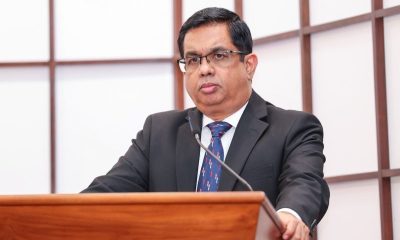

A Chamari Athapaththu seven-wicket haul and Nilakshika Silva’s 50 off 35 saw defending champions Sri Lanka withstand a valiant Indonesian side to register a resounding 75-run victory in their Asia Cup match in Dubai.
Athapaththu was undoubtedly the pick of the bowlers, as she started and finished Indonesia’s slide with career best figures of 7 for 05, inclusive of a hat-trick – nearly two in fact. Chasing a target of 125, the opening pair of Maria Corazon and Rahmawati Pangestuti struck 16 runs in the first two overs, but once spin came into play scoring slowed down to a trickle and Indonesia were eventually bowled out for 49 in the 19th over.
Sri Lanka, too, had found it tough to combat Indonesia’s mix of spin and slow-medium seamers as they stumbled to 62 for 6 in the 13th over, but their innings received a timely boost as Nilakshika countered with a trademark back-against-the-wall effort to drag her side to a total that seemed about par on a pretty sluggish surface. In the end it proved to be plenty.
Sri Lanka struggle early on
Having been put in to bat on a fresh surface, Sri Lanka were perhaps guilty of a little complacency against their less-fancied opponents. Time and again the top order sought to find the boundary, and time and again they failed to find their timing.
On a wicket where the ball was hardly coming on, the Sri Lankan batters’ tunnel vision focused squarely on boundary hitting and eschewed strike rotation; there were 19 dot balls in a powerplay that had fetched 31 runs for the loss of two wickets.
By the halfway point of the innings, the dot count had risen to 28. The scorecard, meanwhile, read 47 for 5. Indonesia, to their credit, did well to bowl to their fields and frustrate the Lankan batters.
Sanjana Kavindi got to double-digits with a pair of nicely struck boundaries, but she was the only one of Sri Lanka’s top five to do so – and she was eventually done in on 15 missing an attempted cut on a straight one.
Nilakshika brings the Silva-lining
With recognised batting fast running out, Sri Lanka needed someone to take control of the innings, and as she has done so often over recent years it was Nilakshika that stood up to be counted.
She first strung together 17 off 18 with Kaushini Nuthyangana, but when Nuthyangana fell Nilakshika produced a masterclass in batting with the tail. She cajoled Kawya Kavindi to keep rotating the strike, and when the opportunity arose she was unerring in finding the boundaries – including Sri Lanka’s first and only six of the innings in the penultimate over.
Their seventh-wicket partnership eventually ended on 50 off 36, reached simultaneously alongside side Nilakshika’s fifty – her third in T20Is – but by then she had already ushered her side to safety.
Athapaththu steals the show
In Chethana Vimukthi, Sri Lanka might have their first ever genuine fast bowler but on a wicket where the ball was not quite coming on, pace never seemed like the answer. For the first two overs of the chase, Indonesia’s openers did well to find boundaries against Vimukthi and and fellow seamer Kawya, but then Sri Lanka introduced their spinners.
Athapaththu promptly castled Pangestuti before removing Corazon and Rada Rani off consecutive deliveries in her next over. Here she missed her hat-trick by a whisker, a yorker narrowly missing Desi Wulandari’s off stump.
She brought herself back into the attack in the 14th and removed Nanda Sakarini, and she capped things off by achieving her hat-trick at the second time of asking, taking three wickets off what proved to be the final three deliveries of the innings.
Scores:
Sri Lanka Women 124 for 7 in 20 overs (Sanjana Kavindi 15, Nilakshika Silva 50, Kawya Kavindi 15*; Ni Ariani 1-23, Sang Maypriani 2-15, Ni Luh Dewi 3-32, Sofia Velic 1-21) beat Indonesia Women 49 all out in 18.3 overs (Rahmawati Pangestudi 10, Ni Made Putri Suwandevi 12; Kavya Kavindi 1-14, Sugandika Kumari 1-03, Chamari Athapaththu 7-05, Kavisha Dilhari 1-02) by 75 runs
[Cricinfo]
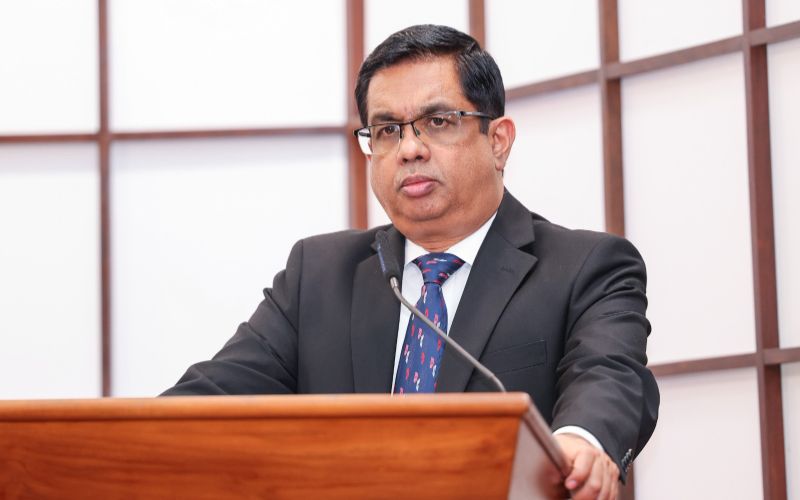
The Memorandum of Understanding (MoU) relating to the project to provide technological solutions to prevent wild elephants from being hit by trains was signed yesterday (01) afternoon at the President’s Media Centre, under the patronage of Secretary to the President Dr Nandika Sanath Kumanayake.
Coordinated through the “Clean Sri Lanka” programme, the project is being implemented as a public-private partnership, with the Railway Department, the Department of Wildlife Conservation and the Forest Conservation Department working together, with full financial support from People’s Bank.
The system consists of three-beam detection, passive infrared (PIR) sensors, automatic temperature sensors and a tamper alarm system to detect animals weighing more than 20 kilogrammes and unauthorised interference. Signal lights (red/yellow/green) installed on either side of the railway tracks, together with a special screen installed inside the locomotive cab, will alert the driver in advance to the exact location of an elephant.
A demonstration test of the system was successfully conducted at the Pinnawala Elephant Orphanage premises in the presence of the relevant officials, following which a report on the system was prepared.
The system will be implemented as a pilot project from next month at 13 locations where wild elephant accidents are frequent. A newly developed website is also scheduled to be launched to enable the progress of the project to be viewed live.
Additional General Manager of Railways P.D.S.B. Chandrasena, Director General of Wildlife Conservation M.S.L.R.P. Marasinghe, Conservator General of Forests S.C. Palamakuumbura and Chairman of People’s Bank Chandana Guniyangoda signed the relevant MoU. Officials from the Clean Sri Lanka Secretariat, including Presidential Additional Secretary (Clean Sri Lanka) Engineer S.P.C. Sugeeshwara, as well as senior officials from the Railway Department, Department of Wildlife Conservation, Forest Conservation Department and People’s Bank, were also present.
[President’s Media Division]

The Commissioner General of Examinations has announced that the results of the 2026 Grade 5 Scholarship Examination have been released online, and can be viewed on the department’s official website: www.doenets.lk

Guest lecture by Amb. Pandey

ProFood ProPack & AgBiz 2026 concludes successfully

Malta businessman acquitted of plotting journalist Caruana Galizia murder

Nilakshika fifty, Athapaththu seven-for rescue Sri Lanka against Indonesia

Winners to receive medals at Western Province School Games after many years

MoU signed for technology to prevent wild elephant-train collisions

‘Dates have the highest sugar content to fight Coronavirus’

Sunday Island 27 December – Headlines

#SundayIsland 17th December – Headlines

Sunday Island – 28th March

Sunday Island Headlines – 21 March

Sunday Island – 21st February – Headlines
-

 News6 days ago
Eight politicians in drug kingpin probe
-

 Features4 days ago
“Wrap Me Up in My Blazer”— A Gentlemanly Bradby Reminiscence
-

 Business6 days ago
Sri Lanka opens up: A new season of direct connectivity
-

 Features3 days ago
When Sri Lankan stories find their own voice
-
 Latest News7 days ago
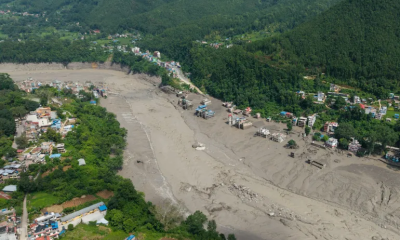
Nepal-Tibet floods: What happened, what caused them and who is missing?
-

 Features6 days ago
Redefining ageing in Sri Lanka
-

 Editorial7 days ago
Unfolding El Niño and burning issues
-

 Editorial6 days ago
The toxic legacy of two lakes