
Features
Socialism’s blight: Power-crazed ‘leftist’ rulers

by Kumar David
Socialism mercifully was avant-garde the world-over in the 1960s and up to the mid-1970s, my salad days as undergrad, postgrad and junior lecturer. It was the age of Heroic Che, steadfast Uncle Ho and young Mandela. There would have been others (Patrice Lumumba, Amilcar Cabral and Ahmed Ben Bella) but imperialism murdered or deposed them quickly. The sun still shone on anti-colonialism and anti-imperialism and the flame of the welfare-state was not yet extinguished in Europe. This haze also obscured the manic reign of power-crazed Stalin and the by then clinically crazy Mao. Why? They, for reasons more to do with the Cold War than ideology or principle, armed and bankrolled global revolt. Many fights ended in defeat, partial defeat or just faded away (Congo, Algeria, Angola, Mozambique, the Baathist experiment in Iraq-Syria, and Nasser’s Egypt come easily to mind) and ugh, there were grotesque bloodbaths in Indonesia (1965-66) and Chile (1973). On the bright side Vietnam won in April 1975 and Cuba survived and still struggles on. Then, oh then the Soviet Union and Eastern Europe went belly-up in 1989-90, Yugoslavia fragmented (early 1990s) and China retreated in the mid-1970s into a foreign policy sink-hole to lick its wounds, and a little later to repair its Mao-shattered economy. If you stand back and survey these last 80-plus years with eagle-eye, it’s been one helluva roller-coaster ride!
Does the dice seems to be rolling the other way again? Not so fast, the scorecard is still mixed. True the times when liberals – some Trotskyites too – lumped Hitler and Stalin together as two sides of a coin has passed. Ted Grant said Stalinism in its conduct, was Nazism pulverising all social independence but with a statist economy. Material benefits to the underprivileged aside, empirically there is truth to this description. Authoritarianism in China is miles different from Stalinist Russia or the US’s besotted Saudi Arabia and UAE and the material uplift of the populace in the PRC they say is a ‘wonder of the modern world’. On balance nevertheless, the world-over, the hopes of leftists and socialists are nowhere near scoring a walkover victory. One reason is that the far-right (political primitives a la Trump and religious and racial extremists of whom we possess a fair share) are making gains in many places. This, largely, is a consequence of the remarkable failure of liberal-democracy cum capitalism, everywhere, to achieve much; the centre has hollowed out.
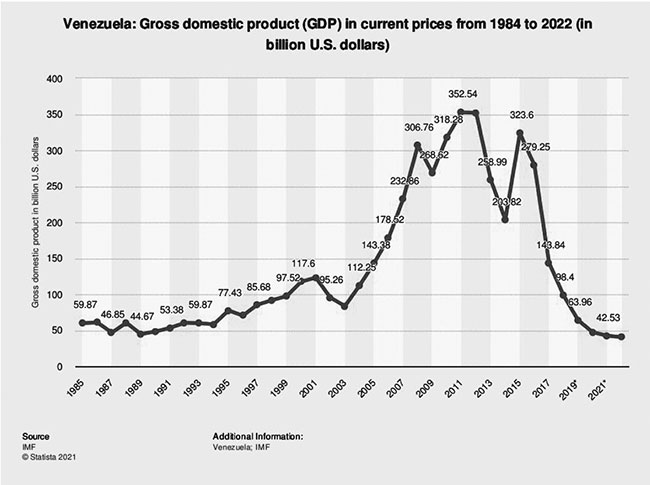
But there is another reason why socialism hasn’t got voters cheering widely; the power-drunk greed of nominally left/socialist government leaders who hang on to office at any price. The reply that dictatorships of the right are more frequent and more brutal is not adequate because people’s expectations from the left are different. There are two cases in the cross hairs right now, Venezuela and Nicaragua. That the former, after Chavez, has been an economic disaster is again not the issue because many right-wing regimes in Central and South America are no better. What is execrable is that the Nicolas Maduro dictatorship retains power by breaking up popular demonstrations, imprisoning opposition leaders and playing fast and loose with the judiciary and the Constitution. During the Chavez (died in March 2013) years when oil prices peaked (2011-12) big advances in housing, education and community building were made. True, this was accompanied by imprudent planning and waste, but notwithstanding, the social and political balance sheet was positive. Had Maduro faced an election, and lost, it would have been fine; no successor government could have rolled back the gains of ‘Chavismo’. But as things stand now the inevitable ejection of Maduro at some point will endanger the gains of Venezuelan socialism. Maduro’s greed for power is the grimmest threat to the socialist ‘project’ in Latin America and it is the sharpest anti-left propaganda assault in the continent. Leftist regimes that orchestrate a transition from democracy into dictatorship are a jinx on socialism.
Elections in Nicaragua have just ended and Daniel Ortega has won by a landslide of votes cast – but independent observers estimate the abstention rate as 80 percent! Ortega locked up seven opposition candidates and made it pointless for all except his jingbang to vote. His wife Rosario Murillo has been promoted from vice president to “co-president”. Ortega was elected for a fifth (fourth consecutive) term much to the delight of all who ridicule socialism as the antithesis of democracy. A statement by all 27 EU members accused Ortega of “systematic incarceration, harassment and intimidation” of opponents, journalists and activists. Murillo’s daughter from a previous marriage alleged in 1998 that Ortega “repeatedly raped her from age 11”. Ortega has never spoken publicly on the subject but Ms Murillo, the girl’s mother, has called her daughter a liar and a lunatic. Nevertheless damage has been done. The Nicaraguan economy in contrast to Venezuela is fortunately not in shambles. Thankfully most people describe Ortega as a “former Marxist”; pity nobody does history the favour of cataloguing Maduro as a “never Marxist”.
The story of Soviet Russia is blurred by the passage of time even for those who once knew it all. A recapitulation along the lines of this essay is needed. The real degeneration of the Soviet state into Ted Grant’s “social fascism”, though its origins date to the late 1920s, became stark only in the mid-1930s in the Great Terror, which included the notorious 1936-38 show trials and the murder of all Lenin’s Bolshevik co-leaders. Millions of citizens were sent off to Gulag labour camps or killed. The stage was set by the murder of Politburo member Sergi Kirov in December 1934 by the NKVD on Stalin’s orders as a pretext for the purges. By 1939 Stalin had brought the party into abject submission and terrorised and atomised society into social fascism. A one-man absolute dictatorship prevailed till Stalin died in 1953.
How then to explain the extraordinary economic success of Stalinist Russia after the revolution and its rise to superpower status side by side with America? The first driver of success was the enthusiasm that victories in the revolution and the civil war (1918-1922) engendered and the winning over of the peasantry by Lenin’s far sighted New Economic Policy. For a decade this drove the passion of the people and at that stage in history a state controlled, rigid centrally-planned economy was apposite to the needs of technically backward Russia where no modernisation had occurred for one to two centuries since Peter the Great (lived 1672-1725) and Catherine the Great (lived 1729-1796). [Deng Xiao Ping, in another world and era, adopted a very different method]. Imperialism sought to overthrow the USSR by every stratagem since the revolution (the Western Powers armed and financed the “White Russians” against the fledging Republic on 17 fronts). Hitler’s main objective in WW2 was to cleanse (‘lebensraum’ – living space) European Russia of Slaves to make space for Germanic Aryans; both threats drove the Russian people into Stalin’s arms in the way that the latter day terrorist LTTE become Sinhala chauvinism’s greatest ally. Hence the USSR worked till perhaps 1975-1980. After that its collapse from economic failure, bureaucratisation and universal hatred of the ruthless Stalinist state came quickly in 1989-90. Russia is now, paradoxically, a toothless nuclear power, never heard and hardly seen except when Europe needs gas.
The case of Eastern Europe is different. The post-war world from East Germany to the Soviet Union, Yugoslavia excepted, was a creation of the Red Army. It was in the first instance a buffer to protect the Fatherland from NATO hell-bent on aggression, but secondly it had to be governed and a post-war economy constructed. In both instances the Stalinist model was transplanted; rigid central planning and social fascism. Both were disasters. The early Soviet Union had freshness and creativity, the transplanted and imposed Eastern European version lacked the bloom of vitality. The theme of this essay is democracy hence I emphasise the universally arid party apparatuses and the repertoire of false charges, forced confessions and uninhibited cruelty of torture.
Still there is a paradox that calls for explanation. The Eastern European communist venture includes relative ethnic peace and de facto territorial devolution, the liberation of women, stable state power, economic rationality via limitations in consumption, sensible work-productivity and notable income equity (all were equally poor the cynic will quip). There was political integration within the bloc, albeit under Soviet hegemony and the bloc enjoyed high standing among third-world peoples and governments. To explain this dichotomy would take me too far afield today, except to say that much of it came with the system. What is critical for the purposes of this essay is that when Stalinism crashed there was no retreat possible from Stalinism to social democracy let alone socialism. When Stalinism reached the end of the road and in general when power-crazed “left” leaders are overthrown it is not democratic socialism and a rational society that follows as fond Marxists and hopeful Trots wish. What come next – well you see it in Poland, Hungary and Belarus. Everywhere a right-extremist, neo-Nazi and ultra-religious backlash. The names are familiar; Victor Orban, Alexander Lukashenko, Andrzej Duda, Slovakia’s Robert Fico, Serbia’s Aleksandar Vucic and many elected dictators in Central Asia.
I have arrived at the punch line of this essay. The lesson that the National People’s Power movement in which I am involved, the JVP which supports it and five or six other credible left parties (the Dead-Left is awaiting cremation) must take away from this story is this. Not merely as a game-plan, but a real commitment to democratic socialism must exist. A genuine guarantee of democracy must accompany a popular but flexible economic agenda and choice in lifestyles. We need to make it clear that if, when in power, the left loses an election it will be so-long, adios, sayonara and bye-bye; we will head for the door.

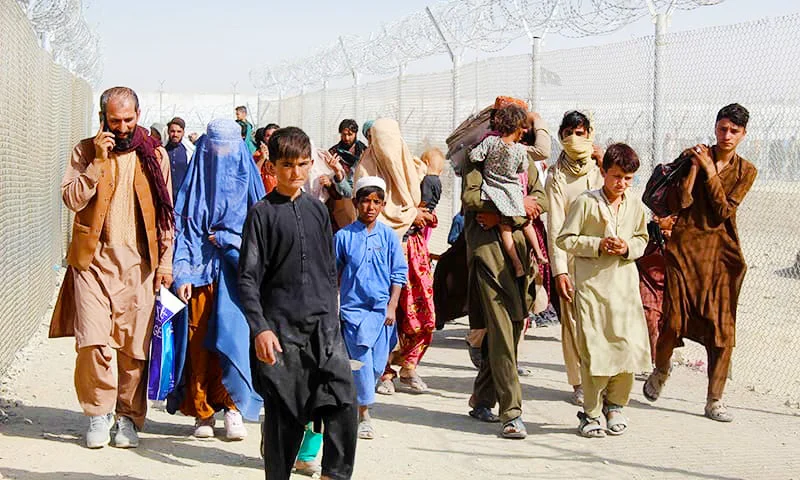
 The mounting mute and unmitigated suffering of the ordinary people of Afghanistan is coming to the fore once again in ongoing efforts by some neighbouring states to deport tens of thousands of Afghan refugees to their country of origin. As in the case of the majority of refugees the world over the Afghan refugees too are caught up in cataclysmic wars and conflicts not at all of their making.
International reports indicate that some six million Afghan refugees have been virtually pressured, to date, to return to Afghanistan by Pakistan and Iran, for instance, on the basis apparently of stringent policies on refugees adopted by the latter. Many refugees are on record that although they are officially identified as of Afghan origin this is the first occasion on which they are seeing the inside of Afghanistan, since thus far they have been living, particularly in Pakistan, as virtual natives of the latter.
‘They are part of the biggest cross border movement of people in recent history, a UNHCR source was quoted saying. However, barring the latter UN agency and a few well wishers, the refugees are being seen as a virtual parasitic and unwanted presence by sections of the publics who have thus far been compelled to have the refugees among them.
The refugees’ haplessness is compounded by the fact that they have been reduced to almost destitution. Having possessed virtually nothing by way of material assets they are getting back to Afghanistan a dis-empowered, dispossessed people.
For well over a century Afghanistan has been at the centre of the big power rivalries of South Asia. The country has been intensely coveted by the majority of major extra-regional powers from the turn of the last century primarily on account of its strategic geographical location, besides some of its natural resources.
Those powers that gain a military foothold in the country would be enabled to bring the majority of Afghanistan’s neighbours within their sphere of influence and power. Some of these are, China, Pakistan, Iran and India. Besides there are the one time Soviet Central Asian Republics, control over whom would be of considerable value, from a number of viewpoints, to expansionist powers.
These attractions account for the appeal Afghanistan has continued to exercise over the majority of extra-regional powers whose presence has proved decisive in the shaping of international politics over the decades. Those powers who have featured majorly and are continuing to do so are, the US, Russia, China and the UK to a lesser degree.
However, the Afghan refugee issue or the ‘Long- suffering’ of the ordinary people of Afghanistan could be considered as having gained exceptional prominence with the Soviet invasion of Afghanistan of 1979.
The latter event needs to be seen as a notable turning point in the last century’s international politics. The initial disintegrative cracks in the Soviet Union were beginning to appear and Islamic fundamentalism was seen by the Soviet authorities as making divisive inroads into their Central Asian Republics.
The influence of Islamic fundamentalism had to be stymied following the Islamic Revolution in Iran in 1979 and Afghanistan came to be seen by the Soviet authorities as a potential hotbed of such religious revolutionary fervour. Thus came about the Soviet invasion of Afghanistan and its subsequent degeneration into a military quagmire for both the Soviet Union and the US.
Thus it was only a matter of time before Afghan refugees began to swell in numbers in neighbouring states. They were haplessly caught up in the ‘cross-fire’ between the Soviet backed Afghan security forces and the Afghan militant resistance which evolved into the Taliban.
As is known, the Afghan resistance came to be armed and backed by the US subsequent to Afghanistan being over-run by the Soviet Union. Thus, Afghanistan became the last proxy war theatre in the long -running Cold War between the US and the Soviet Union. More than a decade of blood-letting convinced the Soviets that there was no choice but to quit Afghanistan.
Thus, to a considerable extent, the Afghan refugees are the victims of big power armed rivalries which are continuing to render the world a most ‘dangerous place’ for ordinary people. The UN agencies seem to be doing their best for the refugees of Afghanistan and most other refugee categories but the continued humiliation of such victims of war would need to be mitigated by the international community to the extent possible. Forcible deportation of refugees in particular may need to be eschewed and outlawed.
Being subjected to an acid test at this juncture is the Universal Declaration of Human Rights (UDHR). It is the latter seminal convention that made the protection of human dignity a cardinal value for the world community.
All those sections that subscribe to international humanitarian law and democratic opinion world wide need to come together, may be under the aegis of the UN, to work out how primacy could be attached to the UDHR and its principal mandate of protecting and perpetuating human dignity and worth.
This is no easy challenge to meet but it needs to be addressed urgently before currently rampant ‘international disorder’ grows well out of control.
The US and Russia are especially obliged to go to the rescue of the Afghan refugees since the Afghan crisis is of their making to a considerable extent but no help could be expected from them because their governments are strongly right wing in orientation. It would be far-fetched to expect of them a strong social conscience.
However, the UN and like-minded organizations need to dialogue strongly with the Taliban regime in Afghanistan with a view to bettering the well being of Afghan civilians. No longer could the lot of the latter be allowed to be dismissed by the Taliban government as ‘an internal matter.’
If the Taliban regime is being assisted by the UN, the former is strongly obliged to be accountable to the international community. The UN would need to non-obtrusively convince the Taliban government that it cannot ignore the essential needs of its civilian populace and the empowering of women forms a central component of this broad programme of work. The UN’s diplomatic finesse needs to come to figure here in a major way.
Refugees everywhere should ideally be re-accommodated in their countries of origin or native lands. However, unless and until their dignity is ensured by governments and other quarters that matter such endeavours would prove to be self-defeating.
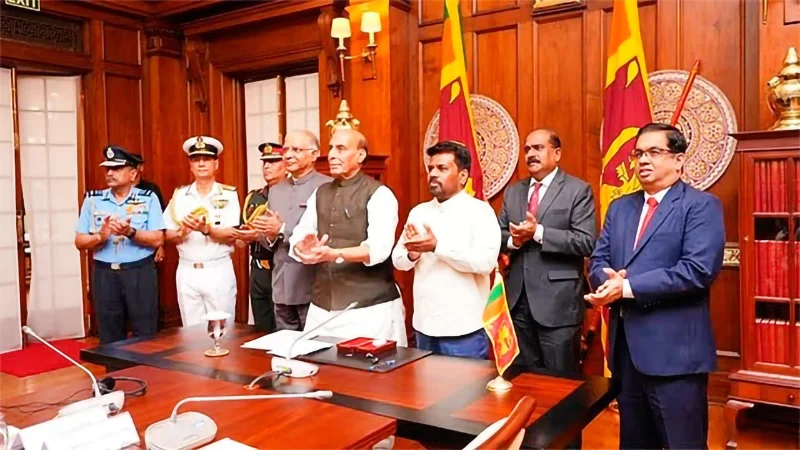
Indian Defence Minister Rajnath Singh’s arrival in Colombo is not a ceremonial call. It is the political face of a security relationship that has been rebuilt, layer by layer, since 2024. Sri Lanka should take the capability on offer, and keep the right to say no.
by Mahil Dole
Senior Superintendent of Police (Retd.)
Indian Defence Minister Rajnath Singh is in Colombo for a three-day official visit, the first by an Indian Defence Minister in 38 years. The last such call was by K. C. Pant in 1988. That long silence itself tells a story. For nearly four decades, defence business between the two neighbours was handled by service chiefs, training colleges and quiet staff talks. New Delhi has now chosen to put a political minister at the centre of the relationship, and to do so immediately after a dense sequence of Indian visits and against a harder contest in the Indian Ocean.
The visit will be read, in Delhi, Beijing and Washington, as a signal. Our task in Colombo is narrower and more serious: to convert the signal into national capability without converting the island into a platform.
Not an isolated visit
Singh’s programme is the latest layer in an unusually concentrated Indian engagement since President Anura Kumara Dissanayake assumed office in September 2024. Prime Minister Narendra Modi’s state visit in April 2025 was the first by any foreign head of government after the new presidency. Seven documents were signed. Among them was the first comprehensive India–Sri Lanka Defence Cooperation Memorandum of Understanding, a five-year umbrella covering joint exercises, training, port calls, humanitarian assistance and disaster relief, information exchange and possible defence-industry cooperation. Either side may terminate it with three months’ notice. That exit clause is not a detail. It is the difference between a structured partnership and a treaty alliance.
What followed was a rhythm, not a one-off. The eighth Annual Defence Dialogue was held in Colombo in June 2025. The Indian Navy Chief called in September 2025. After Cyclone Ditwah, India arrived as a first responder and later announced a reconstruction package of some 450 million US dollars; External Affairs Minister S. Jaishankar came as Special Envoy. In January 2026 the Indian Army Chief, General Upendra Dwivedi, handed over vehicles and training aids, opened a friendship corner at the Defence Services Command and Staff College, and laid a wreath at the IPKF memorial in Battaramulla. The Indian Vice-President visited in April. Foreign Secretary Vikram Misri was in Colombo on 5 August with rupee lines of credit for railways and other priorities. Later that month, Sri Lanka’s Navy Commander, Vice-Admiral Damian Fernando, made his first overseas visit in command, to New Delhi, and met the Chief of Defence Staff, the Defence Secretary and the Navy Chief.
Singh therefore arrives not as a stranger opening a file, but as the political seal on work already in motion. He met President Dissanayaie, who holds the defence portfolio, the Prime Minister and the Defence Secretary. The itinerary also takes in the IPKF memorial, the Defence Ministry, the parliamentary precincts, Gangaramaya Temple, a likely reception on an Indian Navy ship, the National Defence College, and the Sita Amman Kovil in Nuwara Eliya. Indian High Commissioner Santosh Jha has said relations have “never been better” in decades. The visit calendar, at least, is not an invention.
What already stands on the defence floor
It is important to be precise about what already exists, so that we do not mistake institutionalisation for a sudden tilt.
Training is the deepest bond. India is the largest foreign trainer of the Sri Lankan armed forces, offering on the order of a thousand to twelve hundred vacancies a year. One naval accounting records more than two thousand Sri Lankan naval personnel passing through Indian courses over nine years. Shared classrooms produce shared language, shared drills and personal networks that outlast any single government. Reports ahead of this visit point to three new memoranda, one likely on air-defence guns, one on cadet-corps links, and one on cooperation between the Sri Lanka Defence College and Indian defence institutions. If signed, those instruments would push the relationship into the next generation of officers, not only today’s operators.
Exercises are now routine rather than ceremonial. The twelfth edition of SLINEX, the bilateral naval exercise, was held in Colombo from 14 to 18 August 2025, with a harbour phase of professional exchanges and a sea phase of gunnery, boarding, replenishment and communications. MITRA SHAKTI, the army exercise with air elements, held its eleventh edition in Belagavi last November. A fourth bilateral diving exercise was conducted in Colombo in April 2026. The two navies and coast guards continue International Maritime Boundary Line meetings. An Indian Navy Dornier was based here for maritime surveillance from August 2022 to August 2025. A Maritime Rescue Coordination Centre was commissioned with an Indian grant of about six million dollars. INS Vikrant and INS Udaygiri took part in the International Fleet Review marking the Sri Lanka Navy’s seventy-fifth anniversary.
None of this is trivial. None of it, by itself, is alignment. Hardware, hours at sea and staff-college seats are instruments. What they become depends on command, data and political purpose.
National security questions that matter
Three questions should govern Colombo’s handling of the Indian Defence Minister’s visit.
The first is maritime domain awareness. Sri Lanka’s core security geography is not a land frontier. It is the exclusive economic zone and the sea lanes that pass our shores. The live threats are narcotics, people-smuggling, illegal fishing, and the possible relocation of cyber-fraud compounds. Conventional naval war is not on this year’s operational list. Indian help with sensors, hydrography, diving, boarding drills and search-and-rescue is therefore rational. The test is who owns the picture. Shared awareness is useful. Exclusive dependence on one partner’s fusion centre is a vulnerability. Australia’s Disi Rela programme against irregular maritime movement, Japanese passage exercises, and the United States capacity support, cutters, aircraft, humanitarian exercises, already exist. They should remain in the mix. Maritime security should be a Sri Lankan-led coalition of convenience, not an Indian franchise.
The second is the air and coastal defence gap. Talk of Indian air-defence guns is not abstract after the 2026 conflict in West Asia reached our own waters, the sinking of the Iranian frigate IRIS Dena off Galle, and later Iranian hulls lingering near the exclusive economic zone. The government’s public line was the correct one: no combat use of our territory, airspace or waters by any party; humanity first; sailors rescued. That posture only works if the state can see, and if necessary contest, its approaches. Accepting guns, radars or training is compatible with an independent foreign policy if command, basing and rules of engagement remain Sri Lankan. Integrating them into another country’s kill-chain would not be.
The third is internal security. Easter Sunday accountability, narcotics networks that run through ports and prisons, and communal peace are not separate from geopolitics. Partners price political risk. A state that cannot govern its harbours, its financial system and its extremist ecosystems will be offered “help” that looks like tutelage. India’s interest in counter-terror coordination and drugs overlaps with genuine Sri Lankan needs. The discipline required is the same as in any sound intelligence relationship: cooperate on targets; do not outsource the service.
The wreath at the IPKF memorial will be watched, as it was when the Indian Army Chief stood there in January. The years 1987 to 1990 remain raw in our political memory. The only stable line is professional honour to the dead, not a political rehabilitation of an intervention that divided this country.
How the region will read Colombo
India’s motive is not mysterious. Sri Lanka sits on the approaches to India’s southern seaboard. Chinese commercial and dual-use presence at Hambantota and Colombo Port City, and continuing engagement with the People’s Liberation Army Navy, is the backdrop. Pakistani naval units calling at Colombo, including a Chinese-built Hangor-class submarine earlier this year, only sharpen New Delhi’s preference for a denser security habit with us. Neighbourhood First and MAHASAGAR, Mutual and Holistic Advancement for Security and Growth Across Regions, are the language. The operational aim is that extra-regional navies do not treat Sri Lankan harbours as a default logistics base against Indian interests.
Our motive should be equally clear, and different. Geography makes India the permanent neighbour. Crisis behaviour, liquidity and fuel in 2022, the cyclone in 2025, the energy and remittance shock of 2026, has already shifted public sentiment. That is a political fact. It does not require Colombo to adopt India’s threat picture of China, or to freeze other relationships.
A workable posture is polyalignment with a spine. India is the deepest security and connectivity partner, domain awareness, disaster response, training, Trincomalee energy cooperation, grid links and rupee credit, on the condition that ports, exclusive economic zone access and intelligence fusion remain under Sri Lankan law. China remains a major economic and infrastructure partner; new exclusive strategic footholds should not be created, and debt and operational control must stay visible. The United States, Japan, Australia and Europe matter for markets, green shipping, extra training pipelines and non-traditional maritime threats. Ordinary naval diplomacy with Pakistan and others is manners, not signalling.
The government’s stated doctrine, an independent policy that does not favour any country, and territory that will not be used against a third party, is the right public frame. This week will test whether that frame can coexist with deeper, more structured Indian defence cooperation. It can, if the new memoranda are capability contracts with exit clauses, not political alignment documents.
Take help. Keep the choice
Colombo should treat the expected instruments as a capability audit.
On air defence, welcome sensors and guns that Sri Lanka can man, maintain and switch off. Reject any arrangement that requires foreign crews, foreign rules of engagement, or data that only flows one way. In cadet corps and staff colleges, take the training and keep a parallel pipeline with other professional schools so that the officer corps is not a single-source product. On the 2025 Defence Memorandum, measure implementation by Sri Lankan readiness, hours of maritime coverage, time-to-rescue, interdiction rates in the exclusive economic zone, disaster lift, not by the number of Indian ship-days in harbour.
Joint training should emphasise humanitarian assistance, counter-narcotics, hydrography, diving and lawful boarding. Those are the missions that serve the public and do not lock us into someone else’s contingency. Scenarios that only make sense in an India–China or India–Pakistan crisis should be declined politely and firmly.
Defence talks must also be bound to the prosperity agenda. Trincomalee as an energy and industrial node, electricity interconnection, port productivity and cyclone reconstruction are where security cooperation either pays the citizen or looks like militarisation. A Defence Minister’s visit that produces only wreaths and signed paper will be read in the region as alignment. A visit that also moves energy storage, disaster systems and maritime safety will be read as statecraft.
I write as a former police officer who spent a working lifetime on intelligence, counter-terrorism and the unglamorous work of keeping a multi-religious island in one piece. Geography gave us a seat at the table of Indian Ocean commerce and security. Institutions, energy policy, port performance and social cohesion will decide whether that seat produces prosperity, or merely more invitations to other people’s contests.
Singh’s visit should be received with courtesy, used with discipline, and remembered for what it adds to Sri Lanka’s ability to stand on its own water. Take the neighbour’s hand. Keep the island’s choices. Make sure every exercise, every gun and every training slot leaves us more able to say no the next time a great power asks to use our sea, our air or our soil. (18 sources)
This analysis is offered in the interest of national security, institutional reform, and public safety)
The writer is a retired Senior Superintendent of Police. He served as Deputy Director in charge of the Counter Terrorism Desk, State Intelligence Service, and later as Intelligence Coordinator to the Inspector General of Police. He is the author of Security Beyond Enforcement: Practical Approaches for a Safer Nation.
Rediscovery highlights rich, unexplored aquatic biodiversity in Northern Province
By Ifham Nizam
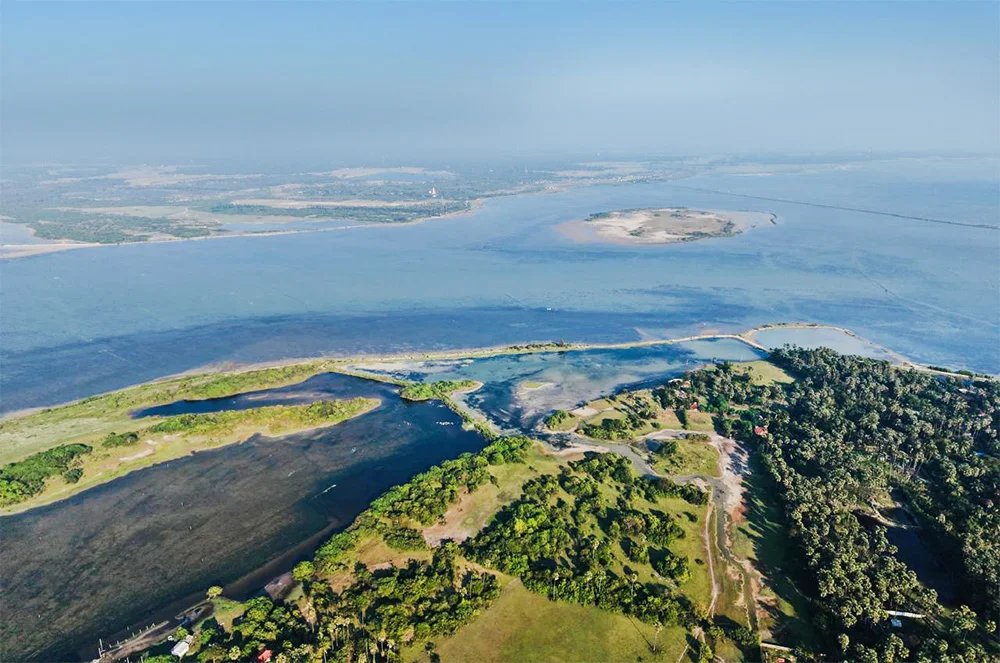
A small fish that vanished from Sri Lanka’s scientific records for nearly 90 years has resurfaced in the waters of Jaffna, providing researchers with a remarkable rediscovery and fresh evidence that the Northern Province still holds significant, unexplored aquatic biodiversity.
The Yellow-stripe Goby, Mugilogobius chulae (Smith, 1932), was recently found in the Karainagar area of Karaitivu Island during a biodiversity survey, almost nine decades after it was last scientifically recorded from Sri Lanka.
The discovery is particularly significant because the species had previously been known from the country only through a single historical specimen collected from Pedduru Thuduwa, Jaffna.
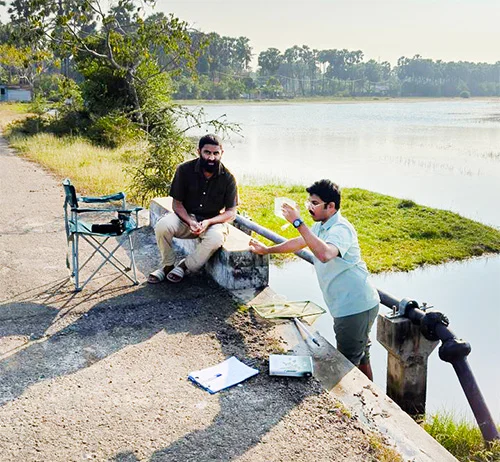
Discovery moment
Research scientist Janamina Bandara, a member of the team that made the discovery, told The Island that the fish was not initially identified as the long-lost species.
“We came across an unidentified Goby during our fieldwork, and it was only after a detailed examination of its external morphology that we were able to establish its identity as Mugilogobius chulae,” Bandara said.
“For us, it was an exciting moment because this species had not been confirmed from Sri Lanka for almost 90 years.”
The fish has a particularly interesting history in Sri Lankan ichthyology.
In 1936, renowned Sri Lankan zoologist P. E. P. Deraniyagala described a new fish from Pedduru Thuduwa in Jaffna in his paper,
“Two New Fishes from Ceylon”, published in The Ceylon Journal of Science.
He named the species Vaimosa valigouva. Subsequent taxonomic revisions established that Vaimosa valigouva was a synonym of Mugilogobius chulae, the currently accepted scientific name of the Yellow-stripe Goby.
However, no further confirmed records emerged from Sri Lanka for decades.
With the species absent from subsequent surveys and inventories, it eventually disappeared from the country’s national fish lists and from much of the scientific literature relating to Sri Lankan fishes.
The prolonged lack of records was also closely linked to the difficulties of conducting biological research in northern Sri Lanka.
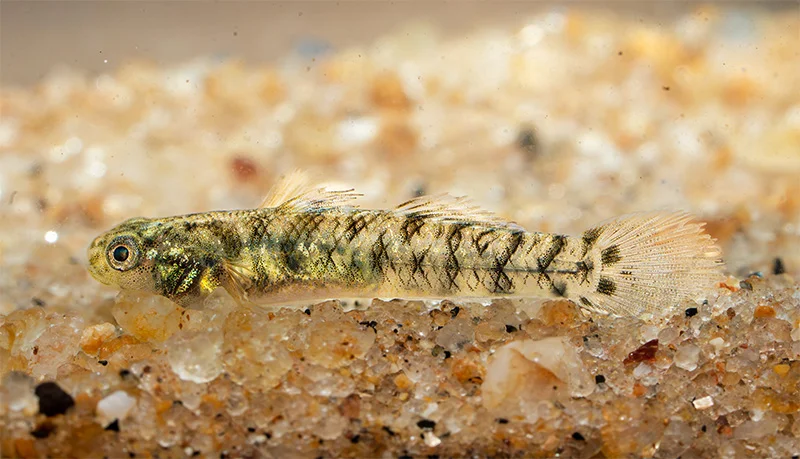
Yellow-stripe Goby, Mugilogobius chulae
For decades, the civil conflict, restricted access, security concerns and limited opportunities for field surveys prevented scientists from systematically investigating many of the region’s aquatic habitats.
Consequently, while considerable advances were made in documenting biodiversity elsewhere in the island, northern Sri Lanka remained comparatively poorly explored.
Bandara said the rediscovery should, therefore, be viewed in a much wider context than the finding of a single fish.
He told The Island: “An absence of records does not necessarily mean that a species is absent. In the case of northern Sri Lanka, there have been enormous gaps in field data because large areas could not be studied systematically for many years.”
“This finding demonstrates how important it is to return to these habitats and carry out detailed surveys. There could be many more species, range extensions and rediscoveries waiting to be documented.”
The research team’s findings did not end with the Yellow-stripe Goby.
During the same study, the researchers also documented the Black-spotted Snubnose Goby, Pseudogobius melanostictus (Day, 1876), providing what they describe as the first confirmed northernmost record of the species in Sri Lanka.
The species had previously been reported mainly from lagoonal and brackish coastal environments in the western part of the country, while recent verified records were limited.
The new finding consequently extends the known geographical range of Pseudogobius melanostictus and adds an important northern record to Sri Lanka’s fish fauna.
Together, the two findings significantly expand the known distribution of both Goby species within Sri Lanka.
They also highlight the importance of small and often overlooked coastal, tidal and inland aquatic habitats in documenting the island’s biodiversity.
Goby species are generally small fishes that occupy a variety of marine, brackish and freshwater environments. Their habitats can include rocky shores, tidal pools, lagoons, estuaries, mangroves and other transitional aquatic ecosystems.
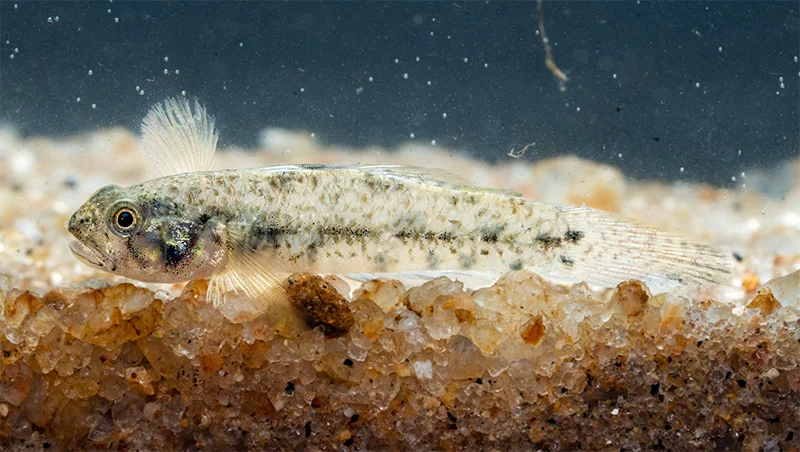
Black-spotted Snubnose Goby, Pseudogobius melanostictus
Because of their small size and preference for habitats that are often overlooked during large-scale biodiversity surveys, some Goby species can remain undocumented for long periods.
The latest research is, therefore, particularly relevant to understanding the aquatic biodiversity of the Jaffna Peninsula and surrounding islands.
According to Bandara, the discovery also demonstrates the importance of combining historical scientific literature with modern field research.
“The old records gave us an important historical reference, while the current fieldwork allowed us to connect that history with what is actually present in these habitats today,” he said.
The rediscovery of Mugilogobius chulae effectively reconnects modern Sri Lankan ichthyological research with Deraniyagala’s 1936 record.
It also establishes the new finding as the westernmost known occurrence of the species in the Indian Ocean, according to the researchers.
The study’s authors — Janamina Bandara, Sahan Randeniya and Aravind Manoj — say their findings underline the need for continued biological surveys in northern Sri Lanka.
The region’s aquatic ecosystems remain insufficiently studied, particularly in areas that were inaccessible or difficult to investigate for extended periods.
Bandara said the team expected that further exploration could produce more unexpected findings.
“We should not assume that we have a complete picture of Sri Lanka’s fish diversity. Particularly in the north, there are habitats that have received very little scientific attention,” he said.
“Every field survey can potentially change what we know about the distribution of a species. That is why continued exploration and proper documentation are so important.
The researchers have expressed particular concern about the need to document such species before changes to their habitats make future identification more difficult.
Coastal development, changes in water quality, habitat degradation and other pressures can affect small aquatic ecosystems, making baseline biodiversity information increasingly important for conservation planning.
The latest study, therefore, provides not merely two new distribution records but also a reminder of the value of maintaining and updating national biodiversity inventories.
The researchers thanked Dr. Helen Larson, Rohan Pethiyagoda, Madhura de Silva, Dr. Kasun Bandara and Neluka Fernando for their assistance with various aspects of the study.


Sri Lanka reiterates its territory won’t be used against India

UK-led Core Group calls Jaffna mass graves a ‘stark reminder’ but stops short of calling for international accountability

India underscores security and defence in overall partnership with SL

If Sri Lanka wants ‘real’ stability, only one way to achieve it, in a short time

Human dignity comes centre stage in Afghan refugee deportation crisis

‘Dates have the highest sugar content to fight Coronavirus’

Sunday Island 27 December – Headlines

#SundayIsland 17th December – Headlines

Sunday Island – 28th March

Sunday Island Headlines – 21 March

Sunday Island – 21st February – Headlines
-

 News5 days ago
Namal remanded until Sept. 18 over Airbus deal investigation
-

 Latest News4 days ago
Tharanga creates history with Diamond League crown in Brussels
-

 News4 days ago
Dispute which triggered listed company director being detained at BIA resolved
-

 Features3 days ago
After the parade: What a traffic OIC’s walk-out tells us
-
 Opinion6 days ago
In Memory of Dr Upatissa Pethiyagoda
-

 Editorial5 days ago
Power vs Equality
-
 Latest News6 days ago
SLPP MP Namal Rajapaksa arrested by CIABOC
-
Editorial3 days ago
Arrests as theatre