
Foreign News
Russian authorities say at least 60 killed in Moscow concert hall attack

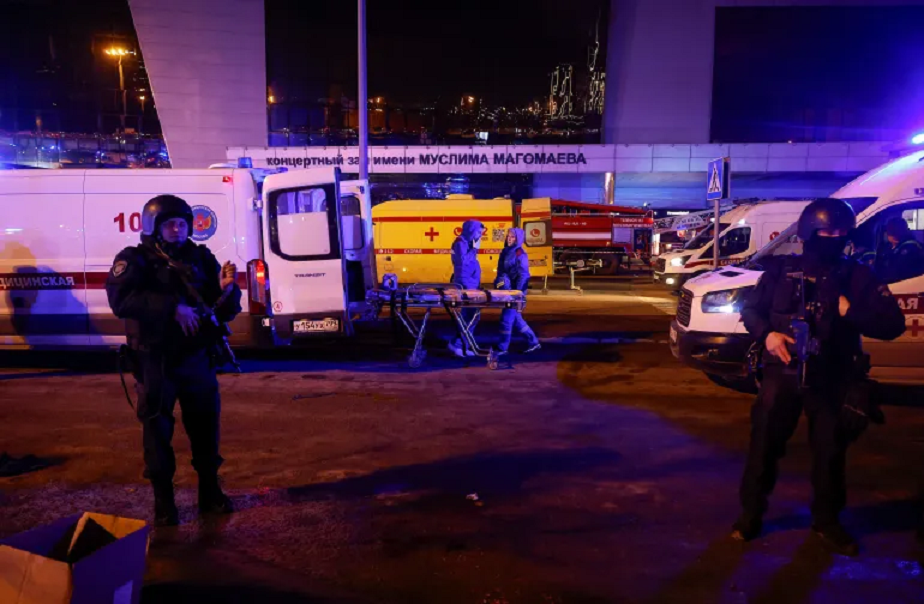
The ISIL (ISIS) group has claimed responsibility for a brazen attack on Moscow’s Crocus City Hall that killed at least 60 people and injured more than 145.
At least five camouflage-clad gunmen with automatic weapons burst into the packed concert hall in the city’s western suburbs on Friday night as the audience was gathering to watch the veteran rock band Picnic, shooting into the crowd and setting off explosives that started a massive fire.
Russian investigators said more than 60 people had been killed. Health officials said about 145 people were injured, and about 60 of them were in critical condition.
ISIL, the hardline group that once sought control over Iraq and Syria, claimed responsibility for the attack on its Telegram channel, saying the gunmen had escaped. It was not possible to independently verify the claim.
The concert hall, one of the most popular in Moscow, can hold some 6,200 people.
Alexei, a music producer, was about to settle into his seat ahead when he said he heard “several machineguns bursts” and “a lot of screams”.
“I realised right away that it was automatic gunfire and understood that most likely it’s the worst: a terrorist attack,” Alexei told the AFP news agency, declining to share his full name.
As people ran towards the emergency exits, “there was a terrible crush” with concertgoers climbing on one another’s heads to get out, he added.
Another witness, speaking to the Reuters news agency, also described the terror and panic inside the venue.
“A stampede began. Everyone ran to the escalator,” they said, declining to share their name. “Everyone was screaming; everyone was running.”
The attack, which left the concert hall in flames and its roof in a state of collapse, was one of the worst in Russia since the 2004 Beslan school siege in which more than 330 people, half of them children, were killed. The death toll appeared set to rise, according to unconfirmed reports.
Moscow Mayor Sergei Sobyanin said Friday’s raid was a “huge tragedy.” President Vladimir Putin was being given continuous updates about the situation, according to his spokesman Dmitry Peskov.
The prosecutor’s office said several men in combat fatigues had entered the concert hall, about 20km (12 miles) from the Kremlin and next to the Moscow ring road, and fired on those inside.
Repeated volleys of gunfire could be heard in videos posted by Russian media and on Telegram channels. One showed two men with rifles moving through the venue. Another showed a man in the auditorium saying the assailants had set it on fire, as repeated gunshots rang out in the background.
Others showed up to four attackers, armed with assault rifles and wearing caps, shooting screaming people at point-blank range.
Security guards at the concert hall were not armed, and Russian media said some could have been killed at the start of the attack.
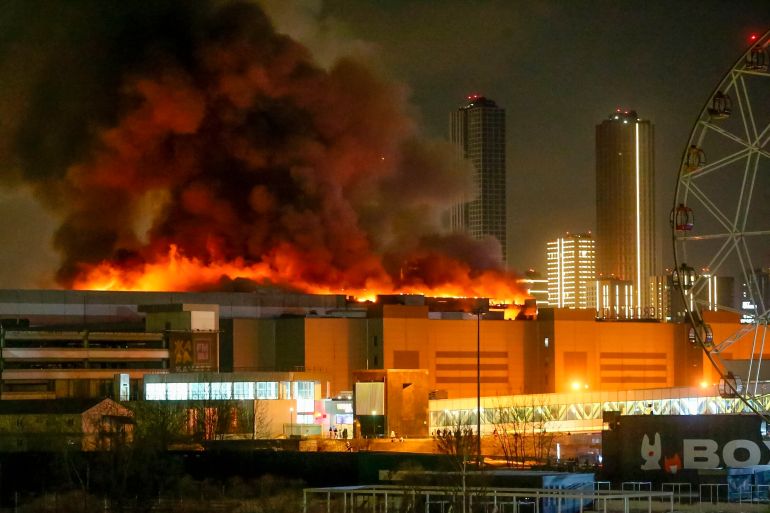 The concert venue, one of the most popular in Moscow, was engulfed in flames (Aljazeera)
ISIL claimed responsibility in a statement posted by its Amaq news agency, saying its fighters had attacked on the outskirts of Moscow, “killing and wounding hundreds and causing great destruction to the place before they withdrew to their bases safely”. The statement gave no further detail.
Russia has reported several incidents involving ISIL this month, with authorities saying they killed six alleged members of the group in a shootout in Ingushetia in the restive Caucasus region, and the FSB saying on March 7 it foiled an attack by Islamic State in Khorasan Province (ISKP), an Afghan affiliate of ISIL, on a Moscow synagogue.
The United States has also warned of the heightened threat. Several hours after the FSB announcement, the US embassy in Moscow issued a warning that “extremists” had imminent plans for an attack in Moscow. On Friday night, a US official said Washington had intelligence confirming ISIL’s claim of responsibility for the attack on Crocus City Hall.
Earlier, Russian Foreign Ministry spokeswoman Maria Zakharova said what had happened was a “bloody terrorist attack”. Investigators from Russia’s Investigative Committee, which deals with major crimes, said they had “opened a criminal probe under article 205 of the criminal code [terrorist act]”.
There was condemnation of the attack from across the world.
United Nations Secretary-General Antonio Guterres expressed his shock at the attack, which his spokesman said he “condemns in the strongest possible terms”, while the UN Security Council condemned what it called a “heinous and cowardly terrorist attack.”
French President Emmanuel Macron “strongly condemns the terrorist attack claimed by the Islamic State”, the Elysee Palace said.
“France expresses its solidarity with the victims, their loved ones and all the Russian people.”
Spain said it was “shocked” at events in Moscow, while Italian Prime Minister Giorgia Meloni condemned what she said was an “odious act of terrorism” and expressed her “full solidarity with the affected people and the victims’ families”.
Russian officials said security has been tightened at Moscow’s airports, railway stations and on the metro system. The mayor cancelled all mass gatherings, while theatres and museums in the area, home to more than 21 million people, were ordered shut for the weekend. Other Russian regions also tightened security.
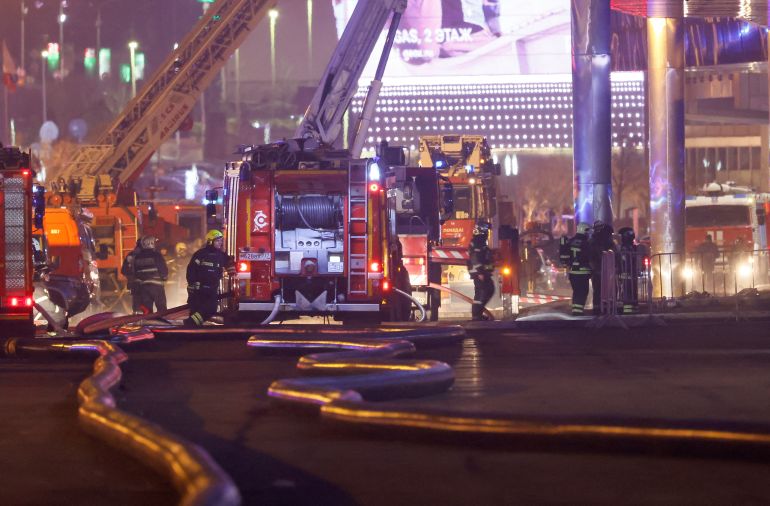 Firefighters work near the burning Crocus City Hall concert venue. The fire was mostly extinguished by early on Saturday morning (Aljazeera)
The Kremlin did not immediately blame anyone for the attack, but some Russian lawmakers were quick to accuse Ukraine.
Former Russian President Dmitry Medvedev wrote on the Telegram app that if those responsible for the attack turn out to be Ukrainian, “all of them must be found and ruthlessly destroyed as terrorists”.
Mykhailo Podolyak, an adviser to Ukrainian President Volodymyr Zelenskyy, denied Ukraine’s involvement.
“Ukraine has never resorted to the use of terrorist methods,” he posted on X. “Everything in this war will be decided only on the battlefield.”
Rosgvardia, Russia’s national guard, said it was searching for the perpetrators of the attack, and its units were helping evacuate concertgoers from the burning building.
Rescue services had evacuated about 100 people from the basement of the Crocus City Hall, but there are still people on the roof, Russian news agencies reported.
Media reports said firefighters were trying to contain the fire, as plumes of black smoke rose above the venue into the night sky. Helicopters were also deployed in an attempt to douse the flames that had engulfed the building.
In the early hours of Saturday morning, authorities said most of the fire had been put out. “There are still some pockets of fire, but the fire has been mostly eliminated. Rescuers were able to enter the auditorium,” Moscow Governor Andrey Vorobyov said on Telegram.
(Aljazeera)







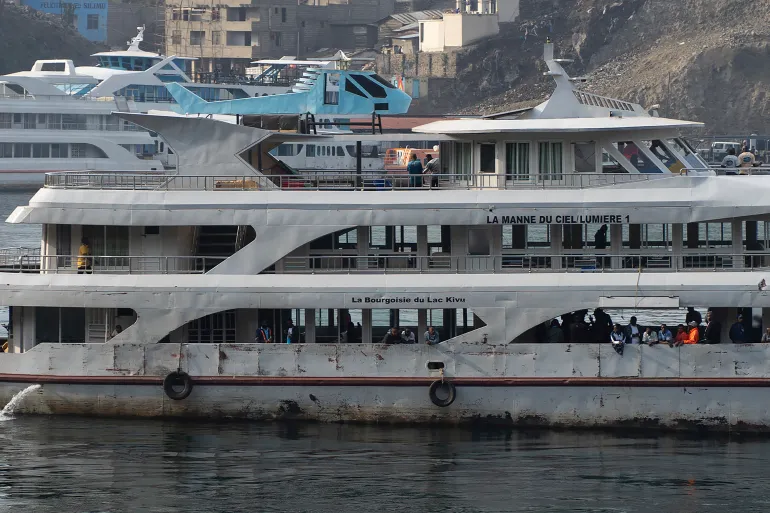
At least 41 people have died, and 49 others have been rescued, after a boat capsized on Lake Tanganyika in the Democratic Republic of the Congo (DRC).
Norris Mulongoyi, the provincial transport minister for DRC’s Tanganyika province, told The Associated Press news agency that search operations were under way to locate the remaining passengers
The boat was reportedly carrying about 100 people and cargo when it capsized near the Congolese village of Mapera.
The vessel was travelling from the port of Kigoma in Tanzania to the city of Kalemie in DRC when it sank on Thursday.
A survivor identified as Annie Moyoni told Radio Okapi, a UN-backed Congolese broadcaster, that passengers were awakened at about 1am and found the boat tilting to one side.
It is unclear what caused the vessel to capsize, but hundreds of people have been killed in boat disasters in the DRC in recent years, according to the AP. Vessels are often overloaded and lack life jackets.
For many in the DRC, travelling by boat is the cheapest and most affordable way to get around. The country is one of the poorest in the world and lacks sufficient infrastructure for its more than 100 million people.
The sinking was the second loss of a Congolese vessel on the Kigoma-Kalemie route in less than a month.
On August 28, the Congolese vessel MV Pacifique caught fire and exploded at the port of Kigoma while loading fuel, according to Radio Okapi.
Six crew members were killed, and a seventh was reported missing, Radio Okapi said, citing port authorities. The vessel operated between Kigoma and Kalemie and was used to transport fuel.
At least 20 people also died when a wooden boat carrying students returning from state exams sank in central DRC in July.
(Aljazeera)
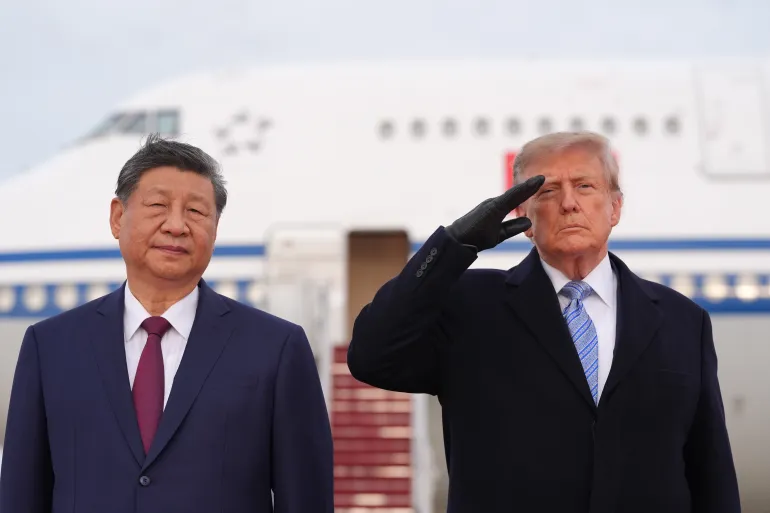
United States President Donald Trump has welcomed Chinese President Xi Jinping as he arrived in the US for a three-day trip focused on issues such as security, trade and technology.
Trump took the rare step of meeting the Chinese leader in person at Joint Base Andrews in the state of Maryland on Wednesday, the first president to do so in recent memory.
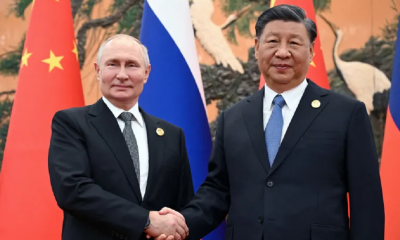
The US president and First Lady Melania Trump greeted Xi and his wife on the tarmac during a welcoming ceremony, where a red carpet was rolled out and the couples exchanged handshakes. Trump and Xi then walked side by side, flanked by US soldiers, before standing for a gunfire salute and the US national anthem
The in-person greeting is a sign of the significance that Washington ascribes to its relationship with Beijing, whose meteoric economic rise over the last several decades has transformed it into a global superpower capable of rivalling the United States.
Despite tense relations that worsened after the Trump administration placed high tariffs on Chinese goods – a move that was met with retaliatory measures from Beijing – Trump has expressed personal affinity for Xi and his desire for strong ties with China.
The Chinese president’s trip to the US will include a state dinner, attended by leaders of the country’s powerful tech industry, a military ceremony at the White House, and a visit to the National Archives, home to documents of historical and cultural significance such as the US Constitution and the Declaration of Independence
But both countries remain wary of the other as they compete for political and economic influence. The trip is likely to include discussion of issues such as the US war on Iran, trade, technology, rare-earth minerals and US ties to Taiwan, the self-governing island that China claims as part of its territory
(Aljazeera)
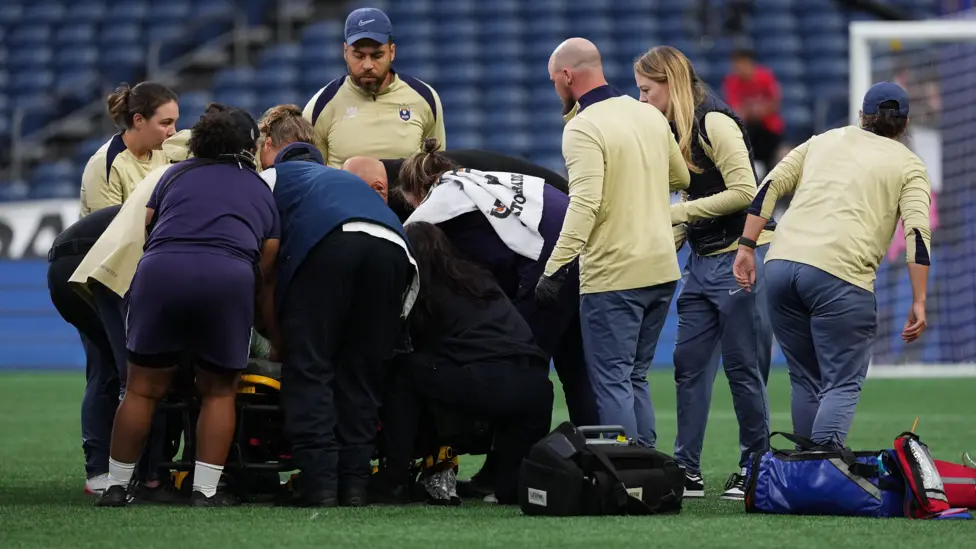
United States women’s national team player Savannah DeMelo is suing a hospital and two doctors after she suffered a cardiac arrest on the pitch last year.
Midfielder DeMelo, who has seven senior caps for the USA, has filed a lawsuit against University of Louisville Health (UofL Health) for negligence.
The 28-year-old, who plays for Racing Louisville, collapsed in the first half of a National Women’s Soccer League (NWSL) match on 14 September 2025.
According to documents seen by BBC Sport, the case was filed on Tuesday morning with Jefferson Circuit Court in Kentucky, where her club is based – a year and a day after her on-field collapse.
DeMelo’s filing claims UofL Health and two doctors, Dr Sarabjeet Suri and Dr Jennifer Daily, “failed to act as a reasonably prudent and competent medical practice, and such negligence was a substantial factor in causing DeMelo to suffer severe physical injuries, including, but not limited to, her cardiac arrest”.
Dr Daily, according to her online UofL biography, is Racing Louisville’s chief medical officer. The lawsuit states DeMelo was under the care of Dr Daily from January 2024 to July 2026.
It states that in March 2025, Dr Daily referred DeMelo to Dr Suri for “evaluation and treatment” after she had been complaining of chest pain, dizziness and shortness of air; Dr Suri obtained a history, performed a physical examination and ordered diagnostic tests.
Nearly six months later, DeMelo suffered the cardiac arrest.
“She was subsequently diagnosed and treated for ventricular tachycardia [an abnormal heart rhythm],” the suit states.
DeMelo, who has spent her entire professional career with Racing Louisville, has not played since her collapse.
In a post to her instagram page on Tuesday, De Melo – who was picked in the USA squad for the 2023 Women’s World Cup and started their first two games – marked the anniversary of the incident.
“A year ago today, while playing soccer, I collapsed due to an undiagnosed cardiac arrhythmia, that caused me to go into cardiac arrest,” she wrote.
“I respect and appreciate the privacy everyone has met me with while going through everything I have this year. I’ll never be able to fully put into words how emotionally hard this year has been. There has been a lot of uncertainty and emotions intertwined with it all.”
[BBC]

Buttler out of Oval decider as Lawrence earns ODI call-up

Showers will occur in the Western, Eastern, Uva and Sabaragamuwa provinces and in Galle, Matara, Kandy and Nuwara-Eliya districts.

Nor’easter brings flooding as New York and New Jersey declare emergency 2 hours ago

Trump rejects Iran deal to reopen Strait of Hormuz in seven days

Govt plans to hire 121,000 state workers, redistribute tax revenue

Parliament clears 22A amid protests

‘Dates have the highest sugar content to fight Coronavirus’

Sunday Island 27 December – Headlines

#SundayIsland 17th December – Headlines

Sunday Island – 28th March

Sunday Island Headlines – 21 March

Sunday Island – 21st February – Headlines
-
 News6 days ago
Hatton youth protest against reported death sentence for Lankan in Saudi Arabia
-

 News4 days ago
Mastermind Naufer Moulavi among 15 found guilty
-
 News5 days ago
Protest against setting up of cement factory in highly populated area near BIA
-
 News6 days ago
Mahaweli rises as heavy rain triggers flood, landslide fears
-

 Latest News7 days ago
Landslide Red Alerts issued to the districts of Kandy, Kegalle and Nuwara Eliya
-

 Midweek Review4 days ago
Thileepan’s fast unto death: An authentic narrative that many missed
-

 Editorial4 days ago
Big Bad Bills
-
Editorial5 days ago
Trouble beginning in earnest