
Latest News
What Hegseth’s comments at Shangri-La Dialogue say about US foreign policy

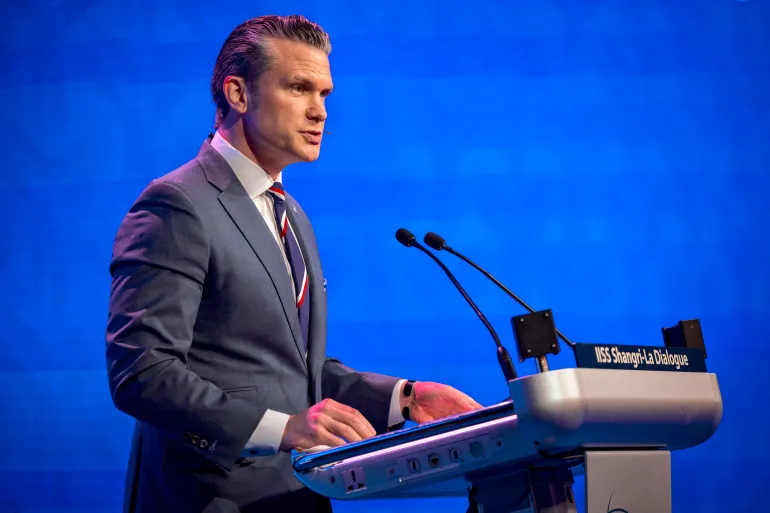
United States Secretary of Defense Pete Hegseth has been discussing key foreign policy issues for Washington at a defence summit in Singapore.
On Saturday at the Shangri-La Dialogue, Hegseth commented on America’s main rival, China, as well as Iran, NATO and Taiwan — a major point of contention between Washington and Beijing.
The US and Israel launched their war on Iran in late February, rattling global markets, triggering an energy crisis and causing shortages of critical US munitions, including Terminal High Altitude Area Defense (THAAD) interceptors, which cost about $12m each.
In a report published on Wednesday, the Center for Strategic and International Studies (CSIS) said it would take two years — and in some cases more than three — to replenish four critical munitions used heavily during the war.
Here are Hegseth’s most important comments.
Beijing is widely seen as Washington’s greatest geopolitical challenge, and Hegseth expressed alarm about China’s growing military presence in the Asia Pacific.
“There is rightful alarm regarding China’s historic military buildup and the expansion of its military activities in the region and beyond,” Hegseth said.
Washington’s latest National Defense Strategy describes China as the world’s second-most powerful country after the US.
Hegseth used his speech to call on US allies in the region to increase defence spending in an attempt to offset China’s growing power.
The defence secretary, who said relations with Beijing were “better” than they had been in many years, warned that unless action was taken, China would become the regional hegemon.
“A Pacific dominated by any hegemon would unravel the regional balance of power,” Hegseth said.
“No state, including China, can impose its hegemony and hold the security or prosperity of our nation and our allies in question.”
Taiwan has been improving its defence capabilities in response to concerns about a potential Chinese invasion. Taiwan, which has never officially declared independence from China, has de facto functioned as a separate country since 1949, despite Beijing viewing the island as its territory.
Earlier this month, President Donald Trump travelled to China to hold talks with his Chinese counterpart, Xi Jinping, who sees Taiwan as the most important issue in China–US relations. Xi told Trump that “clashes and even conflicts” between the two countries could occur if the Taiwan situation is mishandled.
Since then, Trump has cautioned Taipei against formally declaring independence from China, prompting the island to issue a statement saying it was “sovereign and independent” but planned to maintain the status quo.
Following the meeting, Trump said he was not sure whether he would approve an arms sale to Taiwan worth up to $14bn. On Saturday, Hegseth suggested Washington’s commitment to Taiwan remained, but that Trump would ultimately decide whether the weapons deal is finalised.
“Those decisions will depend on the president and the nature of that relationship. There’s been no change in our status,” Hegseth said.
Trump has long pressured allies to increase their military budgets and become less dependent on US firepower under his America First doctrine.
Trump has recently confused European allies after announcing he would deploy a further 5,000 troops to Poland, despite having recently pledged to reduce the number of American soldiers on the continent.
It remains unclear whether the deployment to Poland includes the same troops the Pentagon said would no longer be stationed in Germany.
“The era of the United States subsidising the defence of wealthy nations is over,” Hegseth said.
“We need partners, not protectorates. We don’t have a strong alliance unless everyone has skin in the game. No freeloading.”
Hegseth also discussed Iran — a key issue for much of the world as well as the US. Tehran and Washington are believed to be close to signing a memorandum of understanding to bring the war to a permanent end.
Hegseth, who has played a key role in the US-Israeli war on Iran as defence secretary, warned that the US would resume attacks on Iran if a satisfactory deal isn’t reached.
His comments come as Washington seeks to reassure allies that the Strait of Hormuz — which Iran closed at the start of the war in a bid to deter US and Israeli attacks — will soon be reopened, helping to bring down energy prices. About 20 percent of the world’s oil and liquefied natural gas flowed through the crucial waterway prior to the conflict.
[Aljazeera]


The Rose Bowl, which has been awarded to the winner of ODI series between the women’s teams of Australia and New Zealand since 1985, has now been expanded to include T20Is as well.
New Zealand’s three match T20I tour of Australia, which begins on Sunday at the North Sydney Oval, will be the first T20I edition of the Rose Bowl. The teams will get to face off again for the trophy in March 2027 when they meet again for three ODIs, also in Australia.
For Rose Bowl series that include matches in both white-ball formats, the trophy will go to the team with the most wins overall. In case of a drawn series, the current holder will retain the trophy.
“The Rose Bowl is a prestigious trophy that holds a lot of meaning to current and past players, and it’s a series we’ve always taken a lot of pride in competing in,”Catherine Campbell, NZC’s chief cricket operations officer and a former New Zealand player, said. “With so much T20I cricket now being played, this is a brilliant opportunity to keep the Rose Bowl relevant and to build on the history between us and our Australian rivals.”
New Zealand captain Melie Kerr was excited by the broadening of opportunities to compete for the Rose Bowl.
“We’re all aware of what the Rose Bowl represents and the importance it holds in the White Ferns whakapapa [genealogy],” said Kerr. “Great players and teams have fought for it over the years and we’d love the opportunity to claim our own piece of that history.”
Australia have held the Rose Bowl continuously since wresting it back from New Zealand in 2000. Since that 3-0 win, Australia have won 18 times with one series – in 2008-09 – shared 2-2. Overall, Australia have won 26 of the 31 ODI series played for the Rose Bowl, with New Zealand winning three times and three series drawn.
North Sydney will host all three T20Is of the upcoming Rose Bowl series, on October 18, 20 and 22.
[Cricinfo]
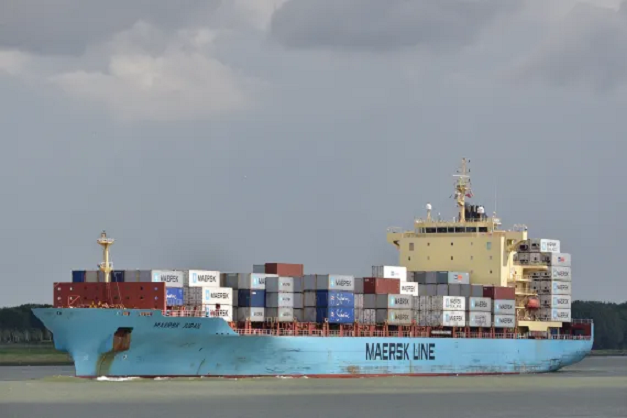
US President Donald Trump claims the US Navy’s “effective” blockade has stopped all Iranian ships from crossing the Strait of Hormuz.
Iran’s Islamic Revolutionary Guard Corps (IRGC) navy says a supertanker carrying more than two million barrels of crude oil has struck a sea mine while attempting to cross the Strait of Hormuz through an “unauthorised” route.
The collision caused a huge explosion and a major fire on board the vessel, the IRGC said in a statement reported by semi-official Tasnim news agency.
It alleged that the tanker had turned off all tracking and radar systems, attempting to pass through the strait using deception and with US military support.
‘The Strait of Hormuz is closed’, the IRGC navy warned, adding that vessels violating Iranian regulations would face severe consequences for relying on US backing.
[Aljazeera]
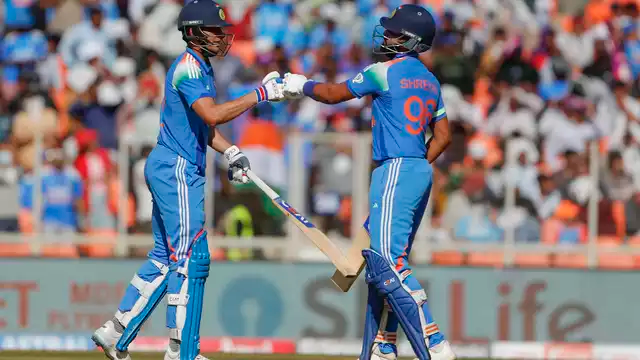
Squad for the first three ODIs: Shubman Gill [C], Rohit Sharma, Virat Kohli, Shreyas Iyer [VC], KL Rahul [WK], Nitish Kumar Reddy, Axar Patel, Naman Dhir, Anshul Kamboj, Gurnoor Brar, Ruturaj Gaikwad, Arshdeep Singh, Ishan Kishan [WK], Mohammed Siraj, Prasidh Krishna*, Kuldeep Yadav
Squad for fourth and fifth ODIs: Shreyas Iyer [C], Rohit Sharma, Virat Kohli, Tilak Varma, Ishan Kishan [WK, VC], Nitish Kumar Reddy, Axar Patel, Naman Dhir, Auqib Nabi, Gurnoor Brar, Ruturaj Gaikwad, Arshdeep Singh, Kumar Kushagra [WK], Mohammed Siraj, Yash Thakur, Kuldeep Yadav
[Cricbuzz]

Review of progress in reforms and modernisation of key state revenue-collecting institutions

Rose Bowl expanded to include Australia vs New Zealand T20Is

Trump claims US Navy blockade stops Iranian ships in Hormuz

Showers above 75 mm are likely at some places in the Western, Sabaragamuwa, Central and North-central provinces and in Trincomalee and Mullaitivu districts

Cut power bills by 3-5%, don’t hike them, consumers demand

Asgiri Mahanayake calls for immediate release of Gnanasara Thera

‘Dates have the highest sugar content to fight Coronavirus’

Sunday Island 27 December – Headlines

#SundayIsland 17th December – Headlines

Sunday Island – 28th March

Sunday Island Headlines – 21 March

Sunday Island – 21st February – Headlines
-

 News6 days ago
Sri Lanka escalates anti-graft drive with Shiranthi’s jailing
-

 Latest News5 days ago
Farhan and Sadaqat help Pakistan seal series in style
-

 News6 days ago
Iranian ships stranded, Lanka fears US sanctions
-

 Latest News4 days ago
Nissanka’s return headlines Sri Lanka’s Test squad against Pakistan
-

 Features5 days ago
Intake 16: 45 years of duty and honour
-

 News5 days ago
Malwathu Chapter issues statement on talks with President over Gnanasara Thera’s robes
-

 News6 days ago
Navi Pillay’s Lankan affairs in focus as she wins 2026 Nobel Peace Prize
-

 News5 days ago
CP alleges NPP has taken the blame for illegal US sanctions on Iranian vessels