
Features
Relations with US authorities and with gentleman-Minister Gamani Jayasuriya

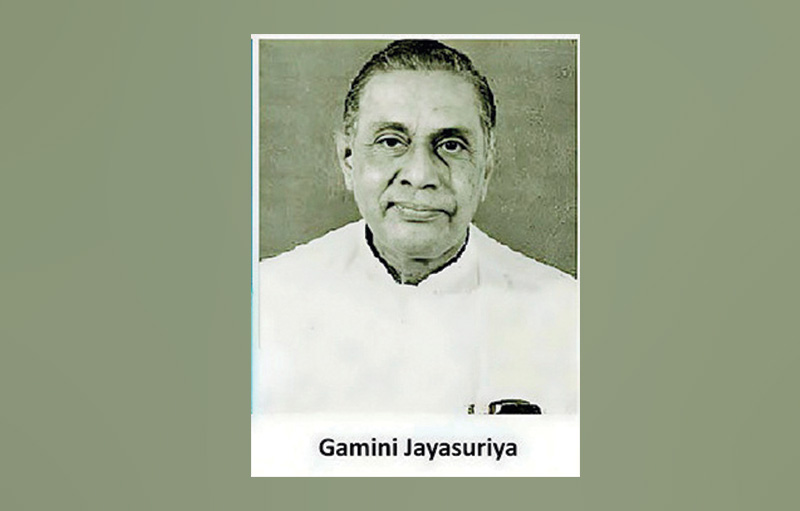
Irritable minister was trying to give up smoking
Now I turn briefly to the overall relationship that we had developed with the United States Department of Agriculture and other US governmental and non governmental authorities on the important aspect of ensuring wheat shipments to Sri Lanka, under aid programs. During the course of handling my responsibilities as Secretary Food, I had to travel to Washington many times. During these visits I was able to establish valuable personal contacts, in the relevant US departments and agencies. It helps both sides to know whom they are dealing with. If the relationship develops, it usually evolves towards a considerable degree of friendship, understanding and trust.
The foundation and basis is always mutual respect. When you deal with people at high levels of government in other countries, your own designation however impressive it may be is only of limited value, unless it is backed by uptodate and relevant knowledge on your subject area, experience, communication skills, wide interests and the ability to talk about them, and above all, credibility. It is only on these bases that you could establish relationships with able and sophisticated people.
I have had meetings and discussions with relevant persons in the State Department, Agency for International Development (AID), and the Office of Management and Budget (OMB) and above all, with several officials in the Department of Agriculture (USDA.) There was an occasion where I had to go right up to the White House, about which I will write later. During these meetings, it was possible to establish considerable personal rapport, which in turn led to benefits for the country.
We received enhanced allocations of aid to purchase wheat under PL 480. This took pressure off our foreign exchange resources, and assisted the process of ensuring food security. Some of our Ambassadors in Washington during this time such as Ernest Corea and Susantha de Alwis, who served for a fairly long period were consistently helpful. The fact that they were able people who knew a wide circle of important persons, and enjoyed credibility and respect was immensely helpful.
The fact that during that period our teams to Washington which included officials from the Food Ministry, Food Department and the External Resources Department of the Treasury were all carefully chosen and consisted of able people gave us a great advantage. US officials have told us as well as our Ambassadors and on at least one occasion, I know of, the State Minister for Food that they regarded the way we conducted business as a model which they hoped other countries would emulate. All this led to the creation of a fund of goodwill and considerable respect.
There were many occasions therefore that US officials went out of their way to be helpful. I would like as an example to refer to just one such instance. This also illustrates how developing personal relationships matter. Over a couple of years I had developed a degree of friendship with a high official of the Department of Agriculture. During our meetings, we discovered that we had an intellectual interest in history. We enjoyed spending some time, both officially and socially, when we had dinner together, discussing various eras, aspects and trends in history.
This led to our exchanging books on history. He sent me a book dealing with historical trends and I sent him two paper back books Professor E.H. Carr’s “What is History?” and Professor Herbert Butterfields “The WhigInterpretation of History.” We had also talked about our families, children and so on. On one occasion when I was in Washington and called on him in his office, after the preliminary exchange of pleasantries, he announced that he had something like an extra 12 million dollars left over under the PL 480 program, due mainly to the delay in some countries acting on the allocations given to them. “Everyone is not as efficient as you are,” he said. I thanked him and quickly asked “Don’t you think it would be fair to reward efficiency?”
He said “I take your point. But naturally I can’t give you the entire amount. I will have to deal with some other countries too.” I said “Look, I am very grateful that you told me of this availability. You need not have done so at all. You know all about us. I will therefore leave it entirely to you to give us whatever you could. It will be a great help.” He thought for sometime and said “I will give you the maximum I can – US dollars 5 million.”
I thanked him most sincerely. I was indeed grateful. I kept in touch with him whenever I could even after I left the Ministry. On one occasion, when I was Secretary to the Ministry of Education and Higher Education, I had to travel to another country, and I discovered by accident that my friend was working in the US Embassy there. I telephoned the Embassy to talk to him and also see whether we could get together to have a meal. But unfortunately he was out of the country, and I had to make do with leaving a message.
We had also built excellent relations with the US Wheat Associates, the influential apex body of US wheat farmers. They had been extremely helpful in trying to obtain for us the maximum possible allocation under PL480. Our relations were so good that they invited me to attend one of their special Board meetings in Honolulu, Hawaii and deliver one of the keynote addresses at the convention of National Wheat Growers.
The authorities at the time took an enlightened approach to this kind of invitation, not regarding it as a mere trip abroad, but as an honour which should be accepted. They had the wisdom to see that the relationships built at these high levels would prove to be very useful to the country. I particularly say this because many are the times I have seen Ministers merely engaging in simple arithmetic just counting the number of times a public servant had gone abroad, instead of seriously pondering issues of relevance and value. This is not to say that public servants do not try to go abroad whenever a chance appears. Some of them certainly do. What I am commenting on is trivial bean counting and the absence of mature judgment.
Wider exposure
These visits to the United States also gave me a wider exposure, because our Ambassadors and other senior embassy officials generally, all of whom I knew very well, often discussed many issues with me and sought my views. Sometimes, if I had a free slot which coincided with one of their important meetings with high US officials, they invited me to go along with them. I remember one such occasion where Ambassador Corea took me to a luncheon meeting with some senior State Department officials, which included a previous Ambassador to Sri Lanka. Ambassador Ben Fonseka, our Permanent Representative at the UN, flew in from New York for this meeting.
When we met at the International Club in Washington, I could see that the atmosphere was warm, informal and friendly. During the introductions and the bantering before we sat down, I too entered into the spirit of the occasion and told the Americans, “Gentlemen, the Portuguese delegation has arrived.” There was loud laughter, because the three on our side were Corea, Fonseka and Pieris. Once the bantering was over, we got down to lunch and serious discussions. I saw that this was a professional discussion by experienced professionals. Much ground was covered during a relatively short period of time without visible or felt strain. An underlying thread of good humour permeated the whole proceedings. The place where the lunch was held, the International Club, was a very exclusive place. Membership usually cost around US Dollars 19,000. Fortunately, Ambassadors accredited to Washington were given honorary membership.
On some of these visits to Washington I also had the pleasure of meeting Ambassador Chris Van Hollen and his wife Eliza. I had a standing order from Chris that I was not to come to Washington and go without contacting him. Once I had lunch with them at their home in Virginia. But most times Chris used to take me to the Cosmos Club on Massachusetts Avenue, another one of those exclusive clubs in the area. At the time it was a club exclusively for men, although the process was on to admit women. Membership was strictly confined to professionals of a certain intellectual calibre holding positions in various areas such as administration and management; diplomacy; other professions such as law; medicine; etc., and academia.
I was taken round the club by Chris. The library devoted a special section to books written by members of the club, and a corridor contained the portraits of Nobel Prize winning members of the club. It was that kind of exclusive club. It was elitist. But it was an elitism not based on an aristocracy of birth, but an aristocracy of achievement. The club also ran an excellent restaurant, and at one of these lunches I was introduced by Chris to Jim Spain, Ambassador designate to Sri Lanka, who was awaiting confirmation by the Senate. These extra experiences were very enriching and added both to knowledge and perspective.
Relations with Minister Gamani Jayasuriya
The relationship of senior officials to ministers is a subject much talked of as well as written about. I propose to deal with this important area analytically, amongst other important issues of governance in a concluding chapter. At this point however, I wish to refer to my relationship with Minister Gamani Jayasuriya. He was a man of principle and a gentleman. At the time I worked with him, he held two portfolios, the one of Agricultural Development and Research, and Food and Co-operatives. I was his Secretary in the latter Ministry, whilst Mr. N.V.K.K. Weragoda was Secretary in the former. The Minister worked from both Ministries, although at times, for the sake of convenience, he used to get down relevant officials from one Ministry to the other.
Mr. Jayasuriya was responsible and conscientious in his approach to his duties, and made certain that he understood everything of importance, in the same manner as one of his outstanding predecessors, Mr. M. D. Banda. Like Mr. Banda and Mr. S.B. Herat, he did not interfere in appointments or disciplinary matters. He had confidence in his officials and expected them to do the right thing. Just to cite an example, there was once heavy pressure on him from Members of Parliament of his party to intervene in the appointment of Co-operative Inspectors. They wanted him to interfere in the results of the examination and appoint their favourites, based on the argument that they possessed the basic qualifications.
Mr. Jayasuriya steadfastly refused to interfere. After one meeting with him, angry MPs were seen leaving his room in Parliament severely criticizing him. One of them was overheard to say “How can we work with Bodhisatvas?!” He obviously wanted to safeguard basic principles. I recall walking into his room when he was with his constituents and hearing him say that he was prepared to recommend someone if deserving, but that he was not prepared to go further and exert pressure on the appointing authorities to take the person.
An argument
Temperamentally, Mr. Jayasuriya differed somewhat from my previous Minister, Mr. Herat. Mr. Herat had a very equable temperament, and found it difficult to get angry. Mr. Jayasuriya, on the contrary demonstrated at times, a peculiar mixture of affability and irritability. He was jovial at one moment, and quite testy at another. Unfortunately one day, I ran into him when he was in one of his testier moods. I happened to walk into his room in the Food Ministry one evening at about 5.30 p.m. because I had something important to discuss. As I entered, he half glared at me, and before I could say anything, proceeded to give me an order on some matter, in a peremptory tone.
His tone and manner caught me by surprise and irritated me. But more than that I saw several harmful implications in carrying out his order. Straightaway, I could think of at least two other options that were safer and better. There could have been more, if only there was time for reflection. I started to politely tell him that there were some better options, but he interrupted me halfway and with suppressed anger said “You carry out my order,” and muttered something about “bureaucracy,” under his breath.
Now I am afraid, I lost my temper. I was as an official and a person, diligent, responsible and hardworking. I was a senior Secretary. I believed that whatever appointments I got in government was due to nothing else but my own record of performance. I was beholden to nobody. Mr. Jayasuriya’s tone and manner therefore hurt, upset and angered me. I was quite charged up by now. The last time I lost my temper with a Minister was with Mrs. Bandaranaike, an event which I have recorded in an earlier chapter.
I sat down, facing him. I told him that with every passing day, I saw very little difference between Ministers and bureaucrats, because Ministers were usurping the powers and doing the work of bureaucrats; that I had a duty as his Secretary to advice him; that a duty could be pleasant, unpleasant or neutral , that on this occasion although it was unpleasant, I was still going to discharge it and say that there were much better options, two of which I quickly mentioned. The Minister was red in face gritting his teeth and speechless. I then got up and began walking towards the door saying “Now that I have discharged my duty, I will go and carry out your order.”
As I opened the door, he bellowed “Do any damned thing you want.” This of course meant that the force of what I had said had struck him and that he was prepared to reconsider. But he was very angry. By the time I came to my room, my anger had gone, because I have had my say. But I was feeling deeply upset, and guilty that I had lost my temper, which I had no business to do. There was no question, I had lost control and I was now more upset at this failure on my part, than the Minister’s tone and manner, which had triggered off this unfortunate incident.
There was nothing one could do now. What was past was past. The Commissioner of Co-operative Development, Mr. Austin Fernando was waiting for me in my room to discuss some matters. Shortly after I started talking to him, the Minister’s office-aide came in and said that the Minister had left. This was standard practice. The Secretary is usually informed when the Minister comes in, and goes out. I continued my discussion with the C.C.D, when towards 6.45 p.m. my “Hot line,” or the security telephone hooked up to a special exchange rang. It was the Minister.
“I say, Dharmasiri, I lost my temper. I am sorry,” he said. I said, “Sir, I lost mine too, and I am very sorry.” “You know, I have been trying to give up smoking over the last few days, and it is making me irritable,” Mr. Jayasuriya went on. I promptly replied “Sir, if it would help you to stop smoking, you could blackguard me everyday.”
He laughed, and the day ended on this note of amity, but not before I related the story to a curious Mr. Austin Fernando, who overheard this telephone conversation. This happened to be a Monday, and the next day Tuesday, we as usual had the Secretaries meeting at 8.30 a.m. in the Cabinet office. Dr. Malinga Fernando, who was Secretary to the Ministry of Health, walked up to me and said “So, your Minister apologized to you yesterday.” I was mystified as to how he knew. But it turned out that both of them had been at dinner together that night, where the Minister had related this story. That was the gentleman that Mr. Jayasuriya was.
(Excerpted from In Pursuit of Governance, autobigraphy of MDD Pieris)


by Rajan Philips
Down but not out may be too uncharitable a way to describe a global agency that was launched with lofty expectations 81 years ago, and has just entered its ninth decade of existence with more forebodings than promises. The precarity of the UN’s circumstance is also a reflection of the crassness of its chief benefactor, the United States of America under its current president. Stellar American Presidents Franklin Roosevelt and Harry Truman, both Democrats, led their country to virtually bankroll the formation of the UN after World War II. President Truman handpicked his predecessor Franklin Roosevelt’s widow and turn-of-the-century President Theodore Roosevelt’s niece, the highly accomplished Eleanor Roosevelt, to spearhead the drafting of the UN Charter of Rights. That was the beginning of the era of human rights in human history. That was also the early stirrings of the civil rights era in American history.
From the plenitude it projected in 1945, America has fallen to the pits under its current President Donald J. Trump. The sight of his arriving at the UN with Melania Trump as First Lady, who may know little or nothing about Eleanor Roosevelt, the greatest First Lady that America has had, says all about everything that is wrong with the US and its fallout for the UN. After Americans elected Trump to a second term as President, the fear of Trump pulling the US out of UN always loomed large. More so, in the wake of Trump-ordered withdrawals from UN agencies and the ungenerous defunding of US Aid programs. Last year at its 80th anniversary, UN insiders were wondering whether the agency had the wherewithal to keep going. In January this year, there were fears of an “imminent financial collapse.”
But nothing untoward happened. Trump did not pull US of the UN. Instead, the Trump Administration gave a financial breather by making a part payment of $725M out of a total $2.0 billion outstanding US dues to the UN. A further $102M was added to support UN peacekeeping. The payments were made a week before the Annual Sessions, perhaps as the US President’s voluntary entrance fee to address the General Assembly. The truth of the matter is that Trump needs the UN forum to validate himself, at least to his base in his own country.
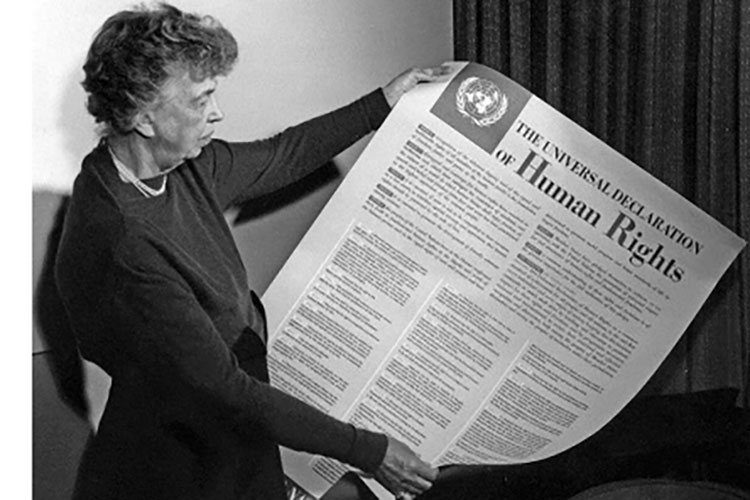
Eleanor Roosevelt with the UN Human Right Charter she helped draft
His own actions overseas throughout 2026 – in Venezuela, in Iran and the Middle East, and on Greenland, not to mention his global tariff war or his bully-thy-neighbor bearing towards Canada – have forced him to show up and make his case at the UN, to his own satisfaction. The assembly hall was virtually full for his speech but it persuaded no one except his own entourage and the delegates from Israel. The same could be said of Israeli Prime Minister Benjamin Netanyahu, who braved the ICC (International Criminal Court) arrest warrant against him to show up at the UN. Unlike during Trump’s speech, UN delegates left the hall in droves as Netanyahu arrived at the podium.
Besides the two notorious attendees, there were powerful absences this year, including China, India and South Africa, the heavyweights of the Global South and three of the five founding members of BRICS (Brazil, Russia, India, China and South Africa). But none of them would wish the withering away of the UN, the way Trump and Netanyahu may entertain thoughts about a world without the UN. Even so, Trump has not precipitously pulled the US out of the UN in the first two years of his second term, and he does not have much time left to do any serious damage to the agency in the future.
Not only time, but also power is running out of Trump’s executive grasp. All indications are that Trump and the Republican Party will likely lose control of both the House and the Senate in the November midterm elections that are barely 20 days away. Even if Democrats do not win control of the bicameral Congress, the Trump Administration is already in disarray, and his Maga base is cracking up with infighting among wannabe Trumps.
What seems to be hitting home almost all Americans is the extent of first family corruption that has been growing exponentially during Trump’s second term as president. Trump’s personal fortunes have allegedly expanded by $2.2 billion in 2025. It is this barefaced moneymaking from the White House that is angering American citizens and raising expectations of a landslide electoral rebuke in November.
UN’s Predicaments
Even though Trump’s powers are waning and his threats are receding, the UN’s own circumstances are not getting any better. Its challenges involve both global turmoils that the agency has to deal with, as well as organizational weaknesses that impair its effectiveness and its influence over member countries. “Restoring Trust, Managing Transformations: A United Nations That Delivers for All,” is the agency’s official theme for its 81st year. The theme is more organizational than achievement oriented. On the eve of the 81st Anniversary, the US Statement Department declared on its website a goal of its own for the UN: “at this year’s session, the United States is pursuing one clear goal: delivering prosperity through peace, by bringing the UN “back to basics.”

Trump and Melania arriving for the last UN General Assemby
Back to basics, whatever that might mean, has long been an American refrain for the UN. Under Trump and Secretary (of State) Marco Rubio, it has taken the form of an ideological fight against the so called global left elitists. The General Assembly sessions this year grappled with a range of issues, including climate change, AI threats, the Russia-Ukraine war and the US-Iran war, the tragedy of Gaza, and the elusive two-state solution for Israel and Palestinians.
The climate change and AI crises are manifestly 21st century addons, all the others are new manifestations of old problems – as old as the UN itself. What is remarkable is that Trump has placed his villainous stamp on every one of these issues, and has contributed nothing to positively resolving any of them. When the principal superpower goes rogue there is little that a global agency like the UN can do to contain the fallout.
Yet the world cannot be without an organization like the UN. Almost all countries and their leaders would like the UN to continue even if only a few of them would be inclined to abide by its decisions. In fact, the world needs a stronger UN and not a weak UN. That was the message of the departing Secretary General António Guterres in what was his last speech to the General Assembly. “The world does not need a weaker United Nations,” said Secretary Guterres, “it needs a U.N. strong enough to face the world as it is — and determined enough to build the world as it should be.”
Mr. Guterres will be leaving the UN on December 31, 2026 after completing two five-year full terms in office. The search for a new Secretary General to succeed Mr. Guterres has begun but early signs are that there is no immediate consensus candidate to succeed him. The UN Secretary General (UNSG) is the de facto head of the organization, and is appointed for a term of five years by the General Assembly on the recommendation of the Security Council. The five permanent members of the Security Council can exercise their veto on a candidate, while no citizen of theirs can be a candidate for the position.
The eventual appointee has always been a compromise candidate from on of the ‘middle powers’ or smaller countries. In general, candidates who are first appointed with grudging unanimity often get their second term approved with generous unanimity. While there is no term limit on a Secretary’s tenure, incumbents have avoided going beyond two terms since the 1981 vetoing by China, of the third term bid by Austria’s Kurt Waldheim. And the only Secretary General to be denied a second term was Egypt’s Boutros Boutros-Ghali thanks to American vetoing in 1996.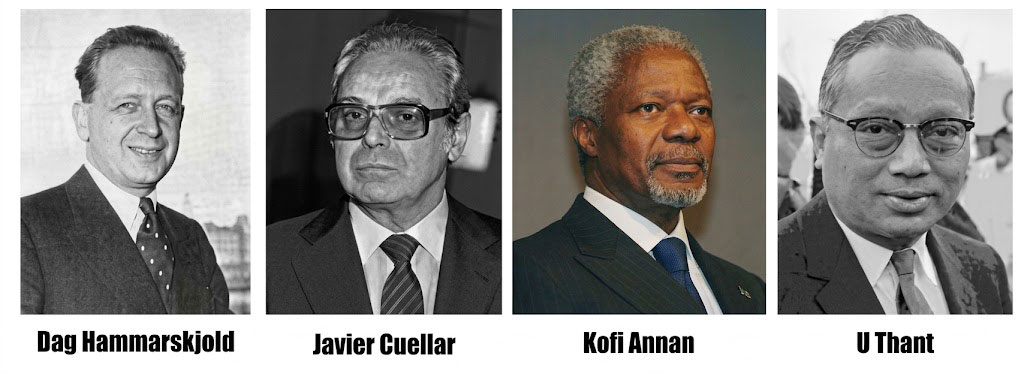
Finding a Secretary General
Since 1997, the SG appointments have been following a rotational system to give representation to the UN’s five regional groups: African Group, Asia-Pacific Group, Eastern European Group, Latin American and Caribbean Group, and Western European and Others Group. Although the principle of gender equality is acknowledged, so far no woman has been appointed as Secretary General. It has been a long wait, considering the role played by a woman, Eleanor Roosevelt, in the setting up of the UN charter enshrining gender rights, among others.
Secretary General António Guterres is the ninth Secretary General that UN has had since its inception 1945. He is the fifth UNSG from a European country – after Britain’s Gladwyn Jebb who started the list; Trygve Lie of Norway; the illustrious Dag Hammarskjold of Sweden whom President Kennedy called “the greatest statesman of our century,” after his plane crash death in Rhodesia (now Zambia), in 1961, which was also attributed to the CIA by global rumour; and Austria’s Kurt Waldheim.
Hammarskjold was succeeded by Burma’s U Thant who became the first non-European and first Asian Secretary General. Waldheim succeeded U Thant, and after Waldheim it was Latin America’s turn with the appointment of Javier Perez de Cuellar in 1982. Cuellar was followed by Egypt’s Boutros Boutros-Ghali, whose successor was Ghana’s Koffi Annan, the first UN insider to become the Secretary General. After Koffi Annan it was South Korea’s Foreign Minister Ban Ki-moon. António Guterres, who succeeded Ban Ki-moon, had been Prime Minister of Portugal (1995-2002) and is the first head of government to become UN Secretary General.
António Guterres’s main legacy may well be that he was the world’s most persistent voice on climate change. In an interview he gave Fiona Harvey, Environment Editor of the Guardian (September 22), he said as much while admitting that ‘voice’ is all that a UN Secretary General can muster as the office “has not much power, and there is no money.” He went on, “it is my duty to use that voice without any compromise, to tell the truth and to alert the international community to the dangers it faces. I have not the power to all of a sudden make everybody invest in renewables, but I have the duty to tell people that unless we accelerate from fossil fuels to renewables, unless we drastically reduce emissions in the next decade, we will be facing dramatic problems that will impact on the whole of humankind.”
An Electrical Engineer by profession and a former leader of both the Socialist Party of Portugal and the Socialist International, Guterres has no qualms about calling regressive spades for what they are: “There are vested interests that are interested in maintaining the present development model based on fossil fuels. You have a systematic campaign that is strongly financed by the huge profits of the sector that tries to divert attention [from] the impacts of fossil fuels.”
Although he has not been able to achieve much, Mr. Guterres’s legacy on climate actions will be a hard act to follow for his successor. Going by UN’s rotational system, this time it is the turn for someone from Latin America or the Caribbean to be appointed as Secretary General. The prospect of a fellow head of government, former Chilean president and UNHRC High Commissioner Michelle Bachelet, succeeding Guterres has been blown out of the water by US veto threat.
That leaves seven candidates contending with varying levels of support and veto threats in the Security Council. Four of them are women: Rebeca Grynspan, 70 year old Economist, former Vice President of Costa Rica, and current head of the U.N. Conference on Trade and Development; Ms. Rodrigues-Birkett, 53, Guyana’s former Foreign Minister and UN Ambassador since 2020; María Fernanda Espinosa, 62, former Foreign Minister and Defense Minister of Ecuador, as well as UN Ambassador; and Ivonne Baki, 75, another Ecuadorean politician and diplomat, as well as the country’s first female ambassador to the United States, to France and Qatar.
The three male candidates are: Olara Otunnu, 75, an Ugandan politician and diplomat, and a former UN under secretary general to Kofi Annan; Rafael Grossi, 65, Argentinian career diplomat and head of the International Atomic Energy Agency, who has played a prominent role in the monitoring of Iran’s nuclear program and nuclear spill threats in Ukraine after Russian invasion; and Macky Sall, 64, a Senegal President and Prime Minister.
There is no clear front runner, but Costa Rica’s Rebeca Grynspan and Guyana’s Rodrigues-Birkett would seem to be garnering the most support in the Security Council. At long last, UN may have a female Secretary General. But the political world is more likely transfixed with the November midterm elections in the US and their fallout for the Trump presidency, than being concerned about the next UN Secretary General. Any fallout for the Trump presidency will have implications for the world and the United Nations. The implications will not amount to a swift reversal of all the follies of Trump and return to pre-Trumpian normalcy. Rather they would slow down and avoid further dismantling of the world order and its agencies which did not seem possible even as recent as a year ago.
From The Pathfinder Collection
By Jennifer Moragoda
jennifermoragoda@sltnet.lk
Let There Be Light
At Lunuganga, Geoffrey Bawa’s country home, a stone bishop stands along the passage from the entrance vestibule, crozier in hand and apparently illuminated from nowhere. Look up and the source reveals itself: a small angled shade, painted white and cut precisely to throw its beam down onto the figure. Channa Daswatte, Bawa’s protégé, told me that it was, in fact, fashioned from a sardine tin—a juxtaposition with the saintly figure that makes the joke all the more irreverent.
Bawa was also an avid collector of beautiful and unusual objects, and among those at Number 11 sits a well-weathered old breudher pan. Its dark, pitted lid contrasts with the worn coppery tones of its spiral-fluted body. The heavy, broad lid, the elegant fluted body perched on long, slender legs, and the small protuberance at the centre of the lid give it an unusual and distinctive appearance, whose logic becomes clearer when the lid is lifted to reveal the tall central column beneath.
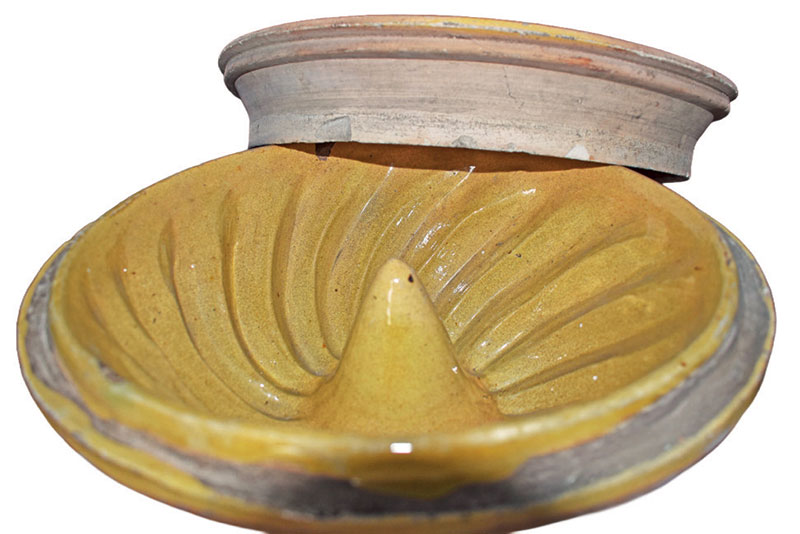
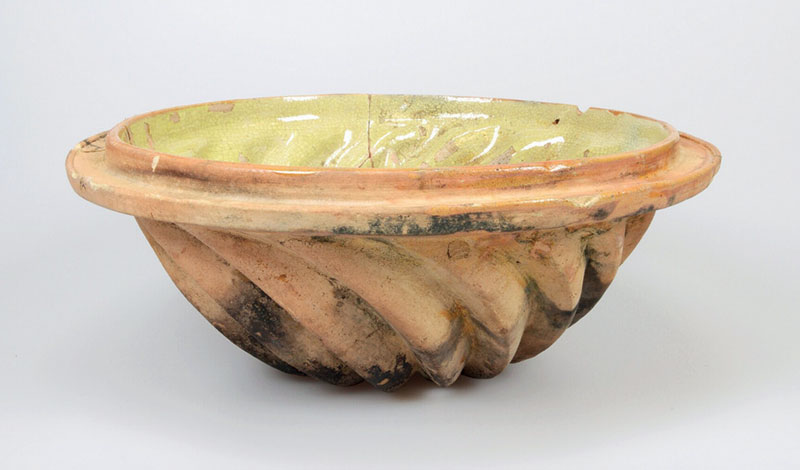
Dutch earthenware broeder mould with lid An earthenware broeder mould with its lid, from the collection of Oudheidkamer Texel, the Netherlands, object OK-0726. The swirled flutes and central cone gave the cake its shape. Its closed cone sits below the rim, allowing the lid to seal the mould for cooking in boiling water. Photograph: Oudheidkamer Texel.
In Pettah, the old quarter of the city, the Dutch Period Museum holds another breudher pan, dating to about 1750–1800. Labelled simply as a “cake mould”, it is identified by Lodewijk Wagenaar in Cinnamon & Elephants as a broeder pot made of copper and tin. It follows the same essential logic as the Bawa vessel: a deep, fluted pan with a tall central column projecting above the rim and three sturdy legs. Unlike the Bawa pan, two prominent curved handles rise from either side and its rectangular legs are much heavier. Seen from above, its broad scalloped rim forms a distinctive petalled outline.
Though the museum vessel survives without a lid, its broad upper flange could have accommodated one. If so, the arrangement would have differed from the Bawa pan: the upturned handles would have prevented a cover from fitting down over the outer lip in the same way. They may have helped steady one from either side. The details differ, but the essential features remain the same.
The provenance of these two vessels remains uncertain. Wagenaar does not mention where the Dutch Period Museum pan was made, although he notes that broederpannen occur repeatedly in eighteenth-century Ceylonese inventories and auction records. His research also shows how easily objects travelled through the Dutch maritime world: goods moved between Holland, Batavia, Ceylon and the VOC settlements of coastal India, while European and Eurasian households acquired characteristically Dutch utensils locally at auction. Their presence in Sri Lanka tells us where they were used and valued, but not necessarily where they were made.
-
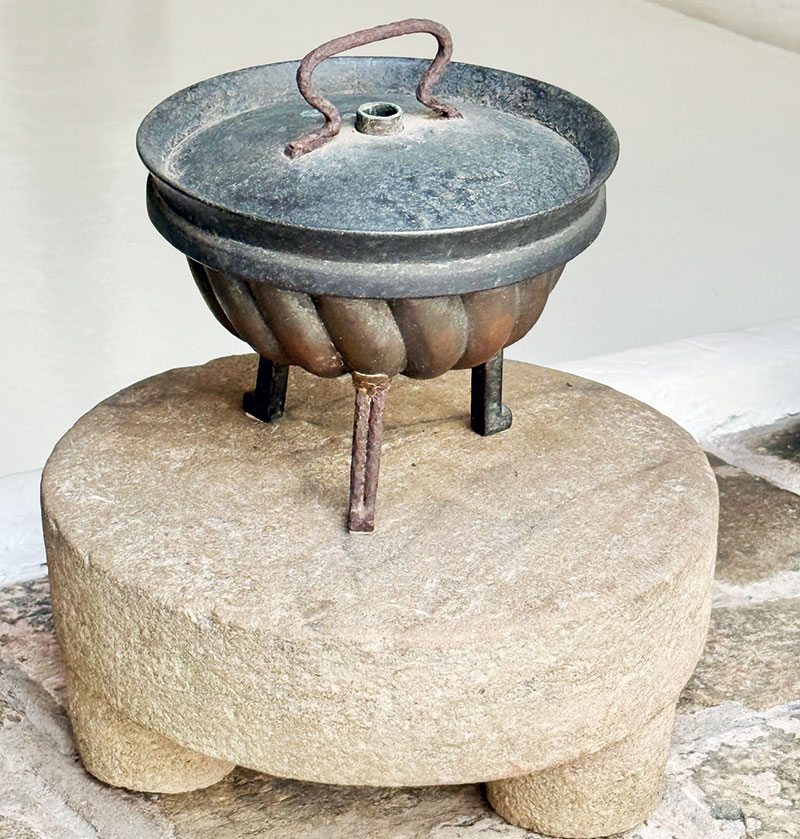
- Bawa’s breudher pan, closed With the heavy lid in place, the central chimney is concealed. Photograph by Jennifer Moragoda
-
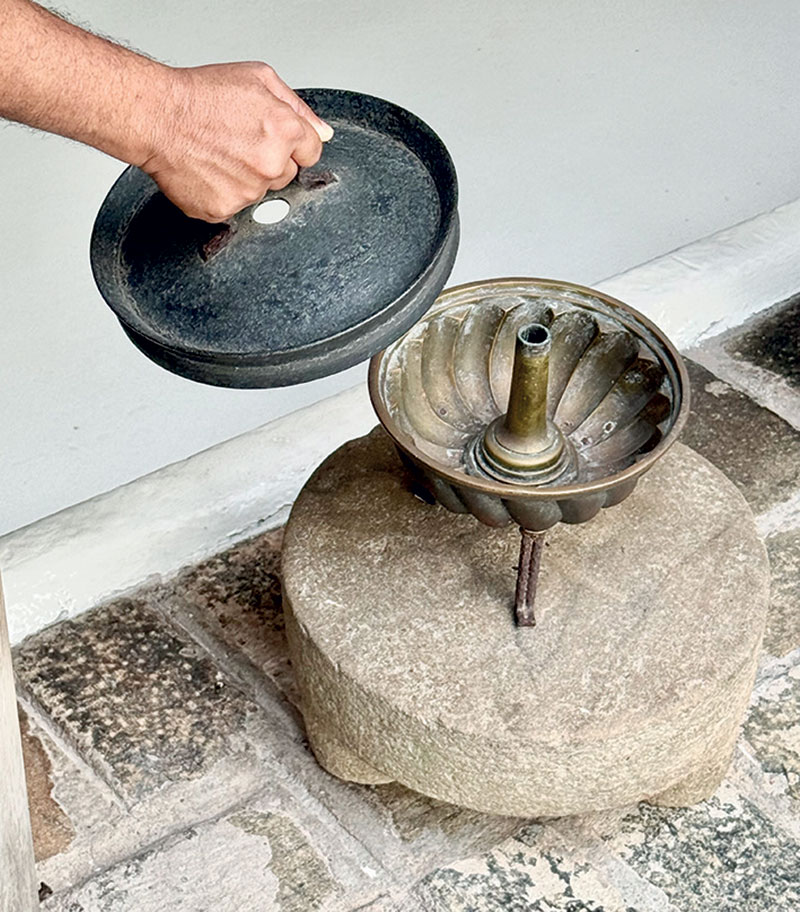
- Bawa’s breudher pan, open Geoffrey Bawa’s breudher pan at No. 11, 33rd Lane, Colombo, with its heavy lid lifted to reveal the fluted brass mould and hollow central chimney. Photograph by Jennifer Moragoda
-
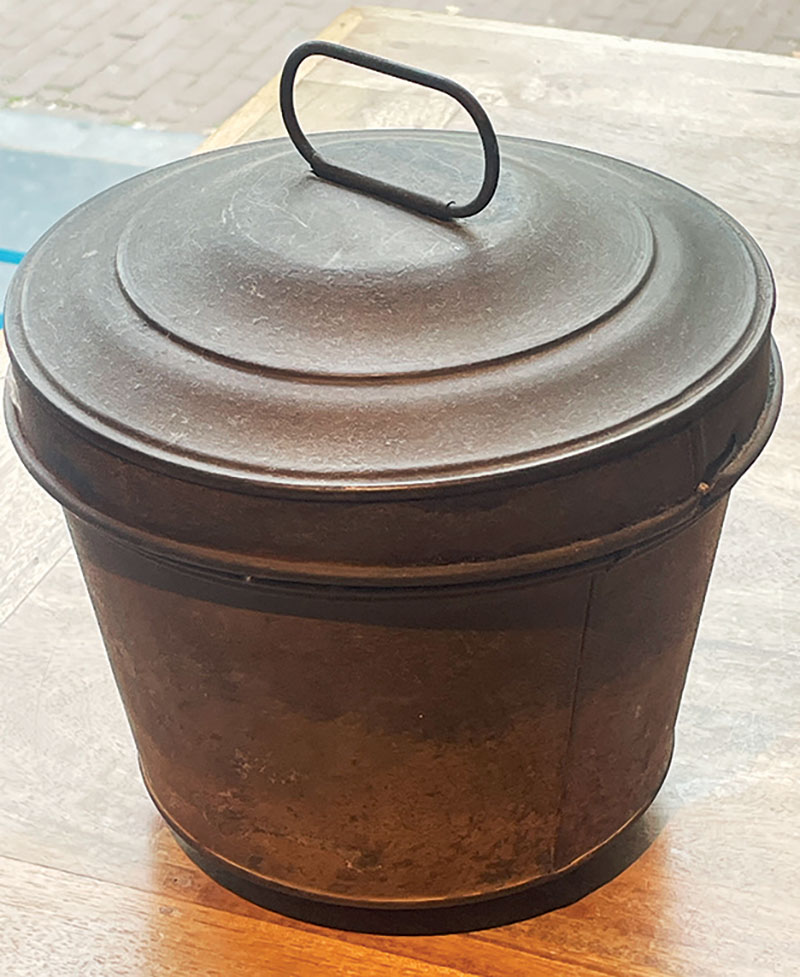
- Bawa’s breudher pan, closed With the heavy lid in place, the central chimney is concealed. Photograph by Jennifer Moragoda
Built for the Hearth
The two pans reveal how breudher was once baked in Sri Lanka: they were designed for the hearth rather than the oven. The Bawa pan makes the engineering especially clear. Its thick metal walls enclosed the dough, while the long legs held the vessel above the embers and the heavy, close-fitting lid could carry hot coals, providing heat from above. Most ingenious was the hollow central column. It reduced the mass of dough through which heat had to travel while acting as a chimney, allowing rising heat to pass through the centre of the bread and out through the lid. The fluting increased the surface exposed to the heated metal while giving the finished bread its tall architecture. Together, these features distributed heat around, above and through the dough—in effect creating a miniature, self-contained oven within the hearth.
A traditional broeder mould from North Holland, made in Germany around 1880, offers a striking comparison. Shallower and made of earthenware, it shares with the Bawa pan a lid, central column and slanted fluting. German earthenware circulated widely in the Netherlands, so its place of manufacture need not imply a specifically German origin for the form.
Jacco Spil, General Director of the bakery museum in Medemblik, North Holland, explains that a domestic broeder could be cooked either in a special cloth bag or in a lidded mould. Other Dutch museum examples show that such broeders were traditionally boiled or steamed rather than baked directly over the hearth. The same general shape could also be used for tulband, a different, cake-like preparation baked in the oven.
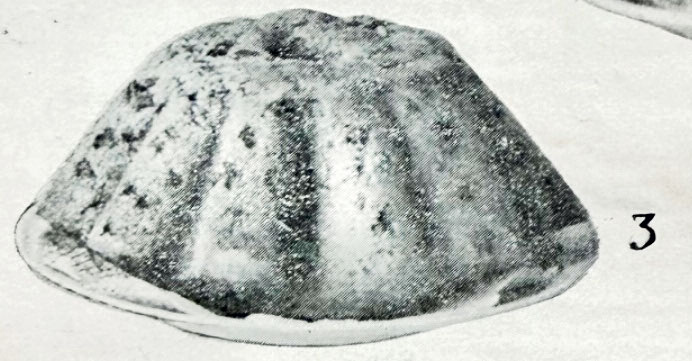
A twentieth-century Broeder A finished Broeder, illustrated in the plate “Dutch and Portuguese Sweets” from the Ceylon Daily News Cookery Book, second edition, 1934.
The surviving Dutch moulds provide an illuminating contrast with the Bawa pan. They have the familiar central tube and fluted ring shape, but the examples examined here have no integral legs. The Bawa pan incorporates the requirements of hearth baking into the vessel itself: long legs hold it above the embers, the heavy lid can carry hot coals while enclosing the dough, and the central tube projects through the lid to channel heat through the centre. It is this integration of functions, above all the projecting chimney, that sets the Bawa pan apart.

The stone cardinal at Lunuganga The stone cardinal at Lunuganga, Geoffrey Bawa’s country estate near Bentota, Sri Lanka. The figure stands within an interior overlooking the garden and lake. Photograph by Jennifer Moragoda
As the hearth gradually gave way to the oven in Sri Lanka, the breudher pan dispensed with its legs and heavy lid, while the projecting chimney became unnecessary. The central tube was shortened to just below the rim, retaining its role in reducing the thick central mass of dough but no longer functioning as a chimney. The oven had taken over much of the work the old pan once had to perform for itself.
From Broeder to Breudher
English speakers might assume that the Dutch broeder means “bread”, especially since brood is the Dutch word for bread. But broeder means “brother” and can also refer to a member of a religious order. A nineteenth-century Dutch dictionary suggests that the food acquired its name because its rotund, plump shape recalled a stout monastery brother.
Rather than a single fixed preparation, broeder belonged to a broad, regionally variable family. Pagrach-Chandra records versions fried in a heavy pan, steamed in a covered mould as ketelkoek, or boiled in a cloth as Jan in de zak. The names broeder, boffert and Jan in de zak could also overlap in local usage. Such preparations are well represented in eighteenth-century cookery books.
In Ceylon, the Dutch spelling broeder persisted through Dutch rule and well into the British period. Breudher is the modern conventional Sri Lankan English spelling, while in Sinhala the bread has been known as burudala.
Deloraine Brohier places breudher’s origins in “Holland and the Hanseatic Towns of the low-country, and elsewhere in Flanders”. Wagenaar traces the name more specifically to West Friesland in North Holland, home of the VOC chambers at Hoorn and Enkhuizen.
Spil distinguishes between broeders made at home and those produced by professional bakers in West Friesland. The domestic version used a yeast dough, sometimes with currants. The bakery broeder, by contrast, was a baked round loaf containing currants or raisins, with a cinnamon-and-sugar filling at the centre. The Hoornse Broeder belongs to this baked tradition.
In parts of Friesland, boffert could also refer to a yeasted celebration cake baked in a tulband pan. Here the relationship to Sri Lankan breudher becomes closer still: an enriched, yeasted festive bread or cake shaped in a tall ring.
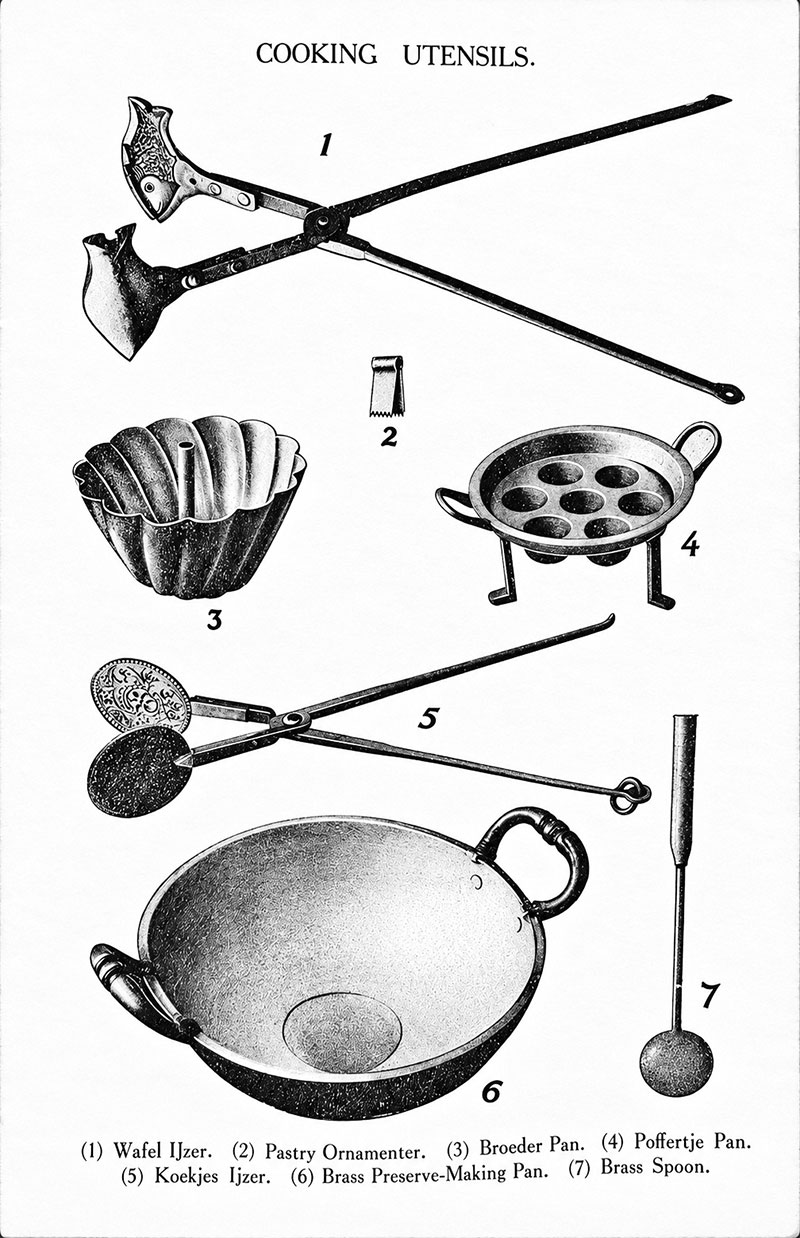
A twentieth-century Broeder Pan A fluted Broeder Pan, illustrated in the plate “Cooking tensils” from the Ceylon Daily News Cookery Book, second edition, 1934.
Beyond the Netherlands, comparable traditions existed in German-speaking Europe. The Dutch tulband and German Gugelhupf belonged to the same broad family of ring-shaped breads and cakes. Maria Riesin’s 1755 cookbook from Franconia, in southern Germany, contains sixteen Gugelhupf recipes, thirteen of them yeast-leavened. The Fränkisches Freilandmuseum, a museum in Franconia that has studied the manuscript, notes that one recipe calls for twenty eggs to a pound of flour—a ratio it describes as high but not unusual—while a “simple” Nuremberg version of 1733 used six yolks.
Thirty Eggs
Deloraine Brohier, in A Taste of Sugar and Spice, records a broeder recipe from what she calls the “Brohier Manuscript”, a slim, yellowed typescript titled Rare Recipes of a Huisvrouw of 1770, found in her father R. L. Brohier’s collection. It calls for only five components:
3 lbs wheaten dough
1 lb butter
1 lb sugar
¼ lb raisins
30 eggs
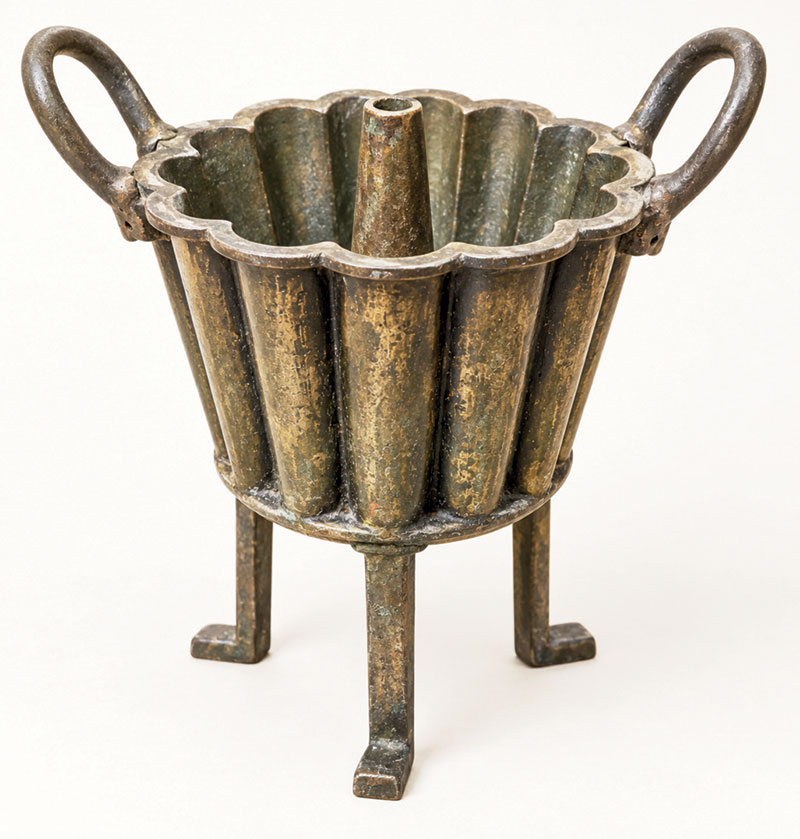
Dutch Period Museum breudher pan A breudher pan in the Dutch Period Museum, Pettah, Colombo, with a deep fluted body, hollow central chimney, two loop handles and three supporting legs. Photograph by Jennifer Moragoda
The recipe is scaled for a large batch, but its proportions are what stand out. One pound of sugar to three pounds of prepared dough is generous for a bread; thirty eggs are startling. Brohier makes clear that only the yolks were used, but even so, the quantity is remarkable.
The curious phrase wheaten dough specifies the flour type, a distinction that may have mattered in a local kitchen where rice and other familiar flours were more common than imported wheat. Yet the recipe says nothing about how the initial dough was made or what leavened it. A 1925 contribution to the Journal of the Dutch Burgher Union, appearing under the heading “Household Hints” as “How to make Broeder”, came from an unnamed female member described as “a much valued lady correspondent”. She notes that dough “can be purchased at any bakery” and would arrive “highly leavened”. The leavening agent used by eighteenth-century bakers may remain unknown, but plain bread dough clearly formed the starting point for breudher.
Breudher-making therefore begins where ordinary bread-making ends: with an already fermented wheat dough transformed through the laborious incorporation of butter, sugar and an exceptional quantity of egg yolks.
From there, Brohier’s instructions are quite clear. The dough is kneaded firm, then butter in pats is gradually worked in. The yolks follow one by one, each thoroughly incorporated before the next is added, and finally the sugar. Kneading continues throughout, alternating with beating or “clapping”; Brohier stresses that this gradual incorporation is necessary to keep the batter firm. The mixture is then placed in the pan and, if possible, left in the sun for half an hour to help it “bake lighter” before going into a “hot oven”. In modern baking terms, gradual enrichment helps such a rich dough retain its structure.
Elsewhere in the book, recalling Christmas in her grandmother’s household, Brohier remembers breudher-making as a whole morning’s work, with her grandmother and aunts “slapping and turning, spooning and twisting” the mixture by hand. Her recollection supplies the time and physical effort compressed by the recipe.
The same correspondent offers a series of practical hints for judging the mixture. If it began to “run”, she advised stopping the addition of yolks because the sugar still had to go in. Incorporating all thirty had been regarded by an earlier generation as “a triumph of culinary art”. She wonders whether success depended on what she calls “the excellency of the dough” supplied to the cook, or simply on the smaller size of village eggs; the reason, she says, “was not clearly known”. In practical baking terms, both could matter: how much yolk the dough could absorb would depend on its condition and fermentation, while larger eggs would contribute more yolk by weight.
Before the raisins were added, the mixture was worked until hollow bubbles appeared, which the writer took as proof that it had been successfully aerated. The desired result was “light and spongy”.
The basic formula proved remarkably durable. The Ceylon Daily News Cookery Book, first published in 1929, still calls for two pounds of dough and twenty yolks, almost exactly preserving the older proportion. Chandra Dissanayake records a three-pound, thirty-yolk version alongside later adaptations using fewer eggs, while Charmaine Solomon simplifies and broadens the formula further. Across the twentieth century, breudher remained recognizable even as cooks adapted it for economy, convenience and changing kitchen practice.
When Recipes Travel
The recipes diverge most clearly in their enrichment. Many domestic Dutch broeders contained little or no sugar in the dough and were sweetened only when served, while the Hoorn and Frisian baked versions were richer. In Sri Lankan breudher, sugar, butter and an unusually large quantity of egg yolks were worked directly into the fermented dough.
Eighteenth-century German Gugelhupf recipes show that yeasted breads or cakes could contain substantial quantities of eggs and fat. Sugar appears more sparingly in these older German recipes and remained expensive. Against that background, the pound of sugar worked into three pounds of prepared dough is notable—and may point elsewhere.
Brohier draws attention to the Portuguese taste for sugar and to the ways Portuguese and Luso-Eurasian foodways entered Dutch-Ceylonese households. Iberian confectionery—particularly the convent traditions of Spain and Portugal—also made conspicuous use of sugar and egg yolks. Together, these parallels make Portuguese influence plausible, perhaps less in breudher’s basic structure than in the degree of richness it acquired in Ceylon.
Many European men serving the VOC married Portuguese-Eurasian women in Sri Lanka and elsewhere in Asia, while cooks and others in colonial households often came from communities shaped by earlier Portuguese influence. Such households offered precisely the setting in which northern European baking traditions and Luso-Eurasian tastes might meet.
It is tempting to imagine that a well-loved festive bread—and perhaps even the specialized vessel used to bake it—travelled with people on VOC voyages, carrying something of home across oceans into unfamiliar places. In new kitchens it acquired new ingredients, techniques and meanings, becoming something more than the dish that had first set out.
(All photos are by the author unless otherwise noted )
by Nilantha Ilangamuwa
A former German intelligence chief has been arrested on suspicion of treasonous espionage just as a former senior CIA official has pleaded guilty after using his government position to defraud the United States of approximately $194 million, including the acquisition of 298 gold bars, both reported last week. David J. Rush fabricated highly classified government programmes to create the appearance of legitimate authority and divert public money into property, gold and luxury assets. US prosecutors also say he admitted giving a foreign government official information identifying a secret American intelligence source.
August Hanning, Germany’s former BND chief, faces a very different set of allegations. German prosecutors accuse him of obtaining classified BND information through a former subordinate who remained inside the agency and of using some of that material in dealings involving foreign intelligence. Hanning denies wrongdoing and hasa not been convicted. The cases differ. One concerns a guilty plea to fraud, the other an espionage investigation. Their near-simultaneous appearance exposes a vulnerability in modern intelligence services. Secret institutions depend on trust, yet that trust creates opportunities for abuse from within, especially when privileged knowledge survives a person’s relationship with the state.
The Bundesnachrichtendienst (BND) is being prepared for a more active role as Germany faces Russian espionage, cyber operations, sabotage and other forms of hybrid pressure. The proposed legislation would expand its ability to interfere with foreign computer systems and conduct disruptive operations. Peter Neumann, the security scholar interviewed by Die Zeit, sees the change as overdue. Germany, he argues, cannot expect French, British and Dutch services to possess capabilities that Germany itself restricts while relying heavily on allied intelligence, particularly from the United States. Former Justice Ministry official Peter Schantz accepts that German capabilities need strengthening but questions whether wider powers provide the answer. His concern centres on sabotage, cyber countermeasures, escalation and political responsibility. The disagreement is about the boundary between intelligence collection and state action.
A failed intelligence operation can produce bad information. A failed sabotage operation can produce casualties, retaliation and an international crisis. Schantz has questioned whether the Independent Control Council, despite its legal review function, provides sufficient political accountability for sensitive operations. Neumann, by contrast, argues that excessive legal and procedural restrictions have made German intelligence slower and less effective than comparable European services. The more consequential an operation becomes, the harder it is to separate legality, secrecy and political responsibility. It concerns the institutional consequences of moving an intelligence service from observing foreign activity towards intervening directly in it. Once the BND possesses capabilities designed to disrupt foreign systems, questions about authorization, review and responsibility become inseparable from the operational purpose of those capabilities.
The Hanning investigation gives this debate a serious internal dimension. Prosecutors allege that Hanning, who led the BND from 1998 to 2005, later obtained roughly 2,000 documents from Manfred D., a former office manager who remained inside the agency and worked for Hanning’s successors until 2026. Investigators allege that some documents came from sensitive BND reporting and could have contained information originating with partner services. The concern is the alleged channel through which it was obtained. A former chief did not allegedly need to penetrate the agency from outside. Prosecutors say a trusted former colleague remained an information link into an organization whose value depends on controlling access. Hanning’s arrest is not proof of guilt, but the allegations raise questions about how effectively the BND detects misuse of privileged relationships.
History provides several reminders. Aldrich Ames betrayed the CIA to the Soviet Union, Robert Hanssen spied for Moscow from inside the FBI, Kim Philby reached senior British intelligence positions while secretly working for the Soviets, and Günter Guillaume penetrated West Germany’s political centre for East German intelligence. These cases are not equivalents of Hanning’s allegations. Their relevance is narrower. Intelligence organizations are unusually exposed to insiders because sensitive information is concentrated in trusted individuals. Hanning’s case, if the allegations are established, would add a different dimension because the alleged access occurred after he had left the BND. The question then extends beyond the classic insider threat to the relationship between intelligence agencies and their former senior personnel.
Senior intelligence officers leave office with knowledge, contacts and reputations built through decades of public service. Moving into consultancy or corporate work is not inherently improper. Yet the boundary between expertise and privileged access can become difficult to police when former officials continue dealing with people connected to foreign governments, security businesses or sensitive disputes. A former intelligence chief can enter a boardroom carrying decades of public investment in his expertise. The issue is whether classified information, institutional relationships or official prestige can become private assets. That concern is particularly relevant when a former official’s commercial value is closely connected to the networks developed while holding public authority. The difficulty lies in the point where legitimate professional experience becomes access to information or relationships that were created for public purposes.
The Rush case shows another side of the same vulnerability. According to US prosecutors, he created fictitious classified programmes and used the authority surrounding them to make fraudulent transactions appear legitimate. The result was a diversion of public money into private wealth. His case is not an espionage equivalent to Hanning’s, but it demonstrates how secrecy and official authority can obstruct ordinary scrutiny. The fewer people authorized to know what a programme is, the more important internal controls become. Secrecy protects intelligence work, but without effective controls it can also shield misconduct.
Germany faces a more difficult security environment. Neumann’s concern about dependence on allied intelligence is legitimate, particularly when Germany expects partners to share sensitive information while its own service has more limited powers. Capability also creates a security burden. An agency authorized to conduct offensive cyber operations will possess more access, more technical capacity and more sensitive information. The question is whether safeguards are equally strong. If partner services believe sensitive material can move from the BND into private networks, cooperation becomes more difficult.
The treatment of former intelligence officers belongs here. Retirement can create a combination of vulnerability and influence. Former officers may lose institutional protection while retaining knowledge valuable to private interests. Professional reputation can become a commercial asset, while accusations can destroy reputations before a court establishes the facts. Hanning remains legally entitled to the presumption of innocence. If the allegations collapse, reputational consequences remain; if proved, the case raises questions about internal controls. The affair demonstrates that retirement is not a clean break from senior intelligence responsibilities. Former officials remain part of the institutional history of the services they once led, and their subsequent activities can affect perceptions of those institutions even when no criminal conduct is established.
Germany’s problem is not unique. Every nation-state faces the dilemma of maintaining capable intelligence services while protecting people who may carry their secrets, networks and responsibilities long after formal service has ended. Greater operational capability also increases the importance of authorization, oversight, internal security and post-service restrictions. If classified material moves into private networks, confidence between intelligence services becomes harder to maintain.
The arrest of Hanning and the Rush guilty plea arrive at a significant moment for modern espionage. Neither case proves that intelligence agencies are inherently corrupt, and the two men face different legal circumstances. Their significance lies in a common institutional problem. Intelligence services concentrate information, authority and trust in a small number of people. That concentration is necessary, but it also creates opportunities for abuse, insider compromise and conflicts of interest.

Farhan and Sadaqat help Pakistan seal series in style

At least 139 dead, 84 missing as migrant boat capsizes off Djibouti

Rahmat, Malik fifties lead Afghanistan’s strong reply

Showers above 75 mm are likely at some places in the Western, Sabaragamuwa, Central, Uva and North-Western provinces and in Galle, Matara, Anuradhapura and Mannar districts.

Iranian ships stranded, Lanka fears US sanctions

Sri Lanka CERT warns of overseas university admission scams

‘Dates have the highest sugar content to fight Coronavirus’

Sunday Island 27 December – Headlines

#SundayIsland 17th December – Headlines

Sunday Island – 28th March

Sunday Island Headlines – 21 March

Sunday Island – 21st February – Headlines
-

 News7 days ago
Geneva takes up Sallay’s case and govt. ignores opportunity to answer accusations
-

 Features6 days ago
Preventing grievances from becoming communal
-

 Features4 days ago
The Sri Lankan who made Scottish history
-

 Sports4 days ago
Nissanka absence opens door for Sri Lanka’s young guns
-

 News5 days ago
Gnansara Thera to be assigned to prison printing section: Officials
-

 News3 days ago
NDB fraud Rs 60mn more than reported
-

 Features7 days ago
Sri Lanka Cricket Bill: Governance reform is not yet a cricket strategy
-

 News3 days ago
Removing monk’s robes matter for Sangha to decide: Mahanayake Theras