
News
Ranil remanded

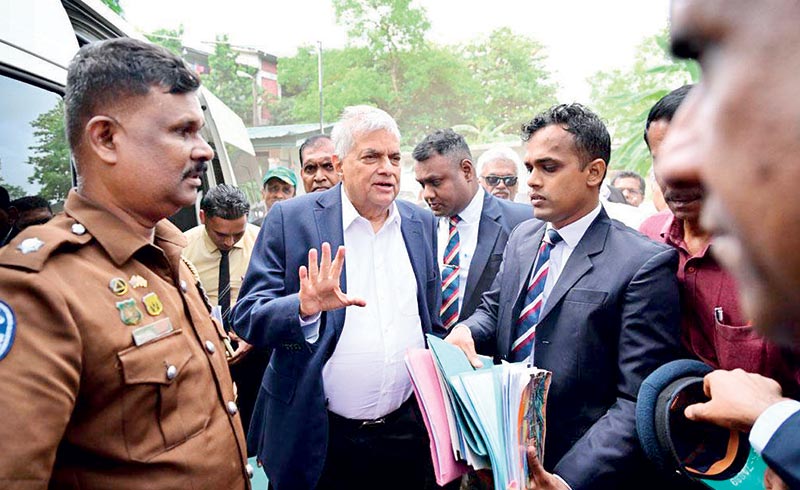
Former President Ranil Wickremesinghe was remanded on Friday until 26 August by the Colombo Magistrate’s court over charges of misappropriation of state funds.Colombo Magistrate Nilupuli Lankapura, while reading out the ruling noted that the reasons argued by Wickremesinghe’s counsels were not sufficient to grant him bail.
Following the arrest by the CID of Wickremesinghe, who was produced before the Fort Magistrate’s Court, bail hearing lasted for several hours, with the court taking a recess. During the break, a power outage plunged the premises, packed with officials, media personnel, and supporters, into darkness. Power was later restored.
A large number of former ministers and MPs were present at the court premises.
Wickremesinghe was taken into custody after arriving at the CID earlier Friday to record a statement in connection with an ongoing investigation into his September 2023 visit to London, using state funds during his tenure as President.
Additional Solicitor General Dileepa Pieris told court that when questioned, Wickremesinghe had said, “There is no such thing as a private or official trip for a President.”
Pieris said that Wickremesinghe had also said that state funds could be used for any visits for a President.
Pieris said some documents had initially described Wickremesinghe’s 2023 London visit as a “private trip,” but were later changed to simply state it was a “visit.” He told court that Rs. 16.6 million in state funds had been spent on 10 people, including security officers, for the trip.
He further argued that the invitation had come from a private institution, the University of Wolverhampton, and that for the visit to be recognized as a state event, there must have been an official invitation from the UK Government.
Wickremesinghe’s counsel told court that the former President is suffering from several health conditions, including heart disease, diabetes and high blood pressure.
The lawyer further said Wickremesinghe’s wife was battling cancer and that he was the only one available to care for her.
He urged the court to take the circumstances into account when considering his client’s bail application.
The CID had previously presented evidence in the Fort Magistrate’s Court on June 24, and recorded statements from Sandra Perera, the former President’s private secretary, and former Presidential Secretary Saman Ekanayake.
According to the CID, Wickremesinghe used state funds for his private travel to London and for the security provided by state-paid bodyguards. The former President has maintained that his wife covered her own travel expenses and no state funds were used.
The UNP media unit released a copy of the official invitation letter from the University of Wolverhampton, asserting that Wickremesinghe did not misuse state funds during the visit. He had travelled to London on his way back from Havana, where he attended the G77 summit, and attended a university ceremony with his wife.
by A. J. A. Abeynayake ✍️

Quarantine and Prevention of Diseases Ordinance No. 3 of 1897 is the principle law that regulates the prevention of the spread of communicable diseases and the implementation of quarantine measures.
However, at present, it has been observed that the risk of spreading communicable diseases across borders have significantly increased due to considerable increase in the
international and domestic movement of persons, goods, and services and frequent international travel and trade have led communicable diseases spread rapidly between countries.
Accordingly, although cabinet approval was granted in the 2016 to amend the Quarantine and Prevention of Diseases Ordinance No. 3 of 1897, the relevant amendment bills have not been presented to Parliament.
Therefore, as per the proposal made by the Minister of Health and Mass Media, the Cabinet of Ministers has approved the appointment of a Review Committee to study the amendment bill that has been prepared and propose suitable amendments to meet the current health challenges as well as challenges that may arise in the future, taking into consideration the experience obtained during the epidemic situations that have occurred in the past.
The Cabinet of Ministers granted approval to the proposal submitted by the President to make a donation of United States Dollars One million as humanitarian and economic relief to the government of Nepal
Latest News
Sun directly overhead Kalpitiya, Talawa, Sinharagama, Galkadawala, Nachchaduwa, Padikaramaduwa, Gomarankalla and Verugal about 12.10 noon today (01)


The sun is going to be directly over the latitudes of Sri Lanka from 28th of August to 07th of September due to its apparent southward relative motion.
The nearest places of Sri Lanka over which the sun is overhead today (01) are Kalpitiya, Talawa, Sinharagama, Galkadawala,
Nachchaduwa, Padikaramaduwa, Gomarankalla and Verugal about 12.10 noon.

Amendment of the Quarantine and Prevention of Diseases Ordinance No. 3 of 1897
Cabinet approves donation of USD One Million to the Government of Nepal

Nahida, Marufa help Bangladesh brush aside Indonesia

Showers will occur in the Western, Sabaragamuwa, Southern and Uva provinces and in Kandy and Nuwara-Eliya districts

Sun directly overhead Kalpitiya, Talawa, Sinharagama, Galkadawala, Nachchaduwa, Padikaramaduwa, Gomarankalla and Verugal about 12.10 noon today (01)

SJB asks what Speaker intended to do about allegations against CJ

‘Dates have the highest sugar content to fight Coronavirus’

Sunday Island 27 December – Headlines

#SundayIsland 17th December – Headlines

Sunday Island – 28th March

Sunday Island Headlines – 21 March

Sunday Island – 21st February – Headlines
-

 News5 days ago
Eight politicians in drug kingpin probe
-

 Features3 days ago
“Wrap Me Up in My Blazer”— A Gentlemanly Bradby Reminiscence
-

 Business5 days ago
Sri Lanka opens up: A new season of direct connectivity
-
 Features5 days ago
Redefining ageing in Sri Lanka
-
 Features7 days ago
Insights from Chieftains of Uva: Genealogy of two Kandyan Families – Part II
-
 Latest News5 days ago
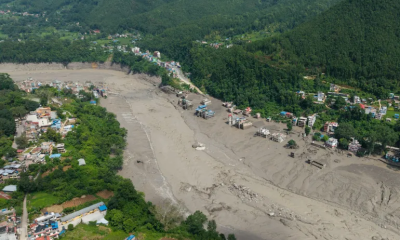
Nepal-Tibet floods: What happened, what caused them and who is missing?
-

 Editorial7 days ago
Warning of power cuts: El Niño and corruption
-

 Features7 days ago
Export diversification: Missing the wood for the trees – Part I