
Features
Private medical schools: Next assault on Free Education?

By Ramya Kumar

Interest-free loans of LKR 1.1 million are to be offered for students to follow degree programmes at private higher educational institutions. An amendment to the Universities Act has been proposed to establish a Quality Assurance Council under the University Grants Commission (UGC) to maintain the quality of academic programmes offered by state and non-state higher educational institutions.
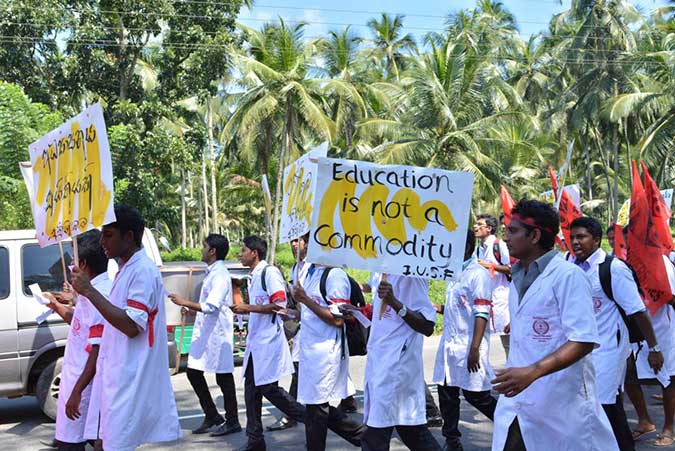
According to the government, these policies are designed to increase access to higher education and standardize the quality of academic programmes. However, the relentless attacks on the student movement, arbitrary arrests of Inter-University Students’ Federation (IUSF) leaders and the media campaigns against free education signal a different agenda: privatisation. As the government sets the stage for a ‘radical’ revamping of higher education, this article looks at what might be in store for medical education.
Minimum standards
Private medical education is a sensitive topic in Sri Lanka, so much so that the government has kept mum about its plans. The foundation for the establishment of private medical schools has already been laid through the setting up of an Accreditation Unit under the Sri Lanka Medical Council (SLMC). The medical fraternity may oppose private medical schools of questionable standards, but does not, in principle, object to private medical education. Indeed, there is much complacency on this front since the gazetting of the Minimum Standards of Medical Education in 2018, after the SAITM debacle. Even the Government Medical Officers’ Association (GMOA), which opposed SAITM based on ‘quality’ concerns, now simply demands that they be consulted in matters pertaining to private medical education.
It is believed that the quality of MBBS degree programmes can be assured by the requirements set out in the Minimum Standards, for instance, minimum qualifications for student admission, staff requirements, hospital bed numbers, bed occupancy rates, etc. To be sure, the Minimum Standards do set much-needed ‘benchmarks’ to check the proliferation of low-quality private medical schools.
However, by considering state and non-state medical schools on an equal footing, neither the Minimum Standards nor accreditation processes give due consideration to the impact private medical schools will have on state medical faculties. In particular, they overlook equity and justice in access to medical education.
An unhealthy symbiosis
Take, for instance, the staff requirements laid out in the Minimum Standards. In terms of academic staff, the Standards specify that MBBS degree-awarding institutions should “conform to teacher-student ratios… not less than one teacher for every 14 medical students, taking into account the permanent academic staff and the extended faculty of specialists in affiliated teaching hospitals and other healthcare settings.” They include provisions for a balance between full-time and part-time academic staff, and ask that “all medically qualified staff engaged in patient care are registered with the designated body responsible for registration of medical professions in the relevant country” (Note: the Minimum Standards apply to overseas medical schools that produce MBBS graduates who intend to work in Sri Lanka).
In the event that private medical schools set foot in the country, it is unlikely that these institutions will be able to attract diaspora medical professionals who could renew their SLMC registration, given the economic situation in the country. Therefore, these institutions would need to rely on retired medical professionals or current teaching faculty at state medical faculties. As the Standards do not place limits on teaching hours, university teachers will be able to divide their time between public and private medical schools (akin to ‘dual practice’ by clinicians) or, if the benefits are appealing, a wholesale movement from state to private medical schools may occur.
If teaching faculty engage in ‘dual practice’ in state and private medical schools, there is no guarantee that their primary commitments will remain with state medical faculties. Given the required hospital beds and occupancy rates specified in the Minimum Standards, private medical schools may need to rely on public hospitals for clinical training. For this reason, they may be located adjacent to tertiary hospitals in peripheral districts that do not serve as clinical training centres for students of state medical faculties.
Winners and losers
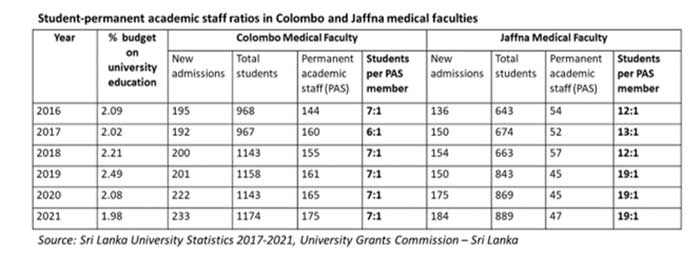
Student intake to state universities, including medical faculties, has steeply risen in recent years (see table). Even so, the Colombo Medical Faculty has been able to maintain its student to permanent academic staff ratio at 7:1. Owing to its location, the Colombo Medical Faculty would be able to attract medical professionals to full-time teaching positions despite the higher salaries offered by the Ministry of Health.
However, the student to permanent academic staff ratio at the Jaffna Medical Faculty has risen over the years, climbing to 19:1 in 2021. The availability of vacant cadre positions at Ministry of Health institutions in and around Jaffna gives medical professionals no reason to resign from the Ministry to take up teaching positions that pay substantially less. (See table)
The requirement of 14:1 is fulfilled by state medical faculties in peripheral districts when temporary staff and extended faculty at teaching hospitals are considered. Yet, curriculum development, ‘quality assurance,’ student welfare and other time-consuming activities are undertaken primarily by permanent academic staff. If private medical schools are established in such districts, state medical faculties will need to compete not only with the Ministry of Health, but also with private medical schools that can offer much higher salaries, causing a dearth in teaching staff at state medical faculties.
Equity of access
The government will gloss over equity concerns by promising loans, voucher schemes and other carrots to study at private medical schools. Even as the state university system as a whole is seeing declines in state investment (see table), and even more so after the economic crisis, it is unclear how these loans will be financed. Accumulating student debt has shown to influence the career choices of medical students in other settings.
As the country struggles to retain medical professionals, it is unlikely that medical graduates burdened by student debt will serve in the public health sector under the present salary structure. It is even less likely that fee-levying international students, the government’s primary target for forex, will serve in Sri Lanka’s health sector. In other words, whether private medical schools will produce medical professionals to service the healthcare needs of ordinary citizens is uncertain.
The entry of private medical schools will change the demographic makeup of medical students by creating a two-tiered system of medical education. Given the emphasis on student resumes and ‘soft skills’, not to mention the hefty fees that will be levied, those who enter private medical schools will mostly represent the middle/upper-middle classes. According to UGC statistics, in 2020/2021, about 63% of enrollment in state medical faculties was through the district quote system. While the Colombo elite suggest that this is a form of reverse discrimination, such arguments overlook the tremendous disadvantages experienced by students from rural districts.
A closer look at the UGC’s admission statistics of 2020/2021 shows that the majority of students who entered medicine from the Vanni districts, Polonnaruwa, Anuradhapura, Moneragala and Nuwara Eliya, did so through the district quotas. With the entrenchment of private medical education, and weakening of state medical faculties, the opportunities for students from rural and plantation districts to access medical education will contract. It must be remembered that it is also these students who tend to populate peripherally located state medical faculties.
Ideology in the making
As health professionals leave en masse from the country, it is argued that private medical schools might present a solution for physician brain drain. The entry of private medical schools will surely create a two-tiered system with lasting impacts on who has access to medical education and on the healthcare system more broadly. Until now, state medical faculties have furnished the public health sector with its medical cadre. While there is certainly room for improvement, at this point, the focus should be on supporting state medical faculties to ensure the survival of the public health sector.
As welfare is steadily chipped away in the name of the economic crisis, the government, supported by sections of the elite, suggest that it is a ‘welfare mindset’ that has brought the country to this state of crisis. The media is drumming up support for the government’s short-sighted policies, including the dismantling of free education. Images of student protests are being deployed to further delegitimize state universities, detracting attention from the ongoing mass-scale dispossession that is taking place in this country, whether through ‘domestic debt optimisation’, labour reforms or the proposals on restructuring higher education and public health. In this context, opposing private medical education is portrayed as ‘ideological’ or impractical, concealing the ideological work that has been undertaken over the years to convince many to believe that fee-levying university education is the way forward.
(The author is attached to the Department of Community and Family Medicine, Faculty of Medicine, University of Jaffna)
Kuppi is a politics and pedagogy happening on the margins of the lecture hall that parodies, subverts, and simultaneously reaffirms social hierarchies.









 Should Sri Lanka consider an 18th IMF programme? Some academicians exploring Sri Lanka’s development prospects in depth are raising this issue. It is yet to emerge as a hot topic among policy and decision-making circles in this country but common sense would sooner rather than later dictate that it be taken up for discussion by the wider public and a decision arrived at.
The issue of an 18th IMF programme was raised with some urgency locally by none other than Dr. Ganeshan Wignaraja,Visiting Senior Fellow, ODI Global London, one of whose presentations, made at the Regional Centre for Strategic Studies (RCSS), Colombo, was highlighted in this column last week, May 7th. An IMF programme is far from the ideal way out for a bankrupt country such as Sri Lanka but a policy of economic pragmatism would indicate that there is no other way out for Sri Lanka. Such a programme is the proverbial ‘Bird in the hand’ for Sri Lanka and it may be compelled to avail of it to get itself out of the morass of economic failures it is bogged down in currently.
While local economic growth possibilities are far from encouraging at present, such prospects globally are far from bright as well. Some of the more thought-provoking data in the latter regard were disclosed by Dr. Wignaraja. For example, ‘The IMF’s April 2026 World Economic Outlook projects global growth slowing to 3.1 percent in 2026; with downside risks dominating: prolonged conflict, geopolitical fragmentation, renewed trade tensions, bearing down hardest on emergent and developing economies.’
However, as is known, an ‘IMF bailout’ is fraught with huge risks for the people of a developing country. ‘The Silver Bullet’ brings hardships for the people usually and they would be required by their governments to increasingly ‘tighten their belts’ and brace for perhaps indefinite material hardships and discontent. For Sri Lanka, the cost of living is unsettlingly high and 20 percent of the population is languishing below the poverty line of $ 3.65 per day.
These statistics should help put the spotlight on the people of a country, who are theoretically the subjects and beneficiaries of development, and one of the main reasons, in so far as democracies are concerned, for the existence of governments. Placing people at the centre of the development process is urgently needed in the global South and shifting the focus to other considerations would be tantamount to governments dabbling in misplaced priorities.
Technocrats are needed for the propelling of economic growth but a Southern country’s main approach to development cannot be entirely technocratic in nature. The well being of the people and how it is affected by such growth strategies need to be prime focuses in discussions on development. Accordingly, discourses on how poverty alleviation could be facilitated need urgent initiation and perpetuation. There is no getting away from people’s empowerment.
In the South over the decades, the above themes have been, more or less, allowed to lapse in discussions on development. With economic liberalization and ‘market economics’ being allowed to eclipse development, correctly understood, people’s well being could be said to have been downplayed by Southern governments.
The development issues of Southern publics could be also said to have been compounded over the years as a result of the hemisphere lacking a single and effective ‘voice’ that could consistently and forcefully take up its questions with the global powers and institutions that matter. That is, the South lacks an all-embracing, umbrella organization that could bring together and muster the collective will of the South and work towards the realization of its best interests.
This columnist has time and again brought up the need for concerned Southern sections to explore the potential within the now virtually moribund Non-Aligned Movement to reactivate itself and fill the above lacuna in the South’s organizational and mobilization capability. In its heyday NAM not only possessed this institutional capability but had ample ‘voice power’ in the form of its founding fathers, with Jawaharlal Nehru of India, for example, proving a power to reckon with in this regard. The lack of such leaders at present needs to be factored in as well as accounting for the South’s lack of power and presence in the deliberative forums of the world that have a bearing on the hemisphere’s well being.
The Executive Director of the RCSS, Ambassador (Retd) Ravinatha Aryasinha, articulated some interesting thoughts on the above and related questions at a forum a couple of months back. Speaking at the launching of the book authored by Prof. Gamini Keerewella titled, ‘Reimagining International Relations from a Global South Perspective’, at the Bandaranaike Centre for International Studies, Colombo, Amb. Aryasinha said, among other things: ‘Historically, there is a precedent that has been realized by the Non-Aligned group of countries – unfortunately, rather than being reformed and modified at the end of the Cold War, it has been tossed away.’
The inability of the nominally existent NAM to come out of its state of veritable paralysis and voice and act in the name of the South in the current international crises lends credence to the view that the organization has allowed itself to be ‘tossed away.’ The challenge before NAM is to prove that it is by no means a spent force.
As indicted, NAM needs vibrant voices that could advocate value-based advancement for the global South. Moral principles need to triumph over Realpolitik. Such transformative changes could come to pass if there is a fresh meeting of enlightened minds within the South. Pakistan by offering to mediate in the ongoing conflict between the US and Iran, for instance, proved that there are still states within the South that could look beyond narrow self-interest and work towards some collective goals. Hopefully, Pakistan’s example will be emulated.
Along with Pakistan some Gulf states have shown willingness to work towards a de-escalation of the present hostilities in West Asia. This could be a beginning for the undertaking of more ambitious, collective projects by the South that have as their goals political solutions to current international crises. These developments prove that the South is not bereft of visionary thinking that could lay the basis for a measure of world peace. That is, there are grounds to be hopeful.
NAM needs to see it as its responsibility to make good use of these hopeful signs to bring the South together once again and work towards the realization of its founding principles, such as initiating value-based international politics and laying the basis for the collective economic betterment of Southern people.

 (The author is on X as @sasmester)
I have often been told by university colleagues how soulless and dangerous ‘artificial intelligence’ (AI) is to academia and humanity. They lament that students no longer read anything as they can now get various AI programmes to summarise what is recommended which is mostly in the English language to Sinhala or Tamil or get easier versions in English itself. They get their assignments and even dissertations fully or partially written by AI. And I am led to believe that universities do not have reliable detection software to assess plagiarism and academic fraud that have been committed using AI beyond the software freely available on the internet with their own limitations. This is due to financial restrictions in these institutions. Even these common malpractices have been done mostly with the aid of free AI programmes which are readily available, which means cheating in this sense is free and mostly safe. For teachers, this is a ‘menace’ in the same way ‘copying’ once was. But its implications are far worse.
But given the global investments made over AI, it cannot be wished away despite the enormous negative impact its use has on the environment, particularly due to its massive demand for energy. So, AI is with us to stay, and it has a considerable role to play in human civilisation even though like most innovations and inventions, this too carries its own burden of negativity. In this context, instead of demonising AI and lamenting its replacement of human agency and ingenuity, one needs to think seriously about how to deal with and engage with it reflectively and pragmatically as there is much it can offer if people are intelligent enough to make rational and sensible choices.
When I am making these observations, I am restricting myself to a handful of practices involving only writing both in university-based examination processes and in the fields of creative writing.
My initial introduction to AI was through the Research Methods class I used to teach in New Delhi. In 2022, this class was supposed to go to Dharmshala in Uttar Pradesh for fieldwork training, and we needed to write a funding proposal quickly. One of the students in the class, already familiar with ChatGPT introduced by OpenAI as a free programme in 2022, did the proposal with its help before the two-hour class was over. I edited it soon after and sent it off to the university administration for funding which we received. That stint of field work was completed in five days and was the most detailed work undertaken as a training programme up to that time in the university which had considerable output ranging from a documentary film to a detailed ethnography based on the findings.
While the technical details, the format of the proposal and its basic writing were done by AI due to the time constraints the class faced, its fine-tuning was done by me and a few students. AI could not then and even now cannot undertake that level of specificity without close human intervention. But the film, the ethnography and the actual process of research had nothing to do with AI. It was the result of human labour, thinking, planning and at times creativity and ingenuity. This was an early example of how AI could coexist in an academic environment if its technical usefulness was clearly understood and potential for excesses was also understood. But this was a time, easily accessible AI was just emerging, and we did not know much about it. But I was fortunate enough to have intelligent students in my class who gave me a crash course into this kind of AI use, which I followed up with my own reading and experimentation later on. As a result, I am keener now to see how it can be used for the betterment of academic practice rather than taking an uncritically demonising position, which I know will not lead anywhere.
But how is this possible? The lamentations of my colleagues about the abuse of AI in academic practice is not unfounded. It is a serious threat that remains mostly unaddressed not only in our country but almost everywhere else in the world too. This is mostly because the advancements of AI even in day-to-day free usage have far exceeded any thoughts for actionable codes of ethics to ensure its practice is sensible and ethical. At the same time, I cannot see why a student should not use AI to correct his spelling and grammar in assignments. I also cannot see why a student cannot seek AI’s help to secure research material from secondary sources available online which I have been doing for years. For instance, the originals of specific books and rare manuscripts might not be available in any repositories in our part of the world. In such situations, what AI might find us is all we have access to in a world where we are restricted in our mobility due to semi-racist visa regimes of failed empires and former superpowers as well as our own lack of ability to travel due to our own unenviable economic conditions. But unfortunately, the materials we need are often only available in research centers and libraries in those nations.
Similarly, when it comes to academic prose, it makes no sense now to take years to translate works from multiple languages to Sinhala and Tamil. This has always been a time-consuming, cumbersome and expensive process. Non-availability of Sinhala and English translations of core originals in languages such as English, French, German and so on has been a long-term problem for our country. But this can now be done well – at least from English to our languages – quite quickly and with a very low margin for error by using specific AI programmes which are meant to do precisely this. What this means is a quick expansion of knowledge in local languages which would have ordinarily taken years to achieve or might not have been possible at all. But still, this needs significant human intervention and time towards perfection. However, I do not think AI-based translations work as well for fiction and poetry or creative works more generally. But the ability for AI to emulate nuance and feeling in language is fast emerging. These are two clear examples of improving technical abilities in research and writing in which AI can be of help.
But looking for sources of information with help the help of AI or using it as a tool to undertake essential translations from one language to another is quite different from simply using it without ascertaining the accuracy of collected information, getting AI to do all your work without any reflection or without any hard work at all, including engaging AI to do the final product in a writing assignment — be that a term paper or a work of fiction. If one proceeds in this direction, as many unfortunately do nowadays, then, our ability to think and be creative as a species will become diminished over time and our sense of humanity itself will take a toll. This is what my colleagues worry about when they say AI is making younger generations soulless.
It is here that ethical practices on how to use AI responsibly without compromising our sense of humanity must play a central role. But these ethical practices must be formally written and taught, followed by viable programmes for detection and publication if unethical practices are followed. This needs to be the case particularly in teaching institutions as well as the broader domain of creative writing. After all, what is the fun in reading a novel or a collection of poetry written by AI?
It is time people began to think about what AI can do in their own fields without falling prey to its power and their own laziness. This brings to my mind Geoffrey Hinton’s words: “There is no chance of stopping AI’s development. But we need to ensure alignment; to ensure it is beneficial to us …” Similarly, as Yann LeCun observed, “AI is not just about replicating human intelligence; it’s about creating intelligent systems that can surpass human limitations.” In this sense, it is up to us to find our edge in creativity and common sense to find the most sensible way forward in using AI.

 The legendary Engelbert Humperdinck, who is known for his hit songs such as ‘A Man Without Love’, ‘Release Me’, ‘Spanish Eyes’, ‘The Last Waltz’, ‘Am I That Easy To Forget’, ‘Ten Guitars’ and ‘I Can’t Stop Loving You’, turned 90 on 02 May, 2026, and there were some lovely Hollywood-related celebrations.
Before his birthday, Engelbert’s new single ‘I’ve Got You’ was released – on 23 April – and Engelbert had this to say: “‘I’ve Got You’ is especially close to my heart. It speaks to love, loyalty, and the quiet strength we find in one another”.
The main birthday event was held at The Starlight Cabaret, in Los Angeles, California, and Sri Lankan Raju Rasiah, now based in the States, and his wife Renuka, who are personal friends of Engelbert, were invited to participate in the celebrations, along with Ingrid Melicon – also a Sri Lankan, now domiciled in America.
The invitation said “An evening of music, memories and celebration. Let’s make it a night to remember!” And it certainly turned out to be a night never ever to be forgotten!

Invitees experienced a “magical entrance” with Engelbert’s name lighting up the screen and showing him performing his hit songs.
The invitees were also presented with a unique gift – a necklace with Engelbert’s face, engraved with the words “Remember, I Love You.”
Engelbert’s son, Bradley Dorsey, sang a tribute song ‘Only You’ for his dad, while Eddy Fisher’s daughters, Tricia and Joely, also got on stage to entertaining the distinguish gathering.
Engelbert didn’t perform but got on stage for the cutting of the birthday cake.
There was also a video compilation of birthday wishes from fellow celebrities, and the lineup included Gloria Gaynor, Micky Dolenz, Wayne Newton, Pat Boone, Lulu, Judy Collins, Deana Martin, Angélica María, Rupert Everett, Matt Goss, and more.

Birthday boy Engelbert Humperdinck
At 90, Engelbert is still performing. He’s on THE CELEBRATION TOUR for his 90th year, with over 50 international dates in 2026, including Australia, Germany, the US, and Canada. He’ll be at Massey Hall in, Toronto, on 06 October, 2026. He said: “The stage is my home… Canada has always been a highlight”.
He performed 60+ concerts, worldwide, in 2025, and says karaoke keeps his songs fresh: “Most of my songs are on karaoke because people love to sing them”.

Saudi Arabia set to host Dunes League T20 from October

The guidance of Religious Leaders is essential to strengthen coexistence among communities. — Prime Minister

‘Watermelon deaths’ in Mumbai puzzle investigators

Mass sex abuse allegations force closure of boarding school in Indonesia

Gunshots fired in Philippine Senate where lawmaker wanted by ICC is holed up

Kohli’s ninth IPL hundred powers Royal Challengers Bengaluru to the top

‘Dates have the highest sugar content to fight Coronavirus’

Sunday Island 27 December – Headlines

#SundayIsland 17th December – Headlines

Sunday Island – 28th March

Sunday Island Headlines – 21 March

Sunday Island – 21st February – Headlines
-

 News4 days ago
Lanka Port City officials to meet investors in Dubai
-
 News1 day ago
Ex-SriLankan CEO’s death: Controversy surrounds execution of bail bond
-
 News5 days ago
SLPP expresses concern over death of former SriLankan CEO
-

 Editorial6 days ago
The Vijay factor
-
 News5 days ago
Police inform Fort Magistrate’s Court of finding ex-CEO of SriLankan dead under suspicious circumstances
-
Features2 days ago
High Stakes in Pursuing corruption cases
-
 Features2 days ago
When University systems fail:Supreme Court’s landmark intervention in sexual harassment case
-

 Features6 days ago
Palm leaf manuscripts of Sri Lanka – 1