
News
Prez urged to withdraw Personal Data Protection Act (A) Bill, consult relevant stakeholders


A group of non-governmental organisations and their linked individuals have urged President Anura Kumara Dissanayakaye to withdraw the Personal Data Protection Act (amendment) Bill (Data Protection Act No 09 of 2022) that was gazetted in March 2025. They have requested President Dissanayake to consult relevant stakeholders and experts on key amendments to be made.
The following is the text of the letter dated May 5, 2025 addressed to President Dissanayake: We write to you in your capacity as the Minister of Digital Economy regarding the proposed amendment to the Personal Data Protection Act, No. 9 of 2022, which was placed on the gazette on 27 March 2025.
It is noteworthy that Sri Lanka is leading by example in South Asia as the first country to enact digital privacy legislation for the protection of its citizens. However, we would like to bring to your attention that the enactment of the Personal Data Protection Act (PDPA) in 2022 was met with criticism by media associations, civil society and members of the opposition, including members of your own party, due to its inability to fulfil the stated aim of safeguarding digital privacy. Regrettably, the proposed amendments to the PDPA do not rectify the concerns raised in 2022.
A crucial shortcoming of the Act is the power of the President to appoint members to lead the Data Protection Authority (DPA). The appointment process is not independent and hence does not guarantee that the DPA will function without political interference by successive governments. In this context, there is risk of the DPA being deliberately under-resourced or the staff lacking subject-domain expertise, which will adversely impact its ability to conduct investigations, develop robust guidelines, handle complaints efficiently, or effectively supervise complex data processing activities, especially when related to AI.
With the mandate to oversee the implementation of the Act, the DPA can carry out executive, administrative and quasi-judicial functions, including conducting investigations, issuing instructions to data controllers/processors and citizens for compliance and imposing hefty fines for non-compliance. With such a broad range of functions, it is imperative that the governing body is appointed with the approval of the Constitutional Council and does not function at the whim of the government in power.
There is a staggering power imbalance between data controllers and citizens, as citizens are unaware of how their data will be used or stored or how to access remedies when data controllers violate their rights under the Act. For instance, there is no mention of whether legal representation is required, timelines for the conclusion of investigations etc. For the Act to achieve the stated aims, the remedies need to be accessible, meaningful and timely.
The vague and broad terms contained in the Act will result in arbitrary and inconsistent application. The Act does not provide clear, enforceable mechanisms for data breach notifications or for assessing risks to individuals’ privacy. Additionally, exemptions contained in the Act allow restriction of citizens’ right to data privacy for purposes such as national security and public safety. The ambit of “public safety” and “national security” are to be determined by a DPA that is not-independent. In such contexts, as historically demonstrated in Sri Lanka, minority groups and marginalised communities have been impacted the most by the arbitrary application of broad and vague laws.
International standards recommend the inclusion of a “journalistic exemption” in data privacy laws, whereby journalists and media organisations are allowed to store/process the private information of individuals, such as political figures, for the purposes of accurate reporting and informing the public. The lack of a “journalistic exemption” in the PDPA can hamper free and fair reporting as journalists carry the risk of being sanctioned under the Act. Additionally, the concern extends to other activities conducted in the public interest, such as research in social sciences or health, investigations by civil society organisations. Even certain forms of artistic expression might involve processing personal data where strict adherence to consent or purpose limitation principles could be challenging or counterproductive to the public good. The Act’s general but not generous exemptions might not adequately or clearly cover these specific contexts, potentially creating chilling effects beyond traditional journalism.
The proposed amendments fail to address these concerns and have not answered the calls for independent oversight to protect digital privacy. The purpose of the Act may be to protect the rights of citizens but the broad mandate of the DPA will likely not allow the full realisation of rights under the Act without adequate enforcement mechanisms.
With the advent of artificial intelligence and advances in technology, citizens are defenceless in the face of an onslaught upon their right to choose how their private data is used and stored by state entities and private corporations. In this context, we urge the government to consider the guiding principles for States proposed by the UN Special Rapporteur on the Right to Privacy when enacting data privacy laws 2022 (attached): legality, consent, transparency, purpose, fairness, proportionality, minimization, quality, responsibility and security.
We request the government not to hurriedly pass amendments to bring an inadequate law into force. Instead, the government should conduct meaningful consultations with stakeholders and international experts to ensure that the proposed amendments address the concerns that have been raised and comply with international standards.
We request the following steps to be taken:
1. Withdraw the Personal Data Protection Act (amendment) Bill that was placed on the gazette in March 2025.
2. Consult relevant stakeholders and experts on key amendments to be made.
3. Ensure the appointment process for the Board of Directors of the DPA is independent and involves the Constitutional Council.
4. Ensure the proposed amendments are in line with international human rights standards and best practices for digital privacy.
5. Commission a capacity assessment to affirm the readiness of public institutions to comply with the requirements of the Act, and the time and resources required to be fully compliant.
a. Release the results of the assessment to the public.
6. Conduct programmes to raise awareness of the public on the rights and remedies available under the Act to strengthen their ability to hold data controllers to account.
CC: 1. Harshana Nanayakkara, Minister of Justice
2. Eng. Eranga Weeraratne, Deputy Minister of Digital Economy
3. Mr. Waruna Sri Dhanapala, Acting Secretary for the Ministry of Digital Economy
Signatories: Adayaalam Centre for Policy Research,Aham Human Resource Centre,
Alliance for Minorities,Anuradhapura District Citizens Committee,Asia Lanka Social Development Cooperation,Association of War Affected Women,Centre for Society and Religion,Eastern Social Development Foundation,Environment and Community Development Information Centre,Families of the Disappeared,Human Elevation Organisation,Human Rights Law Chambers,Institute of Social Development,International Centre for Ethnic Studies,Jaffna Social Action Centre,Law and Society Trust,Mannar Social and Economic Development Organization,Mannar Women’s Development Federation,Movement for Plantation Peoples’ Land Rights,National Fisheries Solidarity Movement,National Peace Council,RED Organisation,Right to Life,Samadana,Shramabhimani Kendraya,Social Institute for Development of Plantation Sector,Tamil Civil Society Forum,Transparency International Sri Lanka,Uva Shakthi Foundation,Viluthu,Women’s Action Network,Women and Media Collective,Young Journalists Association,Anushani Alagarajah,Visaka Dharmadasa,Sarala Emmanuel,
Brito Fernando,Ruki Fernando,Mario Gomez,Sakuntala Kadirgamar,Herman Kumara,
Jayanthi Kuru-Utumpala,Kandumani Lavakusarasa,Maathumai Paranthaman,Denver Mark Peterson,Maithreyi Rajasingham,Kumudini Samuel,Ambika Satkunanathan,Shreen Saroor,Pathujan Srinagaruban,Sandun Thudugala






The Government’s ‘Rebuilding Sri Lanka’ Fund, established to provide relief and support to communities affected by Cyclone Ditwah, continues to receive financial contributions on a daily basis.
Accordingly, the Containers Transport Owners Association made a financial contribution of Rs. 1.5 million, while the Association of SriLankan Airlines Licensed Aircraft Engineers contributed Rs. 1.35 million to the Fund.
The respective cheques were formally presented to the Secretary to the President, Dr. Nandika Sanath Kumanayake, at the Presidential Secretariat on Friday (19).
The occasion was attended by W. M. S. K. Manjula, Chairman of the Containers Transport Owners Association, together with Dilip Nihal Anslem Perera and Jayantha Karunadhipathi.
Representing the Association of SriLankan Airlines Licensed Aircraft Engineers were Deshan Rajapaksa, Samudika Perera and Devshan Rodrigo handed over the cheque.

A meeting between Prime Minister Dr. Harini Amarasuriya and a delegation of UNICEF representatives was held on Saturday, (December 20) at the Prime Minister’s Office.
During the meeting, the Prime Minister explained the measures taken by the Government to ensure the protection of the affected student community and to restore the damaged school system, as well as the challenges encountered in this process.
The Prime Minister stated that reopening schools located in landslide-prone areas would be extremely dangerous. Accordingly, the Government is focusing on identifying such schools and relocating them to suitable locations based on scientific assessments.
The Prime Minister further noted that financial assistance has been provided to students affected by the disaster, enabling parents to send their children back to school without an additional financial burden. Emphasizing that school is the safest place for children after their homes, the Prime Minister expressed confidence that the school environment would help restore and improve students’ mental well-being
The Prime Minister also highlighted that attention has been given to several key areas, including the relocation of disaster-affected schools, restoration of school infrastructure, merging and operating certain schools jointly, facilitating teaching and learning through digital and technological strategies, and providing special transportation facilities. She emphasized that the Government is examining these issues and is committed to finding long-term solutions.
The UNICEF representatives commended the Government’s commitment and the initiatives undertaken to restore the education sector and assured their support to the Government. Both parties also discussed working together collaboratively on future initiatives.
The meeting was attended by the UNICEF representatives to Sri Lanka Emma Brigham, Lakshmi Sureshkumar, Nishantha Subash, and Yashinka Jayasinghe, along with Secretary to the Ministry of Education Nalaka Kaluwewa, Director of Education Dakshina Kasturiarachchi, Deputy Directors Kasun Gunarathne and Udara Dikkumbura.
(Prime Minister’s Media Division)


Drug controversy:
“Setting up state-of-the-art drug testing facility will cost Rs 5 billion”
Activists call for legal action against politicians, bureaucrats
Serious questions have been raised over Sri Lanka’s drug regulatory system following revelations that the National Medicines Regulatory Authority’s (NMRA) quality control laboratory is not accredited by the Sri Lanka Accreditation Board (SLAB), casting doubt on both the reliability of local test results and the adequacy of oversight of imported medicines.
Medical and civil rights groups warn that the issue points to a systemic regulatory failure rather than an isolated lapse, with potential political and financial consequences for the State.
Chairman of the Federation of Medical and Civil Rights Professional Associations, Specialist Dr. Chamal Sanjeewa, said the controversy surrounding the Ondansetron injection, which was later found to be contaminated, had exposed deep weaknesses in drug regulation and quality assurance.
Dr. Sanjeewa said that the manufacturer had confirmed that the drug had been imported into Sri Lanka on four occasions this year, despite later being temporarily withdrawn from use. The drug was manufactured in India in November 2024 and in May and August 2025, and imported to Sri Lanka in February, July and September. On each occasion, 67,600 phials were procured.
Dr. Sanjeewa said the company had informed the NMRA that the drug was tested in Indian laboratories, prior to shipment, and passed all required quality checks. The manufacturer reportedly tested the injections against 10 parameters, including basic quality standards,
pH value, visual appearance, component composition, quantity per phial, sterility levels, presence of other substances, bacterial toxin levels and spectral variations.
According to documents submitted to the NMRA, no bacterial toxins were detected in the original samples, and the reported toxin levels were within European safety limits of less than 9.9 international units per milligram.
Dr. Sanjeewa said the credibility of local regulatory oversight had come under scrutiny, noting that the NMRA’s quality control laboratory was not SLAB-accredited. He said establishing a fully equipped, internationally accredited laboratory would cost nearly Rs. 5 billion.
He warned that the failure to invest in such a facility could have grave consequences, including continued loss of life due to substandard medicines and the inability of the State to recover large sums of public funds paid to pharmaceutical companies for defective drugs.
“If urgent steps are not taken, public money will continue to be lost and accountability will remain elusive,” Dr. Sanjeewa said.
He added that if it was ultimately confirmed that the drug did not contain bacterial toxins at the time it entered Sri Lanka, the fallout would be even more damaging, severely undermining the credibility of the country’s health system and exposing weaknesses in health administration.
Dr. Sanjeewa said public trust in the health sector had already been eroded and called for legal action against all politicians and public officials responsible for regulatory failures linked to the incident.
by Chaminda Silva ✍️

Duffy, Ajaz rip through West Indies as New Zealand seal series 2-0

Financial contributions received for ‘Rebuilding Sri Lanka’ Fund

UNICEF representatives and PM discuss rebuilding schools affected by the Disaster

A few showers may occur in the Uva province and in Ampara, Batticaloa, Matale, Nuwara-Eliya, and Hambantota districts

NMRA laboratory lacks SLAB accreditation

Air quality deteriorating in Sri Lanka

‘Dates have the highest sugar content to fight Coronavirus’

Sunday Island 27 December – Headlines

#SundayIsland 17th December – Headlines

Sunday Island – 28th March

Sunday Island Headlines – 21 March

Sunday Island – 21st February – Headlines
-

 Midweek Review6 days ago
How massive Akuregoda defence complex was built with proceeds from sale of Galle Face land to Shangri-La
-

 News5 days ago
Pope fires broadside: ‘The Holy See won’t be a silent bystander to the grave disparities, injustices, and fundamental human rights violations’
-

 News5 days ago
Pakistan hands over 200 tonnes of humanitarian aid to Lanka
-
 News6 days ago
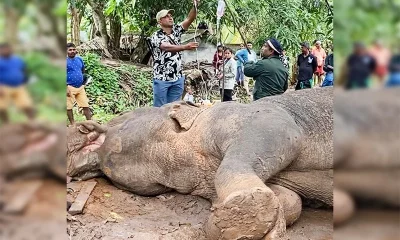
Burnt elephant dies after delayed rescue; activists demand arrests
-

 Business4 days ago
Unlocking Sri Lanka’s hidden wealth: A $2 billion mineral opportunity awaits
-

 Editorial6 days ago
Colombo Port facing strategic neglect
-

 News4 days ago
Army engineers set up new Nayaru emergency bridge
-

 News6 days ago
Sri Lanka, Romania discuss illegal recruitment, etc.