
News
Prez: Crisis beyond govt. control

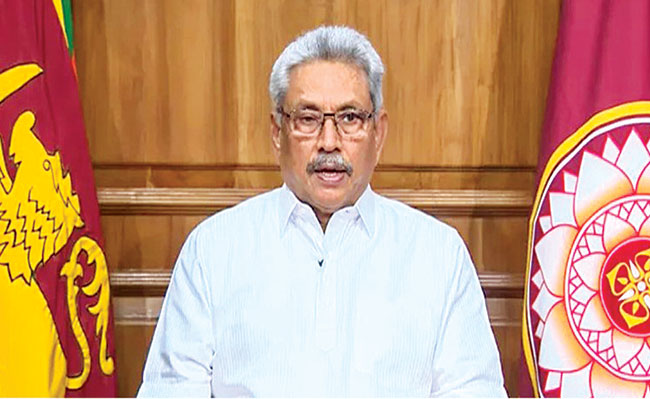
Acknowledging that the growing difficulties experienced by the people, President Gotabaya Rajapaksa has urged them to have faith in him. Blaming the foreign exchange crisis for the current predictment, the President said, in a pre-recorded speeech delivered last night, that he was aware of the shortages of essential items and increase in prices and sensitive to the many sufferings the people have to experience over the past two months.
Text of the President’s statement: “I know that this situation will continue for reasons beyond our control though we make maximum possible efforts with regard to these situations.
“I accept responsibility for the actions I take. Today, I am determined to make tough decisions to find solutions to the inconveniences that the people are experiencing. I have appointed a National Economic Council and an Advisory Committee to assist it. I will constantly monitor whether the decisions I make through this are implemented. Therefore, first of all I request you to have faith in the actions I will take on behalf of the people.
“I am well aware of the difficulties faced by the people. I was able to better understand and manage all the difficulties faced by the soldiers who were at the forefront of the war against the brutal terrorism and the innocent civilians who were affected by the war.
“Our country is not the only country in the world affected by the prevailing crisis situation. The entire world is engulfed with various hardships. Increasing shipping costs, rising commodity prices and shortages of certain goods caused by the Covid-19 pandemic are all beyond our control. However, we have adopted concessionary initiatives for the benefit of the people.
“This crisis was not created by me. When those who contributed to the creation of this crisis are criticizing the government in front of the people today, I am attempting to immediately resolve this crisis and provide relief to the people.
In a crisis situation like this, it is the responsibility of the politicians and intellectuals of a country to collectively find solutions to the issues.
The root cause of current issues is our foreign exchange crisis.
“The projected export earnings for this year is USD 12 billion, before the rupee was floated. According to the data of the last two months, we have to bear USD 22 billion as the import cost this year. Accordingly, this will result in a trade deficit of USD 10 billion.
Based on recent data, this year we will receive about USD 3 billion from tourism, as well as export services such as information technology, and USD 2 billion from remittances from expatriate workers. Accordingly, the trade deficit will be USD 5 billion.
Meanwhile, USD 6.9 billion will have to be paid in loan installments and sovereign bonds this year. Then there will be a deficit of USD 11.9 billion.
We expect to generate USD 2.5 billion from other grants and investments. Accordingly, there is a total deficit of USD 9.4 billion in foreign exchange.
However, once the rupee is floated, export earnings are expected to reach USD 13 billion. This will also reduce the cost of imports from USD 22 billion to USD 20 billion. If that happens, the trade deficit could be reduced to USD 7 billion. We should aim for this target.
“We can also expect USD 4 billion by providing export services and USD 5 billion in remittances from expatriate workers. Accordingly, our trade deficit will be USD 2.4 billion.
“We must take action to fill this deficit and increase our foreign exchange reserves.
To this end, we have initiated discussions with international financial institutions as well as with our friendly countries regarding repayment of our loan installments. The government is in discussions with various parties to implement a new method regarding this which will be beneficial to our country. Yesterday’s discussion with the International Monetary Fund was also held for this purpose.
Through those discussions, we hope to find a way to pay off our annual loan installments, sovereign bonds, and so on. Subsequent to my discussions with the International Monetary Fund, I have decided to work with them after examining the advantages and disadvantages.
“Due to some decisions I have taken in the recent past, we were able to control the import expenditure to a great extent. We suspended importing vehicles two years ago because we saw this issue in advance. In addition, we encouraged local industries. We also stopped the importation of many non-essential food items and took steps to cultivate those crops in our own country. Now we can witness the successful results of those initiatives.
“The most serious issue we face in controlling the cost of imports is the rapidly rising fuel prices in the world market. Generally, more than 20 percent of our import expenditure is spent on purchasing fuel. In the last few months alone, fuel prices in the world market have more than doubled. This is the reason why the increase in fuel prices in our country was inevitable. Fuel is widely used in our country not only for vehicles but also to generate electricity.
“This is why, I constantly took steps to discuss and encourage relevant agencies to use renewable energy sources as much as possible.
Therefore, by limiting the use of fuel and electricity as much as possible, the citizens too can extend their support to the country at this time. I hope that you will understand the responsibility lies with you at this challenging time.
The tourism industry, which was collapsed due to the COVID-19 pandemic, is revving. The last two months have seen a clear increase in tourist arrivals to Sri Lanka.
Also, due to the acceleration of the government’s provision of infrastructure facilities in the IT and telecommunications sectors, the revenue generated through these sectors is increasing.
“We are a nation that has experienced many adversities and at the same time conquered those challenges throughout the history. We have faced foreign invasions, great famines, natural disasters and threats of terrorism. The way we dealt with the Covid-19 situation has been praised even by international organizations. However, we all need to understand that we have to face difficulties when implementing solutions for the issues for a certain period of time. Therefore, I urge all of you not to be discouraged but to unite as a nation to overcome this crisis.
You requested me to build a secure, disciplined, and a modern developed country, as well as a better education for your children. Almost two and a half years of my tenure were devoted to protect you and your child from the 4
pandemic. I will dedicate remaining period of my tenure to accomplish those original goals.
I urge the Cabinet, the Parliament and public officials to work together as a team to achieve our desired goal of providing a better country for our children with a great commitment.
I entered into politics on your invitation. All of you have placed an utmost trust in me. I will never betray the trust you have placed in me and protect it with a great commitment.”




A discussion on the functioning of the Internal Affairs Units established within state institutions and the implementation of the National Anti-Corruption Action Plan 2025–2029 was held at the Presidential Secretariat on 29 May under the patronage of the Secretary to the President Dr Nandika Sanath Kumanayake. The meeting focused on advancing Sri Lanka’s anti-corruption efforts, particularly within key revenue-generating and revenue-collecting institutions, namely the Sri Lanka Customs, the Inland Revenue Department, and the Department of Excise.
During the discussion, the measures currently being implemented to strengthen anti-corruption initiatives and foster a culture of integrity within these institutions were reviewed. Attention was also given to future initiatives aimed at further reinforcing ethical governance and promoting a stronger culture of integrity across these organisations.
The meeting was attended by Additional Secretary to the President Ms Chandima Wickramasinghe, Director General of Customs W. S. K. Liyanagama, Commissioner General of Inland Revenue R. P. H. Fernando, and Commissioner General of Excise M. B. N. A. Pemarathna, together with the heads of the Internal Affairs Units of the respective institutions.
(PMD)
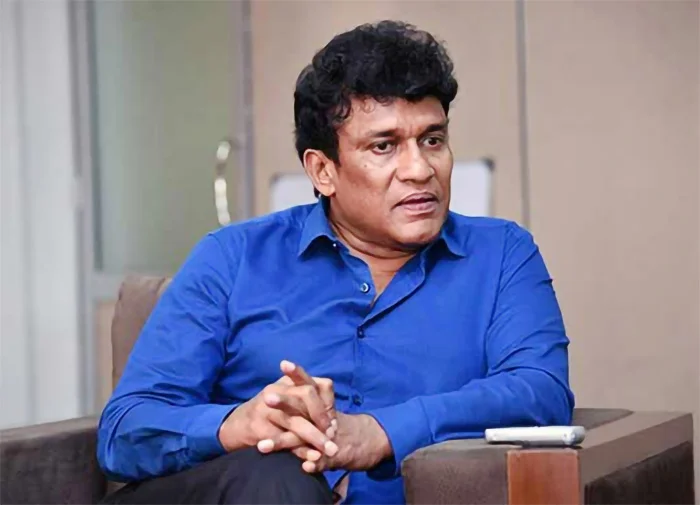
Leader of the Tamil Progressive Alliance (TPA), Mano Ganeshan, MP, said that India shouldn’t intervene here regarding the long-delayed Provincial Council polls.
The former Yahapalana Minister of National Co-existence, Dialogue and Official Languages (2015-2018), Ganeshan, who represents the main Opposition Samagi Jana Balawegaya (SJB) in the current Parliament, stressed that New Delhi’s intervention wouldn’t do any good for them or for us.
Lawmaker Ganeshan said so when The Island asked him whether the TPA would ask India to pressure the NPP government to conduct PC polls, last held in 2014, during Mahinda Rajapaksa’s second term. Ganeshan said: “India shouldn’t get involved in the issue at hand . Such a strategy is also in their interest, particularly in the context of the evolving global order. India should not be perceived as a pro-Tamil state, but rather as a state that supports Sri Lanka as a whole.”
Ganeshan said that the Indian state bears a moral responsibility in this matter. “That responsibility arises from the fact that India’s diplomacy and military intervention played a decisive role in neutralising the Tamil armed struggle in Sri Lanka. Although India’s mission remained unfinished, it nevertheless lost nearly two thousand soldiers in the process. There was also a prelude to this involvement, when Tamil militant groups received training in India. Consequently, the Indian connection became a sensitive issue for both the Sinhalese and Tamils of Sri Lanka.”
But, whatever had happened, the national issue should be settled among us. ” The solution must be found and settled within Sri Lanka itself. We do not need Western interventions in this regard.”
” In recent years, whenever we in the Tamil Progressive Alliance (TPA) have met Indian dignitaries—including the Prime Minister, the External Affairs Minister, and, most recently, the Vice President—the subjects of the 13th Amendment and Provincial Councils have never featured on our agenda.”
The 13th Amendment is part of Sri Lanka’s Constitution. Therefore, it is for Sri Lankans themselves to decide whether to retain, improve, fully implement, reform, or even repeal it, Ganeshan said.
MP Ganeshan found fault with those who represented the Northern and Eastern provinces for failing to utilise the goodwill and influence India enjoyed with successive Governments of Sri Lanka to pursue an amicable political settlement. The parliamentarian said that they should acted after the end of the war in May, 2009. Unfortunately, they failed to effectively use the Provincial Council framework to consolidate their political position and advance further, thereby earning the confidence of both India and successive Sinhala-majority governments, MP Ganeshan said.
Responding to another query, MP Ganeshan said: “
We should keep the ethnic issue separate from bilateral relations with India, while deepening economic connectivity and cooperation on the basis of mutual benefit and a win-win partnership.”
By Shamindra Ferdinando
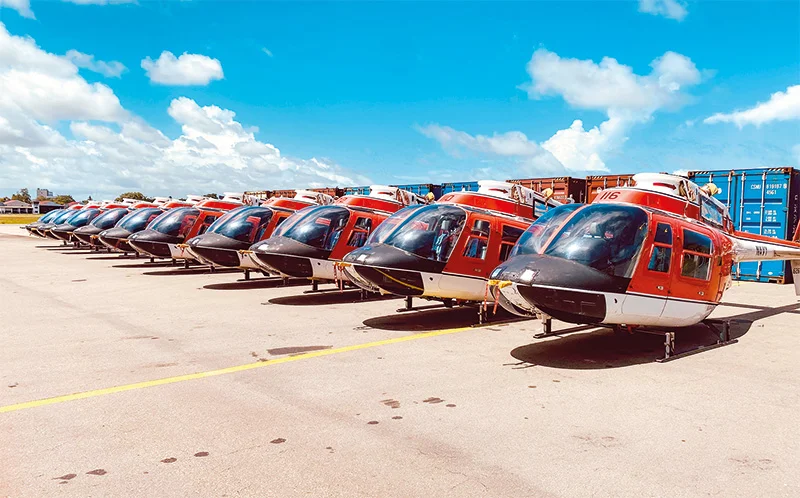
Sri Lanka has taken delivery of 10 TH-57 ‘Sea Ranger’ multi-role helicopters provided by the United States of America to the Sri Lanka Air Force. Air Forces headquarters said that the helicopters arrived here by sea.
The SLAF has said: “The arrival of these aircraft marks a significant milestone in the longstanding defence cooperation between Sri Lanka and the United States and represents a valuable contribution towards enhancing the operational and training capabilities of the Sri Lanka Air Force.
“The helicopters are currently undergoing configurations and technical preparations at SLAF Base Ratmalana. Following the completion of requisite inspections, acceptance procedures and test flights, the aircraft will be inducted into service and deployed for operational duties.
“The TH-57 fleet is expected to significantly strengthen the Air Force’s aviation training capacity while enhancing the ability to support a broad spectrum of national requirements. The aircraft will primarily be employed for pilot training, humanitarian assistance and disaster response (HADR) operations, search and rescue (SAR) missions and other public service commitments undertaken by the Sri Lanka Air Force.”

Ukraine’s Kostyuk blasts Russia stars in French Open outburst over war

Iran armed forces vow to fight ‘to the death’ on Khomeini death anniversary

Urgent meeting called for amid BBL chaos; ACA says merger has caused ‘anxiety’

Measures taken to promote integrity in State Revenue Collection Institutions reviewed

Thailand cracks down on foreign companies using fig leaf of local ownership

US strikes Iran’s Qeshm, says Tehran attacks Kuwait, Bahrain

‘Dates have the highest sugar content to fight Coronavirus’

Sunday Island 27 December – Headlines

#SundayIsland 17th December – Headlines

Sunday Island – 28th March

Sunday Island Headlines – 21 March

Sunday Island – 21st February – Headlines
-
 News4 days ago
IMF urges Lanka not to meddle with exchange rate
-
 Business5 days ago
Sri Lanka’s construction industry losing ground while no one watches
-

 Business2 days ago
IMF’s unstated rate:Sri Lanka’s $695m loan costs about 5.33% per annum
-
 News4 days ago
State of emergency extended
-

 Features5 days ago
The Division Bell Mystery
-
 News2 days ago
UNP challenges NPP move to amend Vihara – Devalagam Act
-

 News1 day ago
Lankan duo emerge winners in Latin dance championship held in Blackpool, UK
-

 Features3 days ago
Are threats to Buddha Sasana external or from within?