
Latest News
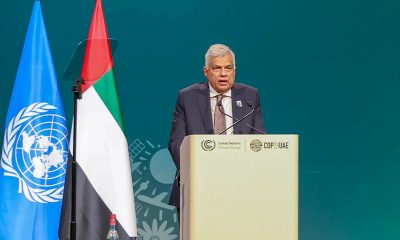
President Ranil Wickremesinghe calls for unified action to safeguard the Indian Ocean

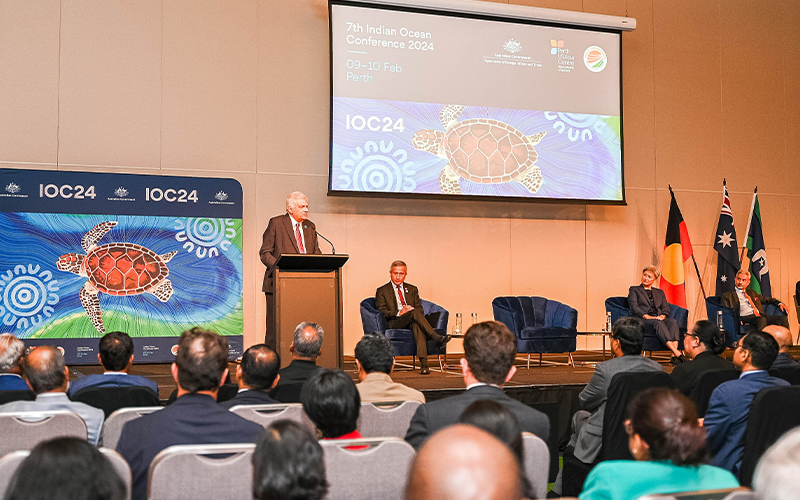
President Ranil Wickremesinghe in his address at the 7th Indian Ocean Conference in Perth, focusing on the theme “Towards a Stable and Sustainable Indian Ocean, ” emphasized the urgency of addressing the climate crisis, noting the Indian Ocean’s vulnerability to warming and rising sea levels. He proposed initiatives such as the Tropical Belt Initiative and the International Climate Change University to mitigate the effects of climate change and ensure climate justice for vulnerable countries.
Following is the full speech delivered by President Ranil Wickremesinghe;
“It is a great pleasure to be here in Perth for the 7th edition of the Indian Ocean Conference. I thank the Australian Government, for the hospitality afforded to all of us. I also thank the India Foundation for once again bringing us together. The theme of this Conference – “Towards a Stable and Sustainable Indian Ocean”- could not be timelier and more appropriate.
The Australasian continent is unique in that it has borders with both the Indian Ocean and the Pacific Oceans. Perth played a crucial role in the history of Sri Lanka – Australia relations. During World War II, Royal Canadian Air Force, Catalina Flying Boats, traversed the expanse of the Indian Ocean, connecting Perth with Koggala Air Base in Ceylon. The only air link between the Indian sub-continent and Australia. Known as flights of the double sunrise, they operated a non-stop route upto 32 hours in radio silence, to ensure the success of a critical air route during World War II for the Allies.
The Japanese attacks in April 1942 on the Indian Ocean specially Ceylon was described by Churchill as the most dangerous moment of the war highlighting the importance of the Indian Ocean to the British Empire. I was just talking with Dr. Balakrishnan and he said there were no carrier battles in the Indian Ocean for the simple reason that the Japanese sank the only British carrier.
Let me highlight a few important developments which I hope will make a contribution to your deliberations.
Firstly, historically speaking, the Indian Ocean is multipolar and has resisted domination by a single power. This multipolarity is a reflection of the essence of the Indian Ocean region and its people. As Asia emerged from colonialism the newly independent countries of Asia ie. Ceylon, India, Indonesia, Burma and Pakistan convened the Bandung Conference in 1955 to oppose colonialism in all its forms. The conference declaration to oppose big power rivalry in turn led to the Non Aligned Movement. Since then the Indian Ocean region has been influenced by the spirit of Bandung. It has never became a part of the US Hub and Spoke system.
The past two decades has seen the emergence of diverse framings of the Indian Ocean region and a flurry of diplomatic activity articulating various policy positions, tilts, and frameworks. What is clear is that no single, objective geopolitical construct has emerged, and we are left instead with a contested vision with multiple interpretations.
The key frameworks that have emerged include in addition to IORA, the Indo-Pacific, the BRI, the QUAD, and the BRICS. There are also regional organizations including ASEAN, ARF (ASEAN Regional Forum), ACD (Asia Cooperation Dialogue) BIMSTEC, SAARC, GCC, Arab League, OIC, SADC, EAC and SCO that have been established. Additionally, we have the operational arrangements that deal with specific areas of cooperation including RCEP, IONS, the Djibouti Code of Conduct, IOTC, Indian Ocean Commission (IOC), MASE, four regional Information Fusion Centres (Singapore, India, Seychelles and Madagascar), and the CGPCS (Contact Group on Piracy off the Coast of Somalia).
Along with these frameworks and groupings, we also see an increased militarization of the Indian Ocean which is redefining power balances and alliances. In the maritime space we see a building up in naval capabilities in India, and with USA, Australia, UAE, Saudi Arabia, and China all increasing their naval presence significantly. Therefore, balancing between the great power rivalries is becoming an increasingly more complex task. As a result, the space for manoeuvrability for littoral states is shrinking fast as this rivalry in the Indian Ocean region intensifies and spills over into decision making on political, economic and security issues. The proverbial question to choose one over the other is perennially hanging over us.
Secondly, the geopolitical developments have resulted in an increase in the strategic importance of the Western Indian Ocean that was not foreseen four years ago. This in turn is shifting the geopolitical emphasis towards the Indian Ocean. The Ukrainian war, and the consequent Western sanctions on Russia has resulted in the resource rich economy finding new markets in China and the Western Indian Ocean. For e.g. Russian Crude Oil is refined in the Gulf refineries. Dubai has replaced London as the financial centre for the oligarchs. Russia has developed a closer friendship with Iran, which is an important source of supply for drones. Russia is carrying on naval exercises with Indian Ocean countries, including Myanmar and South Africa.
China itself has played an active role in healing the rift between Iran and Saudi Arabia. Iran and its allies have become important players in West Asia. The Shanghai Cooperation Organisation, with India, Pakistan and Iran as members have the Western Indian Ocean as its outer limits.
The ill-advised judgment of the US in supporting the Gaza war will diminish its influence in the region. The hostility of the countries forming the Islamic Arch in the Indian Ocean will prevent any close rapprochement with the US for some time. The Russian, Chinese and Iranian strategies are successfully biting at the US hegemony thereby further weakening the US. The Indian Ocean stability requires an early end to the Gaza war followed by,
a. the establishment within 5 years of an Independent Palestine State and
b. guarantees for the security of the state of Israel.
Thirdly, the recent attacks on commercial vessels by the Yemen-based Houthi rebels, is a challenge to the ‘Freedom of Navigation’. We have to ensure access and mobility in the Suez Canal, Red Sea, Bab-el-Mandeb and the Gulf of Aden. In addition, we also face the threat of Somali Pirates, once again. The safety of undersea cables and critical infrastructure are also facing additional threats. The presence of drugs in the Indian Ocean and Human Smuggling has increased. IUU fishing still takes place. These threats present challenges to the Freedom of Navigation. We need to refocus on the freedom of navigation in the Indian Ocean. Sri Lanka offers to recommence the discussions on the Freedom of Nation in the Indian Ocean.
Fourth, is expanding connectivity. According to estimates there will be an eight-fold increase in the GDP of India and Indonesia by 2050. Similar increases are expected in some of the other countries in South and West Asia. This requires additional port capacities and new transport routes. The Suez Canal may not be sufficient. In this regard India’s two new connectivity initiatives are welcome. Firstly, the India (Mumbai) – Iran – Russia corridor and secondly the India (Mumbai) – Middle East – Europe corridor. Similarly, there are connectivity initiatives taking place in the Bay of Bengal. Work has already commenced on the Chongqing – Kyaukphyu corridor giving access to Western China. Thailand is planning the Kra land bridge connecting the Gulf of Siam with the Bay of Bengal. India and Sri Lanka are commencing feasibility studies on land connectivity between the two countries making Sri Lanka a Regional Logistics Hub with Colombo and Trincomalee ports available to South India.
The Indian Ocean Conference theme this year “Towards a more stable and sustainable Indian Ocean” highlights the two key areas which require our focus. What I have outlined before, dealt primarily with pursuing stability of the region. There is an equally serious, more immediate and existential threat that looms and that is the Climate Crisis.
Experts have revealed that the Indian Ocean is warming at a higher rate than the other oceans around the world. The levels of warming are estimated to be three times higher than in the Pacific Ocean and coastal areas across the IOR will experience continuous rise in sea levels and face severe coastal erosion. The Indian Ocean is also rising at a level of 3.7 millimetres annually and extreme sea disasters are inevitable. The island states of the IOR are vulnerable and have to be provided with adequate resources to mitigate the effects of climate change. Changes at sea also affect monsoon patterns and in turn impact on agriculture and food security across the Indian Ocean region. They also impact on the biodiversity and in turn on food and livelihood of people of the littoral states.
The Indian Ocean presents opportunities in terms of ecology. Not only is it our biggest sink for Carbon, but it also provides potential for mitigating the climate crisis, through offshore wind, solar, and wave energy. Through seaweed farming and mangrove cultivation we can increase the sequestration of Carbon. Sustainable exploitation of our Ocean’s resources is critical for our survival, as the Ocean provides for our future.
At COP 28 Sri Lanka proposed three key initiatives, (1) the Tropical Belt Initiative, including the Indian Ocean (2) The International Climate Change University and the Climate Justice Forum. As the current Chair of the Indian Ocean Rim Association (IORA) Sri Lanka is focusing on the interdependence between the Indian Ocean and climate change. The Climate Justice Forum aims to accelerate financing of losses and damages and includes debt justice as an essential component of the overall solution. Any proposals for mitigation and adaptation interventions must take into account the debt component faced by Climate-vulnerable and developing countries.
We are living in uncertain times. The stability we had taken for granted since the end of WWII and the Cold War is unravelling. Globalisation is being challenged as is multilateralism. The Climate Crisis is affecting prospects for trade and economic development around the world. It is impacting on food security, livelihoods, supply chains, biodiversity and maritime transportation. Either we can wait for global developments to dictate our fate or unite, so that we may chart our own course.
Creating a safer ocean environment by building confidence and predictability among users and enhancing ocean situational awareness will be key to maintaining peace and security in the Indian Ocean. The main platform that can undertake this important task is the Indian Ocean Rim Association (IORA). Ensuring a peaceful and secure Indian Ocean would facilitate sustainable use of oceans for the economic and social benefit of coastal and littoral states.
An overarching architecture for the Indian Ocean that deals with critical issues is required. The basis for such a structure is already in existence including the United Nations Convention on the Law of the Sea (1982) and the recently adopted BBNJ agreement in 2023 on the conservation and sustainable use of marine biological diversity of areas beyond national jurisdiction or the High Seas Treaty.
A Code of Conduct on freedom of navigation and over flight and unimpeded commerce and similar guiding principles on dealing with the climate crisis and the sustainable use of the Indian Ocean are a necessity. Only the leaders of the IORA countries can ensure that these measures are translated to the creation of an overarching regional architecture for the Indian Ocean region. Therefore the responsibility lies with us.
I thank you.”








Latest News
Heavy showers above 100 mm are likely at some places in the Western, Sabaragamuwa, Southern, Central, and North-western provinces and in Anuradhapura district.

WEATHER FORECAST FOR 14 OCTOBER 2026
Issued at 05.30 a.m. on 14 October 2026 by the Department of Meteorology
Due to a low-level atmospheric disturbance persisting in the Bay of Bengal near Sri Lanka, cloudy skies and increased rainfall are expected to continue over the island.
Misty conditions can be expected at some places in the Sabaragamuwa, Central and Uva provinces during the early hours of the morning.
Showers or thundershowers will occur at times in the Northern, Eastern, Southern and Western provinces. Showers or thundershowers will occur in other parts of the island after 1.00 p.m.
Heavy showers above 100 mm are likely at some places in the Western, Sabaragamuwa, Southern, Central, and North-western provinces and in Anuradhapura district while fairly heavy showers above 75 mm are likely at some places in other areas of the island.
The general public is kindly requested to take adequate precautions to minimize damage caused by temporary localized strong winds and lightning during thundershowers.
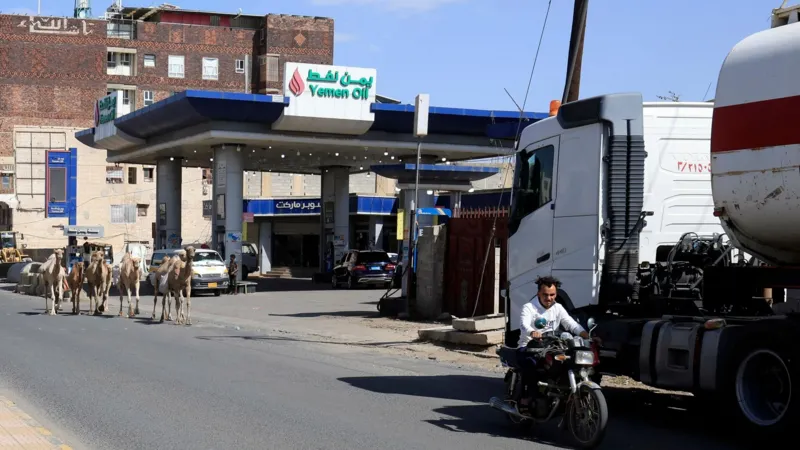
Missiles and drones have been intercepted over Riyadh after the Saudi-led coalition fighting in Yemen struck a fuel depot near the Houthi-controlled capital, Sanaa, its spokesperson says.
Maj Gen Turki al-Maliki said several projectiles targeting the Saudi capital and other cities were intercepted after the coalition carried out a strike on the Yemen Petroleum Company’s al-Sabaha facility on Tuesday night.
The Houthis warned they would target the airport and Aramco refinery in Saudi Arabia’s capital, Riyadh, and Aramco’s headquarters in the eastern city of Dammam.
Al-Maliki later said missiles targeting cities including Dammam had been intercepted, while shrapnel had fallen in a residential area in Dhahran.
It came as the Saudi cabinet, chaired by Crown Prince Mohammed bin Salman, said the Iran-backed group would “bear the consequences” of its recent deadly attacks on the kingdom.
Thirteen people were killed when a missile hit King Khalid International Airport in Riyadh on Saturday, while another person was killed in a similar attack there the following day.
On Tuesday, the coalition said its forces had destroyed three drones north of Riyadh.
The Houthis have said they are targeting airports, oil and gas facilities, and military bases in Saudi Arabia with missiles and drones in response to deadly Saudi strikes on territory that they control in western Yemen, including Sanaa.
The Saudi-led coalition has been providing air support for Yemeni pro-government forces mounting an offensive on Yemen’s Red Sea coast and several other front lines.

A correspondent for AFP news agency reported that queues formed at petrol stations in Sanaa on Tuesday afternoon following the coalition’s warning of an impending operation against the al-Sabaha oil facility, with many residents worried about shortages.
The Yemen Petroleum Company, which is run by the Houthis, issued a statement that sought to reassure them, saying the facility “does not contain any stock of petroleum products”.
The company also said it had “taken all necessary precautionary measures to address any emergency, ensuring the stability of the supply situation and the continued meeting of citizens’ needs in a normal manner”.
After al-Maliki confirmed the strike, first reported by Houthi media, explosions were heard over Riyadh and other Saudi cities, with al-Maliki reporting four missiles and two drones had been intercepted near the capital.
Yemen has been devastated by a civil war that began in 2014, when the Houthis ousted the internationally-recognised government from Sanaa. The conflict escalated in 2015, after the Saudi-led coalition of Arab states intervened in an attempt to restore the government’s rule.
A four-year-old informal ceasefire began to unravel in July, when the Houthis announced a “maritime embargo” against Saudi Arabia and began missile and drone attacks on Saudi airports, oil facilities and tankers in the Red Sea.
The Houthis said they were retaliating for what they call a Saudi blockade of their territory, as well as an air strike on Sanaa airport that they blamed on the kingdom.
The conflict escalated in September after the Houthis seized part of Yemen’s south-western Red Sea coast near the Bab al-Mandab Strait, a chokepoint for global shipping. Their advance contributed to a rise in oil prices following six months of war between the US, Israel and Iran.
US President Donald Trump said on Truth Social on Tuesday the Houthis were “behaving very badly… and purposefully trying to drive up Oil Prices”.
Speaking to reporters, he did not answer a question on whether he’d made a decision to help the Saudis retaliate against them, but said he “might” ask Turkish President Tayyip Erdogan to intervene.
Last week, pro-government forces said they had regained control of territory overlooking Bab al-Mandab after launching a major counter-offensive with the support of Saudi air strikes.
Hundreds of people have reportedly been killed in Yemen since August. The UN’s human rights office says they include at least 54 civilians, half of them children.
More than 216,000 people have also been displaced across the country, and suspected cholera cases have tripled in three weeks, rising from 217 to 647, according to the UN.
[BBC]
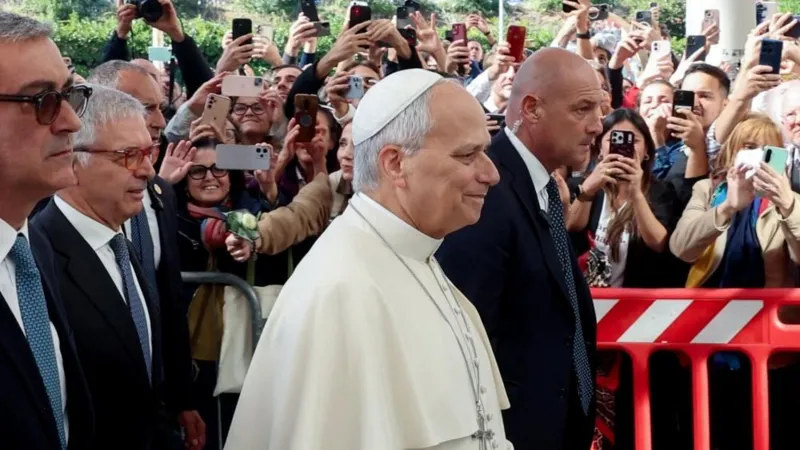
Pope Leo XIV has been diagnosed with lung cancer but had successful surgery to remove a lower lobe of his right lung, the Vatican has said in a medical bulletin.
The 71-year-old underwent a 90 minute surgery on Tuesday at Rome’s Gemelli Hospital and was subsequently diagnosed with lung adenocarcinoma.
“After the operation, the Pope awoke normally and returned after a brief period of observation to his room on the 10th floor,” the Vatican said in a statement.
The lump was first detected during what the Vatican has described as “routine checks”.
Earlier, large crowds gathered outside the hospital to greet the Pope, with some waiting for several hours.
They cheered greetings and well wishes as he passed, while he waved and smiled back through the lowered back window of his car.
He was then met by staff on the hospital steps. “I’m sorry,” one of them commiserated, to which the Pope gave a smile and a shrug. “We’re here for you,” he was assured.
In its statement, the Vatican said the whole lower lobe of the Pope’s right lung was removed “to ensure the procedure was radical”.
A Vatican source told Agence France-Presse news agency further tests were being carried out to see if there was any sign the cancer had spread.
It was Leo XIV himself who on Sunday announced news of his operation to the world, speaking from the balcony in St Peter’s Square after delivering the traditional Angelus blessing.
He said the nodule, or growth, on his lung was “contained” and had been found “at a very early stage”, but that doctors had advised him to have it removed.
Gemelli’s thoracic surgery team operated on the Pope, whose schedule has already been cleared until 20 October to give him time to recover.
Nodules are quite common and not necessarily cancerous, but after it was examined the medical team confirmed it was pulmonary adenocarcinoma, “as suspected by pre-operative tests”, the Vatican said.
The Vatican has stressed that the pontiff, who is generally thought to be fit, had no symptoms of infection or illness.

Cardinal Kikuchi Tarcisio Isao of Tokyo wrote on social media that he’d had an audience with Pope Leo on Monday, and said the pontiff felt “nothing wrong” physically.
He said the Pope had decided to check in for surgery as soon as possible because he was due to travel to Latin America in early November, and was keen to stick to that plan.
The trip is particularly significant because it includes a visit to Peru, where the pontiff was a missionary and then a Bishop for many years.
Despite all the reassurances, the news has shaken Catholics all over the world.
“Am I worried? Yes, because I certainly wasn’t expecting anything like this,” Vatican Secretary of State Cardinal Parolin told journalists on Tuesday.
He agreed that the news was like a “bolt from the blue”, but said the cardinals had been struck by the Pope’s “serenity” and were confident in his recovery.
Outside Gemelli Hospital, which has treated several popes and is home to a large statue of John Paul II, a few Catholics lingered after the pontiff was admitted.
Carla had come specially, wanting to be close.
“He seems calm, so we are calm too – even though illness is always unpleasant,” she told the BBC. “We will wait here and pray.”
[BBC]

Heavy showers above 100 mm are likely at some places in the Western, Sabaragamuwa, Southern, Central, and North-western provinces and in Anuradhapura district.

Sri Lanka, India caught in US-Iran ship crisis

Namal further remanded

IMF projects Lankan economic growth to moderate amidst mounting global uncertainties

Major Gen Pushpakumara assumes command of 56 Infantry Division

Dickwella axed, Bandara earns maiden Test call up

‘Dates have the highest sugar content to fight Coronavirus’

Sunday Island 27 December – Headlines

#SundayIsland 17th December – Headlines

Sunday Island – 28th March

Sunday Island Headlines – 21 March

Sunday Island – 21st February – Headlines
-

 Features7 days ago
The Sri Lankan who made Scottish history
-

 Sports7 days ago
Nissanka absence opens door for Sri Lanka’s young guns
-

 News6 days ago
NDB fraud Rs 60mn more than reported
-

 News6 days ago
Removing monk’s robes matter for Sangha to decide: Mahanayake Theras
-
 News7 days ago
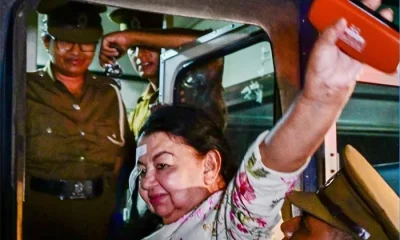
Shiranthi R remanded until 13 Oct.
-

 News4 days ago
Sri Lanka escalates anti-graft drive with Shiranthi’s jailing
-

 Features7 days ago
Future of Sri Lanka’s state university system: Should it be shut down and reopened?
-
 News5 days ago
NPP govt. reminded of its responsibilities as US warship leaves Colombo