
Foreign News
Qatar’s Father Emir Sheikh Hamad bin Khalifa Al Thani laid to rest in Doha


Father Emir Sheikh Hamad bin Khalifa Al Thani, the architect of Qatar’s remarkable transformation into an ultra-wealthy modern nation with global influence, has been laid to rest in Doha following his death at the age of 74.
Sheikh Hamad’s death was announced on Sunday morning, and his simple funeral ceremony was held after the daily evening prayer at sunset at the Imam Muhammad ibn Abd al-Wahhab Mosque in the capital.
Mourners wearing traditional Qatari dress stood with their hands clasped in front of them during a funeral prayer, facing the shrouded body of Sheikh Hamad.
Afterwards, close family members, including his son and successor as emir, Sheikh Tamim bin Hamad Al Thani, carried his body out of the mosque. Sheikh Hamad was laid to rest at the Lusail Cemetery north of Doha.
Al Jazeera’s Zein Basravi said the ceremony was “a humble event” and Sheikh Hamad was “buried in a simple grave”.
“The simplicity really is in keeping with Islamic tradition but also emblematic of how the father emir carried himself in his life,” Basravi said. “He did not concern himself with the trappings of wealth but was focused on the welfare of his own people.”
During Sheikh Hamad’s reign from 1995 to 2013, Qatar’s gross domestic product rose more than 24-fold, largely because of his focus on developing the country’s massive gas resources. By 2006, the small nation had become the world’s largest exporter of liquefied natural gas (LNG).
[Aljazeera]


New Zealand is to introduce a bill seeking to ban under-16s from using social media.
Under the latest proposals, platforms including TikTok, Instagram, Snapchat and Facebook, will have to take steps to check users are over 16 and platforms that fail to meet their obligations could face fines of up to 10% of their global revenue.
Prime Minister Christopher Luxon said social media was exposing children to “harmful content, addictive technology and pressures they are not equipped to deal with”. But several political parties have said they will vote against the bill.
The move follows a similar ban in Australia, while countries including the UK and Greece are set to introduce restrictions next year.
Luxon said social media was affecting children’s family life, mental health, sleep and education.
“We have protections to keep children safe in the real world and we need them in the virtual world too,” he said.
New Zealand’s government has not outlined which other “high risk” platforms could be impacted.
A statement said that under the Online Safety Bill, which is being introduced to parliament on Monday, social media companies would be required to “take reasonable steps” to check users are over the age of 16 by using methods including existing account information, facial age estimation and digital identity checks.
Platforms regularly used by children would also be required to regularly assess the risks they pose and report on how they are being identified and reduced.
No penalties are proposed for children, parents or caregivers for breaches of the ban, but fines for social media companies could be substantially higher than in Australia, where the maximum penalty is $99m.
It is unclear if the bill will get enough votes to pass however, after both the Act and New Zealand First (NZF) parties – which are coalition partners in the government – said they would oppose it.
David Seymour, New Zealand’s deputy prime minister and leader of Act, said the ban would not work.
Foreign affairs minister Winston Peters, who leads the NZF party, said: “We have been concerned with the proposed legislation and the direction and slippery slope that legislation like this will inevitably take our country.”
Peters also described a ban introduced in Australia in December as a “colossal failure”.
The ban has been difficult for Australia to enforce, and it has been widely acknowledged that many children under the age of 16 have still been able to access and use banned apps.
Earlier this month, France’s top court struck down a similar proposed social media ban, saying it infringed upon freedom of expression.
[BBC]
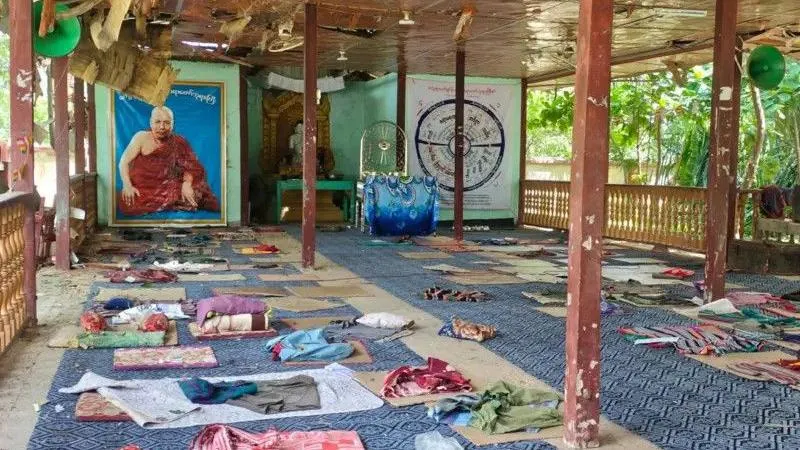
Fourteen people were killed in military air strikes at a monastery in Myanmar early on Friday, opposition fighters and a local rescue worker have said.
All of those killed were elderly and a number of monks were also injured, the rescue worker told BBC Burmese, adding that the site was struck twice.
The attack happened at around 09:00 local time (02:30 GMT) in Myaung township in the central Sagaing region, some 70km (47 miles) west of Mandalay, the news agency AFP reported.
Civilians had reportedly gathered at the site for a meditation retreat to mark Buddhist Lent. Myanmar’s military has not commented.
Nway Oo Myaung, a pro-democracy rebel, told AFP that the victims included 11 men and three women. Five of the victims were said to be from one village, while the remaining nine were from a neighbouring township.
“Older people had entered the meditation centres,” Myaung added, saying the dead were aged between 50 and 70.
A second, unnamed opposition fighter said he had been among those searching for survivors of the attacks.
“While we were trying to rescue people, the aircraft came to bomb a second time,” he said.
Myanmar has been locked in civil war since the military staged a 2021 coup ousting Aung San Suu Kyi, and has been under martial rule since. The military, which is frequently accused of carrying out strikes on public buildings, has previously said it only strikes legitimate targets.
[BBC]

Debiram Panika, a 37-year-old daily wage labourer from northeastern India’s Assam state, would speak to his wife and two daughters on video calls every day from Dimapur, a town in neighbouring Nagaland state where he worked.
But when his phone rang at about 11am on July 19, there was panic in the voice of his 30-year-old wife, Dipika
“I could only see my wife telling me on the video call, ‘This is it for us. We are going to die,’ before the call was disconnected,” Panika recalled, speaking to Al Jazeera.
It was the last time they spoke. Moments later, rising waters from the nearby Dikhow River, which snakes past their village in Assam’s Sivasagar district, surged into their bamboo-and-mud home with a ferocious current and swept away Dipika and four-year-old daughter Radhika.
“The water came flooding like sea waves, and they were gone in a flash,” Panika said, as he stood in front of the ruined home he has since returned to.
Sivasagar is part of the eastern Assam region, also referred to as Upper Assam. Incessant rains between July 18 and July 20 submerged the region and the neighbouring Naga Hills of Nagaland.
Monsoon floods usually impact northern and western Assam, and parts of central Assam, the worst. But several Nagaland districts bordering Upper Assam received heavy rainfall on those three days, leading to dozens of landslides. This intense run-off swelled Naga Hills-origin rivers and caused devastation downstream.
The resultant floods killed more than 100 people, destroyed 2,700 villages, and displaced 700,000 people across the state. The state government says 1.2 million people were impacted in all, their lives disrupted.
Most waters have since receded, but Radhika’s body is yet to be found.
“I look for Radhika every day in the bushes, tirelessly,” Panika said, holding back his tears. “Her last words, calling me ‘Papa’, are still reverberating in my ears.”
Panika’s other daughter, Ridhika, 10, was at a relative’s place a few metres away when her mother and sister were swept away by the flood. Ridhika held onto a bamboo bush and was later rescued by locals.
![A car buried in silt in front of a home affected by floodwater in Sivasagar in India's Assam [Arshad Ahmed/Al Jazeera]](https://www.aljazeera.com/wp-content/uploads/2026/08/A-car-bogged-down-in-silt-in-front-of-home-affected-by-floodwater-in-Sivasagar-Assam-Arshad-Ahmed_Al-Jazeera-1787307390.jpg?w=770&resize=770%2C513&quality=80)
‘Apocalyptic event’
Several riverine villages in Sivasagar have been wrecked by debris carried down by the waters of the Dikhow from the surrounding Naga Hills.
Tens of thousands of tree trunks lie piled up in places that used to be homes, as lush rice fields, the main source of livelihood, have been washed away.
Kukil Das, a 30-year-old Facebook vlogger in Debiram’s village of Nepali Khuti, told Al Jazeera that “the torrent of the flood was like an apocalyptic event seen in the movies.
“Trees as tall as 30 to 40 metres (100-130ft) came down from the hills, flooding the river, and wiped out everything as they crashed against our homes,” he said. “There is no home left. It was a tsunami.”
Das and his friend Shravan Prasad, from the neighbouring Bihubor village, said they saved at least 1,000 lives by using boats the two villages had at that time.
“We put together a group of friends with the seven boats and started rescuing people turn by turn for two days and nights without food and water,” Prasad said.
Das said the floods forced residents to take shelter on the roofs of concrete homes they could find, as cries for help and the sounds of the river washing away homes echoed in the neighbourhood.
Laxmi Sharma, who owned one such concrete house, said she provided shelter to at least 60 people on her terrace after the river water gushed into Nepali Khuti.
“People ran towards the roof of my building. We thought we were going to die,” Sharma, 46, told Al Jazeera. “But it is a miracle that we are still alive even though my house was barely out of water.”
Not everyone could escape the flood’s wrath, though.
In Sivasagar’s Simaluguri village, two friends – Reihana Ahmed, a Muslim, and Ratul Swarna, a Hindu, both in their 30s – were swept away in the torrent.
When Ahmed, a mother of two, was drowning as the deluge entered her village, Swarna, who did not know how to swim, jumped to save her without thinking about his life.
The two friends were later found dead in the paddy fields. “It was humanity that won in a disaster like this,” Ahmed’s husband Aminul Haque said with a sorrowful smile.
![Asor Ali, 75, in Prajabasti, a flood-affected village in Assam, India [Arshad Ahmad/Al Jazeera]](https://www.aljazeera.com/wp-content/uploads/2026/08/20260814_115112-1787307841.jpg?w=770&resize=770%2C578&quality=80)
‘Human-made flood’
Besides the eroding banks of the Dikhow River in Prajabasti, another flood-affected village, 75-year-old Asor Ali sat in disbelief next to his wife, Jamila Khatun.
“Even the generations preceding me have not seen a flood like this,” he said, staring at the flowing river. “Even the 1950s earthquake that triggered the floods here did not do so much damage.”
A magnitude 8.6 earthquake hit Assam and Tibet across the border in 1950, altering the region’s riverine system. Nearly 5,000 people died. Since then, Assam has witnessed frequent floods, which intensify during the monsoons, says Mirza Zulfiqur Rahman, a researcher on the basin of the Brahmaputra, the region’s major river: The Naga Hills rivers that flooded Upper Assam are its tributaries.
But residents say this year’s deadly deluge is not just a natural phenomenon.
Biren Gogoi, 43, says rampant stone and sand mining in regional rivers, coupled with aggressive deforestation and coal extraction in Nagaland’s Mon district, triggered the devastation.
Global Nature Watch, an open-source online platform that provides real-time data on deforestation across the world, showed that Nagaland lost 14 percent of its tree cover between 2002 and 2025, with Mon district bordering Assam’s Sivasagar being the most affected.
According to the latest report published in 2023 by the Forest Survey of India, Nagaland has lost about 794.88 square kilometres (306.9 square miles) of forest cover between 2013 and 2023.
Al Jazeera travelled along the Assam-Nagaland border and saw signs of deforestation on the hills and mining activities in both the states. Satellite images also confirmed rampant coal mining in Nagaland’s Mon district, and stone mining crushers on Assam’s side, especially in Bihubor, one of the epicentres of the Assam flood.
While Mon’s Deputy Commissioner Wennyei Konyak acknowledged the possibility of illegal mining in the district, he added that the land was protected under Indian laws to uphold the rights of Indigenous tribes, and therefore government interference in the area was limited.
“I would not blame mining activities for the flood. It was just the wrath of nature,” he told Al Jazeera.
But experts and political leaders in Assam say mining played a direct role in the floods.
Debabrata Saikia of the opposition Congress party, who is a former legislator from Sivasagar constituency, accused Assam’s governing Bharatiya Janata Party (BJP) of allowing illegal excavations for stone and sand on the Dikhow riverbank, resulting in a cratered wasteland that worsened the floods.
“This unchecked plundering of riverbeds and hills under the ruling government has engineered this into a man-made disaster,” Saikia told Al Jazeera.
Assam Chief Minister Himanta Biswa Sarma, however, rejected the allegation on August 4, blaming excessive rainfall in Nagaland for triggering the Upper Assam deluge. On August 14, Ranoj Pegu, a cabinet minister in the state’s BJP government, blamed erratic rainfall due to climate change for the deluge.
Rahman, the Brahmaputra river basin researcher, believes that while the climate crisis played a role, the flood was “purely human-made”, caused by the fracturing of the landscape.
“Even the generations preceding me have not seen a flood like this,” he said, staring at the flowing river. “Even the 1950s earthquake that triggered the floods here did not do so much damage.”
A magnitude 8.6 earthquake hit Assam and Tibet across the border in 1950, altering the region’s riverine system. Nearly 5,000 people died. Since then, Assam has witnessed frequent floods, which intensify during the monsoons, says Mirza Zulfiqur Rahman, a researcher on the basin of the Brahmaputra, the region’s major river: The Naga Hills rivers that flooded Upper Assam are its tributaries.
But residents say this year’s deadly deluge is not just a natural phenomenon.
Biren Gogoi, 43, says rampant stone and sand mining in regional rivers, coupled with aggressive deforestation and coal extraction in Nagaland’s Mon district, triggered the devastation.
Global Nature Watch, an open-source online platform that provides real-time data on deforestation across the world, showed that Nagaland lost 14 percent of its tree cover between 2002 and 2025, with Mon district bordering Assam’s Sivasagar being the most affected.
According to the latest report published in 2023 by the Forest Survey of India, Nagaland has lost about 794.88 square kilometres (306.9 square miles) of forest cover between 2013 and 2023.
Al Jazeera travelled along the Assam-Nagaland border and saw signs of deforestation on the hills and mining activities in both the states. Satellite images also confirmed rampant coal mining in Nagaland’s Mon district, and stone mining crushers on Assam’s side, especially in Bihubor, one of the epicentres of the Assam flood.
While Mon’s Deputy Commissioner Wennyei Konyak acknowledged the possibility of illegal mining in the district, he added that the land was protected under Indian laws to uphold the rights of Indigenous tribes, and therefore government interference in the area was limited.
“I would not blame mining activities for the flood. It was just the wrath of nature,” he told Al Jazeera.
But experts and political leaders in Assam say mining played a direct role in the floods.
Debabrata Saikia of the opposition Congress party, who is a former legislator from Sivasagar constituency, accused Assam’s governing Bharatiya Janata Party (BJP) of allowing illegal excavations for stone and sand on the Dikhow riverbank, resulting in a cratered wasteland that worsened the floods.
“This unchecked plundering of riverbeds and hills under the ruling government has engineered this into a man-made disaster,” Saikia told Al Jazeera.
Assam Chief Minister Himanta Biswa Sarma, however, rejected the allegation on August 4, blaming excessive rainfall in Nagaland for triggering the Upper Assam deluge. On August 14, Ranoj Pegu, a cabinet minister in the state’s BJP government, blamed erratic rainfall due to climate change for the deluge.
Rahman, the Brahmaputra river basin researcher, believes that while the climate crisis played a role, the flood was “purely human-made”, caused by the fracturing of the landscape.
(Aljazeera)

BCCI AGM set for September 18 in Mumbai

Three franchises sold in Afghanistan Premier League T20

Showers above 75 mm are likely at some places in the Western, Sabaragamuwa and North-western provinces and in Kandy, Nuwara-Eliya, Galle and Matara districts

Govt. determined to press ahead with 22A: Justice Minister

U.S. Ambassador designate to Sri Lanka Eric Meyer here

GL alleges Justice Minister committed contempt of court by ruling out referendum

‘Dates have the highest sugar content to fight Coronavirus’

Sunday Island 27 December – Headlines

#SundayIsland 17th December – Headlines

Sunday Island – 28th March

Sunday Island Headlines – 21 March

Sunday Island – 21st February – Headlines
-

 News5 days ago
Country’s first woman Surveyor General appointed
-

 Business4 days ago
SriLankan Airlines makes ShakthiSAT Mission possible for talented Sri Lankan student
-

 Sports6 days ago
Tharanga, Weber headline stellar Lausanne javelin field
-

 Features5 days ago
Medical education in Sri Lanka: Then and now
-
 Business6 days ago
Mannar’s offshore opportunity: the dollar question behind Sri Lanka’s oil and gas search
-

 Latest News5 days ago
Imran Khan moved to private hospital amid deteriorating health
-

 Latest News5 days ago
Government has declared 21, 22 and 23 August 2026 as national days of mourning
-
Latest News4 days ago
Tharanga edges out Chopra in 88m javelin battle