
Foreign News
‘It was a tsunami’: Floods leave death trail in India’s Assam

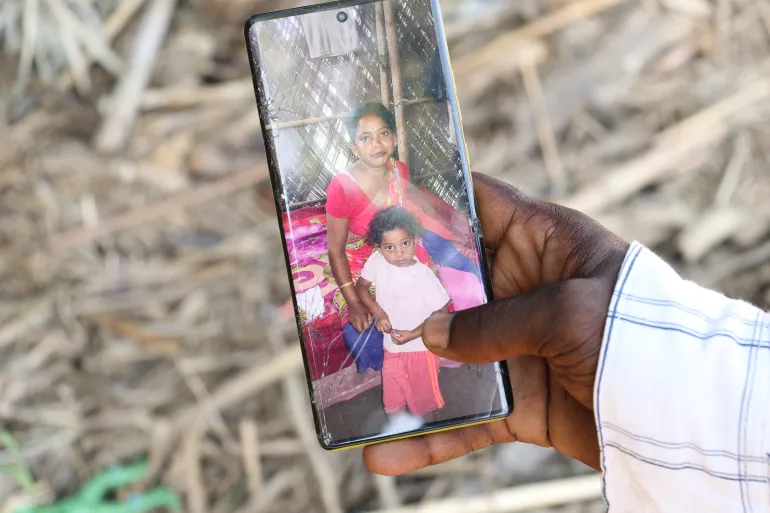
Debiram Panika, a 37-year-old daily wage labourer from northeastern India’s Assam state, would speak to his wife and two daughters on video calls every day from Dimapur, a town in neighbouring Nagaland state where he worked.
But when his phone rang at about 11am on July 19, there was panic in the voice of his 30-year-old wife, Dipika
“I could only see my wife telling me on the video call, ‘This is it for us. We are going to die,’ before the call was disconnected,” Panika recalled, speaking to Al Jazeera.
It was the last time they spoke. Moments later, rising waters from the nearby Dikhow River, which snakes past their village in Assam’s Sivasagar district, surged into their bamboo-and-mud home with a ferocious current and swept away Dipika and four-year-old daughter Radhika.
“The water came flooding like sea waves, and they were gone in a flash,” Panika said, as he stood in front of the ruined home he has since returned to.
Sivasagar is part of the eastern Assam region, also referred to as Upper Assam. Incessant rains between July 18 and July 20 submerged the region and the neighbouring Naga Hills of Nagaland.
Monsoon floods usually impact northern and western Assam, and parts of central Assam, the worst. But several Nagaland districts bordering Upper Assam received heavy rainfall on those three days, leading to dozens of landslides. This intense run-off swelled Naga Hills-origin rivers and caused devastation downstream.
The resultant floods killed more than 100 people, destroyed 2,700 villages, and displaced 700,000 people across the state. The state government says 1.2 million people were impacted in all, their lives disrupted.
Most waters have since receded, but Radhika’s body is yet to be found.
“I look for Radhika every day in the bushes, tirelessly,” Panika said, holding back his tears. “Her last words, calling me ‘Papa’, are still reverberating in my ears.”
Panika’s other daughter, Ridhika, 10, was at a relative’s place a few metres away when her mother and sister were swept away by the flood. Ridhika held onto a bamboo bush and was later rescued by locals.
![A car buried in silt in front of a home affected by floodwater in Sivasagar in India's Assam [Arshad Ahmed/Al Jazeera]](https://www.aljazeera.com/wp-content/uploads/2026/08/A-car-bogged-down-in-silt-in-front-of-home-affected-by-floodwater-in-Sivasagar-Assam-Arshad-Ahmed_Al-Jazeera-1787307390.jpg?w=770&resize=770%2C513&quality=80)
‘Apocalyptic event’
Several riverine villages in Sivasagar have been wrecked by debris carried down by the waters of the Dikhow from the surrounding Naga Hills.
Tens of thousands of tree trunks lie piled up in places that used to be homes, as lush rice fields, the main source of livelihood, have been washed away.
Kukil Das, a 30-year-old Facebook vlogger in Debiram’s village of Nepali Khuti, told Al Jazeera that “the torrent of the flood was like an apocalyptic event seen in the movies.
“Trees as tall as 30 to 40 metres (100-130ft) came down from the hills, flooding the river, and wiped out everything as they crashed against our homes,” he said. “There is no home left. It was a tsunami.”
Das and his friend Shravan Prasad, from the neighbouring Bihubor village, said they saved at least 1,000 lives by using boats the two villages had at that time.
“We put together a group of friends with the seven boats and started rescuing people turn by turn for two days and nights without food and water,” Prasad said.
Das said the floods forced residents to take shelter on the roofs of concrete homes they could find, as cries for help and the sounds of the river washing away homes echoed in the neighbourhood.
Laxmi Sharma, who owned one such concrete house, said she provided shelter to at least 60 people on her terrace after the river water gushed into Nepali Khuti.
“People ran towards the roof of my building. We thought we were going to die,” Sharma, 46, told Al Jazeera. “But it is a miracle that we are still alive even though my house was barely out of water.”
Not everyone could escape the flood’s wrath, though.
In Sivasagar’s Simaluguri village, two friends – Reihana Ahmed, a Muslim, and Ratul Swarna, a Hindu, both in their 30s – were swept away in the torrent.
When Ahmed, a mother of two, was drowning as the deluge entered her village, Swarna, who did not know how to swim, jumped to save her without thinking about his life.
The two friends were later found dead in the paddy fields. “It was humanity that won in a disaster like this,” Ahmed’s husband Aminul Haque said with a sorrowful smile.
![Asor Ali, 75, in Prajabasti, a flood-affected village in Assam, India [Arshad Ahmad/Al Jazeera]](https://www.aljazeera.com/wp-content/uploads/2026/08/20260814_115112-1787307841.jpg?w=770&resize=770%2C578&quality=80)
‘Human-made flood’
Besides the eroding banks of the Dikhow River in Prajabasti, another flood-affected village, 75-year-old Asor Ali sat in disbelief next to his wife, Jamila Khatun.
“Even the generations preceding me have not seen a flood like this,” he said, staring at the flowing river. “Even the 1950s earthquake that triggered the floods here did not do so much damage.”
A magnitude 8.6 earthquake hit Assam and Tibet across the border in 1950, altering the region’s riverine system. Nearly 5,000 people died. Since then, Assam has witnessed frequent floods, which intensify during the monsoons, says Mirza Zulfiqur Rahman, a researcher on the basin of the Brahmaputra, the region’s major river: The Naga Hills rivers that flooded Upper Assam are its tributaries.
But residents say this year’s deadly deluge is not just a natural phenomenon.
Biren Gogoi, 43, says rampant stone and sand mining in regional rivers, coupled with aggressive deforestation and coal extraction in Nagaland’s Mon district, triggered the devastation.
Global Nature Watch, an open-source online platform that provides real-time data on deforestation across the world, showed that Nagaland lost 14 percent of its tree cover between 2002 and 2025, with Mon district bordering Assam’s Sivasagar being the most affected.
According to the latest report published in 2023 by the Forest Survey of India, Nagaland has lost about 794.88 square kilometres (306.9 square miles) of forest cover between 2013 and 2023.
Al Jazeera travelled along the Assam-Nagaland border and saw signs of deforestation on the hills and mining activities in both the states. Satellite images also confirmed rampant coal mining in Nagaland’s Mon district, and stone mining crushers on Assam’s side, especially in Bihubor, one of the epicentres of the Assam flood.
While Mon’s Deputy Commissioner Wennyei Konyak acknowledged the possibility of illegal mining in the district, he added that the land was protected under Indian laws to uphold the rights of Indigenous tribes, and therefore government interference in the area was limited.
“I would not blame mining activities for the flood. It was just the wrath of nature,” he told Al Jazeera.
But experts and political leaders in Assam say mining played a direct role in the floods.
Debabrata Saikia of the opposition Congress party, who is a former legislator from Sivasagar constituency, accused Assam’s governing Bharatiya Janata Party (BJP) of allowing illegal excavations for stone and sand on the Dikhow riverbank, resulting in a cratered wasteland that worsened the floods.
“This unchecked plundering of riverbeds and hills under the ruling government has engineered this into a man-made disaster,” Saikia told Al Jazeera.
Assam Chief Minister Himanta Biswa Sarma, however, rejected the allegation on August 4, blaming excessive rainfall in Nagaland for triggering the Upper Assam deluge. On August 14, Ranoj Pegu, a cabinet minister in the state’s BJP government, blamed erratic rainfall due to climate change for the deluge.
Rahman, the Brahmaputra river basin researcher, believes that while the climate crisis played a role, the flood was “purely human-made”, caused by the fracturing of the landscape.
“Even the generations preceding me have not seen a flood like this,” he said, staring at the flowing river. “Even the 1950s earthquake that triggered the floods here did not do so much damage.”
A magnitude 8.6 earthquake hit Assam and Tibet across the border in 1950, altering the region’s riverine system. Nearly 5,000 people died. Since then, Assam has witnessed frequent floods, which intensify during the monsoons, says Mirza Zulfiqur Rahman, a researcher on the basin of the Brahmaputra, the region’s major river: The Naga Hills rivers that flooded Upper Assam are its tributaries.
But residents say this year’s deadly deluge is not just a natural phenomenon.
Biren Gogoi, 43, says rampant stone and sand mining in regional rivers, coupled with aggressive deforestation and coal extraction in Nagaland’s Mon district, triggered the devastation.
Global Nature Watch, an open-source online platform that provides real-time data on deforestation across the world, showed that Nagaland lost 14 percent of its tree cover between 2002 and 2025, with Mon district bordering Assam’s Sivasagar being the most affected.
According to the latest report published in 2023 by the Forest Survey of India, Nagaland has lost about 794.88 square kilometres (306.9 square miles) of forest cover between 2013 and 2023.
Al Jazeera travelled along the Assam-Nagaland border and saw signs of deforestation on the hills and mining activities in both the states. Satellite images also confirmed rampant coal mining in Nagaland’s Mon district, and stone mining crushers on Assam’s side, especially in Bihubor, one of the epicentres of the Assam flood.
While Mon’s Deputy Commissioner Wennyei Konyak acknowledged the possibility of illegal mining in the district, he added that the land was protected under Indian laws to uphold the rights of Indigenous tribes, and therefore government interference in the area was limited.
“I would not blame mining activities for the flood. It was just the wrath of nature,” he told Al Jazeera.
But experts and political leaders in Assam say mining played a direct role in the floods.
Debabrata Saikia of the opposition Congress party, who is a former legislator from Sivasagar constituency, accused Assam’s governing Bharatiya Janata Party (BJP) of allowing illegal excavations for stone and sand on the Dikhow riverbank, resulting in a cratered wasteland that worsened the floods.
“This unchecked plundering of riverbeds and hills under the ruling government has engineered this into a man-made disaster,” Saikia told Al Jazeera.
Assam Chief Minister Himanta Biswa Sarma, however, rejected the allegation on August 4, blaming excessive rainfall in Nagaland for triggering the Upper Assam deluge. On August 14, Ranoj Pegu, a cabinet minister in the state’s BJP government, blamed erratic rainfall due to climate change for the deluge.
Rahman, the Brahmaputra river basin researcher, believes that while the climate crisis played a role, the flood was “purely human-made”, caused by the fracturing of the landscape.
(Aljazeera)


US authorities have found debris from a medical transport aircraft that went missing with six people on board.
The Federal Aviation Administration told the BBC it had lost contact with the Gulfstream G-100 plane just after 01:00 local time (05:00 GMT) on Saturday, while it was travelling from Bermuda to Boston, Massachusetts.
The search for survivors continues off the coast of Nantucket, a Massachusetts island, the US Coast Guard said.
Authorities have notified the next of kin of those on the flight, four Canadian nationals and two Bermudian nationals.
“Search crews located a debris field confirmed to be from the aircraft off the coast of Nantucket,” the US Coast Guard said in an update on Saturday night. It added that ships, helicopters and planes were involved in searches that would through continue the night.
The plane departed from Bermuda’s L.F. Wade International Airport at 23:40 local time, according to flight data from FlightAware, and was due to land at Boston’s Logan International at 01:30 EDT (05:30 GMT).
According to the tail number released by the Coast Guard, the plane belonged to Latitude Air Ambulances, a company that provides international medical flights for patients returning home.
Among those on board were two pilots and two medical staff, both Canadian, Clarence Togeretz, director of flight operations at Latitude, told CBC News.
The crew flew to Bermuda to collect a patient and their relative, who are not Canadian, Togeretz said.
FlightAware’s tracker shows the aircraft significantly dropped in altitude before its communications went dark, plummeting from around 7,300m (24,000ft) to 3,300m (11,000ft).
Radio transmissions shows trouble with communications between the air traffic controller and the pilot, the Boston Globe reported based on transmissions provided by LiveATC.net.
“You’re coming in blind? Is that what you said?,” the air traffic controller asked. “Are you declaring an emergency, or no?”
The pilot’s response was inaudible.
“You’re coming in a little weak so I didn’t hear what your response was, if you were declaring an emergency or not,” the air traffic controller said, according to the Globe.
The air traffic controller later confirmed the pilot had declared an emergency.
An area fire dispatcher asked emergency crews just after 01:00 EDT to prepare to meet a plane with an “electrical issue”.
The dispatcher later said “the aircraft has lost radio and radar”.
The Coast Guard said it would provide an update on Sunday morning local time.
[BBC]

A car has crashed into a crowd of rugby league supporters in the eastern Australian city of Newcastle, injuring 10 people, including three children.
New South Wales police said on Saturday that two of the injured – a five-year-old girl and a 67-year-old man – were in a critical condition and the other eight were in stable condition in hospital.
Police said they had arrested the 18-year-old man driving the vehicle and were investigating what happened. They said the crash was not believed to be related to “terrorism”.
The crowd had gathered to farewell the local rugby league side, the Newcastle Knights, ahead of their grand final against the Sydney Roosters on Sunday.
Newcastle Lord Mayor Gavin Morris said the driver, a rugby league fan, had lost control of his vehicle and had been taken into custody.
“He was revving the car, he was excited, he was a supporter, he was there for the joy of the moment,” Morris told the national broadcaster ABC.
“Somehow he lost control of the car … and he’s gone into the crowd,” he added.
Prime Minister Anthony Albanese said: “My thoughts are with everyone injured or involved in the horrible incident this morning in Newcastle.”
“Rugby league brings people together, and this should have been a weekend of excitement and pride for Newcastle fans,” he wrote in a social media post.
[Aljazeera]

Polls have opened in Latvia for an election taking place against the backdrop of perceived security threats from Russia and a nationwide cost-of-living squeeze.
Saturday’s vote is the first electoral test for Prime Minister Andris Kulbergs after coming to power in May this year when his predecessor resigned due to a backlash from stray drone incursions from Ukraine.
Kulbergs, whose right-wing United List party is currently polling at about 20 percent, is expected to hold onto his position, but the decline of two allies in his current coalition means he is set for a complicated negotiation over the makeup of any future government.
Polls opened at 05:00 GMT and will close at 17:00 GMT. The results are not expected to change Latvia’s pro-European and pro-Ukrainian course.

About 1.5 million people are eligible to vote in the country’s 11th parliamentary election since independence from the Soviet Union in 1991.
Latvian politics are highly fragmented, with parties rarely seeing above 20 percent vote share and coalitions being the norm.
This year, 14 electoral lists are contesting the election, but polls indicate only seven are likely to enter parliament, with the rest expected to fail to meet the minimum 5 percent vote threshold.
Rising living costs, low wages, strains on the healthcare system and long-term population decline have all featured prominently in campaign debates.
Most parties in Latvia are pro-Ukraine; however, the populist Sovereign Power party – which says it wants Ukraine to win but argues money spent supporting Kyiv would be better spent at home – looks likely to become the country’s second-biggest party, with more than 9 percent of the vote. Most other parties have ruled out forming a coalition with Sovereign Power.
Latvia First, a pro-Ukraine and populist nationalist party currently polling at about 9 percent, could be a potential coalition partner for PM Kulbergs.
The Progressives, a pro-European social democratic party, are polling at 6 percent.
Ethnic Russians make up roughly one in four Latvian citizens, but their vote, which has traditionally been cast along identity-based lines, looks set to be made according to economic and social issues.
Latvia is the poorest of the Baltic states, and it has sharply increased its defence spending since Russia invaded Ukraine, now allocating nearly 5 percent of its gross domestic product (GDP) to defence.
[Aljazeera]

Showers or thundershowers will occur at several places in the most part of the island after 1.00 p.m

Geneva takes up Sallay’s case and govt. ignores opportunity to answer accusations

Section of wartime KKS High Security Zone vacated to facilitate economic development in the area

Lawyer lodges complaint against Govt. Printer, Media Ministry Secy.

Sri Lankan troops in joint anti-terrorist exercise in Russia

Nine Indian poachers brought to KKS with their boat

‘Dates have the highest sugar content to fight Coronavirus’

Sunday Island 27 December – Headlines

#SundayIsland 17th December – Headlines

Sunday Island – 28th March

Sunday Island Headlines – 21 March

Sunday Island – 21st February – Headlines
-

 Latest News6 days ago
Gold winner Tharanga gets brand-new Honda Vezel from SLAAJ
-

 Features6 days ago
Why Sri Lanka needs an Inclusive Civic Nationalism – urgently
-

 News5 days ago
US-assisted ‘Ice’ detection: NPC to examine IGP’s move to transfer drug-busting team
-

 Features7 days ago
Thailand’s biggest new global star …
-

 Editorial4 days ago
Colombo Port drug bust: The plot thickens
-

 News6 days ago
Civil society activist accuses govt. of favouring Ven. Gnanasara
-
 News7 days ago
First cases taken up by SC after enactment of 22A dismissed
-

 Editorial7 days ago
Aftershocks of 22A