
Latest News
President Ranil Wickremesinghe advocates bold climate action at COP28

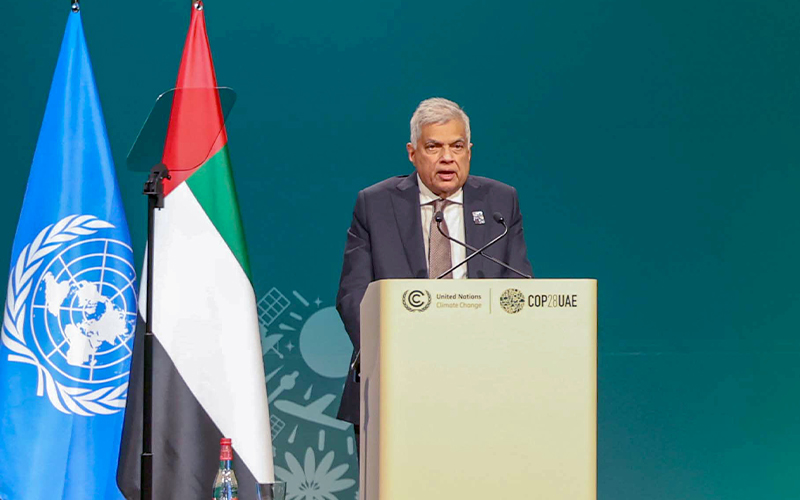
Addressing the 28th session of the Conference of Parties (CoP28) to the United Nations Framework Convention on Climate Change (UNFCCC) in Dubai, UAE on Friday (01), President Ranil Wickremesinghe acknowledged the historical significance of the UN Conference on Human Environment, emphasizing its goal to defend and improve the environment for present and future generations. He referenced the alarming findings of the UNEP Report of 2023, titled “Broken Promises,” which warns of a 3-degree Celsius increase in global temperatures by the end of the century.
Highlighting the challenges faced by developing countries, President Wickremesinghe stressed the disproportionate vulnerability and impact due to lower adaptive capacities in Finance, Technology, and Climate investments. He cited the Independent High-Level Expert Group Report on Climate Finance, which underscored the need for at least a US$ Trillion per annum to combat climate change.
The President commended the Government of the United Arab Emirates for hosting the crucial event and expressed gratitude for their warm hospitality
Expressing concern about the lack of concrete measures in the Transitional Committee’s report on funding arrangements, the President called for a more transparent approach, particularly addressing issues of global debt relief. He questioned the wisdom of avoiding contentious issues, emphasizing the urgency of the climate crisis.
President Wickremesinghe advocated for climate justice accessible to all nations and proposed a resolution for a Climate Justice Forum. This forum, agreed upon at the 5th Forum of the Ministers of Environmental Authorities of Asia Pacific, aims to provide a platform for constructive and proactive engagements, with the proposal scheduled for the UN Environment Assembly on 6th February 2024.
Underlining the critical nature of the current period, the President urged immediate action to find effective solutions, thinking outside the box and investing in the Tropical Belt to tackle the Triple Planetary Crisis. The Tropical Belt, covering 134 countries and 44% of the Earth’s surface, holds rich biodiversity and potential for renewable energy. President Wickremesinghe announced plans for a panel to report on the Tropical Belt Initiative, emphasizing its global impact.
As the current Chair of the Indian Ocean Rim Association (IORA), President Wickremesinghe linked the health of the Indian Ocean to climate change. He stressed the need for a sustainable Blue Economy to counter the adverse effects of rising sea levels, ocean acidification, coral bleaching, and extreme weather patterns.
President Wickremesinghe also revealed plans to establish the International Climate Change University (ICCU) for capacity building and advancing research, operationalizing it next year. The ICCU aims to contribute significantly to global efforts to limit global warming to 1.5 degrees Celsius.
In conclusion, President Wickremesinghe’s address at COP28 outlined a comprehensive approach, blending regional initiatives like the Tropical Belt and the Indian Ocean with global measures, reflecting Sri Lanka’s commitment to climate action and leadership on the international stage.
The speech made by the President at the World Leaders Summit of the COP28:
“Chairperson, Excellencies, Esteemed Delegates, At the outset let me congratulate his highness and the Government of the United Arab Emirates for hosting COP28 and extend to you my gratitude for your warm hospitality.
The UNEP Report of 2023 “Broken Promises” warned that we are facing a 3 degree Celcius increase in global temperatures by the end of the century. It is we; the developing countries are both disproportionately vulnerable and disproportionately impacted due to their lower adaptive capacity when it comes to investments in Finance, Technology and Climate.
The Independent High-Level Expert Group Report on Climate Finance highlighted that at least a Trillion USD per annum is required to combat climate change. The Transitional Committee on the Operationalization of Funding Arrangements in its Report of 4th November 2023 only calls for voluntary contributions to the “Loss and Damage fund”. The Report makes no mention of the funds needed or who the contributors are. It is silent on the issue of global debt relief. These are interconnected’
Nevertheless, four days later, the Technical Dialogue of the First Global Stocktake highlighted the requirements of a minimum of US$ trillion per annum. To arrive at a consensus not to take up a contentious issue is not a solution. Who are we fooling?
Climate justice must be available to all the people and all the countries. In this background, Sri Lanka will propose a resolution for a Climate Justice Forum which was agreed upon at the 5th Forum of the Ministers of Environmental Authorities of Asia Pacific to be moved at the UN Environment Assembly of 6th February 2024.
The Climate Justice Forum will provide us a platform for constructive and proactive engagements. The Secretary General of the UN highlighted, “The era of global boiling has arrived”. The enemy is at the gates. We are still procrastinating. We are still forming our battalions to take the fight to the enemy. Therefore, this fortnight is critical.
It will determine whether we are capable of providing a leadership. Let us prove we can do so by action and delivery.
Sri Lanka is committed to the 1.5 degree Celcius limit. We are facing a drastic situation to await the disaster. We must think outside of the box. We must Invest in the Tropical Belt to tackle the Triple Planetary Crisis.
The Tropical Belt constitutes 134 countries covering 44% of earth’s surface, and will by 2030s be home to roughly 50% of world’s population. Most of the world’s remaining primary forests are tropical, along with its coral reef systems. The rich biodiversity of the Tropical Belt enhances biological carbon sequestration and can shield the world from instabilities in weather.
Furthermore, the energy generation potential from solar, wind and biomass are significantly higher in the tropics than that of other areas on the earth. Yet, anthropogenic activities in the Tropical Belt can easily lead to an imbalance in the equilibrium of this region.
So much so that some scientists predict that the Tropical Rain Belt could shift away from the Equator by the 22nd Century. Large scale investments in Renewable Energy, Pollution Control and Nature-based Solutions will lead to significant transformative changes in the entire world by enhancing carbon sequestration.
Therefore, Sri Lanka and other concerned countries will convene a panel to report on the Tropical Belt Initiative. A multi sector plan distributed not only among the whole tropical region but the whole world. As the current Chair of the Indian Ocean Rim Association (IORA), Sri Lanka is focusing on the interdependence between the Indian Ocean and climate change.
A healthy ocean generates oxygen and absorbs the carbon and heat produced from global warming. Mangroves and sea grasses sink more carbon than land forests. However, the rapid climate change is altering the marine environment with rising sea levels and temperatures, Ocean acidification, coral bleaching, habitat destruction and extreme weather patterns. These phenomenon have a direct impact on human lives by disrupting ocean biodiversity, the Ocean dependent food patterns, and coastal livelihoods. Member states and partners of IORA will work towards ensuring a sustainable, Indian Ocean for future generations.
The Tropical Belt initiative and the Indian Ocean IORA program combined will form the largest global sink for carbon sequestration. Addressing the climate change need, up to date scientific knowledge, and the effective use of these findings
Therefore, at COP27, I proposed to establish an International Climate Change University (ICCU) for capacity building and advancing research, necessary to contribute to the crucial efforts to limiting global warming to 1.5 degrees Celsius. We will be operationalizing the International Climate Change University (ICCU) next year.
Ministers Ali Sabry, Keheliya Rambukwella, Kanchana Wijesekera, and Member of Parliament Madhura Withana represented the government, while Members of Parliament. Champika Ranawaka and Ajith Mannapperuma represented the Opposition. Additionally, Senior Adviser to the President on Climate Change Ruwan Wijewardena, Secretary of the Ministry of Environment Dr. Anil Jasinghe, Director of International Affairs Dinouk Colomboge, Adviser to the Ministry of Finance Deshal De Mel, and President’s Private Secretary Ms. Sandra Perera were also present.
(PMD)









Bus fares have been increased by 12.19% with effect from midnight today [23rd March 2026].
The minimum fare will be increased from Rs 27 to Rs 30 while the maximum fare of Rs2159/- will be increased to 2422/-
Latest News
Public will not be served as Computer system failure at Department of Registration of Persons
The Acting Commissioner General of Registration of Persons has announced that due to an unexpected failure of the computer system of the Department of Registration of Persons, all services, including the one day service will not be held on Tuesday (24th March) at the Head Office and all Provincial offices.

Latest News
Trump says he is postponing strikes on Iran power plants after ‘productive’ talks on ending war

Donald Trump says the US and Iran have held talks on the “complete and total resolution of hostilities” in the Middle East
He says that, as a result of the talks, he has postponed threatened strikes on Iranian power plants and oil and gas fall immediately after.
On Saturday night, Trump had given Iran a 48 hour deadline to reopen the Strait of Hormuz. – or, he said, the US would “obliterate” Iranian power plants
An Iranian news agency quotes an unnamed source saying there have been no talks between Teheran and Trump.
Earlier, the UK’s Keir Starmer and Trump agreed that reopening the Strait of Hormuz is “essential to resume global shipping” during a call late on Sunday according to Downing Street
Meanwhile, the Israel Defense Forces (IDF) says it expects to face ‘several more weeks of fighting against Iran and Hezbollah in Lebanon
(BBC)

Two killed when Air Canada jet hits fire truck at NYC’s LaGuardia Airport

Bus fares increased by 12.19% from midnight today [23]
Public will not be served as Computer system failure at Department of Registration of Persons

Trump says he is postponing strikes on Iran power plants after ‘productive’ talks on ending war

Asia stocks slide as US and Iran threaten to escalate war

Heat Index at Caution Level in the Western, Sabaragamuwa, Southern and North-western provinces and in Anuradhapura, Mannar and Vavuniya districts

‘Dates have the highest sugar content to fight Coronavirus’

Sunday Island 27 December – Headlines

#SundayIsland 17th December – Headlines

Sunday Island – 28th March

Sunday Island Headlines – 21 March

Sunday Island – 21st February – Headlines
-

 News6 days ago
CIABOC questions Ex-President GR on house for CJ’s maid
-

 News7 days ago
Sri Lankan marine scientist Asha de Vos honoured at UNGA opening
-

 News7 days ago
Australian HC debunks misleading travel risk claims for Sri Lanka
-
 News5 days ago
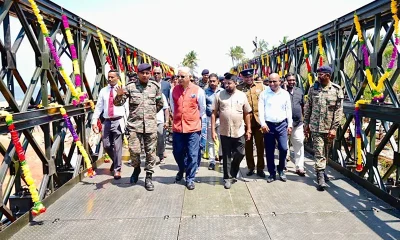
Bailey Bridge inaugurated at Chilaw
-

 News5 days ago
Pay hike demand: CEB workers climb down from 40 % to 15–20%
-
 News4 days ago
CIABOC tells court Kapila gave Rs 60 mn to MR and Rs. 20 mn to Priyankara
-

 Editorial6 days ago
Couple QR-based quota with odd-even rationing
-

 Features1 day ago
Trincomalee oil tank farm: An engineering marvel