
Business
Once the pride of Hong Kong, Cathay Pacific becomes government’s punchbag

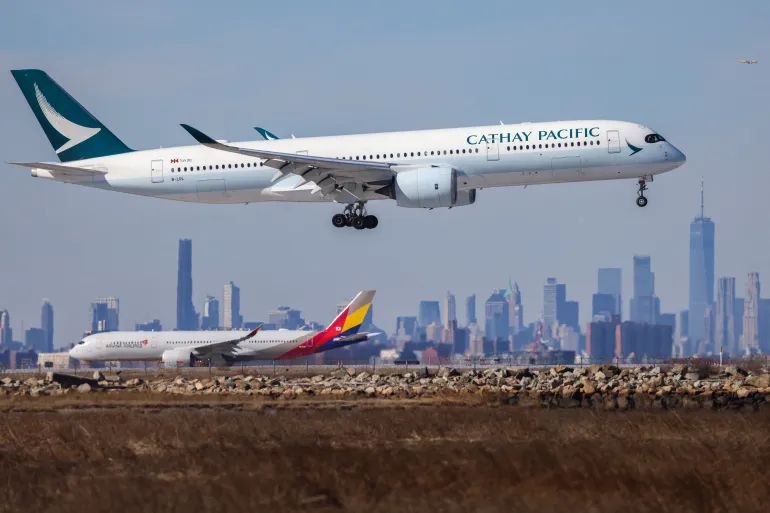
For decades, Hong Kong’s Cathay Pacific Airways (CPA) stood as a proud symbol of the city’s international status and an exemplar of Asian aviation.
These days, the flagship carrier is treated more like the Chinese-ruled financial hub’s bete noire, regularly receiving severe scrutiny and criticism from its own government as it struggles to recover from the fallout of the COVID-19 pandemic.
After Cathay cancelled more than 700 flights scheduled between December and February, Hong Kong Chief Executive John Lee Ka-chiu told local reporters he was “very concerned” and wanted local aviation to “rebuild its capacity fast”.
Criticism from the Transport and Logistics Bureau was followed in March by Cathay CEO Ronald Lam Siu-por being subject to a public grilling by the Legislative Council, where lawmakers slammed the airline’s “chaotic management”.
In an article the following month, the pro-Beijing South China Morning Post newspaper published an article with the headline: “Can Cathay Pacific get its act together, or is it time for Hong Kong authorities to take a stake in the airline?”
The Hong Kong government has so far rejected calls to take a stake in Cathay to ensure the semi-autonomous territory’s status as an aviation hub, a scenario envisioned in Beijing’s 14th five-year national plan – a practically sacred text in Hong Kong business circles these days amid the growing influence of the Chinese mainland.
“It is not the government’s intention to become a long-term shareholder of CPA,” a spokesperson for the Transport and Logistics Bureau told Al Jazeera.
Most observers agree with the Hong Kong Aviation Officers Association’s (HKAOA) assessment that a pilot shortage is at the core of Cathay’s woes – the result of Hong Kong imposing some of the world’s longest-lasting and most draconian travel restrictions during the pandemic.
In January 2020, more than 5.7 million passenger movements were reported at Hong Kong International Airport (HKIA).
By April, the figure had dropped to just 31,739 – about 0.55 percent of pre-pandemic levels.

Despite its heavy reliance on international travel and trade, Hong Kong was one of the last jurisdictions on the planet to reopen to the world, only fully lifting restrictions in early 2023.
Cathay’s management fired 1,000 pilots in 2020 and saw a further 1,000 resign over the next couple of years, according to the HKAOA.
Many pilots who quit cited the stress of complying with Hong Kong’s ultra-strict quarantine rules, which forced the airline to operate “closed loop” flights, where crew were required to isolate for five weeks in a hotel followed by two weeks at home.
Cathay has said it has more than 2,900 pilots, including at its subsidiary budget carrier Hong Kong Express, but needs 3,400 to restore pre-pandemic capacity.
It has announced “robust plans” to hire another 500 pilots.
Some observers have said the government’s criticism is especially unfair given that its rigid restrictions caused many of Cathay’s difficulties in the first place.
“Cathay is still one of the best-performing airlines in the world with good financial performance compared to the three top Chinese carriers – reporting about 10 billion Hong Kong dollars of profit,” Zheng Lei, chair of the Department of Aviation at Swinburne University, told Al Jazeera.
In March, Cathay reported its first annual profit in four years of 9.78 billion Hong Kong dollars ($1.25bn).
“We achieved our end-2023 Group target of 70 percent pre-pandemic passenger flights as planned, only 12 months after Hong Kong opened up. We will reach 80 percent within this quarter, and we are working towards reaching 100 percent within the first quarter of 2025,” a Cathay Pacific spokesperson told Al Jazeera.
“The city has been our home for more than 77 years, and we represent Hong Kong on the global stage as its home carrier,” the spokesperson added.
While these encouraging results prompted CEO Ronald Lam to proclaim that “Cathay is back”, few in government circles seem to be celebrating their flag carrier’s return.
“Some of the government criticism might be justified in relation to flight cancellations, service and chaotic management – these issues need to be addressed. But Cathay has done a lot to rectify the situation, and they are actively recruiting pilots from China,” Lei said, adding that improving customer service is much easier than turning around a loss-making airline.

Cathay received significant government financial support during the pandemic, which critics argue imposed a moral obligation on the airline to maintain its standards and human resources.
“For me, the key point is that the Hong Kong government stepped in to support Cathay Pacific so the Hong Kong aviation sector would be preserved – and it wasn’t,” Paul Weatherilt, chairman of the HKAOA, told Al Jazeera.
Lei agreed, pointing out that mainland China’s top airlines did a much better job at staff retention.
The government in June 2020 provided Cathay with a 7.8 billion Hong Kong-dollar ($998m) bridge loan and purchased shares with detachable warrants of 19.5 billion Hong Kong dollars ($2.49bn).
Cathay redeemed half of the preference shares held by the government in December 2023 and the loan option was never exercised.
Weatherilt said Cathay had taken advantage of the pandemic to force permanent redundancies, pay cuts and worsened conditions on staff.
“Of course, China was slow to emerge from the pandemic, but nearly every other airline made temporary cuts and tried to keep core skills and assets in place,” Weatherilt said.
“Cathay has left Hong Kong aviation in a sorry place.”
The Hong Kong government has said that when it offered financial support, it specifically requested Cathay to “fully consider the potential impact on Hong Kong’s status as an international aviation hub and Hong Kong’s aviation network”.
Weatherilt said the government’s stance leaves the airline in a vulnerable position.
“Swire should be extremely worried because it stands out like a sore thumb – the company that controls Hong Kong aviation is ultimately run by a company in London,” said Weatherilt, referring to John Swire & Sons Limited.
As China tightens its control of Hong Kong, politics and colonial baggage stemming from Britain’s former administration of the territory increasingly lurk beneath the surface in business.

Cathay has been in Beijing’s cross-hairs since mass pro-democracy protests swept the territory in 2019.
Rupert Hogg, Cathay’s British chief executive, and Paul Loo, the chief customer and commercial officer, resigned in August of that year following pressure from the Chinese authorities to crack down on employees who supported the protests.
At the same time, pilots were subject to rigorous new ground checks imposed on any Cathay aircraft landing at airports in mainland China.
Chongxian Ma, deputy secretary of the Communist Party Committee of Air China, was made a non-executive director of the company in June 2021. Two more Communist Party non-executive directors were added to the board in May 2022 and July 2023.
In May last year, Cathay issued a public apology after a recording of flight attendants making fun of a non-English-speaking passenger was shared on social media.
When Bloomberg reported earlier this year that Beijing-based Air China was considering increasing its 29.99 percent stake in Cathay, some observers assumed it to be part of China’s patriotic drive to obtain a firmer grip over Hong Kong’s flag carrier.
However, one industry insider, speaking on condition of anonymity, told Al Jazeera that the move was more likely based on financial logic, as Air China depends on its Cathay stake to offset its own financial losses.
While ousting Cathay as Hong Kong’s flag carrier in favour of a Chinese-owned operator might please some nationalist elements, there is little dispute that there are no credible alternatives to Cathay, at least not in the short or medium term.
“It would not be easy for the government to develop an airline as an alternative flag carrier – it’s not feasible and not a good idea,” Lei said.
Some observers believe that British-owned Cathay Pacific presents a convenient target for politicians eager to boost their patriotic credentials, especially since criticism of the government has become highly sensitive and potentially illegal under the Beijing-drafted National Security Law passed in 2020.
On Wednesday, Hong Kong lawmaker Jeffrey Lam Kin-fung told local media that Cathay should roll out direct passenger services to the eight small Chinese mainland cities recently chosen by Beijing for relaxed travel restrictions to Hong Kong.
This would “fully capitalise on Beijing’s goodwill measures”, Lam said.

Inevitably, political interference is a growing concern.
Using Cathay as a public punching bag could be counterproductive for Hong Kong as it struggles to re-establish itself as a vibrant city, financial epicentre, tourism hotspot and business gateway to China.
Unlike Hong Kong’s stance towards Cathay, Dubai’s government did not attack Emirates Airways after tens of thousands of its passengers were left stranded in April following extreme flooding in the United Arab Emirates.
“Cathay will never complain in public, but they have good reason to feel aggrieved,” one industry insider who works closely with Cathay management told Al Jazeera on condition of anonymity.
While local rival Singapore reported a return to pre-pandemic passenger activity in February this year, Hong Kong still lags behind.
Passenger traffic at Hong Kong International Airport for March 2024 was 4.35 million – about two-thirds the figure during the same month in 2019.
“There must be collective responsibility for the loss of interest in Hong Kong, which arose partly from the protests of 2019 – which greatly damaged the SAR’s reputation as an aviation, financial and tourist destination – as well as the draconian measures imposed during COVID,” Shukor Yusof of Endau Analytics told Al Jazeera, referring to Hong Kong’s official designation as a Special Administrative Region.
Hong Kong’s image has also been battered by negative media coverage of its crackdown on dissent, including the high-profile prosecution of former media mogul, Jimmy Lai.
As both Hong Kong and Cathay seek to rebuild, what is certain is that their fates remain inextricably linked.
“If the government wants to develop Hong Kong as a finance hub and if Hong Kong is to return as a hub for global aviation, more support should be given to Cathay Pacific Airways, rather than criticism,” Lei said.
[Aljazeera]


Samagi Spice Exports (Pvt) Ltd is set to introduce SPICEUP, a new Sri Lankan beverage brand, at its grand launch on Saturday 17 October 2026 at the University of Ruhuna, Matara.
With a history dating back to 1969, Samagi Spice is taking a new step in its business journey by expanding beyond traditional spice exports into value added consumer products.
Through SPICEUP, the company aims to connect Sri Lanka’s internationally recognized cinnamon heritage with contemporary beverage innovation, creating a distinctive identity in the country’s beverage market.
The SPICEUP range will feature a variety of products, including Original, Cream Soda, Power, GO, Cool, Burn, Memo+ and Zingy. Designed to offer consumers a range of refreshment experiences, the products will be available in two packaging formats: cans and plastic bottles, catering to different consumer preferences and occasions.
At the heart of the initiative is the potential of true Ceylon cinnamon as a value-added ingredient in the beverage industry. Rather than limiting cinnamon to its traditional uses, SPICEUP seeks to explore new opportunities for bringing this iconic Sri Lankan spice into everyday consumer experiences.
The initiative also highlights the broader potential of transforming the country’s agricultural resources into innovative products with commercial value.
The launch ceremony will be attended by legendary Sri Lankan cricketer Sanath Jayasuriya as the Chief Guest, alongside representatives from the Export Development Board (EDB), Industrial Development Board (IDB), Cinnamon Research Academy and other industry stakeholders.
A major highlight of the occasion will be the official unveiling of the SPICEUP product range, followed by the launch of the brand’s official website. The event will also feature the signing of a Memorandum of Understanding (MoU) between Samagi Spice Exports and the University of Ruhuna, marking an important step towards strengthening collaboration between industry and academia.
The proposed collaboration will provide a platform for future research, product innovation and value addition involving true Ceylon cinnamon. By bringing together business expertise and university-based knowledge, the initiative aims to support the development of innovative, value-added products and contribute to Sri Lanka’s potential in international markets.
With its roots in the country’s spice industry and its ambitions in the beverage sector, SPICEUP is poised to begin a new chapter in Samagi Spice’s journey—one that seeks to bring the distinctive identity of Ceylon cinnamon to a new generation of consumers.

Business
Indian business leader urges SL entrepreneurs to tap into India’s rapidly expanding consumer market


By Sanath Nanayakkare
Speaking at the Sri Lanka Economic and Investment Summit 2026, T. Krishnakumar, Chief Executive Officer of Reliance Consumer Products Ltd (RCPL), emphasised that local enterprises can unlock substantial economic benefits by strategically aligning with India’s booming consumer base.
Addressing business leaders and policymakers at the Shangri-La Hotel in Colombo, Krishnakumar highlighted that geographical proximity and rich cultural ties provide a natural foundation for deeper commercial collaboration.
He noted that instead of viewing bilateral trade narrowly, regional partnerships should act as conduits to build robust, scalable enterprises capable of plugging into wide-reaching regional value chains.
“For Sri Lankan exporters dealing in traditional staples as well as value-added goods, accessing India’s rising middle class presents a phenomenal growth window,” he said.
Drawing insights from Reliance Consumer Products’ rapid expansion – which scaled efficiently to thousands of employees and multi-billion-dollar metrics – Krishnakumar stressed that modern corporate success relies on disciplined execution, localised consumer understanding, and smart technology integration.
Furthermore, he underscored that while rapid growth is critical, businesses must consistently anchor their models in affordability and consumer trust.
Concluding his address at the summit, the RCPL chief noted that pairing regional trade integration with resilient business practices and predictable regulatory frameworks will be vital as Sri Lanka transitions firmly toward accelerated economic development.
Addressing the Summit during a subsequent fireside chat, President Anura Kumara Dissanayake underscored that a core concern currently being targeted by the government is developing a critical mass of local entrepreneurs equipped to engage with international enterprise counterparts.
Business
SriLankan Airlines wins prestigious SATA 2026 Visitors’ Choice Award for Leading International Airline

SriLankan Airlines has once again been honoured with the prestigious Visitors’ Choice Award for Leading International Airline at the South Asian Travel Awards (SATA) 2026, reaffirming its continued recognition in the regional travel and tourism industry. The airline, which has received this award in previous years, was the only international airline to be recognised in this category at this year’s event. The 10th anniversary edition of the awards ceremony was held earlier this month at Hotel Barcelo Nasandhura in Male, Maldives.
Recognised as one of the key events on the Maldivian tourism and travel industry calendar, SATA celebrated its 10th anniversary on a grand scale, bringing together prominent industry stakeholders, including Government Ministers, distinguished dignitaries, diplomats and senior representatives from leading airlines and their respective head offices.
Commenting on the achievement, Dimuthu Tennakoon, Head of Commercial, SriLankan Airlines, stated, “We are honoured to receive this recognition at the South Asian Travel Awards 2026. Being named the Leading International Airline in the Visitors’ Choice Awards once again is a meaningful acknowledgement of our commitment to serving our passengers and strengthening our presence in the region. This award inspires us to continue enhancing the travel experience we offer and to build stronger connections with the markets and communities we serve.”
Complementing its commitment to service excellence, SriLankan Airlines offers an extensive flight network with convenient connections to destinations across the globe. In South Asia, the airline operates nearly 130 flights each week to 15 destinations across India, Pakistan, the Maldives, Nepal, and Bangladesh. With schedules thoughtfully designed to suit the needs of travellers, SriLankan Airlines provides seamless connectivity for those visiting Colombo for business or leisure, as well as passengers travelling onwards to destinations worldwide.

Iyer to lead in last two New Zealand ODIs, Kushagra earns maiden call-up

Pope pictured for first time since surgery and cancer diagnosis

Qatar announces ‘massive’ solar plant project in Lebanon

Samagi Spice Exports to launch Ceylon Cinnamon based beverage range

Asian Cup in Saudi Arabia could be postponed by a year amid Houthi attacks

Houthi missile attack on Yemeni presidential palace kills five, minister says

‘Dates have the highest sugar content to fight Coronavirus’

Sunday Island 27 December – Headlines

#SundayIsland 17th December – Headlines

Sunday Island – 28th March

Sunday Island Headlines – 21 March

Sunday Island – 21st February – Headlines
-

 News6 days ago
Sri Lanka escalates anti-graft drive with Shiranthi’s jailing
-

 News7 days ago
NPP govt. reminded of its responsibilities as US warship leaves Colombo
-

 Latest News5 days ago
Farhan and Sadaqat help Pakistan seal series in style
-

 News6 days ago
Iranian ships stranded, Lanka fears US sanctions
-

 Latest News4 days ago
Nissanka’s return headlines Sri Lanka’s Test squad against Pakistan
-

 News7 days ago
Interdicted top House official Kularatne receives special recognition in Mexican Parliament
-

 Features5 days ago
Intake 16: 45 years of duty and honour
-

 News5 days ago
Malwathu Chapter issues statement on talks with President over Gnanasara Thera’s robes