
Business
No second chance for Sri Lanka, says CB Governor

Turn this crisis into an opportunity – ADB
By Sanath Nanayakkare
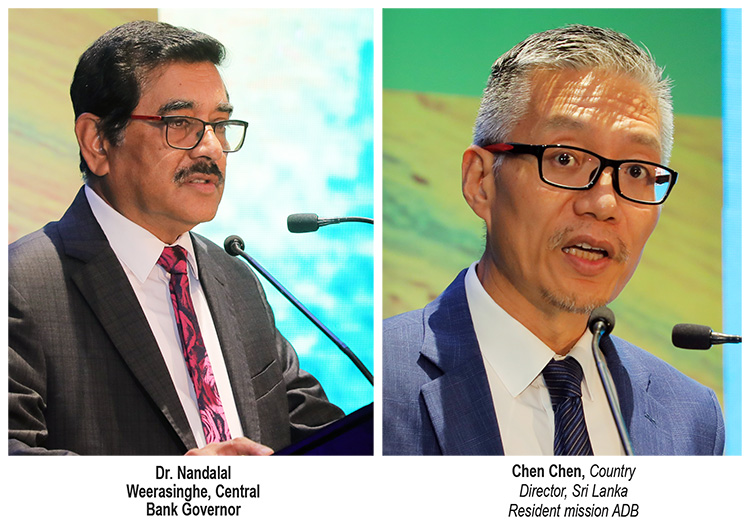
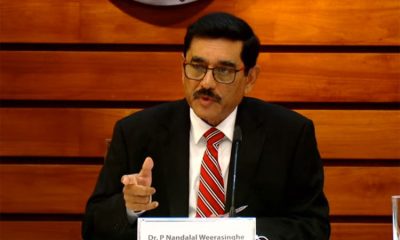
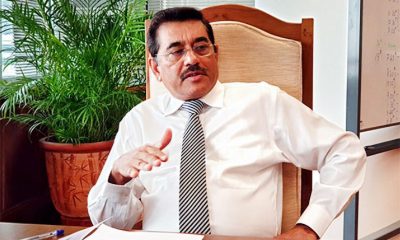
Sri Lanka will have no second chance if this time it forgets why it took the Extended Fund Facility from the IMF and goes back to doing things that create fiscal imbalances, like in the past 16 programs with the IMF, Central Bank Governor Dr. Nandalal Weerasinghe warned on Tuesday.
The Governor conveyed this well-informed message to all stakeholders in Sri Lanka at the Asian Development Bank’s “Serendipity Knowledge Program” (SKOP) event, at the Cinnamon Grand Colombo. ADB’s SKOP also saw the launch of the Asian Development Outlook for 2023.
Inviting the CBSL Governor as keynote speaker of the event, Chen Chen, Country Director, Sri Lanka Resident mission ADB, urged Sri Lanka to turn the current economic crisis into an opportunity and go for deep, comprehensive reforms to address the long standing issues inflicting the economy, assuring that the ADB will remain steadfast in its support to Sri Lanka.
“In 2022, ADB provided emergency support to sustain Sri Lanka’s basic services and livelihood and to mitigate the impacts of the economic crisis on the people, particularly on the poor and vulnerable groups. We also supported the essential trade facilitating the importation of medicine and fertilizers. ADB worked very closely with the private sector, the civil society and development partners to maximize the impact of its emergency assistance. We will continue this collaborative approach in ADB’s future assistance to Sri Lanka. One year on, since the unprecedented crisis, we hope the worst is already behind us. However, there are lessons to learn from the crisis. Moving beyond the near term outlook, the main question remains on tackling the long standing challenges of Sri Lanka. Although the country has come a long way since last year, there is a long road ahead for economic recovery. I hope this discussion and insights into ADB’s outlook for 2023 will help understand and navigate the uncertainties that lie ahead.”
Later on Dr. Nandalal Weerasinghe in his keynote speech said:
“The root cause of the economic crisis was the long standing fiscal imbalance we have carried forward over a long period of time. There is empirical evidence to show that structural fiscal imbalances and the current account balance had a strong association to the economic crisis. Sri Lanka is a classic case of a twin-deficit country over several decades. As a result, we have been experiencing recurring Balance of Payment (BOP) issues. This is the reason why we have sought IMF bailout packages for 16 times and the latest rescue package is Sri Lanka’s 17th IMF programme. This time it is different from the past because we are not only in a BOP crisis, we are also in a sovereign debt crisis–both occurring together. That’s why it is much more difficult and complex this time. We had to continuously seek bailout packages because we have never been able to address the fiscal imbalance on a permanent basis. The key theme of any IMF programme was revenue-based fiscal consolidation and some structural reforms related to fiscal imbalances. We agreed with certain policy packages with the IMF, got some money and focused on stabilization in the beginning and we even completed two three programmes successfully; for example from 2009- 2012 after the end of the war.
“But soon after completing the programme or in between , after achieving stability, we had forgotten why we took those loans; why we agreed with those bailout packages and took two steps backward without going forward. It made us go back to the same crisis creating current account imbalances, depletion of our reserves, depreciating our currency and thereby resulting in a repetition of the vicious cycle. As a result, the country came to a point of unsustainable sovereign debt situation. If we had sought an IMF bailout when we saw the balance of payment crisis coming, we could have stabilized the economy without landing on an economic crisis. In the past, people didn’t feel the pain of the crisis as a lot of people hadn’t known there was a looming BOP crisis. If we had taken timely action, we could have at least stabilized the situation without addressing long term structural issues.
“The lesson learned from this was to seek assistance without being too late so that people wouldn’t have felt so much pain arising from a crisis that led to hyper-inflation. All what the Central Bank did was aimed at avoiding the collapse of the economy and preventing the social and political unrest. Certain analysts claim that the Central Bank contracted the economy with its tight monetary policy and other policies. My argument is; due to the BOP crisis, the economy was going to collapse and we were able to limit the contraction to 7.8% last year. This is not a happy situation, but still the contraction was minimized and hyper- inflation was reversed despite many had thought it would go spiral over 100%. It is the fiscal policy that has to implement cost reflective utility prices and address revenue and expenditure, and also address expansive monetary financing which was the root cause of the hyper-inflation experience d last year.”
“The key lesson I learned from this crisis was; for Sri Lanka, I don’t think we have a second chance this time. We can’t afford to what we did with our past IMF programmes- take one step forward and stabilize and then take two steps backward and cause fiscal imbalances. This time we have no chance. This is why we need strong commitment from all stakeholders of the country to take forward the 4-year IMF extended facility and implement the targets of the IMF which are also the benchmarks of the government.
“This time we need to be able to not just meet those targets, but outperform them and get out of the crisis for good.”








18 March 2026; Colombo – SriLankan Airlines wishes to alert customers to social media scams circulating on Facebook, WhatsApp and other platforms, often sent from both known and unknown contacts, featuring fake offers that misuse the SriLankan Airlines name, logo and brand.
SriLankan Airlines will never request payments, OTPs, credit card details, bank information or any other financial details via social media channels.
Customers are advised to always verify that any promotional offer is linked to the airline’s official website, www.srilankan.com, or shared through the verified social media accounts of SriLankan Airlines, as scammers often use fake links with unusual characters or spellings, or impersonate the airline through fake social media accounts.
Business
JSL & Fentons Joint Venture to Construct Double Circuit Transmission Line from Mannar Grid Substation to Mullikulam Collection Grid Substation

Approval has been granted at the Cabinet meeting held on 03-02-2025 to implement the formal procurement procedure to select a contractor for the construction of a 28 km long double circuit transmission line with the capacity of 220 kW, from Mannar Grid Substation to Mullikulam Collection Grid Substation under the Lot B of the Mullikulam Wind Power Transmission Project.
Bids have been invited following the International Competitive Procurement Procedure and five (5) bids have been received.
Accordingly, based on the recommendations submitted by the High-Level Standing Procurement Committee after evaluating the aforementioned bids, the Cabinet of Ministers has approved the resolution furnished by the Minister of Power and Energy to award the contract to the JSL & Fentons Joint Venture – Intend (Jyoti Structure Limited, India and Hayleys Fentons
Limited, Sri Lanka), substantially responsive minimum bidder, for an equal amount of Sri Lankan Rs. 2,269.18 million (without VAT).

Economic pressure likely to push already-strained businesses into a liquidity crunch
By Sanath Nanayakkare
Sri Lanka is slowing to a midweek halt as a deepening fuel shortage has compelled the government to suspend most public sector operations every Wednesday, while courts have been advised to take a lenient view of attendance requirements amid transportation difficulties caused by fuel rationing.
The directive, issued by the Commissioner General of Essential Services, suspends most state functions one day a week until further notice in an attempt to conserve scarce fuel reserves. Authorities have also urged the private sector to adopt a similar arrangement.
Officials say the measure is aimed at reducing commuter traffic into major cities, particularly Colombo, where thousands of public servants travel daily from suburban areas.
Explaining the decision to select Wednesday, officials said declaring Friday a holiday could have effectively denied the public access to government services for three consecutive days when combined with the weekend.
However, the development underscores the fragility of Sri Lanka’s economic recovery as households continue to grapple with rising prices of essential goods.
The impact is already visible on the streets. Long queues have formed outside fuel stations while public buses have been seen overcrowded, with passengers clinging to footboards. Many commuters were also seen attempting to secure rides through the ride-hailing platforms Uber and PickMe, where drivers were demanding higher fares as demand surged.
Recognising these difficulties, the Judicial Service Commission (JSC) has issued a circular instructing judges to take transportation constraints caused by fuel rationing into consideration when making legal determinations.
Judges have been advised to consider the possibility that lawyers, litigants, witnesses and even suspects may be unable to attend court due to limited fuel availability.
While court proceedings are expected to continue, judicial officers have been asked to assess such situations on a case-by-case basis.
The JSC has also directed courts to make greater use of virtual platforms whenever possible. This is expected to apply particularly to proceedings such as extending remand orders, thereby avoiding the need to transport prisoners physically to court.
Authorities believe that conducting such hearings online could significantly reduce fuel consumption associated with prison transport. The temporary measures will remain in effect until further notice.
Meanwhile, officials say special fuel allocations may be considered for critical sectors including tourism, the Colombo Port, agriculture, health services, the plantation industry and public transportation in order to sustain essential services and economic activity.
However, the broader economic outlook remains uncertain. Business leaders warn that companies already burdened with higher taxes, rising operational costs and thin margins could face severe liquidity pressures if global oil prices remain elevated.
Industry observers say some firms may be compelled to seek loan moratoria if the disruption linked to the conflict involving Iran continues for another month.
Public concern has also been heightened by recent comments from Iranian officials indicating that Tehran has not sought a ceasefire in the ongoing conflict.
For President Anura Kumara Dissanayake, the unfolding fuel shortage is emerging as one of the most serious challenges facing his administration. Although the government has been holding internal consultations, critics say an all-party conference has yet to be convened to formulate a unified national response to the crisis.
Within business circles and sections of the public, questions are increasingly being raised about whether the government possesses the institutional capacity and experience required to manage a prolonged energy shock.

SriLankan Airlines Alerts Customers to Social Media Scams

Four dead 32 injured in head on collision at Weerawila

JMSDF ship OONAMI concludes goodwill visit

Cabinet nod to amend Central Cultural Fund Act No. 57 of 1980
’National Namal Uyana’ declared as a National Heritage
Establishment of Supervisory Committees for restoring economic activities.

‘Dates have the highest sugar content to fight Coronavirus’

Sunday Island 27 December – Headlines

#SundayIsland 17th December – Headlines

Sunday Island – 28th March

Sunday Island Headlines – 21 March

Sunday Island – 21st February – Headlines
-

 News7 days ago
Historic address by BASL President at the Supreme Court of India
-

 Sports7 days ago
The 147th Royal–Thomian and 175 Years of the School by the Sea
-

 Business3 days ago
Browns EV launches fast-charging BAW E7 Pro at Rs. 5.8 million
-

 Life style4 days ago
From culture to empowerment: Indonesia’s vision for Sri Lanka
-
 News7 days ago
Power sector reforms jolted by 40% pay hike demand
-

 Opinion6 days ago
M. D. Banda: Memories of Appachchi – II
-
 Latest News4 days ago
QR code system will be implemented for fuel with effect from 06.00 a.m. today (15th)
-

 News2 days ago
Australian HC debunks misleading travel risk claims for Sri Lanka