
Foreign News
Nestle CEO fired over undisclosed affair


Nestle has fired CEO Laurent Freixe after just one year in the job following an investigation into an undisclosed “romantic relationship”, ousting its second chief executive in a year and throwing the Swiss food giant into its deepest leadership chaos in decades.
Freixe’s sudden dismissal followed an investigation into an undisclosed romantic relationship with a direct subordinate that breached Nestle’s code of business conduct, Nestle said late on Monday.
Freixe was replaced by Nespresso chief Philipp Navratil, a rising star at the world’s largest food company as it battles slowing sales, the impact of United States tariffs and eroding investor confidence after years of underperformance.
The Frenchman’s predecessor Mark Schneider failed to cope with the challenge, and it cost him his job in August 2024. Paul Bulcke, CEO from 2008 to 2016, will step down as chairman in April and will be replaced by Pablo Isla, a former CEO of Spanish fashion retailer Inditex.
“The loss of two CEOs and a chairman in a year is of historic proportions for Nestle,” said Ingo Speich, head of corporate governance and sustainability at Deka, a top 30 Nestle investor.
“The new CEO needs to fix the business model and bring volumes back. He needs to do better M&A [mergers and acquisitions] and focus more on emerging markets.”
The upheaval underscores the struggle not only at Nestle but also other consumer goods companies to reignite sales and recover stock values as the post-pandemic cost-of-living crisis drives consumers towards cheaper alternatives. Meanwhile, US tariffs threaten to further inflate prices and alienate already price-sensitive shoppers.
Shares in the maker of Nescafe and KitKat chocolate bars were down 0.8 percent in Zurich by 1:18pm (11:18 GMT).
The company said concerns about a possible relationship were raised by staff via the company’s internal reporting channel, Speak Up, although an initial investigation was unsubstantiated. Freixe had initially denied the relationship to the board, a company spokesperson said.
When staff concerns persisted, Nestle said it ordered an investigation overseen by Bulcke and Lead Independent Director Isla with the support of independent outside counsel. Swiss media reported that Swiss lawyers from the Baer & Karrer law firm helped with the inquiry.
Freixe, who spent 39 years with Nestle, will receive no exit package, the company told the Reuters news agency.
In a short statement, Bulcke thanked Freixe for his years of service at Nestle but said the dismissal was a “necessary decision”.
His dismissal adds to a list of top executives forced to resign after investigations into their relationships with colleagues.
Energy giant BP’s former CEO Bernard Looney and McDonald’s CEO Steve Easterbrook were both removed for failing to disclose relationships with colleagues.
The Swiss financial news website Inside Paradeplatz reported that Freixe met the woman in 2022 before he became CEO and when he was head of Nestle’s Latin America business.
Freixe was not immediately available to comment when contacted via email. The identity of the female subordinate has not been made public.
Swiss law does not prohibit relationships between senior executives nor does it require disclosure although most large companies have internal codes of conduct that require they are disclosed.
Corporate governance expert Peter V Kunz from the University of Bern said he was not familiar with Nestle’s rules but said requirements at most public companies were broadly similar.
“In this respect, Mr Freixe’s behaviour – regardless of whether it was legal or not – seems to me to be simply stupid and incomprehensible in this day and age,” Kunz told Reuters, adding that he did not think investors had grounds for legal action against Nestle.
Nestle’s shares, a bedrock of the Swiss stock exchange, have lost almost a third of their value over the past five years, under-performing their European peers.
Freixe’s appointment failed to halt the slide, and the company’s shares shed 17 percent of their value during his leadership, disappointing investors.
One top 20 Nestle investor welcomed news of the change, saying Freixe had been a disappointment and bringing in Navratil was an opportunity for a more ambitious overhaul.
The new CEO needs to slim down the company, cut costs and above all reduce the headcount, the investor, who declined to be named due to the sensitivity of the matter, said, adding that it is also crucial for the company to raise organic growth to boost volumes.
“The cash flow must cover the dividend,” the investor said. “That’s an absolute priority.”
In July, Nestle launched a review of its underperforming vitamins business, which could lead to the divestment of some brands after first-half sales volumes missed expectations.
Freixe’s dismissal was featured on the front page of Swiss newspapers with Neue Zuercher Zeitung noting that Nestle had lost its “legendary stability” during which CEOs stayed on for years before eventually becoming chairmen.
AJ Bell investment director Russ Mould said the company would likely face a period of uncertainty over whether Navratil will follow the same path as his predecessor.
“While Navratil is also an internal appointment, he will want to put his own mark on strategy, and that suggests the clock could be reset when it comes to the turnaround plan,” Mould said.
[Aljazeera]


Ten people have been killed after a fire broke out in the trauma centre of a government hospital in the eastern Indian state of Odisha.
All the victims were patients, while 11 hospital staff are being treated for burns suffered while trying to rescue patients, state Chief Minister Mohan Charan Majhi said.
The fire – suspected to have been caused by an electrical short circuit – started in the trauma care ICU of SCB Medical College and Hospital in Cuttack city around 02:30 local time on Monday (21:00 GMT Sunday).
Hospital fires are often reported in India, with many blamed on electrical faults. Last October, six critically ill patients were killed in an ICU fire in Rajasthan state.
In 2024, a blaze in the neonatal ICU of a medical college in northern Jhansi city killed at least 10 new born babies. In 2021, a fire in the ICU of Vijay Vallabh hospital in the western city of Virar killed 13 patients receiving treatment for Covid-19. Another fire in 2021 at a newborn care unit in Bhandara district in western state Maharashtra killed 10 infants.
In Odisha, the blaze was brought under control after fire service personnel rushed to the hospital. Patients were moved to other departments inside the same hospital, officials said.
SCB Medical College and Hospital is one of the largest government-run medical facilities in Odisha.
Speaking to reporters after visiting the hospital, Majhi said the fire affected the trauma care ICU as well as an adjoining ICU and wards.
Majhi said medical staff and security personnel “risked their lives” during the rescue operation and some of them were injured, adding that the government had directed officials to ensure proper treatment for those hurt in the incident.
The state government has announced financial compensation for the families of the victims. Majhi said he has ordered a judicial inquiry into the incident and said strict action would be taken against anyone found responsible.
Short circuits are among the most common causes of hospital fires in India. Hospitals are particularly vulnerable to fires because they contain a lot of electrical equipment, oxygen systems and patients who often cannot be moved quickly during emergencies.
[BBC]

The Ecuadorean government has deployed more than 75,000 police officers and soldiers to four of the country’s most violence-wracked provinces, the interior minister says.
The authorities have also declared a night-time curfew in these areas as part of a “new phase” in their “war” on criminal gangs.
Since coming to office in November 2023, President Daniel Noboa has tried to quell drug-related violence but nevertheless Ecuador registered a record murder rate in 2025.
Noboa has also joined a US-led alliance of 17 countries aimed at fighting criminal cartels in the Western Hemisphere.
“We’re at war,” Ecuadorean Interior Minister John Reimberg told residents of the provinces of El Oro, Guayas, Los Ríos and Santo Domingo de los Tsáchilas.
“Don’t take any risks, don’t go out, stay at home,” he added.
Ecuador’s geographical location – sandwiched between Colombia and Peru, the world’s largest producers of cocaine – has turned it into a key transit country for the illicit drug.
Around 70% of the cocaine produced in Colombia and Peru is estimated to be shipped through Ecuador.
Noboa’s government has been working with the administration of US President Donald Trump to quell the flow of cocaine from Ecuador to the US.
Last week, the FBI opened its first office in the Andean country, a move which came shortly after the two countries launched joint counter-narcotic operations.
Noboa was one of the Latin American leaders to attend an international meeting hosted by Trump in Mar-a-Lago, which the US authorities dubbed the “Shield of the Americas” summit.
At the summit, Trump likened criminal gangs to a “cancer” and urged his Latin American counterparts to use military force to root them out.
“We don’t want it spreading,” Trump added.
Following the meeting, Noboa posted a photo on social media of himself standing next to Trump with the words: “For too long, the mafias thought that America was their territory. That they could cross borders, move drugs, guns and [spread] violence without consequences. Their time has run out.”
Since coming to office, Noboa has tried to combat criminal organisations in his country with an iron fist and has declared several states of emergency but nevertheless the murder rate rose by over 30% between 2024 and 2025.
[BBC]

Stew, a 35-year-old from Montana, has enjoyed dabbling in sports bets since he downloaded the Kalshi app about 18 months ago.
But just a few weeks ago, after spotting reports of elevated pizza deliveries around the Pentagon during some late-night scrolling, he made a different kind of bet – wagering $10 (£7.50) on the odds that Iran’s Ayatollah Ali Khamenei would be “out” by 1 March.
It was a trade that tested the limits of the kinds of bets Americans are allowed to make.
So-called predictions markets – overseen by firms such as Kalshi – have exploded in popularity over the last year, hosting more than $44bn in trades.
They are rapidly transforming the betting landscape in the US, where sports betting was largely illegal until 2018 and gambling on elections had been off-limits for years until 2024.
While much of the activity on the platforms revolves around sporting matches, users can speculate on any number of questions, including local elections, whether the US central bank will cut interest rates and the year of Jesus Christ’s return.
The apps caught fire during America’s 2024 presidential campaign, after a legal victory cleared the way for them to accept election bets and they showed the odds tilting toward Donald Trump.
But it is more grisly wagers tied to military action involving Iran, Venezuela and Israel that have drawn attention lately.
In theory, such bets run afoul of US financial rules, which bar trading on contracts involving war, terrorism, assassination, gaming or other illegal activities.
But that hasn’t stopped firms from taking in millions of trades.
Critics have seized on the activity, calling for a crackdown on the apps, which they say are facilitating unseemly, and potentially illegal, war profiteering, generating national security risks and enabling opportunities for insider trading and corruption.
“You have now opened up gambling basically on almost anything and it has turned into this very, very gruesome type of thing on the death of a head of state,” said Craig Holman, government affairs lobbyist at the Public Citizen advocacy group, which recently filed a complaint this week over the bets.
Polymarket alone has hosted what Bloomberg estimated as more than $500m in bets related to the Iran war, at one point offering an opportunity to play the odds on the chance of nuclear detonation.
The company, which is headquartered in New York but operates on a limited basis in the US, eventually removed that market after it drew scrutiny on social media but users can still submit bets on questions like when US forces will enter Iran. It did not respond to the BBC’s request for comment.
Kalshi also ended up cancelling the Khamenei market, which had drawn $54m in trades, noting that US-regulated entities are barred from “having a market directly settling on someone’s death”.
The company, which did not respond to a request for comment for this article, has said the war bets are happening on unregulated exchanges outside the US.
Concerns about the war bets have collided with a bigger battle over how prediction market firms should be regulated.
Unlike traditional gaming firms, in which the odds are set by the company, prediction market companies function more like a stock exchange, allowing users to bet against each other on the outcome of future events using “event contracts”.
That design has allowed national financial regulators at the Commodities Futures Trading Commission (CFTC) to claim oversight.
But critics say they are sports betting and gambling operations trying to dress up as financial exchanges in a bid to avoid stricter rules and taxes faced by traditional gaming firms, which are regulated by the states.
Disagreement over who should be policing the apps has sparked dozens of legal battles across the US, as states start to assert their right to regulate the companies like other gaming firms, rather than leave oversight up to the CFTC.
Even some Republicans have voiced concerns, as traditional gaming firms have also stepped up their lobbying, enlisting a savvy former Trump official, Mick Mulvaney, to plead their case in Washington.
“Nobody is saying that gambling shouldn’t be allowed,” says Ben Schiffrin, director of securities policy at Better Markets, which advocates for financial reforms. “What the states are saying and other advocates are saying is things that are gambling should be regulated as gambling.”

Suspiciously timed bets related to military operations involving Israel, Venezuela and Iran have added fodder to those calls.
In recent weeks, Democrats have introduced legislation to bar federal officials from trading event contracts, pointing to incidents such as when a gambler new to Polymarket made nearly half a million dollars on the capture of Venezuela’s president just before it was officially announced.
They have also issued alerts to consumers about the risks of insider trading and written to the administration urging it to more clearly enforce the rules against wagering on war.
But the odds of a crackdown remain long.
Though the Biden administration had taken a hard line on the sector, proposing to ban sports and politics-related event contracts, that regulatory drive stalled after a court defeat and the 2024 election of Donald Trump, who came to power promising a lighter hand.
Last month, the CFTC said it would withdraw the proposed ban on sports and election related contracts.
It has also taken the side of prediction market firms in the legal fights they are facing in the states, which Michael Selig, Trump’s chairman of the Commodity Futures Trading Commission, condemned in a recent opinion piece as “overzealous”.
He argued that event contracts served “legitimate economic functions”, allowing businesses to hedge against risks triggered by events.
“It’s clear that Americans like the product and want to participate,” he said, while also emphasising that platforms must still follow rules.
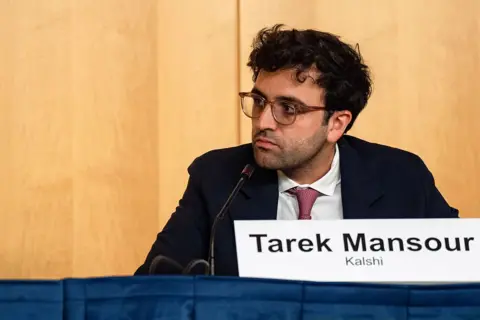
As the pressure mounts, Polymarket has announced steps to more formally police suspicious activity, while Kalshi, which advertises its status as a “regulated exchange”, has become more vocal about what it is doing to combat insider trading.
It recently announced punishments in two cases of insider trading and disclosed that it had opened up 200 investigations over the last year.
The company also ultimately cancelled the $54m market around Khamenei’s ouster.
In series of statements explaining the decision, the firm said it did not “list markets directly tied to death”, noting that its terms had included that carve-out.
It promised to make the terms more clear from the get-go, saying it had “learned a lot” from the incident.
But in an indication of growing pains, the decision still sparked outrage among users, including Stew, who said the firm had initially “buried” those rules and its explanation seemed disingenuous, given that there were “only a handful of realistic methods” for Khamenei to go.
Stew, who received a refund, said he wasn’t sure regulation was the answer, but he was sympathetic to the idea that the debate seemed to be stumbling around semantics.
“They call it contract trading, which I guess technically speaking, that’s what it is. But if we’re all being honest here, it’s still betting,” he said.
[BBC]

CIABOC questions Ex-President GR on house for CJ’s maid

Post-Ditwah Indian recovery assistance to SL: health experts from here visited India

Professor G L Peiris addresses seminar at national university of singapore

New Zealand HC meets Defence Secretary

US paying the price for disregarding military advice

Lawmakers complain of insufficient fuel allocation

‘Dates have the highest sugar content to fight Coronavirus’

Sunday Island 27 December – Headlines

#SundayIsland 17th December – Headlines

Sunday Island – 28th March

Sunday Island Headlines – 21 March

Sunday Island – 21st February – Headlines
-
 News6 days ago
Historic address by BASL President at the Supreme Court of India
-

 Sports6 days ago
The 147th Royal–Thomian and 175 Years of the School by the Sea
-

 Life style3 days ago
From culture to empowerment: Indonesia’s vision for Sri Lanka
-
 News6 days ago
Power sector reforms jolted by 40% pay hike demand
-

 Business2 days ago
Browns EV launches fast-charging BAW E7 Pro at Rs. 5.8 million
-

 News4 days ago
Crypto loopholes funnel Lankan funds abroad
-

 Latest News3 days ago
QR code system will be implemented for fuel with effect from 06.00 a.m. today (15th)
-

 Sports3 days ago
Kirsten brings pedigree, but Sri Lanka must fix the system