
Foreign News
China’s Xi steals the limelight in a defiant push against US-led world order


As the cannon fire echoed through Tiananmen Square, even before the first set of troops goose-stepped their way through Beijing’s central avenue, the day’s most enduring image unfolded.
China’s President Xi Jinping welcomed North Korea’s Kim Jong Un with a long handshake, then moved on to greet Russia’s Vladimir Putin, and then walked to his seat, flanked by two of the world’s most sanctioned leaders.
It was sheer political theatre. And it was this meeting – rather than the weaponry – that appears to have irked US President Donald Trump.
As the parade began, Trump sent a sharply-worded message on Truth Social, accusing the three leaders of conspiring against America.
This may well have been the reaction President Xi had hoped for as he kept Putin to his right and Kim to his left throughout the parade. The moment may have even been designed to infuriate a US president who would perhaps prefer to be the centre of the world’s attention.
The Chinese leader has stolen the limelight, and he’s using it to show his power and influence over an eastern-led alliance – a defiant group determined to push back against a US-led world order.
It is a strong message from Xi as the world reels from the unpredictability of Trump’s presidency. Besides Kim and Putin, there were more than 20 other foreign heads of state. Just earlier this week, Xi also appeared to be resetting his troubled relationship with Indian Prime Minister Narendra Modi. Trump’s 50% levy on Indian imports has prompted a thaw between the long-time rivals.
Wednesday’s spectacle was supposed to be about commemorating an 80-year-old victory over Japan. But it was actually about where China is headed – right to the top, with Xi playing the role of a global leader.
And at his feet was a military that is being built to rival the West.
This was the first time Xi, Putin and Kim had been seen together – and together, they climbed to the top of the Gate of Heavenly Peace that overlooks the historic square to watch the parade.
The symbolism was hard to miss. Communist China’s founder Mao Zedong had declared the founding of the republic there in 1949 – and 10 years later, it was where he hosted Kim’s grandfather and the then Soviet leader Nikita Khrushchev, to watch a military parade.
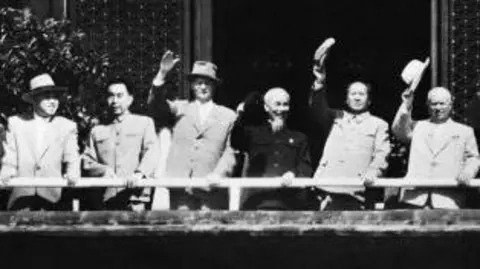
That was the last time the leaders of the three countries were together. It was the height of the Cold War, China was isolated from much of the world, as was North Korea, and the Soviet Union was the most powerful and richest among them.
Now, it’s China that holds the reins in this relationship. Nuclear-armed but still poor, North Korea needs Beijing’s aid. And Putin needs the legitimacy that Xi just provided him.
In the past, Xi appeared to keep his distance from Putin and Kim, and publicly maintain a neutral stance on the war in Ukraine. He did not condemn it, but denied China was helping Russia.
It even seemed like he was on the sidelines as Russia and North Korea grew closer more recently. Kim has been sending troops to support Putin’s invasion of Ukraine in exchange for money and technology.
But now he seems to be standing by his two neighbours, even as they continue to attack Kyiv.
“Today humanity is again faced with the choice of peace or war, dialogue or confrontation, win-win or zero sum,” Mr Xi told the watching crowds, along with millions glued to the parade coverage on state TV across the country.
China is a “great nation that is never intimidated by any bullies”, he declared.
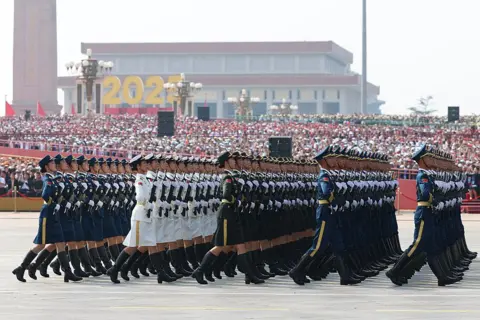
The US may still have an edge, honed over years and through its involvement in conflicts across the world, but there is no doubt that China is building a military to rival that.
And Wednesday’s show of strength was a statement aimed at Washington and its allies, as well as the rest of the world – and even at Putin and Kim, who knew the significance of what they were looking at.
“The great rejuvenation of the Chinese nation is unstoppable,” Xi had said in his speech in an effort to bolster pride in the nation.
And the military parade that followed was about showing that – it was a display of power, precision and patriotism.
It started with a gun salute – 80 times to mark 80 years since China’s victory over Japan in World War Two, ending a brutal occupation. The sound bounced off every corner of the square as 50,000 spectators, some of them war veterans, sat in silence.
The choir followed, every single member appearing exactly spaced out as the cameras panned above them. They sang in perfect harmony: “Without the Communist Party, there is no modern China.” Each verse was punctuated by raised fists.
President Xi drove the length of the parade route to inspect his troops before each battle unit took turns to goose-step past their leader. Every joint strike on the tarmac reverberated through the stands.
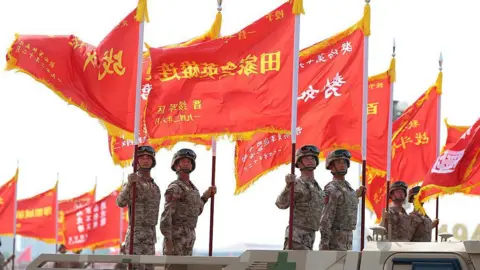
The rumbling tanks came first in the display of China’s new weapons. But they looked old compared to what followed. A new nuclear-capable missile that can be launched from sea, land and air, hypersonic anti-ship missiles and laser weapons to defend against drone attacks. There were new underwater and airborne drones that can spy on targets.
It appears to be working on some people.
On a bridge overlooking the Tonghui River, crowds had gathered away from the main parade route to try to see the military flypast. Thirty-year-old Mr Rong said he found the parade moving.
“Cherishing this moment is the most fundamental thing we can do. We believe we will retake Taiwan by 2035,” he declared.
This is the rhetoric feared by many on the self-governing island of Taiwan, which China believes is a breakaway province that will one day be united with the motherland. Xi has not ruled out the use of force to achieve that goal. And the weaponry that he showed off on Wednesday, much of which emphasised China’s naval capabilities, is bound to worry Taiwanese leaders.
It also worries many Western nations, especially in Europe, which are still grappling with how to end the war in Ukraine. Many were absent from the parade.
Han Yongguang, 75, shrugged off any suggestion that Western leaders had shunned the parade.
“It’s up to them to come or not,” he said. “They are envious of China’s fast development. To be honest, they are aggressive at heart. We are completely committed to the common prosperity of mankind. We are different.”
This parade has been fuelling a wave of nationalism at a time when China is battling serious domestic challenges: a sluggish economy, a real estate crisis, an ageing population, high youth unemployment and local governments deep in debt.
As confident as China appears on the world stage, President Xi must find a way to keep a burgeoning middle class from worrying about their future. China’s economic rise was once thought unstoppable, but that is no longer the case.
So this parade – with all the rhetoric about an old enemy, Japan – may be a welcome distraction.
After a long display of cutting-edge weaponry, including nuclear missiles, the parade concluded with thousands of doves and balloons released into the skies over Beijing.
The commemoration – the songs, the marches, the missiles, the drones, even the “robot wolves” – was not so much about China’s struggle.
Rather, it was about how far China has come – and how it is catching up with the US and challenging it for supremacy.
[BBC]


Several armed men robbed a bank in broad daylight in Naples, holding 25 people hostage before making their escape via a tunnel.
Police surrounded a branch of Crédit Agricole in the southern Italian city shortly after the robbery began around midday local time (10:00 GMT).
Local outlets reported that they negotiated with the robbers before the hostages could be released, about two hours into the robbery.
Firemen could be seen smashing in a window with battering rams and helping people climb out from inside in videos shared on social media.
Some hostages simply shook off the shards of glass and walked on.
But others looked visibly shaken, crying and hugging their relatives. Six people, who were in a state of shock, were offered medical assistance.
One man later told local news site Fanpage.it that the robbers had locked them into a room and that, while they were armed, “they did not use violence”.
Nobody was seriously injured. “Thanks to the swift response… all the hostages were freed shortly after 13:30 without serious injuries,” regional official Michele di Bari said in a statement.
A large crowd of bystanders, local residents and firefighters gathered in the square waiting for developments, while ten of thousands of people tuned into a livestream from the scene of the crime.
Members of the special forces of the carabinieri armed police were urgently flown in from Tuscany.
It was not until several hours later that they stormed the bank by breaking a window.
Several shots and the loud noises of stun grenades could be heard on the live feed shortly after.
But by then, the robbers had reportedly escaped through a tunnel, local media reported. It was thought they could have vanished into the sewer system.
The video feed later showed a number of carabinieri and firefighters peering into a manhole nearby as a crowd continued to mill about the square.
Fanpage.it reported that it was not yet possibly to quantify the value of the loot taken because the robbers had seized personal safety deposit boxes rather than cash.
(BBC)
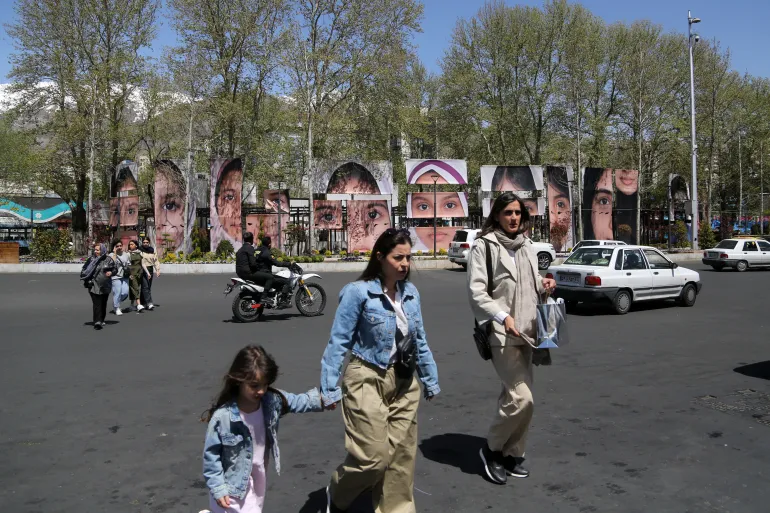
Iran has demanded that it receive compensation for the destruction caused by the United States and Israel’s attacks, as the country remains defiant and regional powers continue their attempts to mediate an end to the conflict.
Tehran’s envoy to the United Nations said on Tuesday that five regional countries must pay compensation, based on his accusation that their territories were used for launching attacks on Iran.
Iran has also raised the idea of compensation for damages to come through a Strait of Hormuz protocol, which would include a tax on ships passing through the waterway.
An early estimate indicates that Iran has suffered about $270bn in direct and indirect damages since the start of the US-Israel war on February 28, Iranian government spokeswoman Fatemeh Mohajerani said during an interview with Russia’s RIA Novosti news agency, published on Tuesday.
She did not provide further information, such as a breakdown of the damages, but said the issue of compensation was discussed in last week’s negotiations between Tehran and Washington in Pakistan, and will be raised in any potential future talks with the US and mediators.
The government has said it is still assessing the extensive damage dealt to Iran’s critical infrastructure, after oil and gas facilities, petrochemical companies, steel plants, and aluminium factories were repeatedly targeted, in addition to military complexes. These will take years to fully rebuild.
Bridges, ports and railway networks, universities and research centres, and several power plants and water desalination plants were also directly hit, while a large number of hospitals, schools and civilian homes were damaged or destroyed.
(Aljazeera)

Hushruzjon Salohidinov, 26, was working as a courier in Saint Petersburg, Russia’s second-largest city and President Vladimir Putin’s hometown.
But last year, the Tajik man and practising Muslim says he was arrested while picking up a parcel which police claimed contained money stolen from elderly women.
Salohidinov says he never interacted with the alleged criminals, but nevertheless spent nine months in the Kresty-2 pre-trial detention centre about 32km (20 miles) from the city, while a judge refused to start his trial because of the “weak evidence” against him.
But instead of releasing him after that, prison wardens threatened to place him in a cell with HIV-infected inmates who, they said, would gang-rape him – unless he “volunteered” to fight in Ukraine.
“They said, ‘Oh, you’ll put on a skirt now, you’ll be raped,’” Salohidinov, who has raven black hair and a messy full beard, told Al Jazeera at a centre for war prisoners in northeastern Ukraine, where he is now being held, having been captured in January this year by Ukrainian forces.
Using a carrot-and-stick tactic, the wardens also promised him a sign-up bonus of 2 million rubles ($26,200), a monthly salary of 200,000 rubles ($2,620) and an amnesty from all convictions.
So, in the autumn of 2025, Salohidinov signed up as he “saw no other way out”.
Officials in Kresty-2, St Petersburg’s prosecutors’ office and Russia’s Ministry of Defence did not respond to any of Al Jazeera’s requests for comment.

Hochu Jit, a Ukrainian group that helps Russian soldiers surrender, has published verified lists of thousands of Central Asian soldiers like Salohidinov.
“They are literally sent to be killed, no one considers them soldiers that need to be saved,” the group wrote in a 2025 post on Telegram. These soldiers’ life expectancy on the front line is about four months. “Losses among them are catastrophic,” the group reported.
With its low birthrate and large oil wealth, Russia has for years been a magnet for millions of labour migrants from ex-Soviet Central Asia, especially Tajikistan, Uzbekistan and Kyrgyzstan.
The campaign by the Kremlin to force Central Asians to fight in Ukraine dates back to 2023 – the year after Russia’s invasion of Ukraine – when police began rounding up anyone who didn’t look Slavic and charging them with real or imagined transgressions such as a lack of registration, expired or “fake” permits or blurred stamps on their documents. Sometimes, migrants are simply bused straight to conscription offices.
In 2025, Al Jazeera interviewed another Tajik man who said he had been detained with an expired work permit and was then tortured into “volunteering” while being subjected to countless xenophobic and Islamophobic slurs from his officers.
Migrants say they are abused, tortured and threatened with jail or having their entire families deported.
“The main way of recruiting as many migrants as possible is pressure on them with threats of deportation,” Alisher Ilkhamov, the Uzbekistan-born head of the London-based Central Asia Due Diligence think tank, told Al Jazeera.
Sometimes, migrants are simply duped.
Salohidinov said one serviceman in his squad was an Uzbek who “didn’t speak a word of Russian” and was fooled into “volunteering” while signing papers at a migration centre.
In their reports about “catching” migrants, officials frequently use derogatory terms about them, and also when they describe men who have obtained Russian passports but skipped registration at conscription offices. Since the Soviet era, such registration has been obligatory for all men and, since 2024, a newly naturalised Russian national can lose his citizenship if he fails to do it.
“We’ve caught 80,000 such Russian citizens, who don’t just want to go to the front line, they don’t even want to go to a conscription office,” chief prosecutor Alexander Bastrykin said in May 2025, referring to the migrants’ alleged patriotic sentiments.
He boasted that 20,000 Central Asians with Russian passports were herded to the front line in 2025.
The year before, he said 10,000 Central Asians had been sent to Ukraine.
Such remarks resonate with the Russian public that lives with “a high level of xenophobia in the stage of fear and helplessness,” Sergey Biziyukin, an exiled opposition activist from the western city of Ryazan, told Al Jazeera.
“For them, such phrases from Bastrykin are a form of sedative.”
What makes Central Asians easy targets is that they hail from police states, which depend on Moscow politically and economically, observers say.
“While the migrants are frightened into signing contracts, their motherland doesn’t really pay any attention,” Galiya Ibragimova, an Uzbekistan-born, Moldova-based regional expert, told Al Jazeera.
Despite hefty signup bonuses and relentless propaganda, the number of Russians who want to fight in Ukraine fell by at least one-fifth this year, and Moscow will strive to recruit more Central Asians, she said.

After signing the contract and leaving his debit card with his sign-up bonus with his parents, Salohidinov was sent to the western city of Voronezh for three weeks of training that did little to prepare him for the war.
“We just kept running back and forth with guns,” he said.
Their drill sergeants, he says, told the conscripts that the standard-issue flak jackets, helmets, boots and flashlights were of subpar quality and urged them to pitch in a million rubles ($13,100) each for “better” gear.
The incident corroborates reports on dozens of similar cases in Russian military units.
Salohidinov was ordered to work in a kitchen – and was verbally abused and beaten for the slightest transgression.
Of 28 men in his unit, 21 were Muslims – but their ethnic Russian officers ignored their pleas not to have pork in meals, repeating a decades-old practice of ignoring religion-related dietary restrictions dating back to the Soviet army.
The commanders demonised Ukrainians, telling them “that if we surrender, we’d be tortured, have our fingers broken, maimed, get [construction] foam up our a**, have our teeth yanked out one by one, have our arms broken”, Salohidinov says.
In early January this year, the conscripts were bused to the Russia-occupied Ukrainian region of Luhansk.
Salohidinov says he was tired, frightened and disoriented – Ukrainian drones were “always” above them and a grenade explosion nearby damaged his left eardrum.

On the fourth day of his service, Salohidinov was ordered to run beyond Ukrainian positions as part of Russia’s new tactic to send two or three servicemen to infiltrate the porous front line.
The mission was suicidal because the terrain was open, dotted with landmines and the bodies of dead Russian soldiers, while Ukrainians were firing machineguns and flew drones above them.
“I ran and ran and saw we were being shot at,” he said. “Me and my commander decided to surrender voluntarily instead of dying for nothing.”
They detached their assault rifles’ magazines, raised their hands and yelled they were surrendering.
What followed was “a calm feeling, beautiful”, he said. “They fed us, let us have a smoke, gave us food and water and even cake.”
Now, Salohidinov hopes to return to Tajikistan and panics at the thought of being made part of a prisoner swap – these have taken place several times each year – and returning to Russia because he would be sent back to the front line.
Tajikistan and other Central Asian nations have never endorsed Russia’s war in Ukraine, but nor have they openly criticised it.
In August 2025, Tajikistan’s Prosecutor General Habibullo Vohidzoda declared that no Tajik national would be charged for fighting in Ukraine.
So, what Salohidinov needs right now is an extradition request.
“I’m even glad that I got captured, because I’m not fighting anyone now, not risking anything,” he said. “I’ll even say thanks to Ukraine for taking me prisoner.”
The Tajik embassy in Kyiv did not respond to Al Jazeera’s request for comment.
[Aljazeera]

Heat Index at Caution Level in the Northern, North-central, North-western, Western, Sabaragamuwa, Eastern and Southern provinces and in Monaragala district

Naples bank robbers hold 25 people hostage then vanish through tunnel

Oil prices plunge as Iran says Strait of Hormuz ‘open’ during ceasefire

Iran says $270bn war loss must be compensated, as fresh talks with US loom

Navy seize 161kg heroin shipment in high-seas operation

Minister of Power and Energy and Ministry Secretary resign from posts

‘Dates have the highest sugar content to fight Coronavirus’

Sunday Island 27 December – Headlines

#SundayIsland 17th December – Headlines

Sunday Island – 28th March

Sunday Island Headlines – 21 March

Sunday Island – 21st February – Headlines
-

 News6 days ago
CEB orders temporary shutdown of large rooftop solar systems
-
 Features6 days ago
From Royal College Platoon to National Cadet Corps: 145 years of discipline, leadership, and modern challenges
-
 Latest News5 days ago
PNS TAIMUR & ASLAT arrive in Colombo
-

 News7 days ago
Anura Solomons passes away
-

 Features6 days ago
CIA’s hidden weapon in Iran
-
 Latest News5 days ago
Prasidh, Buttler set up comfortable win for Gujarat Titans
-

 News2 days ago
PNS TAIMUR & ASLAT set sail from Colombo
-

 Business7 days ago
SL’s economic outlook for 2026 being shaped by M-E conflict