
Features
More on the Russian tea trade – bear traps and an Iron Lady

(Excerpted from the Merrill, J, Fernando autobiography)
Up to the dissolution of the Soviet Socialist Republic, India had maintained a stranglehold on tea imports into Russia, on account of the existence of a barter agreement between the two nations since 1979. Indian tea imports into the USSR, approximately 10 million kilos per year in 1960, had increased to around 128 million kilos by 1990.
With the dissolution of the Soviet Union, the trade agreement was voided and replaced with an annually-renewable purchasing protocol, allowing tea and other Indian products under a ‘Technical Credit’ scheme. The release of the Indian grip on the Russian tea market was our opportunity to step in, as Ceylon Tea, despite being dwarfed in volume by the cheaper and lower quality Indian tea, still enjoyed an excellent reputation for quality amongst the consumers in the CIS bloc.
Liberalization of the Russian trade resulted in an immediate influx of short-term speculators from various countries, exploiting unsuspecting Russian merchants, who were equally ignorant of both tea quality and market prices. Hundreds of intermediaries from Europe and other regions contracted to supply the Russian distributors with tea, at relatively high prices, for average and low quality tea, purchased from the cheapest possible sources.
Many traders in Colombo, too, temporarily cashed in on this situation, going to the extent of getting the Government to relax the minimum quality standard for exports to Russia. Subsequent events proved that this was a serious error.
With our traders packing cheap tea for Russian labels, what followed was tragic in its predictability. As more and more supermarkets came in to existence, they resorted to the Western, multinational type of retailing. Soon the Russian traders set up their own packaging plants in the country, sourcing cheaper tea from other origins, but still retaining the Ceylon origin on the label, despite the diminution of real Ceylon Tea in the pack.
Today, some of those fully Russian-owned brands, developed on the value proposition of Ceylon Tea, with the support of our own exporters, are competing successfully with our exports, not only in Russia but in our traditional markets in other countries as well.
Consumer loyalty is built around brand names and claims of quality. Brand loyalty, the foundation of branding success, is the customer’s creation. Progressive variations in quality, caused by the gradual diminution of quality tea in the pack, are not detected by the average consumer in the everyday cup of tea, if the brand loyalty is strong. This is exactly what has happened in the case of the market in Russia. Our traders’ venality and greed for short-term profits got them entangled in a race to the bottom and lost us a golden opportunity, for the development of genuine Sri Lankan brands.
Ironically, it was a sad replication of this lack of enterprise and foresight that both our trade and the regulatory institutions demonstrated, just a few years previously, in the case of the Middle East market. Our failure to capitalize on that opening then did not serve as a lesson of history to us, just a few years later, in a different market but under very similar circumstances. Those opportunities will never come our way again.
Warning unheeded
In February 1994, at the invitation of Michael de Zoysa, then Chairman of the Ceylon Tea Traders’ Association, I made a presentation on the `Russian Tea Market’ on the occasion of the Centenary Celebrations Congress of the Association, held in Colombo. Within my allotted 20 minutes, I presented to the gathering, the history, background and the prevailing situation of the Russian market, accompanied by a concise Strengths, Weaknesses, Opportunities, and Threats (SWOT) analysis, of and for Ceylon Tea, in relation to that market.
In the presentation, I briefly covered all the issues I have described in greater detail in the preceding paragraphs and elsewhere in this writing as well. I was invited to make the presentation, as it was acknowledged that of all our exporters, I had the widest and the longest experience in the tea trade with Russia. In retrospect, I am inclined to believe that many of my listeners would have agreed with me. However, I have not seen much evidence of the practical implementation of any of the suggestions I made then.
In or around 1995, the Russian Government imposed increased tariff rates on value-added tea imports to the country. That was an indication that investment incentives and other concessions aimed at invigorating the local tea packaging industry were in the pipeline. The State-sponsored protection measures compensated the incompetent Russian tea packaging industry against, the general inefficiency of that operation in its totality, whilst attracting the additional investment required to make the industry more viable. Since then, the development of the Russian local tea packaging industry and the parallel decline of our presence in Russia is a matter of history.
Interesting episodes
My trade with Russia was marked by many interesting episodes, some amusing, and a few fraught with danger the latter occurring during the general lawlessness which engulfed Russian society, arising from the loss of the strong central controls following the break-up of the Soviet Union.
Dilmah had become a household word, with singular demand in tea-drinking circles in Russia. One day, in 1993, the representative of one of our customers, Koncom of Nizhni Novgorod, rang me and said that he wanted to fly to Sri Lanka to purchase a plane-load of tea. I tried to talk him out of it as it seemed a preposterous idea, apart from being a very costly proposition as well.
However, he was insistent, and I found out that he could transport 16 MT of tea in the aircraft model he was planning on bringing in. I then proposed to him a date for arrival, giving myself time to purchase the tea. He agreed and requested me to make visa arrangements for nine passengers.
When I was notified of his arrival at Katunayake, I sent a Dilmah staff coach to collect them from the airport. My driver rang from Katunayake and said that the buyer had arrived with 33 passengers and I had to hastily send a staff bus instead.
I was amazed that they had been able, on their own, to obtain visas for the entire contingent, when my arrangement with immigration was for only nine named crew members. I asked my representative why he had brought so many passengers and his answer was simple: “They paid for the fuel”!
It was a Saturday and I was alone in the office. The group wanted to do some shopping and I sent them to the ‘Night Bazaar’ near the Fort Railway Station, where they negotiated with our traders for local goods, with mostly the vast quantities of Russian vodka they had brought with them, launching what was the first informal barter trade between Russia and Sri Lanka. I also hosted them for lunch and they loved the spicy food. Meanwhile, the plane was loaded with Dilmah tea and they left for Russia immediately thereafter. The next morning The Sunday Observer featured a bold headline: ‘Russians Come to Town’!
Earlier on, sometime in 1984, there was another incident which could have had unpleasant consequences for the company MJF Exports which was then regularly servicing very large Russian orders for bulk tea. During that period, before the dissolution of the Soviet Union, the tea export volumes were determined on a Government-to-Government purchase agreement, and the buying was distributed between six companies. Mine was one of them. The purchases were almost entirely from the High- and Medium-Grown catalogues and at periods of peak Russian buying, the volumes were such that the buying had a significant impact on the auction in its entirety.
One auction day, when we were scheduled to buy extensively from the High-Grown catalogue against an urgent Russian order, I got a call from the auction floor advising me that there was no buyer for MJF Exports and that, as a result, many of the ex-estate lots normally snapped up by me were unsold or being purchased by other traders, cashing in on an unexpected opportunity. I was astounded as my two junior buyers, David Colin-Thome and Hemantha Fernando, should have been active on the floor the former buying the Off-Grades and Hemantha bidding for the quality High-Growns. With some difficulty I managed to get David to the phone a difficult task in the middle of an auction before the mobile phone era and found that Hemantha had failed to turn up at the auction.
I instructed David to immediately switch to the High-Grown catalogue and start buying, pending my arrival at the auction to take over from him. Due to the early warning I managed to avert what would have been a serious embarrassment, resulting from Hemantha’s unpardonable and unexplained absence from the auction. Justifiably, he later felt the full weight of my wrath.
It was an infraction of trade protocol which affected Hemantha’s relationship not only with me but his standing in the trade as well. Our tea trade is a small, insular world, peopled by individuals with long memories.
In another instance several small traders from Russia had flown in to Colombo and, having secured a taxi, requested the driver to take them to the Dilmah office. The driver brought them up to our main gate and had told the security officer on duty that the Russians had actually wanted to go to another company, but that he had persuaded them to come to Dilmah instead. On the strength of this alleged favour to us, he also sought a commission!
This group walked into my office with a large briefcase stuffed full with US Dollars no longer an uncommon occurrence with Russian buyers and I immediately sent them off with one of my accountants to pay the money into the bank. Having finalised the banking, they returned to the office and asked me for the tea. I had to explain to them, much to their irritation, that the delivery of an order would take three to four weeks.
A significant feature of our business with Russia was the receipt of large sums of money into our bank accounts and our inability to immediately trace the source of funding. We would then get a call from a Russian buyer who would advise us that he had paid money into our account and asking why we had not shipped his tea. Then my office would hurriedly set about regularizing the transaction, for which we had developed a standard procedure.
We also received orders from Germany, France, and Italy for shipments of tea destined for Russia. For these orders, which we would meet at our usual FOB prices, the final Russian buyer would pay an additional 25%-30%. To me, these purchases were an affirmation of the strength of the Dilmah brand and the reliability of the service I had provided to Russian buyers over the years.
Russian bear traps
Zara Tolstenkova, of Dora Ltd., Moscow, was another regular buyer of Dilmah tea. She too once visited me with a bag stuffed full of US Dollars and said that she wanted to buy 25 containers of our specialty ‘Fruit Tea’. This variety, which I introduced as a ‘Fun Tea,’ became enormously popular both in Russia and in Western markets. Subsequently, a major competitor introduced 30 different flavours at prices substantially below those of Dilmah.
Zara incurred a huge loss in her business during a period when I was visiting Moscow. We were at lunch together when her warehouse manager called to tell her that it was a good day for them as they had sold a large volume of tea. When the surprised Zara said that she had not received any new orders, her manager advised her that two men had arrived at the warehouse with an order on a company letterhead, and driven away with the tea. Apparently, these two men, through some ploy, had obtained a company letterhead from her office and defrauded her of the tea. Zara was robbed, but in the context of the times in Moscow, she was unable to take any action to recover her losses.
The popularity of Dilmah in Russia caused me much grief as well. In Moscow and in the Ukraine, the Dilmah pack was replicated by fraudsters. The packaging was perfect, but the contents were terrible. When I approached the local Police and asked them to investigate, I was advised that such a course of action could endanger my life! Basically, what they gently told me was, “You could disappear.” As a counter-strategy, I reluctantly placed the image of my face on the packs. Within two months that too was replicated to perfection.
When I discussed this matter with my agent, he suggested that we change the distributor, he too advising me of the physical danger to myself in pursuing legal action against those responsible. However, we managed to counter the threat to an extent by well-orchestrated PR programmes and radio interviews. That was how my face became the focal point of our advertising, thereafter, even in other markets. Though I did not realize it then, my face on the pack later became one of our strongest marketing tools.
Viktor Mikhailchenko, another buyer who owed us a large sum of money which he delayed to settle, met Dilhan, who had agreed to a meeting in his (Dilhan’s) hotel room at the Moscow International, without understanding the implications. Mikhail had not been friendly. However, at my insistence, the discussion was moved to the hotel reception area and Mikhail agreed to produce the bank manager, who would guarantee payment within two weeks. Since he could have brought any individual and identified him as the bank manager, I suggested a meeting at the bank, which Mikhail did not agree to! We had no option but to agree to his verbal assurances of settlement, but surprisingly, he did pay us the outstanding some weeks later. However, despite his repeated requests, we stopped doing business with him thereafter.
When I first started visiting the USSR, in the early 1960s, it was a quiet, orderly society with a rigidly-controlled economy. There were absolutely no public displays of affluence and the only privileged people were Government officials. In the course of my business dealings with tradespeople in Russia, I used to be frequently invited to parties and other social gatherings. Apart from the wonderful array of traditional Russian food, a feature of these parties was the large consumption of vodka, for which my Russian hosts demonstrated an enormous capacity, as well as an inexplicable resistance to its impact.
My maximum would be about three glasses but that was totally insufficient to meet the demands of the innumerable toasts that would be drunk of an evening. I would, in every possible instance, surreptitiously empty my glass into the nearest flowerpot or some other container a move that would not be lost on my friend Rafiq Nishonov!
On my visits to Rafiq’s home in Moscow, an elegantly-appointed official residence, his wife Rano used to prepare a delicious ‘pilaf’ that we call ‘pilau’ with which our plates would be loaded. Whilst in Sri Lanka he had two fierce Doberman dogs, who used to be locked up when visitors were present. The same pair were guarding his household in Moscow as well. Traveling around in Moscow in Rafiq’s beautiful Mercedes 350 was a pleasure, as his official status enabled quick access to any destination, with highly-deferential treatment from security officers.
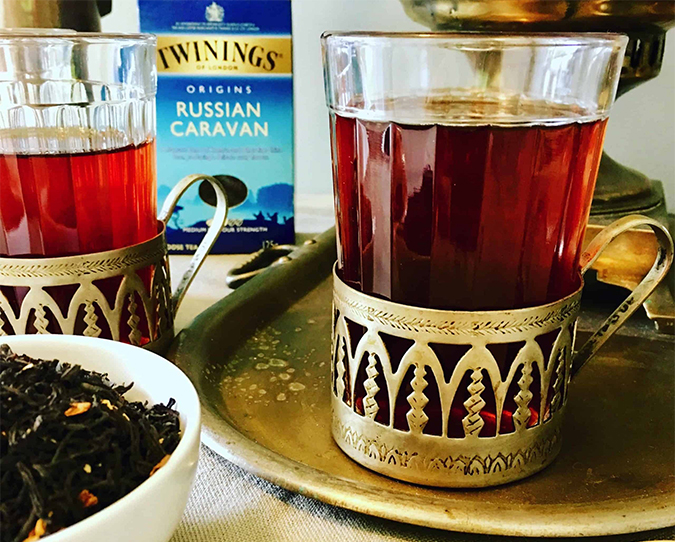
On one of my visits, with Dilhan also accompanying me, after finishing our work in Moscow we flew to Belarus, where we had direct importers of Dilmah tea. We stayed a couple of nights in a hotel which also had a casino where, in a rare gambling session, we won enough money to pay for our hotel and also purchase an old, traditional Russian tea samovar for around USD 300. I thought that it would be an attractive addition to the Dilmah Tea Archive in Colombo, but, unfortunately, at the Moscow Airport Customs, it was confiscated on the grounds that the samovar was an antique item and therefore not transferable out of the country.
In 2006 Herman Gref, Minister of Economic Affairs and Trade of Russia from 2000 to 2007, made an official visit to Sri Lanka. He first met the then Minister of Trade and Commerce, the late Jeyaraj Fernandopulle, in the latter’s office, in order to sign the WTO protocol. During the meeting he had told the Minister that he would also like to visit the Dilmah factory as he had grown up drinking Dilmah tea in Russia. When Minister Fernandopulle conveyed the request to me, I said I would be quite happy to come over to the Ministry to meet Gref, but the latter insisted on coming over to my office in Peliyagoda on his way to the airport, on the return journey to Russia.
He congratulated me on my trade with Russia and the quality of my products and offered me unconditional assistance, which included land at no cost, to set up a tea packaging operation anywhere in Russia. I had some difficulty in declining this seemingly-magnanimous offer! Gref was subsequently appointed CEO and Chairman of Sberbank, the largest bank in Russia. He still holds these positions.
Eventually, in view of my considerable losses in the trade with Russia, largely owing to illegal intrusions by the Russian mafia, from 1997 onwards I significantly downsized my presence in that market, despite having been a major player with my Dilmah brand since 1988. The devaluation of the ruble also had its impact on the import-export trade, as Russian traders experienced difficulties in obtaining US Dollars from banks. However, in retrospect, despite the difficulties, I feel that moving out of Russia was an error of judgment as when I returned to it, I was not able to recapture the dominance I had been enjoying earlier. In the relatively short period of my limited involvement, many other brands had moved in.
The iron lady becomes a friend
When marketing Dilmah tea in Russia more than a decade later, it was my intention to link up with one of the country’s largest supermarket chains, the X-5 Retail Group, which operated chains of convenience stores, supermarkets, and hypermarkets under different brands right across Russia. The X-5 Group was also Russia’s largest food retailer. In order to re-develop our business in Russia I had, in the meantime, set up a company in Russia called Dilmah Rus, as an associate company of the MJF Group. Megapolis, Russia, was appointed as the Dilmah distributor in the country.
Despite all our preparations, however, our team was facing problems in obtaining listings with the X-5 Group. Though Dilmah tea had previously been widely available in Russia, since we had changed distributors, as was the practice the retailer had de-listed us. Unquestionably, our success in Russia was contingent upon our linking up with the X-5 Group and that was to be determined solely by Olga Ivanovna, the Chief Commercial Buyer of Beverages for the X-5 Group. She was, reputedly, an uncompromising negotiator. Both Dilhan and Roshan Tissaaratchy, my Director, reported to me that Ms. Olga had laid out very rigorous conditions, which included wide-ranging discounts and a stiff listing fee, before she would consider accepting the Dilmah brand.
In 2010 I travelled to Moscow, accompanied by Roshan, for a meeting with this lady. She arrived alone for the discussion and, firstly, insisted that my Russian distributor, who was also present, be asked to leave the meeting as she dealt only with principals. We tried to convince her, without success, that the distributor’s presence was necessary. Fortunately, our distributor resolved the problem by courteously agreeing to withdraw and we commenced our negotiations with her with only me, Roshan, and our Country Manager present.
Olga was extremely business-like, controlled, and gave no indication of her true feelings, but I did get the impression that, inwardly, she was intrigued at having to deal directly with the owner of a brand. My guess was that it was an unusual situation for her, and for me an advantage that I would go on to use as a lever in the negotiation. We laid out our product range for inspection and I described my background in the tea trade in Russia to her. I also explained my business philosophy. I then told her that years before, I had introduced to the Russian market a large-leaf tea pack called OP-COP, which had sold very well and that it continued to be our best seller, along with our Pure Ceylon Tea bags, as I had provided the same product over the years with no change in quality.
However, whilst she was appreciative of our arguments, she still laid out pre-qualification conditions, which included a 50% discount on our price range and a USD 800,000 listing fee. I was startled at the stiffness of her terms, but told her very courteously that the tea I was proposing to deliver was of the finest quality, direct from the plantations and superior to any product that she already had.
I also made it clear to her that I would not be able to provide that package on the bargain-basement terms she was proposing, as that would compel me to compromise on the Dilmah benchmark of product purity and authenticity. I explained to her that those were was not concessions I was prepared to consider, irrespective of the rewards at stake. Having thus stated my position, I thanked her for her time and prepared to withdraw.
She then spoke to the Country Manager in rapid-fire Russian and, at the end of the that exchange, turned to me and asked how quickly we could deliver one million units of Dilmah tea, at my price, for a special promotion. She also agreed to fund part of the promotional expenses. We came away from that meeting with an order for one million X 100 tea bag units. Eventually, we also became great friends with Olga and subsequently, after she had left the X-5 Group, she visited Sri Lanka with her family for a vacation.
To me, the episode in its entirety was the reinforcement of my long-held personal ethos, that if you have a good product and refuse to compromise on quality, at a commensurate price, the buyer-consumer will eventually accept the proposition as a fair bargain. To both Dilhan and Roshan I think it was part of an interesting learning curve, the kind that is not normally reflected in marketing textbooks. Persistence, reinforced by integrity, rarely fails to produce a decent result.
However, the developments and the progression of events described above, were indisputable proof of a prediction and a statement I had made repeatedly, firstly to the Ceylon Tea Propaganda Board and later to the Sri Lanka Tea Board in any market, one must use the opportune moment to enter and establish the dominance of your product or brand. If you fail to do so, another trader-entrepreneur will step in and occupy that space. In large, lucrative markets, that kind of opportunity may come only once, and a belated re-entry carries a massive cost that only a few can afford.

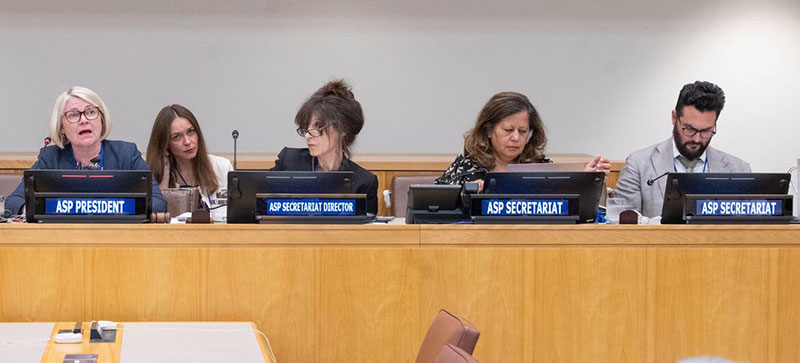
 US Secretary of State Marco Rubio’s warning to the International Criminal Court (ICC) was stark: ‘Either the ICC will end its threats, or we will end the ICC.’ It followed US central administration accusations that the court was unfairly targeting Americans on the basis of trumped-up war crimes charges.
However, a new plethora of sanctions has been clamped on the ICC by the US, which in turn has spurred accusations by sections of the world that the latter has unleashed an ‘assault’ on the international legal order.
What some of the sanctions would mean for the ICC was outlined by Rubio: ‘We will ban transactions with this rogue court, cutting off their resources and crippling their ability to operate against us.’
The ICC has shown consistency of purpose over the years. Despite some operational constraints it has indicted a large number of political strongmen from around the world, accused of war crimes and other governance excesses that come under its purview. Two such recent figures are: Russian President Vladimir Putin and Israeli Prime Minister Benjamin Netanyahu.
Rather than enjoy a mere nominal presence in the world community, the ICC has proved its effectiveness by detaining and bringing to justice scores of VIP politicians and others of their ilk who have been found guilty of human rights abuses and kindred excesses that come within the terms of reference of the ICC.
Accordingly, the international justice system would be stymied considerably as a result of the ICC being dis-empowered, particularly financially. Needless to say, potential and real perpetrators of the species of crime coming under the jurisdiction of the ICC would stand to gain most from such anarchic tendencies. That is, political repression globally would be enabled to enjoy a new lease of life.
A detailing of the types of crime coming under the purview of the ICC provides an idea of what it would cost the international community if the ICC’s operations are gravely hampered. They are mainly: genocide, war crimes, crimes against humanity and the crime of aggression.
That is, the part of the world to be worst affected would be the global South, since the latter is awash with the mentioned crimes. Needless to say, a chronically-disaffected South will sooner rather than later undermine the well being of the world dangerously. The world is already being put through these paces.
At the time of writing, ‘illegal migrants’ from the South, for example, are aggravating many a Western economy’s woes, besides creating for them acute law and order issues. The fact that these migrants’ presence goes on to become a virtual test of the migrant receiving states’ ability to forge domestic social inclusion in the face of jingoistic protests by mainly white supremacist groups is evidence of the latter. As is known, the US, to take just one example, has been up against this crisis for quite a while.
Accordingly, it will be in the best interests of the West if ‘illegal’ migrant arrivals on their shores are stemmed. If the socio-political and economic problems assailing the South are effectively managed through North-South collaborative, ‘trouble-shooting’ efforts the causes leading to ‘illegal’ migration and connected issues could be resolved at source as it were. For, it is the aggravation of the South’s material questions that lays the basis for the emergence of repressive and anti-democratic regimes in the hemisphere.
Until such time that the aforementioned issues in North-South relations are visited afresh and addressed urgently, a vibrantly functioning ICC would be needed. For, the latter would prove a deterrent to Southern political and military strongmen, highly prone to power abuse and like excesses, from coming into being in the wake of the South’s chronic material woes and the wars and conflicts that result from them.
It stands to reason then that the US would be acting in its own interests by enabling the ICC to perpetuate its mandate without hindrance. For a crop of issues that impinges negatively on internal law and order would be defused.
Meanwhile, there needs to be a meeting of minds among the rest of the West to put back in place a North-South dialogue process aimed at reducing some of the economic pressures that are weighing on the South.
Since economics usually drives politics it will be in the interests of the world community to scrutinizingly re-visit North-South issues of the past and put in place economic relief packages for Southern publics that would enable them to tide over their material hardships rather than permit the latter to aggravate into social disaffection and eventually armed militancy. It is the latter juncture that paves the way for the emergence of authoritarian rulers in the South who then go on to be a blight on their publics.
Accordingly, the Southern-based global development thinking of the past that envisaged a more equitable world economic order needs to be seen as an urgent need. That is, NAM’s international development paradigms need to be resuscitated to the extent possible.
It is unlikely that rightist governments of the West, such as the current Republican administration in the US, would find these projects feasible, but democratic states of Europe, led by perhaps the UK, are likely to think otherwise. For it would not be beneficial for the democratic world to be having on their hands repressive governments in the South who would be gravitating towards the major military and economic actors of the South, such as Iran and North Korea, who tend to be in constant power struggles with the West.
However, until such time that the mentioned, pro-people initiatives are given serious thought the ICC would need to be enabled by the international community to be in place comfortably and carry on with its mandate of bringing repressive rulers to book. Besides the ICC should pave the way for the peoples of the developing world to enjoy some substantial respite from the political repression and even terror which tend to be their lot.
Meanwhile, the wars of West Asia are relentlessly aggravating the economic hardships of people everywhere, driving the point home to enlightened sections that there is no alternative to peacemaking. A challenge is to convert the US under President Trump to this line of thinking.

 This week, I give you five simple, time-tested homemade remedies that help reduce the appearance of blemishes, control excess shine and leave your skin feeling softer and smoother.
The Honey and Lemon Brightening Dab:
For stubborn blemish marks, this is a classic. Mix one teaspoon of pure bee honey with three to four drops of fresh lemon juice. Apply gently, only on the affected spots, and leave for 10 minutes before rinsing with lukewarm water. While honey soothes and softens, lemon helps to brighten naturally. Use twice a week in the evening.
Besan and Rose Water Oil-Control Pack:
An ideal remedy to combat shine, especially on the T-zone. Take two teaspoons of besan (gram flour) and mix with sufficient rose water to form a smooth paste. Add a pinch of turmeric for its antiseptic goodness. Apply evenly, keep for 15 minutes and wash off. It absorbs excess oil without over-drying, leaving a beautiful matte finish.
Aloe Vera and Cucumber Ice Soother:
Blend fresh aloe vera gel with the juice of a grated cucumber and freeze the mixture in an ice tray. Each morning, wrap one cube in a soft muslin cloth and gently rub over a cleansed face for 30 seconds. It calms, tightens pores and imparts a baby-soft smoothness.
Oatmeal and Curd Gentle Polish:
Roughness and old blemish marks need gentle exfoliation. Combine one tablespoon of finely powdered oatmeal with one tablespoon of fresh curd (yoghurt). Massage very gently, in circular motions, for one minute, leave for five minutes and rinse. It removes dead cells and unveils softer, clearer skin.
Multani Mitti and Green Tea Magic Mask:
Brew some green tea and allow it to cool completely. Mix one and a half teaspoons of Multani Mitti (Fuller’s Earth) with the tea water to make a fine paste. Apply for 10 to 12 minutes – do not let it dry and crack completely – and wash off. It draws out impurities, fades blemishes and bestows a fresh, shine-free glow.
A Gentle Reminder:
As with any natural remedy, always do a patch test on your inner arm first. For those with oily or combination skin, avoid heavy coconut oil application and harsh scrubbing, as they tend to aggravate shine and blemishes.

 Dream of performing on a world stage? Well, here is your unique, golden opportunity!
The World Championships of Performing Arts (WCOPA) — the one and only official “Talent Olympics” — is the world’s premier global platform for aspiring singers, dancers, actors, models, instrumentalists, etc., to compete, shine and be discovered!
And, yes, this world stage is open to YOU, Sri Lankans living in Sri Lanka and overseas!
Held annually in glittering Las Vegas, WCOPA brings together over 70 countries, all competing for Gold, Silver and Bronze Medals, just like the traditional Olympics.

Lakisha Bernard: Will represent Team Sri Lanka at WCOPA 2027
Outstanding performers vie for the coveted titles of Junior and Senior Grand Champion Performer of the World, with winners and standout participants awarded over $500,000 in scholarships, cash awards and prizes to catapult their education and careers!
Sri Lanka is already making waves! At WCOPA 2026, Natharie Wickramasinghe, representing Team Sri Lanka, made the nation proud by winning a Bronze Medal in the Ethnic/Folklore Dance category!

Lakisha: Accomplished freelance Model and Fashion Design graduate
Recruitment for this prestigious competition is handled through a system of scouts and licensed National Directors — and this is where our very own Chris Rajendra, now based in Las Vegas, and National Director for Team Sri Lanka, comes into the scene.
If you are a singer, dancer, actor, model, instrumentalist — if you have talent burning inside you — contact Chris Rajendra today for registration and, who knows, you may find yourself in Las Vegas, and proudly draped in the Sri Lankan flag, at WCOPA 2027!
The contact address is: Chris Rajendra, wcopa.nationaldirector.sl@gmail.com
or chris.rajendra@gmail.com
Meanwhile, a star is born for 2027, in the form of Lakisha Bernard who is all set to represent Team Sri Lanka at WCOPA 2027.
Originally hailing from the sun-drenched coastal city of Colombo and now carving out her creative career in Canada, 22-year-old Lakisha is stepping into the international spotlight.
This accomplished freelance Model and Fashion Design graduate has officially been appointed as the Team Sri Lanka Promoter for Canada as she prepares to represent Team Sri Lanka at WCOPA in Las Vegas.
Lakisha brings a unique blend of high-fashion sensibility, captivating camera presence and expert garment design to the Team.
Having built her career, from local college shoots to high-glamour concepts, Lakisha’s inspiring journey embodies the true spirit of cultural bridge-building and creative resilience, bringing immense pride and recognition to Sri Lanka on the global stage.
WCOPA 2027 will be held at the legendary Westgate Hotel & Casino, Las Vegas, from 12th to 20th July – the very same iconic arena where the late, great Elvis Presley himself performed!
Your moment is now. Your stage is Las Vegas, so hurry and contact Chris Rajendra.

AgriConnect Sri Lanka’ to be launched on 30 October to Modernise the Agricultural Sector Through Digitalisation

57th Annual Saints’ Quadrangular Tournament on Saturday and Sunday

Showers or thundershowers will occur at most parts of the island

Prison rules to be revised over monks’ attire

AC President recuses himself from hearing prison attire case pertaining to Gnanasara Thera

Court orders steps to obtain INTERPOL Red Notice against Basil

‘Dates have the highest sugar content to fight Coronavirus’

Sunday Island 27 December – Headlines

#SundayIsland 17th December – Headlines

Sunday Island – 28th March

Sunday Island Headlines – 21 March

Sunday Island – 21st February – Headlines
-

 News7 days ago
NDB fraud Rs 60mn more than reported
-

 News7 days ago
Removing monk’s robes matter for Sangha to decide: Mahanayake Theras
-

 News5 days ago
Sri Lanka escalates anti-graft drive with Shiranthi’s jailing
-

 News6 days ago
NPP govt. reminded of its responsibilities as US warship leaves Colombo
-

 Latest News6 days ago
Farhan, Sadaqat help Pakistan ace 183 chase to go 1-0 up
-

 News7 days ago
BHC, Colombo: “LTTE remains a proscribed org. in the UK”
-

 Latest News4 days ago
Farhan and Sadaqat help Pakistan seal series in style
-

 News5 days ago
Iranian ships stranded, Lanka fears US sanctions