
Features
IGP stakes: why’s and wherefores of old values of succession being scuttled

BY Kingsley Wickremasuriya, Senior DIG (Retd.)
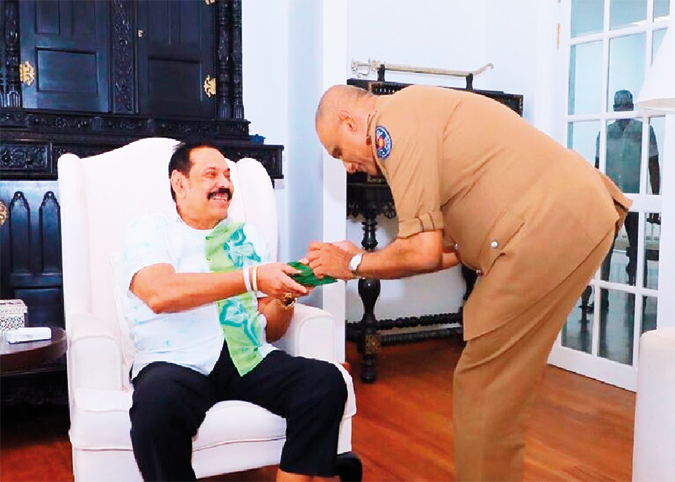
The post of Inspector-General of Police is ‘vacant’ and the government is dilly-dallying with the appointment of a successor to take over, apparently for reasons of political expediency. This is the first time in the known history of the Department that the Police had to face such a situation.
In all these years the succession to the post of the Inspector-General of Police was almost automatic being based, by and large, on the line of Seniority and Merit. The post usually went to the Senior-most Deputy Inspector-General of Police, the most experienced and respected leader in the department. To name a few, Inspectors-General of Police Aleric Abeygunawardena, John Attygalle, and Cyril Herath were officers par excellence known for their integrity and impartiality and for doing their duty according to the Rule of Law.
The road to succession was known to be either through the post of Director of Headquarters Administration (DHA) or Director of Criminal Investigation (D/CID). This was the norm accepted by the rank and file. The succession was, therefore, smooth and easy and widely accepted by the rank and file and the country at large. This time-tested process gave legitimacy to the post of Inspector-General of Police in the eyes of all the stakeholders including the Police themselves.
In a disciplined service, rank is sacrosanct. An officer has necessarily to aspire to a higher rank through performance. If his work had been of exceptional merit and distinction, he may even be considered for a special promotion. A promotion can also be posthumous where the deceased officer had been exemplary in performance and achievement. An officer will therefore naturally like to safeguard his position in the line of seniority. He will be unhappy if a junior officer is placed over him merely because the latter wields influence. It is natural for an officer in a disciplined service to jealously protect his place in the line of seniority against encroachment (Merril Gunaratna, ‘Perils of a Profession).
This paper will try to find an explanation as to why the police have failed to ‘Serve and Protect’ the citizen, which is the main purpose of a Democracy.
Police & Politics
Police have in recent times come in for sharp criticism from various quarters ostensibly for their failure to contain the lawlessness prevailing in the country and to maintain the Rule of Law, particularly in the face of mass protests that took the country by storm. Critics allege the partiality of the police as the reason for their inability to enforce the Rule of Law. It has led to a near riotous situation being created in many parts of the country by police inaction against lawbreakers.
It is commonly known that this situation has been brought about by the politicization of the Police. A review of the constitutional history will show how undue political interference in police affairs has affected the legitimacy of the Police (and the legitimacy of the government itself, whose agents the police are) contributing to the current lawlessness in the country and the resulting failure of the police to enforce the Rule of Law.
Looking at the root cause, it has been found that the beginnings of political interference in the affairs of the Public Service were a problem even before the country gained Independence from the British. It had its origins in the early 1920s. The reports on the Colebrook – Cameron Reforms, the Donoughmore and Soulbury Reforms are a testimony to the measures they proposed to protect the Public Service from the undue interference of unscrupulous politicians.
Whilst these Commissioners made continuous efforts to ensure an efficient and effective Public Service by protecting it from undue political interference, the working of the Constitution in the aftermath of the Soulbury Commission showed how the highest in the political hierarchy of the country, no less a person than the Prime Minster himself (of the time) attempted to scuttle the legally adopted constitutional provisions by his attempts to circumvent the Constitution.
The legend has it that a Prime Minster (at the time) is alleged to have said once, ‘Public Service Commission or no Commission, I get whom I want’. We also have the story going around in police circles about how the same Prime Minster exhorted the then Inspector-General of Police, Osmund de Silva that the Police should have that ’extra bit of loyalty to the Government’, and how the Inspector-General responded in return by exhorting his officers that what they should uphold is the Rule of Law although he knew that he would be falling out of favour with the premier and that it would affect his tenure.
With all these attempts behind the scenes the Public Service Commission at that time worked reasonably well without a major hiccup until the introduction of the first Republican Constitution in 1972 that vested the responsibility of appointments, transfer, dismissal, and disciplinary control of all State Officers with the Cabinet of Ministers by Article 106 and other provisions in Chapter XII of that Constitution giving a blank cheque for political interference. The best illustrations of these efforts are the Chapter XII of the Republican Constitution of 1972 and Chapter IX of the Republican Constitution of 1978. This was the start of the process of politicization of the public service in general and the Police in particular.
In the meanwhile, the effects of these constitutional provisions brought about by Article 106 and the other provisions in Chapter XII of the first Republican Constitution (1972) on the Police have had far-reaching effects on its morale, and discipline. Consequently, delivery of services to the people has suffered severely resulting in the lowering of quality and professional standards that used to be maintained in the Police previously. With the proclamation of the Second Republican Constitution, the provisions of Chapter XII were given effect to more or less completely concerning the control of the Public Service in Chapter IX (The Executive) of the 1978 Republican Constitution. The effects of that on the Police have far exceeded those referred to by the Basnayake Police Commission (1970) or the Subasinghe Committee (1979) in their reports. This is confirmed by the report produced by the Jayasinghe Committee in 1995.
Police Reforms
As far as the Police are concerned several Police Commissions/Committees were appointed by successive governments to go into Police matters and report on reforms. The Soertz Commission Report (1946), the Basnayake Police Commission Report (1970), The Subasinghe Committee Report (1979), and Jayasinghe Committee Report (1995) on Police Reforms spoke eloquently of the impact these constitutional provisions had on the Police. They all spoke of how undue political interference undermined the moral of the Service, led to a poor public image, and loss of public respect or cooperation.
Jayasinghe Committee
In 1995 once again a three-man Committee was appointed by the President headed by Mr. W. T. Jayasinghe, a former Secretary to the Ministry of Defence ‘to inquire into and report on the reorganization of the Police Service’. The Jayasinghe Committee in particular in their report said that all the officers who appeared before them agreed that undue pressure was brought to bear in the matter of appointments, promotions, postings, and even transfers. These undue pressures were mostly from politicians and those close to politicians. They also agreed that this was one of the main reasons for the breakdown of discipline, loss of morale, and high incidence of corruption in the police. The interference did not stop with personnel matters like transfers, promotions, etc. It extended even to operational matters like criminal investigations.
As a result of the increasing incidence of interference by MPs in investigations, the Committee said that some of the officers who were fair and acted impartially were removed and transferred from their stations overnight at the instance of an MP because the offender happened to be a supporter of the MP, and yet others who had a well-known track record of corruption or inefficiency were promoted over the heads of those conscientious and dedicated officers. They also pointed out how in recent years junior officers have been promoted over their seniors, ostensibly on the ground of outstanding merit. This affected the morale of the entire Service.
While tracing back the history of the police to British times in an attempt to explain this phenomenon, the Committee said that the sole function of the police during that time was to safeguard the interests of the rulers. Even after Independence, the stance of the police did not change. The prime duty of the police now became the safety of the State instead. In the process, the police saw their immediate role to be safeguarding the interests of the government in power which eventually took the form of safeguarding the interests of the Members of Parliament (MP) of the ruling party.
They then went on to show how this relationship between the Police Officer and the MP became a particularly sensitive one, much more than that with other Government Officials because of the special demands of those constituents close to him to help them escape the rigorous application of the law by the police. Since every Government is faced with this dilemma resulting from this sensitive relationship between the MP and his constituents and consequently the MP and the police, the Committee thought that in the circumstance it would help the Government and the MPs themselves if a Police Service Commission is established as recommended by the Basnayake Police Commission in 1970 by easing the constituents’ pressure on MPs on police matters on the one hand, and that it will also go a long way to restore the morale and confidence in the police themselves on the other.
Almost all the officers who appeared before the Commission were “vehemently in support of the establishing of such a Commission.” They were further of the view that the Commission should play an active role, unlike the previous PSC in laying down policies and ensuring that they are scrupulously followed. Therefore, while recommending the establishment of a Police Service Commission they were of the view that the Commission should be appointed by the Constitutional Council of the Parliament and the members of that Commission should consist of senior serving or retired administrators, judicial officers, police administrators, and academics in sociology. They also suggested that the Constitution should be suitably amended to give effect to the establishment of a Police Service Commission. The recommendations were of no avail. Once again, the government did nothing to implement these recommendations.
17th Amendment
These recommendations however lay ignored for more than three decades when suddenly came the 17th Amendment, after a long period of inaction. The 17th Amendment was not the result of any of these recommendations. It was the result of some politicians in the opposition waking up from their slumber about police reforms and thinking of acting only after they had been themselves victims of delayed reforms and at the receiving end of a series of events affecting their political interests.
The 17th Amendment was the result of a political initiative launched by Members of Parliament in the Opposition led by the United National Party in 2001. The move was prompted by the violence and alleged election malpractices that was present during the Waymaba Provincial Council Elections in 1998, where it was alleged that “massive thuggery and vote rigging took place on an unprecedented scale”. It was not surprising that the UNP should take the lead because it was, they who suffered most during the election campaign being the victims of their constitutional device introduced during the UNP regime in 1978 placing unlimited power in the hands of the President. The Amendment naturally sought to neutralize or curb those powers vested in the President by Chapter IX of the Constitution of 1978.
The Amendment had its origins in the Report of the Citizens’ Consultation on Free and Fair Elections and De-politicisation of Key Institutions, which was set up by the Leader of the Opposition. That year a Drafting Committee was set up under the chairmanship of Mr. Karu Jayasuriya, MP where the OPA was represented by its General Secretary. A report was drawn up by the Citizens’ Consultation but it lay dormant till 2000 when a first draft of the 17th amendment was made.
After further consultation with an Expert Committee where three Senior Deputy Inspectors-General assisted in Police matters, a preliminary draft was presented by the OPA to the political parties. But what ultimately came out in Parliament on October 3, 2001 was something entirely different from the OPA draft. Even then, out of all the Institutions set up under the 17th Amendment, the National Police Commission was the most criticized by the politicians in the ruling party. If not for the JVP who put pressure on the PA Government, the 17th Amendment would not have seen the light of day even in this form.
Nevertheless, the Amendment wittingly or unwittingly introduced some of the measures contained in the recommendations made by the Basnayake Police Commission and the Jayasighe Committee. One of the major recommendations of the Basnayake Commission was the establishment of a separate Police Service Commission outside the jurisdiction of the PSC with an amendment to the Constitution. The 17th Amendment has already taken this step. It has also met the condition set by Jayasinghe Committee that the Police Service Commission be appointed by a Constitutional Council.
One of the other major conditions set by the Basnayake Police Commission was the Security of Tenure of the Inspector-General. It said that “An Inspector-General who has reached the age of optional retirement or has only a few years to reach that age is haunted by the fear that if he does not please those in power he may be retired either at once or the moment he reaches the age of optional retirement.” They pointed out that the head of so important a department being haunted by such fear in the performance of his very responsible duties is not in the public interest. The Basnayake Commission, therefore, recommended that the Inspector-General should be protected against the irresponsible exercise of the power of removal.
This safeguard is now provided by the Amendment under Article 41C by way of subsequent legislation in the form of Act No. 5 of 2002 which stipulates that the Inspector-General (amongst others) shall not be removed from office except following the procedure laid down in the Act. But, the power of grating extension of service is still in the hands of the President. That has not changed and the Amendment is silent on the matter. So, he will continue to be haunted by the fear of the threat of retirement and that fear will continue to hang over the incumbent like the ‘Sword of Damocles’ in the future as well if steps are not taken to rectify this situation sooner than later.
Therefore, it will not be a matter of surprise if he continues to secure his position by pleasing those in power to stay in office despite the many safeguards provided to bring the status quo back to square one. The amendment had several other deficiencies as well (for a detailed discussion on the subject, refer to the original article written by the same author, titled ‘Police. Politics and the 17th Amendment’ published in OPA Journal Vol.22 – May 2007).
Even if this fear is effectively removed through Constitutional Amendment, recent experience has shown that this argument is somewhat flawed in the present context of things considering the tendency some incumbents have shown to overreach their term to secure their position so that they could continue to remain in office even after reaching the age of retirement. The temptation not only to prolong his stay in office as long as possible but also to try and secure high office even thereafter has been reinforced by the recent practice of the governments offering prestigious postings abroad to the retiring Inspectors- General.
This encourages a ‘you scratch my back and I scratch yours’ kind of attitude. It also vitiates all the good intentions contained in the legislation designed to ensure the impartiality of the police by securing the tenure of the Head of the Department. The remedy may, therefore, lie in the appointment of the IGP for a fixed period of the contract, say for 3-4 years (as was the practice previously but discontinued later) with a ‘Retirement Package’ that will enable him to live comfortably without the lure of extensions beyond retirement age, ambassadorial postings or another high office so that he could do his duty by the people.
These, however, are safeguards against an IGP in office. What are the safeguards against the chances of an unscrupulous aspirant getting into office through political lobbying? This has often remained an open question probably until the next IGP stakes. So, safeguards have to be built not only against undue political pressure on the incumbent IGP but also against aspirants from getting to the top post through political lobbying. All other safeguards that have been proposed would be set at naught for having secured the post through lobbying it will be natural for the incumbent to feel obliged to his political Godfathers to ensure he continues in office.
So, when we are discussing ways and means of building public confidence in the police, what should be uppermost in our minds is not only an ‘Independent Police Commission’, but also an independent Head of the Police who by the circumstances of his appointment alone can infuse confidence in the public. Selection procedures (similar to the appointment to the post of Vice Chancellor) that are transparent enough to infuse public confidence in the appointment of the Inspector General have to be put in place in the future towards this end, without delay. Therefore, the need of the hour is not to rush with deadlines for reasons of expediency but to study the problem in-depth and bring meaningful reforms that will restore public confidence in the police, in due process, and in democracy.
Conclusions
The various Commissions on Constitutional Reforms from Colebrook-Cameron to Soulbury and several Police Commissions/Committees on Police Reforms such as Basnayake Police Commission, Subasinghe Committee, and Jayasinghe Committee on Police Reforms have all repeated the ill effects of political interference in the functioning of Police (one of the watchdogs of Democracy) ad nauseam and at great length.
But the provisions in the 1972 Republican Constitution concerning transfers, promotions, etc. of the public officers and its repetition in the next constitution in 1978 demonstrated the determination that has taken the better of politicians of all hues in this country against saner counsel opposing undue political interference in government affairs. Then came the 18th Amendment putting the clock back on all that has been achieved by the 17th Amendment. It simply demonstrated the obstinacy of those in power wanting to politicize everything under the sun.
The outcome of this undue political interference is a Police that is servile, inefficient, corrupt, and pliable that has lost Public Respect. Having lost their Legitimacy in the eyes of the Public they have forfeited their right to Public Support and their Respect for the Law (and the Police themselves). What is therefore at stake is not only the legitimacy of the Police but the very legitimacy of the government itself putting Public Security in jeopardy. That is why people have taken the Law into their own hands and resorted to mass action.
This is an ominous trend that needs to be remedied without delay. What is at stake is the legitimacy of all governments as could be seen from the peoples’ ‘uprisings’ in the form of protests, demonstrations, violence, etc. which are only symptoms of the deep malaise. Police are the bulwark of a democracy. If the Police fail all else will fail in a democracy. Playing with police is playing with fire. Therefore, it is time that civil society woke up from its slumber and take timely steps without waiting to shut the stables after the horses have bolted








 When the National People’s Power won elections in 2024, there was much hope that the country’s education sector could be made better. Besides the promise of good governance and system change that the NPP offered, this hope was fuelled in part by the appointment of an academic who was at the forefront of the struggle to strengthen free public education and actively involved in the campaign for 6% of GDP for education, as the Minister of Education.
Reforms in the education sector are underway including, a key encouraging move to mainstream vocational education as part of the school curriculum. There has been a marginal increase in budgetary allocations for education. New infrastructure facilities are to be introduced at some universities. The freeze on recruitment is slowly being lifted. However, there is much to be desired in the government’s performance for the past one year. Basic democratic values like rule of law, transparency and consultation, let alone far-reaching systemic changes, such as allocation of more funds for education, combating the neoliberal push towards privatisation and eradication of resource inequalities within the public university system, are not given due importance in the current approach to educational and institutional reforms. This edition of Kuppi Talk focuses on the general educational reforms and the institutional reforms required in the public university system.
General Educational Reforms
Any reform process – whether it is in education or any other area – needs to be shaped by public opinion. A country’s education sector should take into serious consideration the views of students, parents, teachers, educational administrators, associated unions, and the wider public in formulating the reforms. Especially after Aragalaya/Porattam, the country saw a significant political shift. Disillusionment with the traditional political elite mired in corruption, nepotism, racism and self-serving agendas, brought the NPP to power. In such a context, the expectation that any reforms should connect with the people, especially communities that have been systematically excluded from processes of policymaking and governance, is high.
Sadly, the general educational reforms, which are being implemented this year, emerged without much discussion on what recent political changes meant to the people and the education sector. Many felt that the new government should not have been hasty in introducing these reforms in 2026. The present state of affairs calls for self-introspection. As members affiliated to the National Institute of Education (NIE), we must acknowledge that we should have collectively insisted on more time for consultation, deliberations and review.
The government’s conflicts with the teachers’ unions over the extension of school hours, the History teachers’ opposition to the removal of History from the list of compulsory exam subjects for Grades 10 and 11, the discontent with regard to the increase in the number of subjects (now presented as modules) for Grade 6 classes could have been avoided, had there been adequate time spent on consultations.
Given the opposition to the current set of reforms, the government should keep engaging all concerned actors on changes that could be brought about in the coming years. Instead of adopting an intransigent position or ignoring mistakes made, the government and we, the members affiliated to NIE, need to keep the reform process alive, remain open to critique, and treat the latest policy framework, the exams and evaluation methods, and even the modules, as live documents that can be made better, based on constructive feedback and public opinion.
Philosophy and Content
As Ramya Kumar observed in the last edition of Kuppi Talk, there are many refreshing ideas included in the educational philosophy that appears in the latest version of the policy document on educational reforms. But, sadly, it was not possible for curriculum writers to reflect on how this policy could inform the actual content as many of the modules had been sent for printing even before the policy was released to the public. An extensive public discussion of the proposed educational vision would have helped those involved in designing the curriculum to prioritise subjects and disciplines that need to be given importance in a country that went through a protracted civil war and continue to face deep ethno-religious divisions.
While I appreciate the statement made by the Minister of Education, in Parliament, that the histories of minority communities will be included in the new curriculum, a wider public discussion might have pushed the government and NIE to allocate more time for subjects like the Second National Language and include History or a Social Science subject under the list of compulsory subjects. Now that a detailed policy document is in the public domain, there should be a serious conversation about how best the progressive aspects of its philosophy could be made to inform the actual content of the curriculum, its implementation and pedagogy in the future.
University Reforms
Another reform process where the government seems to be going headfirst is the amendments to the Universities Act. While laws need to be revisited and changes be made where required, the existent law should govern the way things are done until a new law comes into place. Recently, a circular was issued by the University Grants Commission (UGC) to halt the process of appointing Heads of Departments and Deans until the proposed amendments to the University Act come into effect. Such an intervention by the UGC is totalitarian and undermines the academic and institutional culture within the public university system and goes against the principle of rule of law.
There have been longstanding demands with regard to institutional reforms such as a transparent process in appointing council members to the public university system, reforms in the schemes of recruitment and selection processes for Vice Chancellor and academics, and the withdrawal of the circular banning teachers of law from practising, to name a few.
The need for a system where the evaluation of applicants for the post of Vice Chancellor cannot be manipulated by the Council members is strongly felt today, given the way some candidates have reportedly been marked up/down in an unfair manner for subjective criteria (e.g., leadership, integrity) in recent selection processes. Likewise, academic recruitment sometimes penalises scholars with inter-disciplinary backgrounds and compartmentalises knowledge within hermetically sealed boundaries. Rigid disciplinary specificities and ambiguities around terms such as ‘subject’ and ‘field’ in the recruitment scheme have been used to reject applicants with outstanding publications by those within the system who saw them as a threat to their positions. The government should work towards reforms in these areas, too, but through adequate deliberations and dialogue.
From Mindless Efficiency to Patient Deliberations
Given the seeming lack of interest on the part of the government to listen to public opinion, in 2026, academics, trade unions and students should be more active in their struggle for transparency and consultations. This struggle has to happen alongside our ongoing struggles for higher allocations for education, better infrastructure, increased recruitment and better work environment. Part of this struggle involves holding the NPP government, UGC, NIE, our universities and schools accountable.
The new year requires us to think about social justice and accountability in education in new ways, also in the light of the Ditwah catastrophe. The decision to cancel the third-term exams, delegating the authority to decide when to re-open affected schools to local educational bodies and Principals and not change the school hours in view of the difficulties caused by Ditwah are commendable moves. But there is much more that we have to do both in addressing the practical needs of the people affected by Ditwah and understanding the implications of this crisis to our framing of education as social justice.
To what extent is our educational policymaking aware of the special concerns of students, teachers and schools affected by Ditwah and other similar catastrophes? Do the authorities know enough about what these students, teachers and institutions expect via educational and institutional reforms? What steps have we taken to find out their priorities and their understanding of educational reforms at this critical juncture? What steps did we take in the past to consult communities that are prone to climate disasters? We should not shy away from decelerating the reform process, if that is what the present moment of climate crisis exacerbated by historical inequalities of class, gender, ethnicity and region in areas like Malaiyaham requires, especially in a situation where deliberations have been found lacking.
This piece calls for slowing-down as a counter practice, a decelerating move against mindless efficiency and speed demanded by neoliberal donor agencies during reform processes at the risk of public opinion, especially of those on the margins. Such framing can help us see openness, patience, accountability, humility and the will to self-introspect and self-correct as our guides in envisioning and implementing educational reforms in the new year and beyond.
(Mahendran Thiruvarangan is a Senior Lecturer attached to the Department of Linguistics & English at the University of Jaffna)
Kuppi is a politics and pedagogy happening on the margins of the lecture hall that parodies, subverts, and simultaneously reaffirms social hierarchies
by Mahendran Thiruvarangan

Looking back at the past year, the anxiety among influential sections of the population that the NPP government would destabilise the country has been dispelled. There was concern that the new government with its strong JVP leadership might not be respectful of private property in the Marxist tradition. These fears have not materialised. The government has made a smooth transition, with no upheavals and no breakdown of governance. This continuity deserves recognition. In general, smooth political transitions following decisive electoral change may be identified as early indicators of democratic consolidation rather than disruption.
Democratic legitimacy is strengthened when new governments respect inherited institutions rather than seek to dismantle them wholesale. On this score, the government’s first year has been positive. However, the challenges that the government faces are many. The government’s failure to appoint an Auditor General, coupled with its determination to push through nominees of its own choosing without accommodating objections from the opposition and civil society, reflects a deeper problem. The government’s position is that the Constitutional Council is making biased decisions when it rejects the president’s nominations to the position of Auditor General.
Many if not most of the government’s appointments to high positions of state have been drawn from a narrow base of ruling party members and associates. The government’s core entity, the JVP, has had a traditional voter base of no more than 5 percent. Limiting selection of top officials to its members or associates is a recipe for not getting the best. It leaves out a wide swathe of competent persons which is counterproductive to the national interest. Reliance on a narrow pool of party affiliated individuals for senior state appointments limits access to talent and expertise, though the government may have its own reasons.
The recent furor arising out of the Grade 6 children’s textbook having a weblink to a gay dating site appears to be an act of sabotage. Prime Minister (and Education Minister Harini Amarasuriya) has been unfairly and unreasonably targeted for attack by her political opponents. Governments that professionalise the civil service rather than politicise them have been more successful in sustaining reform in the longer term in keeping with the national interest. In Sri Lanka, officers of the state are not allowed to contest elections while in service (Establishment Code) which indicates that they cannot be linked to any party as they have to serve all.
Skilled Leadership
The government is also being subjected to criticism by the Opposition for promising much in its election manifesto and failing to deliver on those promises. In this regard, the NPP has been no different to the other political parties that contested those elections making extravagant promises. The problem is that the economic collapse of 2022 set the country back several years in terms of income and living standards. The economy regressed to the levels of 2018, which was not due to actions of the NPP. Even the most skilled leadership today cannot simply erase those lost years. The economy rebounded to around five percent growth in the past year, but this recovery now faces new problems following Cyclone Ditwah, which wiped out an estimated ten percent of national income.
In the aftermath of the cyclone, the country’s cause for shame lies with the political parties. Rather than coming together to support relief and recovery, many focused on assigning blame and scoring political points, as in the attacks on the prime minister, undermining public confidence in the state apparatus at a moment when trust was essential. Despite the politically motivated attacks by some, the government needs to stick to the path of inclusiveness in its approach to governance. The sustainability of policy change depends not only on electoral victory but on inclusive processes that are more likely to endure than those imposed by majorities.
Bipartisanship recognises that national rebuilding and reconciliation requires cooperation across political divides. It requires consultation with the opposition and with civil society. Opposition leader Sajith Premadasa has been generally reasonable and constructive in his approach. A broader view of bipartisanship is that it needs to extend beyond the mainstream opposition to include ethnic and religious minorities. The government’s commitment to equal rights and non-discrimination has had a positive impact. Visible racism has declined, and minorities report feeling physically safer than in the past. These gains should not be underestimated. However, deeper threats to ethnic harmony remain.
The government needs to do more to make national reconciliation practical and rooted in change on the ground rather than symbolic. Political power sharing is central to this task. Minority communities, particularly in the north and east, continue to feel excluded from national development. While they welcome visits and dialogue with national leaders, frustration grows when development promises remain confined to foundation stones and ceremonies. The construction of Buddhist temples in areas with no Buddhist population, justified on claims of historical precedent, is perceived as threatening rather than reconciliatory.
Wider Polity
The constitutionally mandated devolution framework provided by the Thirteenth Amendment remains the most viable mechanism for addressing minority grievances within a united country. It was mediated by India as a third party to the agreement. The long delayed provincial council elections need to be held without further postponement. Provincial council elections have not been held for seven years. This prolonged suspension undermines both democratic practice and minority confidence. International experience, whether in India and Switzerland, shows that decentralisation is most effective when regional institutions are electorally accountable and operational rather than dormant.
It is not sufficient to treat individuals as equal citizens in the abstract. Democratic equality also requires recognising communities as collective actors with legitimate interests. Power sharing allows communities to make decisions in areas where they form majorities, reducing alienation and strengthening national cohesion. The government’s first year in office saw it acknowledge many of these problems, but acknowledgment has not yet translated into action. Issues relating to missing persons, prolonged detention, land encroachment and the absence of provincial elections remain unresolved. Even in areas where reform has been attempted, such as the repeal of the Prevention of Terrorism Act, the proposed replacement legislation falls short of international human rights standards.
The New Year must be one in which these foundational issues are addressed decisively. If not, problems will fester, get worse and distract the government from engaging fully in the development process. Devolution through the Thirteenth Amendment and credible reconciliation mechanisms must move from rhetoric to implementation. It is reported that a resolution to appoint a select committee of parliament to look into and report on an electoral system under which the provincial council elections will be held will be taken up this week. Similarly, existing institutions such as the Office of Missing Persons and the Office of Reparations need to be empowered to function effectively, while a truth and reconciliation process must be established that commands public confidence.
Trust in institutions requires respect for constitutional processes, trust in society requires inclusive decision making, and trust across communities requires genuine power sharing and accountability. Economic recovery, disaster reconstruction, institutional integrity and ethnic reconciliation are not separate tasks but interlinked tests of democratic governance. The government needs to move beyond reliance on its core supporters and govern in a manner that draws in the wider polity. Its success here will determine not only the sustainability of its reforms but also the country’s prospects for long term stability and unity.
by Jehan Perera
While agreeing wholeheartedly with most of the sentiments expressed by Dr Geewananda Gunawardhana in his piece “Pharmaceuticals, deaths, and work ethics” (The Island, 5th January), I must take exception to what he stated regarding corruption: “Enough has been said about corruption, and fortunately, the present government is making an effort to curb it. We must give them some time as only the government has changed, not the people”
With every change of government, we have witnessed the scenario of the incoming government going after the corrupt of the previous, punishing a few politicians in the process. This is nothing new. In fact, some governments have gone after high-ranking public servants, too, punishing them on very flimsy grounds. One of the main reasons, if not the main, of the unexpected massive victory at the polls of this government was the promise of eradication of corruption. Whilst claiming credit for convicting some errant politicians, even for cases that commenced before they came to power, how has the NPP government fared? If one considers corruption to be purely financial, then they have done well, so far. Well, even with previous governments they did not commence plundering the wealth of the nation in the first year!
I would argue that dishonesty, even refusal to take responsibility is corruption. Plucking out of retirement and giving plum jobs to those who canvassed key groups, in my opinion, is even worse corruption than some financial malpractices. There is no need to go into the details of Ranwala affairs as much has been written about but the way the government responded does not reassure anyone expecting and hoping for the NPP government to be corruption free.
One of the first important actions of the government was the election of Ranwala as the speaker. When his claimed doctorate was queried and he stepped down to find the certificate, why didn’t AKD give him a time limit to find it? When he could not substantiate obtaining a PhD, even after a year, why didn’t AKD insist that he resigns the parliamentary seat? Had such actions been taken then the NPP can claim credit that the party does not tolerate dishonesty. What an example are we setting for the youth?
Recent road traffic accident involving Ranwala brough to focus this lapse too, in addition to the laughable way the RTA was handled. The police officers investigating could not breathalyse him as they had run out of ‘balloons’ for the breathalyser! His blood and urine alcohol levels were done only after a safe period had elapsed. Not surprisingly, the results were normal! Honestly, does the government believe that anyone with an iota of intelligence would accept the explanation that these were lapses on the part of the police but not due to political interference?
The release of over 300 ‘red-tagged’ containers continues to remain a mystery. The deputy minister of shipping announced loudly that the ministry would take full responsibility but subsequently it turned out that customs is not under the purview of the ministry of shipping. Report on the affair is yet to see the light of day, the only thing that happened being the senior officer in customs that defended the government’s action being appointed the chief! Are these the actions of a government that came to power on the promise of eradication of corruption?
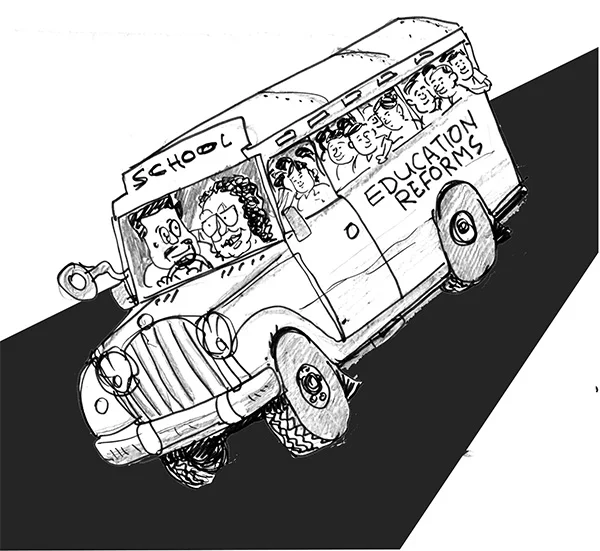
The new year dawned with another headache for the government that promised ‘system change.’ The most important educational reforms in our political history were those introduced by Dr CWW Kannangara which included free education and the establishment of central schools, etc. He did so after a comprehensive study lasting over six years, but the NPP government has been in a rush! Against the advice of many educationists that reforms should be brought after consultation, the government decided it could rush it on its own. It refuses to take responsibility when things go wrong. Heavens, things have started going wrong even before it started! Grade Six English Language module textbook gives a link to make e-buddies. When I clicked that link what I got was a site that stated: “Buddy, Bad Boys Club, Meet Gay Men for fun”!
Australia has already banned social media to children under 15 years and a recent survey showed that nearly two thirds of parents in the UK also favour such a ban but our minister of education wants children as young as ten years to join social media and have e-buddies!
Coming back to the aforesaid website, instead of an internal investigation to find out what went wrong, the Secretary to the Ministry of Education went to the CID. Of course, who is there in the CID? Shani of Ranjan Ramanayake tape fame! He will surely ‘fix’ someone for ‘sabotaging’ educational reforms! Can we say that the NPP government is less corrupt and any better than its predecessors?
by Dr Upul Wijayawardhana

Cuba says 32 Cuban fighters killed in US raids on Venezuela

Venezuela’s abducted leader, Nicolas Maduro, and wife appear in NYC court

Showers about 100 mm are likely at some places in Uva province and in Nuwara-Eliya, Matale, Polonnaruwa, Batticaloa and Ampara districts

Advisory for low pressure area over South-east Bay of Bengal Sea area

US raid on Venezuela violation of UN Charter and intl. law: Govt.

Ban on foreign research vessels: FM promises decision within two months

‘Dates have the highest sugar content to fight Coronavirus’

Sunday Island 27 December – Headlines

#SundayIsland 17th December – Headlines

Sunday Island – 28th March

Sunday Island Headlines – 21 March

Sunday Island – 21st February – Headlines
-
 News1 day ago
Private airline crew member nabbed with contraband gold
-

 News3 days ago
Health Minister sends letter of demand for one billion rupees in damages
-

 Opinion5 days ago
Remembering Douglas Devananda on New Year’s Day 2026
-
 News6 days ago
Leading the Nation’s Connectivity Recovery Amid Unprecedented Challenges
-

 Latest News1 day ago
Curran, bowlers lead Desert Vipers to maiden ILT20 title
-

 Features1 day ago
Pharmaceuticals, deaths, and work ethics
-

 News22 hours ago
PM lays foundation stone for seven-storey Sadaham Mandiraya
-

 News1 day ago
Bellana says Rs 900 mn fraud at NHSL cannot be suppressed by moving CID against him