
Latest News
Hazlewood’s haul of five helps Australia surge to victory inside three days

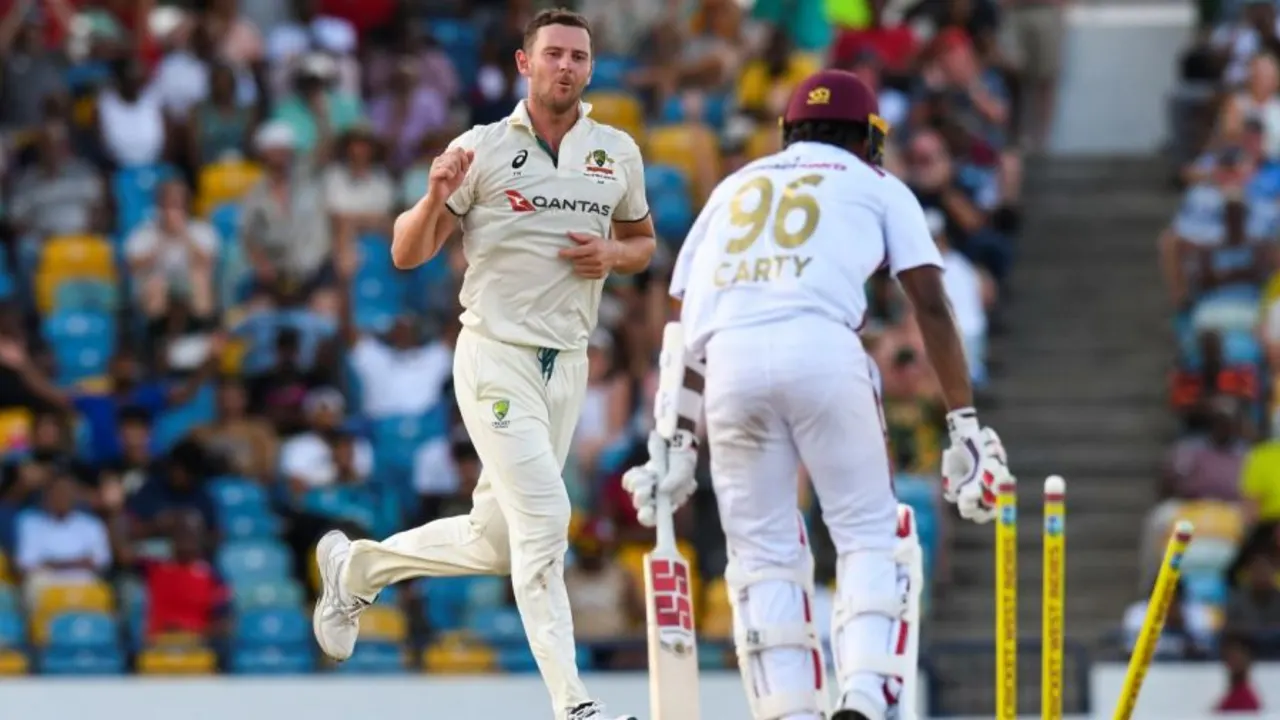
Josh Hazelwood led Australia’s surge to victory in Barbados as West Indies lost all 10 wickets in the final session of the third day, the final two falling in consecutive deliveries to Nathan Lyon in what would have been the last over the day to seal a 159-run margin.
Australia claimed the extra half an hour with West Indies seven down but with Shamar Joseph throwing the bat, having been dropped in the deep by Sam Konstas, and Justin Greaves playing solidly it appeared Australia would be forced to return on the fourth day. However, Shamar edged to slip before Jayden Seales was caught at short leg. It completed a performance where familiar Australia strengths came to the fore amid continued questions about the top order, but they were confronted by challenging conditions.
Travis Head, who was the beneficiary of West Indies’ seventh dropped catch of the match, Beau Webster and Alex Carey all played with the pro-activeness needed on this surface. Head was named player of the match for his twin half-centuries on a tricky surface. Carey’s superb strokeplay gave Australia plenty of buffer zone when it came to defending the target, meaning a repeat of what happened in the World Test Championship final was always unlikely on a surface that remained devilish at times, especially with the harder ball.
Mitchell Starc struck in the first over the chase when former captain Kraigg Brathwaite clipped loosely to backward square leg where Konstas held a low catch. However, that was followed by some adventurous strokeplay by John Campbell, including a sweep against Hazlewood, as he and Keacy Carty made encouraging process.
But innovation brought Campbell’s downfall when he attempted to lap-sweep Hazlewood again, and this time could only glove the ball to Carey. Next ball, Brandon King got an inside edge into his pads which flew high towards gully where Cameron Green, who had earlier given Carty a life on 1, used all his height to cling on. Sadly for Hazlewood, he did not make Roston Chase play at the hat-trick delivery as a packed ring of catchers awaited.
Not that he was delayed long when, two overs later, Chase got an inside edge that looped to short leg before spearing one through Carty. This was Hazlewood at his very best: hammering away back-of-a-length and giving the surface every chance to play some tricks.
Pat Cummins was then the beneficiary of those tricks when Shai Hope was cleaned up by a wicked delivery that scuttled under his bat. The run-scoring of Australia’s middle order against an older ball felt a long time ago. The only question was whether the visitors could get the job done in the evening.
Marnus Labuschagne, on as a sub, produced a direct hit run out to remove Alzarri Joseph and Hazlewood removed Jomel Warrican for his fifth wicket. Shamar Joseph launched two balls out of the stadium and some frustration was growing for Australia before Lyon sealed the job in fading light.
The game was in the balance at the start of the day, Australia ahead by 82, with plenty of eyes on how the surface would play. There was an early grubber to Head, which fortunately for him wasn’t straight, and he responded by flaying the next delivery through the off side. As Head would later find out there was always something lurking, but with a touch of fortune, runs were there to be made when intent was shown.
West Indies, though, were their own worst enemy again. On 21, Head was given a life when Greaves spilled a chance at second slip. It was the seventh they had put down for the game and had come after coach Daren Sammy had overseen the morning slips catching practice where nothing had been spilled. Head went to his second fifty of the match from 77 balls.
Webster, meanwhile, built an excellent innings, the third of his brief Test career which has come on a challenging surface following the debut half-century against India at the SCG. He used his reach to good effect to get out to the ball but was especially eye-catching off the back foot through the off side.
The stand of 102 was broken when Head received a brute of a delivery from Shamar Joseph that barely bounced, the only success for West Indies in the morning session when they would have hoped to knock over most of the remaining Australia batting.
After the break Webster brought up his fifty from 100 balls with a thick edge along the ground through gully before glancing Shamar Joseph down the leg side to Hope. An on-field not-out decision was overturned by third umpire Adrian Holdstock without any of the drama of the previous day.
By then Carey was into his stride having started positively but went up a gear in the over following Webster’s departure when he took 14 off Seales including the shot of the match: a skip down the pitch and perfectly executed lofted straight drive into the sightscreen. He went on to repeat the stroke against the lesser pace of Greaves, sending him over the stands at long-off, to motor to a 40-ball half-century as the game sped away from West Indies.
When joined by Lyon and Hazlewood he started to farm the strike as West Indies set their entire field back to him before lofting Chase into the deep. Shamar Joseph, who bowled the most overs in a match of his brief Test career, removed Hazlewood to claim the five-wicket haul which eluded him in the first innings.
Brief scores:
Australia 180 in 56.5 overs (Travis Head 59, Usman Khawaja 47; Jayden Seales 5-60, Shamar Joseph 4-46) & 310 in 81.5 overs (Alex Carey 65, Beau Webster 63, Travis Head 61, Shamar Joseph 5-87, Alzarri Joseph 2-65) beatWest Indies 190 in 63.2 overs (Roston Chase 44, Shai Hope 48; Mitchell Starc 3-65,Josh Hazelwood 2-41, Pat Cummins 2-34, Beau Webster 2-20 ) & 141 in 33.4 overs (Shamar Joseph 44, Josh Hazlewood 5-43, Nathan Lyon 2-20) by 159 runs
[Cricinfo]


Spain snuffed out France’s dream of a third World Cup triumph, taming their galaxy of forwards to win 2-0 and progress to a final against England or Argentina.
Didier Deschamps’ men were hot favourites for the trophy after a string of breathtaking displays in the United States but they met their match against the slick European champions at the semifinal stage on Tuesday.
Mikel Oyarzabal opened the scoring for the 2010 winners with an emphatic penalty in the first half in Arlington, Texas, and Pedro Porro doubled their lead in the second half.
Shell-shocked France could not find a way back into the match despite their wealth of attacking riches.
The game at the Dallas Stadium caught fire midway through the first half when Salvadoran referee Ivan Barton pointed to the penalty spot after a reckless challenge by France left-back Lucas Digne on Spain winger Lamine Yamal.
Oyarzabal hammered the ball past France goalkeeper Mike Maignan for his fifth goal of the World Cup to leave France trailing for the first time in the tournament.

Minutes later they suffered another blow when centre-back William Saliba had to leave the pitch after a recurrence of his lower back injury, replaced by Crystal Palace defender Maxence Lacroix.
Spain went agonisingly close to extending their lead after some dazzling one-touch football but Dayot Upamecano’s challenge denied Fabian Ruiz.
France finished the half without a single shot on target, and just two attempts overall.
Deschamps threw on Desire Doue for Bradley Barcola in the 57th minute in a bid to supercharge his attack but a minute later they were 2-0 down after a stunning team goal for Luis de la Fuente’s men.
Defender Porro delivered a sharp pass to the feet of Dani Olmo on the edge of the box and collected the return ball before coolly slotting past Maignan.
(Aljazeera)
Latest News
S. N. B. M. Patdmasiri appointed Director General of the Department of Government Factories

The Cabinet of Ministers approved the resolution furnished by the Minister of Housing, Construction and Water Supply to
appoint S. N. B. M. Patdmasiri who is a Special Grade officer in Sri Lanka Engineering Service and currently serving at the Department as the Additional Director General to the post of Director General of the Department of Government Factories with immediate effect.
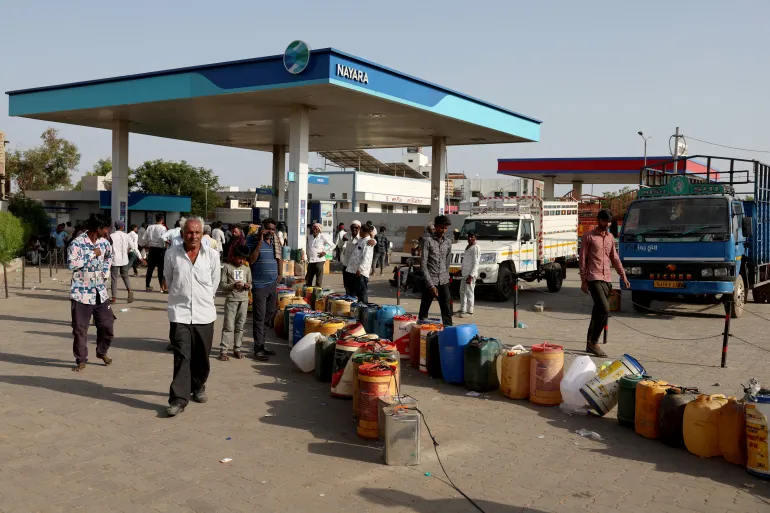
Oil prices have surged to their highest level in a month as renewed hostilities between the United States and Iran continued for a third consecutive day, dampening hopes for a return to normality in the Strait of Hormuz.
Brent crude, the primary international benchmark, rose 2.8 percent on Tuesday, extending a 9.6 percent gain from the previous day.
Brent futures for September delivery stood at $85.67 a barrel as of 07:00 GMT, the highest since June 15.
After easing to pre-conflict levels following Washington and Tehran’s signing of a memorandum of understanding (MoU) for peace last month, Brent has risen 18 percent from its price before the start of the US-Israel war on Iran in late February.
The US Central Command on Monday announced strikes on Iran for a third day, saying its forces targeted Tehran’s ability to attack “innocent civilians and commercial shipping” in the Strait of Hormuz.
Iran’s Islamic Revolutionary Guard Corps said it hit two oil supertankers in the strait and launched missile and drone strikes against US military assets in Kuwait and Bahrain in retaliation for the attacks.
Adding to the market volatility, President Donald Trump said on Monday the US would reimpose its blockade of Iranian ports and begin charging vessels transit fees as the “guardian” of the critical waterway.
“Crude oil is fast losing its strategic petroleum reserve buffer, and a violent repricing up cannot be discounted until the market sees toned-down rhetoric from both parties,” June Goh, a senior oil market analyst at Sparta Commodities in Singapore, told Al Jazeera, referring to the US government’s emergency oil stockpile, which the Trump administration has drawn on to mitigate supply constraints.
After ticking up in recent weeks amid hopes for a permanent peace deal between Washington and Tehran, traffic in the Strait of Hormuz has plummeted amid the renewed threat of violence against commercial shipping.
A total of 57 transits were recorded from Friday through Sunday, a more than 50 percent drop compared with the previous week, according to ship-tracking platform MarineTraffic.
Roughly 130 vessels transited the strait daily before the US and Israel launched their initial strikes on Iran in late February.
“Traffic through Hormuz is grinding to a halt, back to – or even below – our immediate pre-MoU pace,” Rory Johnston, founder of oil market research firm Commodity Context, told Al Jazeera.
“The oil market has proven extremely patient through this crisis, in large part thanks to an ample stock cushion upon which we were able to draw to blunt the sharpness of the supply shock,” Johnston said.
“Unfortunately, much of that cushion has now been depleted, leaving us much more vulnerable to a rerun of March and April.”
[Aljazeera]

A few showers may occur in the Western, Sabaragamuwa and North-western provinces and in Kandy, Nuwara-Eliya, Galle and Matara districts

Negombo Prison riot: No convicts among 21 inmates killed

2026: 128 elephants killed in first four-and-a-half months

Sigiriya Jungles marks 10 years with community medical camp

Protests continue in Valikamam North demanding military-held land

Dirty Money

‘Dates have the highest sugar content to fight Coronavirus’

Sunday Island 27 December – Headlines

#SundayIsland 17th December – Headlines

Sunday Island – 28th March

Sunday Island Headlines – 21 March

Sunday Island – 21st February – Headlines
-
 News5 days ago
Herath warns prospective migrant workers not to get fleeced by racketeers
-

 Features3 days ago
Prison riots and politics: NPP’s biggest challenge and Sri Lanka’s biggest opportunity
-

 Editorial4 days ago
What’s the world coming to?
-
 Foreign News5 days ago
Tensions erupt in Indian state after 11-year-old raped and murdered
-

 Features5 days ago
Devanesan Annan – in Memoriam
-

 News6 days ago
Negombo Prison riot: Ensuring protection of prisoners fundamental responsibility of the state – UN
-
Editorial5 days ago
Punishment in hellholes
-

 News6 days ago
Representatives of the Organization of Professional Associations (OPA) of Sri Lanka meet the Prime Minister