
Foreign News
Crucial Red Sea data cables cut, telecoms firm says


Several undersea communications cables in the Red Sea have been cut, affecting 25% of data traffic flowing between Asia and Europe, a telecoms company and a US official say.
Hong Kong-based HGC Global Communications said it had taken measures to reroute traffic after four of the 15 cables were recently severed. The cause is not yet clear.
The US official said it was trying to find out whether the cables were cut deliberately or snagged by an anchor.
Last month, Yemen’s internationally-recognised government warned that the Iran-backed Houthi movement might sabotage the undersea cables in addition to attacking ships in the sea.
The Houthis – who control much of western Yemen’s Red Sea coast – denied last week that they had targeted cables and blamed US and British military strikes for any damage to them.
US and British forces have targeted Houthi weapons and infrastructure in response to the drone and missile attacks on merchant vessels passing through the Red Sea and the Gulf of Aden.
The Houthis say their attacks are a show of support for the Palestinians in the war between Israel and Hamas in the Gaza Strip.
HGC Global Communication said in a statement on Monday that four submarine cables in the Red Sea – Seacom, TGN-Gulf, Asia-Africa-Europe 1 and Europe India Gateway – had been cut in a recent “incident”. An estimated 25% of traffic was affected, it added, noting that some 80% of the west-bound traffic from Asia passed through the cables.
HGC said it had taken measures to mitigate any disruptions for its clients by rerouting data to Europe through cables in mainland China and under the Pacific Ocean to the US, as well as using the remaining cables in the Red Sea.
African telecoms cable operator Seacom told the Associated Press that “initial testing indicates the affected segment lies within Yemeni maritime jurisdictions in the Southern Red Sea”.
A Pentagon official confirmed to CBS News, the BBC’s US partner, that undersea telecommunications cables in the Red Sea had been cut.
The official said the US was still trying to determine whether they were deliberately severed or snagged by a ship’s anchor.

Last week, Israeli business website Globes reported that the same four cables running between the Saudi city of Jeddah and Djibouti had been damaged and pointed the blame at the Houthis, without providing any evidence. Sky News Arabia, which is based in the United Arab Emirates, cited unnamed sources as accusing the Houthis of “blowing up” the cables”.
The Houthis’ telecommunications ministry denied those reports. The ministry said it wanted to reaffirm remarks in a recent speech by Houthi leader Abdul Malik al-Houthi, who said the group did not want to put any communications cables at risk.
The decision to “prevent the passage of Israeli ships” through the Red Sea did “not apply to ships belonging to international companies licensed to carry out marine work on cables in Yemeni waters”, it added.
On Monday, Telecommunications Minister Misfer al-Numair said his ministry was “ready to assist requests for permits and identify ships with the Yemeni Navy”, referring to the Houthis’ naval forces.
Meanwhile, the US military’s Central Command said the Houthis had fired two anti-ship ballistic missiles at a Liberian-flagged, Swiss-owned container ship, MSC Sky II, in the Gulf of Aden. One of the missiles hit the vessel, causing damage but no injuries, it added.
Houthi military spokesman Yahya Sarea claimed that the ship was Israeli and that it would “continue to prevent Israeli navigation or those heading to the ports of occupied Palestine”.
(BBC)











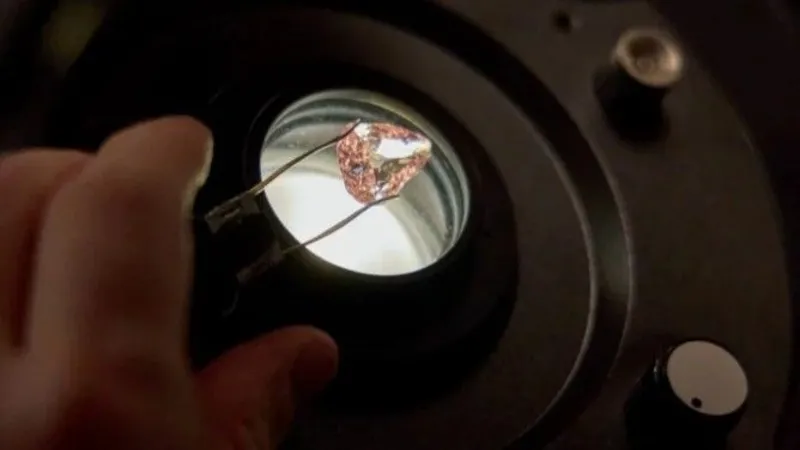
A rare pink diamond is going on display in France for the first time since it was stolen almost 100 years ago to the day – the last time it was shown to the public.
The nine-carat, pear-shaped gemstone known as the “Grand Condé” was pilfered in an overnight raid on the Château de Chantilly in October 1926 and concealed in a hollowed-out apple.
The diamond – one of few royal jewels to survive the French Revolution – was recovered a few weeks later when a hungry maid at the hotel in which the thieves were staying took a bite of the apple.
It will once again be on display in the Condé Museum at the Château de Chantilly until 3 January.
The museum’s director Mathieu Deldicque said that while the apple story may sounds far-fetched, it was widely covered by newspapers at the time.
Deldicque has faced questions about whether the exhibition may be tempting fate, especially given the string of heists on European cultural institutions in the past 12 months, including the daring daylight robbery of jewellery from the Louvre museum in Paris.
While he declined to reveal to CNN how much the diamond was insured for, he noted that extensive academic study into the properties of the diamond had taken place to make it uniquely identifiable.
The results of this analysis, as well as previously unseen archive material about the gem’s history and theft, form part of the exhibition, according to the museum.
Naturally occurring pink diamonds are exceptionally rare and often sell for tens of millions of dollars. The highest price ever fetched for one at auction was $71.2m (£53.6m) in 2017, according to Sotheby’s.
The exact origins of the Grand Condé remain a mystery.
It was first mentioned in 1740 in an inventory of Louis Henri de Bourbon, Prince of Condé, drawn up following his death, the Château de Chantilly said.
It then became part of the collection of Queen Marie-Amélie of Bourbon-Sicily, the wife of French King Louis Philippe I, and then her son, Prince Henri of Orléans, the Duke of Aumale.
He bequeathed it to the Institut de France, which now owns the Château de Chantilly, 50km (31 miles) north of Paris, along with thousands of artworks and manuscripts which became the Musée Condé collection.
(BBC)

A nursery owner and five members of her staff have been jailed after they were found to have poisoned more than 200 children with lead-tainted food.
Li Huifang, who operated the Heshi Peixin Kindergarten in Tianshui, in the Gansu province, was sentenced to life in prison for producing and selling toxic and harmful food, according to Chinese state media.
In July 2025, 247 pupils and staff at the nursery were found to have abnormally high blood lead levels after children began falling ill.
A report into the incident found that chefs at Heshi Peixin had used inedible paint to “enhance the look” of its meals to attract more students – despite the paint being being clearly marked as such.
In addition to the sentence, the Lanzhou Intermediate People’s Court also ordered the confiscation of 500,000 yuan (£56,200; $74,700) of Li’s personal assets, state broadcaster CCTV reported.
Nursery executive principal Zhi Jinglin was sentenced to 15 years in prison and fined 300,000 yuan.
Four other members of staff who worked in the nursery’s kitchen received sentences of between six to eight years, according to state media.
The court found the four had been instructed by Li and Zhi to add toxic and harmful ingredients to food served to children and staff.
Food samples were later found to contain lead 2,000 times in excess of China’s national safety limit.
The investigation into the poisoning began after 235 children from Heshi Peixin nursery had to be treated for lead poisoning after eating steamed red date cakes and sausage corn buns.
Investigators found that the red date cake and the corn sausage rolls had lead levels of 1052mg/kg and 1340mg/kg respectively, both of which far exceed the national food safety standard limit of 0.5mg/kg.
Lead poisoning is “particularly harmful to young children” and can “severely damage the brain and central nervous system”, according to the World Health Organization.
Officials later found that dozens of provincial officials and hospital staff attempted to cover up the incident by tampering with blood tests and accepting bribes from a nursery investor.
China has since published a set of national guidelines for the provision of meals on campuses. Among the measures is the requirement for every new batch of food to be tested, and for flour, rice and cooking oil to be purchased from centralised procurement points only.
(BBC)

Five people have been killed and 16 injured in a Houthi missile attack targeting the presidential palace in the port city of Aden in southern Yemen, which is the seat of the internationally-recognised government, officials say.
Information Minister Moammar al-Eryani told the BBC that the prime minister and other ministers were unhurt when five ballistic missiles hit al-Maashiq Palace.
The Houthis’ military spokesman, Yahya Sarea, said they struck “the Saudi enemy’s military operations headquarters in Aden”.
A coalition led by Saudi Arabia backs the government and is providing air support for an offensive by pro-government forces against the Iran-backed Houthis.
Yemeni health minister Qasim Buhaibeh said the casualties included “those working to guard the site and civilian employees”.
The country’s Prime Minister Shaya Zindani condemned the Houthis’ attack on Aden, calling it “cowardly” and a “continuation of their criminal behaviour”.
He said the government continued to carry out its duties and vowed that it would not weaken the resolve of its forces to continue operations against the Houthis on Yemen’s south-western Red Sea coast and other front lines.
Earlier, the Houthis denied that they had attacked Saudi Arabia on Thursday, after the coalition said its forces had intercepted a cruise missile in the Medina region, home to one of Islam’s holiest shrines.

The Houthis have been launching missiles and drones at airports, oil and gas facilities, and military bases in Saudi Arabia in retaliation for the strikes on the territory that they control in western Yemen, including the capital Sanaa.
On Saturday, a Houthi missile strike killed 13 people at Riyadh’s international airport, which was the deadliest attack in Saudi Arabia in more than a decade.
Saudi Arabia’s deputy foreign minister accused Iran of encouraging the Houthis to escalate their conflict with the kingdom.
“Iran continues to arm, train and support the Houthi militia in violation of UN Security Council resolutions,” Rayed Krimly told reporters, according to AFP news agency.
“We think that the escalation by the Houthis at this latest stage of the conflict is encouraged by Iran,” he added.
There was no immediate response from Iran’s government. However, it has previously denied supplying weapons to the Houthis and said it only supports them politically.
Iran’s foreign minister has also said it is ready to provide “any assistance necessary to facilitate the start of talks” between Saudi Arabia and the Houthis.
Yemen has been devastated by a civil war that began in 2014, when the Houthis ousted the internationally-recognised government from Sanaa. The conflict escalated in 2015, after the Saudi-led coalition of Arab states intervened in an attempt to restore the government’s rule.
A four-year-old informal ceasefire began to unravel in July, when the Houthis announced a “maritime embargo” against Saudi Arabia and began missile and drone attacks on Saudi airports, oil facilities and tankers in the Red Sea.
The Houthis said they were retaliating for what they call a Saudi blockade of their territory, as well as an air strike on Sanaa airport that they blamed on the kingdom.
The conflict escalated in September after the Houthis seized part of Yemen’s south-western Red Sea coast near the Bab al-Mandab Strait, a chokepoint for global shipping. Their advance contributed to a rise in oil prices following six months of war between the US, Israel and Iran.
Last week, pro-government forces said they had regained control of territory overlooking Bab al-Mandab after launching a major counter-offensive with the support of Saudi air strikes.
At least 1,282 people have been killed and 5,890 injured in the fighting in Yemen since 6 August, according to the government’s health ministry.
The UN says another 201,000 people have been displaced and that there has been an alarming surge in suspected cholera cases.
(BBC)

Showers or thundershowers will occur in most parts of the island after 1.00 p.m

CTU: Teacher shortage casts doubt on govt.’s education reforms

Norochcholai to remain offline for several days after blackout

President links businessman held with arms to politicians

CID probe sought into tusker’s death amid fears of elephant-killing syndicate

Bill to allow remote witness testimony in courts

‘Dates have the highest sugar content to fight Coronavirus’

Sunday Island 27 December – Headlines

#SundayIsland 17th December – Headlines

Sunday Island – 28th March

Sunday Island Headlines – 21 March

Sunday Island – 21st February – Headlines
-

 Latest News6 days ago
Nissanka’s return headlines Sri Lanka’s Test squad against Pakistan
-

 News5 days ago
Sri Lanka, India caught in US-Iran ship crisis
-

 Latest News6 days ago
Imran Khan’s PTI braces to fight federal takeover of Khyber Pakhtunkhwa
-

 Latest News5 days ago
Kusal Mendis’ unbeaten 87 hands Sri Lanka consolation win
-

 Latest News5 days ago
Missiles intercepted near Riyadh after Saudi coalition hits Yemen fuel depot
-

 News6 days ago
Mahinda and Shiranthi hospitalised
-

 News6 days ago
Presidential pardons: Govt. studying Justice Thurairaja’s recommendations – Minister
-

 News2 days ago
Asgiri Mahanayake calls for immediate release of Gnanasara Thera