
News
Civil society calls for immediate moratorium on use of PTA


Civil society groups and individuals have called for an immediate moratorium on the use of the Prevention of Terrorism Act (PTA).
In a statement titled ‘Civil Society Statement on Government Proposals to Reform the Prevention of Terrorism Act’, they said: We reiterate that national security cannot be achieved by creating insecurity for already discriminated against and marginalized communities, and call for the repeal of the PTA. The repeal of the PTA must also be considered in light of the anti-terrorism and public security legal framework that Sri Lanka has in place, and the historical abuse of power by state entities.”
Full text of the statement: In June 2021 the government of Sri Lanka announced it would ‘reform’ the Prevention of Terrorism Act (PTA) and appointed a Ministerial Sub-Committee for that purpose. It was reported in the media that Kamal Gunaratne, the Secretary, Ministry of Defence and the head of the Technical Committee that functions under the Ministerial Sub-Committee, submitted the Technical Committee’s recommendations to the Ministerial Sub-Committee in November 2021.
Historically, for decades, the PTA has been weaponized against the Tamil community, and following the Easter attacks against the Muslim community as well. This has resulted in the victimization of members of these communities. It was also used against the Sinhalese during the JVP insurrection and now against dissenters. We reiterate that any process which seeks to tackle issues related to the PTA must address this factor to ensure those adversely affected by the law will receive justice, including reparations.
While the government has not shared its plans for the supposed “reform” of the PTA with the public, we note the Sri Lanka Consensus Collective’s (SLCC) statement of 29 November 2021 sets out proposals for reform the government shared with the said group. In the absence of official communication by the government, we consider the elements contained in the SLCC statement as the changes being deliberated by the government. We note that nearly all so-called changes proposed already exist in law and do not address any of the shortcomings in the PTA that enable grave human rights violations.
We call for repeal of the PTA and in the interim an immediate moratorium on the use of the law. This is in line with the requests of persons and communities adversely affected by the law. We reiterate that any law that purports to deal with terrorism must adhere to international human rights standards. In this regard, we set out below the provisions of the law that result in egregious human rights violations and the minimum standards that have to be followed to ensure the protection of fundamental rights.
The critical factor to take note is that the PTA is a human rights deficient law that does not adhere to basic human rights standards enshrined in international conventions, such as the International Covenant on Civil and Political Rights (ICCPR), which the government of Sri Lanka has ratified and hence has an obligation to respect and protect. Nor does it adhere to many provisions in the Constitution of Sri Lanka. In this context the following are key provisions in the PTA that result in grave human rights violations:
The PTA does not contain a definition of terrorism. Instead, the offences stipulated are those found in other laws, such as the Penal Code, to which the PTA makes reference. Hence, the decision as to whether the PTA would apply in a certain instance is a subjective decision that can be shaped by personal prejudice and bias, rather than objective standards. In this regard, the PTA does not adhere to the definition set out by the UN Special Rapporteur on Countering Terrorism while Protecting Human Rights. For instance, post- Easter attacks even persons with books in Arabic and decorative swords were arrested. Similarly, those memorializing the lives lost at the end of the war have been arrested.
The lack of basic due process safeguards in the PTA enables arbitrary arrest and detention, which continue to date. This is exacerbated by the lengthy periods of administrative detention. For example, for decades we have witnessed persons who had any connection to a person accused of an offence in the normal course of their employment or personal life being arrested, without investigations being conducted, and detained for months.
We reiterate that arrests should be made based only on evidence following investigation or reasonable suspicion.
The detention period should be that stipulated in the Code of Criminal Procedure and any extension of detention should be made by a judge, who should be satisfied of the reasons for continued detention and exercise discretion as to whether or not to extend detention.
There is documented evidence, including Supreme Court decisions and the Human Rights Commission’s (HRCSL) reports, which illustrate that the admissibility of confessions made to an Assistant Superintendent of Police (ASP) or above as evidence, has resulted in persons being tortured to extract confessions. This has normalized and entrenched the use of torture. Even if the confession is ruled inadmissible during trial, the existence of the provision creates room for persons to be subject to torture. This not only violates basic due process and fair trial rights of a person accused of an offence, but also calls into question the competence of the criminal justice system that has to rely on confessions to prosecute persons. Such a provision, which is a deviation from the norm, has no place in law. Instead, current provisions in the Code of Criminal Procedure and the Evidence Ordinance should be followed with regard to the admissibility of confessions.
Section 7(3) allows a person to be taken out of judicial custody to any other place for investigation. Section 15A empowers the Secretary, Ministry of Defence, to determine a person’s place of detention even after the person is remanded. This removes a person from the protection of judicial custody and empowers the Secretary to override a judicial order. The incident in September 2021 of the Minister of Prison Reforms and Prisoners Rehabilitation Affairs entering Anuradhapura prison and reportedly threatening persons detained under the PTA with a weapon and verbally abusing them illustrates the insecurity faced by such persons even when in judicial custody. Removing them from judicial custody would only exacerbate their vulnerability. As the Human Rights Commission’s national study of prisons documented, persons remanded under the PTA were subjected to severe torture when taken out of judicial custody or held in other places upon the instructions of the Secretary, Ministry of Defence.
Persons detained under the PTA spend a prolonged period of time in pretrial detention because the Act requires such persons to remain in remand custody until the conclusion of the trial, unless the Attorney General consents to the release on bail. For all arrests, provisions of the Bail Act should apply, and bail should be denied only if any of the exceptional circumstances set out in the Bail Act are met.
The PTA allows the Minister of Defence to issue Restriction Orders for up to 18 months. Restriction Orders can be used to prevent people from engaging in political activities, speaking at events, or advising an organisation. Such orders allow civic rights to be curtailed arbitrarily by the Minister with no due process, transparency or accountability.
The SLCC statement mentions the government stated that for the very first time a detained person would be able to challenge administrative detention in the Supreme Court. We point out that the right to challenge arbitrary detention, including under the PTA, is enshrined in the Constitution of Sri Lanka and is not a new right that any proposed reform could bestow. The challenge many detained persons face in accessing this existing right is the administrative restrictions on access to lawyers and lack of financial resources to retain competent counsel.
Similarly, the HRCSL Act already mandates the Commission to monitor the welfare of persons deprived of liberty and empowers it to access any place of detention unannounced. However, following the 20th Amendment to the Constitution in 2020, the HRCSL is no longer a legally independent body as appointment of the officers of the Commission is at the discretion of the President. This adversely impacts the activities of the Commission as well as public trust in the institution.
The Advisory Board established by Section 13 of the PTA, as we have pointed out in the past, is an inadequate protection mechanism that is not independent as its members are appointed by the President. Further, the Minister of Defence has the power to make rules on how the Board deals with representations made by detained persons. It therefore does not act as a safeguard against executive abuse of power. Any non-judicial mechanism that is established to decide on/recommend the release of persons detained under the PTA must be independent and entities, such as the Attorney-General’s Department, should not be able to veto its decisions.
The proposals shared by the government with SLCC fail to address the fundamental shortcomings of the PTA. Instead, they propose changes that already exist but are often observed in the breach.
We note with deep concern that the functioning of the aforementioned committees was not transparent and the recommendations were formulated without any consultation with members of civil society who have been working on issues related to the PTA or persons affected by the law. We call for greater transparency in the reform process from this point onwards and request the government to inform the public of the process for consultation and the proposed timeline for reform.
We reiterate that national security cannot be achieved by creating insecurity for already discriminated against and marginalized communities, and call for the repeal of the PTA. The repeal of the PTA must also be considered in light of the anti-terrorism and public security legal framework that Sri Lanka has in place, and the historical abuse of power by state entities. These entities should not be bestowed with additional power.
The way forward must give due recognition to the protection of physical liberty. Deprivation of physical liberty by the executive must be used only as last resort and strictly require sufficient basis that is determined on objective factors, judicial supervision of such basis, prompt and free access to legal representation including legal aid, prompt trials or release, and an enforceable right to compensation for arbitrary detention. The prohibition of arbitrary deprivation of liberty has acquired customary international law status and constitutes a jus cogens norm which Sri Lanka is duty bound to secure for its citizens.
The balance the government wishes to achieve between personal liberties and national security can only be achieved through addressing the root causes of conflict and violence. Attempts to further curtail civil liberties in the guise of national security will only exacerbate the insecurity of all communities and undermine the rule of law and democracy in Sri Lanka.
Signatories of the statement were: S. Annalaxumy, Bisliya Bhutto, S.C.C. Elankovan, Lawyer and Development Consultant Philip Dissanayake, A.M. Faaiz, Brito Fernando, Nimalka Fernando, Ruki Fernando, Aneesa Firthous, Amarasingham Gajenthiran, T.Gangeswary, K. Ginogini, Ranitha Gnanarajah AAL, B. Gowthaman, S. Hayakirivan, Director, THALAM, V. Inthrani, Noorul Ismiya, Vasuki Jeyshankar, Dr. Sakuntala Kadirgamar, S. Kamalakanthan – Social Activist, Mahaluxmy Kurushanthan, Kandumani Lavakusarasa, Human Rights Activist, Jensila Majeed, Buhary Mohamed, Human Rights Activist, Juwairiya Mohideen, Jaabir Raazi Muhammadh, Chairman, Voices Movement, P. Muthulingam, Thangaraja Prashanthiran, Dorin Rajani, Maithreyi Rajasingham, Executive Director, Viluthu , A.R.A. Ramees, V. Ranjana, Anuratha Rajaretnam, K.S. Ratnvale, Yamini Ravindran, AAL, Kumudini Samuel, Thurainayagam Sanjeevan, Shreen Saroor, Ambika Satkunanathan, Rev Fr S D P Selvan,
S. Selvaranie, Vanie Simon, P. N. Singham, Usha Sivakumar, N. Sumanthi, Vani Sutha, Ermiza Tegal, S. Thileepan – Social Activist, P Vasanthagowrey, Rev Fr Yogeswaran, Adayalam Centre for Policy Research, Alliance for Minorities, Centre for Human Rights and Development, Centre for Justice and Change, Eastern Social Development Foundation, Families of the Disappeared, Forum for Plural Democracy, Law and Society Trust, Mannar Women’s Development Federation, Rural Development Foundation, Tamil Civil Society Forum, Viluthu and Women’s Action Network

Latest News
Advisory for Severe Lightning issued For Western, Sabaragamuwa and North-western province

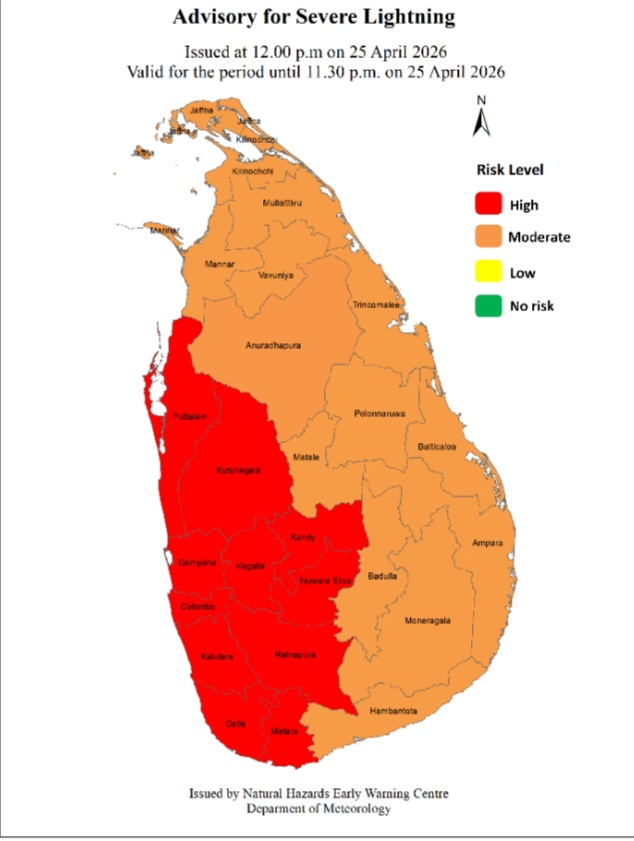
Advisory for Severe Lightning
Issued by the Natural Hazards Early Warning Centre
Issued at 12.00 noon 25 April 2026 valid for the period until 11.30 p.m. 25 April 2026
Thundershowers accompanied with severe lightning are likely to occur in the Western, Sabaragamuwa and North-western provinces and Galle, Matara, Kandy and Nuwara-Eliya
districts after 1.00 p.m.
There may be temporary localized strong winds during thundershowers. General public is kindly requested to take adequate precautions to minimize damages caused by lightning
activity.
ACTION REQUIRED:
The Department of Meteorology advises that
people should:
• Seek shelter, preferably indoors and never under trees.
• Avoid open areas such as paddy fields, tea plantations and open water bodies during thunderstorms.
• Avoid using wired telephones and connected electric appliances during thunderstorms.
• Avoid using open vehicles, such as bicycles, tractors and boats etc.
• Beware of fallen trees and power lines.
• For emergency assistance contact the local disaster management authorities.
As large language models take over more and more cognitive tasks, researchers are warning this mental outsourcing comes with a cost.
When research scientist Nataliya Kosmyna was looking for interns, she noticed that cover letters she received were suspiciously similar. They were long, polished and after introductions would often jump to an abstract and arbitrary connection to her work.
It was obvious to her that applicants were using large language models (LLMs) – a form of artificial intelligence that powers chatbots such as ChatGPT, Google Gemini and Claude – to write the letters.
At the same time, during lessons on campus at Massachusetts Institute of Technology (MIT), Kosmyna, who studies the interaction between humans and computers, noticed that numerous students were forgetting content more easily compared to a few years ago.
With the increasing reliance on LLMs, she had a hunch that this could be affecting her students’ cognition and sought to understand more.
The concern that researchers like Kosmyna have is that if we become too reliant on AI, it could affect the language we use and even our ability to do basic cognitive tasks. There is now a growing body of research suggesting that this “cognitive offloading” to AI can have a corrosive effect on our mental abilities. The consequences could be alarming and may even contribute to cognitive decline.
“The ChatGPT group showed notably less brain activity – it was reduced by up to 55%”
It’s well known that the tools we use can change how we think. With the advent of the internet for instance, tasks that once required deep research could be found by plugging a simple query into a search box. As the use of search engines increased, research found we became less likely to remember details, something dubbed “the Google effect”. (Some argue, however, the internet also serves as an external memory system that frees up our brain to do other tasks)
But there is now growing alarm that as we offload even more of our thinking to LLMs and other forms of AI, the effects on our memories and ability to solve problems could get worse. Artificial intelligence tools can write convincing poetry, give financial advice and provide companionship. Students are increasingly outsourcing their own work to AI tools as well.
Studies have already shown that young people might be particularly vulnerable to the negative effects that using AI can have on key cognitive skills like critical thinking. Kosmyna, however, wanted to dig deeper into the potential effects.
Reduced mental effort
She and her colleagues at MIT Media Lab recruited 54 students to write short essays and split them into three groups. One was instructed to use ChatGPT. A second could use Google search, with AI-generated summaries turned off. The third didn’t use technology. Each student’s brainwaves were measured while they worked.
The essay topics were deliberately open-ended, meaning little research was needed for the task, with prompts including questions around loyalty, happiness or our daily life choices.
The results haven’t been published in a scientific journal yet, but they were none-the-less eye-opening, according to Kosmyna. Those who used their own minds had a brain that was “on fire”, showing widespread activity across many parts of the brain, she says. The search engine-only group still showed strong activity in the visual parts of the brain, but the ChatGPT group showed notably less brain activity – it was reduced by up to 55%.
“The brain didn’t fall asleep, but there was much less activation in the areas corresponding to creativity and to processing information,” says Kosmyna.
ChatGPT also affected people’s memories. After submitting their essays, people in the AI group were unable to quote from their essays, and several felt they had no ownership over the work. Other studies have also shown that people become less able to retain and recall information when they use AI tools such as ChatGPT.
While the findings are still undergoing peer review, they echo those from other studies. One study by researchers at the University of Pennsylvania suggests that some people undergo something they term “cognitive surrender” when using generative AI chatbots. This means they tend to accept what the AI tells them with minimal scrutiny and even allow it to override their own intuition.
Similar effects can be found outside the world of AI chatbots too – even in life-or-death situations. A recent multinational study team found that medical professionals who used an AI tool to screen for colon cancer for three months were subsequently worse at spotting the tumours without it.
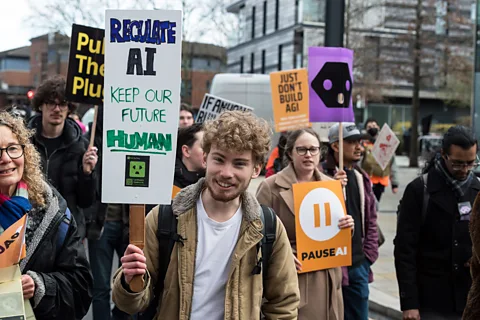
Outsourcing work to AI also risks losing much of the creativity that produces original work, warns Kosmyna. The essays that students in her study wrote with ChatGPT looked very similar and were described by the teachers marking them as “soulless”, lacking originality and depth, Kosmyna says. “One of the teachers asked if students were sitting next to each other because the essays were so similar.”
While studies such as these illustrate the short-term effects LLMs can have on the brain, the long-term impacts are far less clear. The study by Kosmyna and her colleagues provides a glimpse. Four months after the initial study they asked the students to write another essay, but this time those who had used ChatGPT were told to work without LLM support. The neural connectivity in their brains was lower than those who switched the opposite way, perhaps indicating that they had not engaged with the topics properly in the first place.
Cognitive decline
Yet, LLMs can be a positive tool to aid thinking, but only if we don’t rely on them by outsourcing our mental tasks in the process, says computational neuroscientist Vivienne Ming, author of Robot Proof. She’s concerned though that this is not how most people interact with this technology.
Her reasoning comes from research she conducted for her book, during which Ming asked a group of students at the University of Berkeley to predict real-world outcomes, such as the price of oil. She found that the majority of participants simply asked AI and copied the answer.
She measured their brains’ gamma wave activity – a marker of cognitive effort – finding it showed very little activation. Again her research is yet to published, but Ming worries that if her findings are borne out in further studies it could have long-term implications. Other research, for example, has linked weak gamma wave activity to cognitive decline later in life.
“That’s really worrying,” Ming says. “If that is a natural mode for people to interact with these systems – and these are smart kids – that’s bad.” Deep thinking, she says, is our superpower. “If we don’t use it, the long-term implications for cognitive health are pretty strong.”
That’s because when we rely on LLMs it requires very little cognitive effort, Ming adds, which is exactly what’s needed for a healthy brain.
A small subset of participants though – less than 10% – worked differently and used AI as a tool to gather data that they then analysed themselves. These individuals made more accurate predictions than others participants and showed stronger brain activation too.
For long-term brain health we need to continue to challenge ourselves
Almost two decades ago, Ming predicted that within 20 to 30 years we would see a statistically meaningful rise in dementia rates directly related to our overreliance on Google Maps. “I meant it to be provocative,” Ming says. “If you don’t have to think about navigating then there’ll be some detectable effect.”
While we don’t have data on this exact prediction, the increased use of GPS has been linked to worse spatial memory over time, according to one study of 13 people conducted over three years. And poor spatial navigation may be a potential predictor of Alzheimer’s Disease, according to another study.
It’s clear that the more active our brain is, the more protected it is from cognitive decline. LLMs then, Ming says, could not only reduce creativity but could harm cognition and potentially increase the risk of dementia.
As AI tool use increases, we need to work with it in a way that benefits us rather than harms us. Ming suggests that ultimately, the goal could be a form of “hybrid intelligence” where humans and machines “do the hard stuff” together. By this she means we need to think first and use tools to challenge us later, rather than simply letting them answer questions for us. Kosmyna agrees and suggests learning subjects without AI tools first to build a foundation and then think about using LLMs.
Ming recommends using what she calls the “nemesis prompt” to challenge your own thinking. It works by prompting an AI to act as a “lifelong enemy” or nemesis, then ask it to explain in detail why your ideas are wrong and how you can fix them, forcing you to defend and refine your arguments rather than simply accepting the answers it provides.
Another technique she suggest is prioritising “productive friction” and asking the AI to only provide context and ask you questions, rather than supplying answers. When she tested this by fine-tuning an AI bot not to give answers, she found that more individuals were more engaged.
Ultimately, we should all be wary of cognitive shortcuts, which is something “our brains love”, Kosmyna says. Clearly, for long-term brain health we need to continue to challenge ourselves. Our minds, creativity and cognitive health will benefit in the process.
[BBC]
Latest News
Heat Index at Caution Level in the Northern, North-central, North-western, Western, Sabaragamuwa and Eastern provinces during the day time
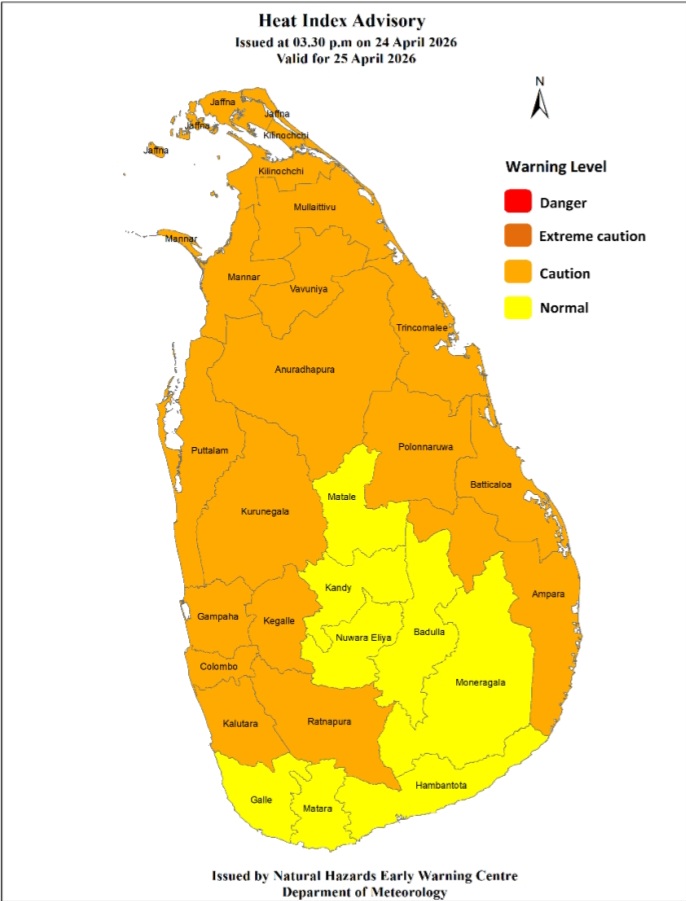
Warm Weather Advisory
Issued by the Natural Hazards Early Warning Centre
Issued at 3.30 p.m. on 24 April 2026, valid for 25 April 2026.
Heat index, the temperature felt on human body is likely to increase up to ‘Caution level’ at some places in Northern, North-central, North-western, Western, Sabaragamuwa and
Eastern provinces during the day time.
The Heat Index Forecast is calculated by using relative humidity and maximum temperature and this is the condition that is felt on your body. This is not the forecast of maximum temperature. It is generated by the Department of Meteorology for the next day period and prepared by using global numerical weather prediction model data.

Effect of the heat index on human body is mentioned in the above table and it is prepared on the advice of the Ministry of Health and Indigenous Medical Services.
ACTION REQUIRED
Job sites: Stay hydrated and takes breaks in the shade as often as possible.
Indoors: Check up on the elderly and the sick.
Vehicles: Never leave children unattended.
Outdoors: Limit strenuous outdoor activities, find shade and stay hydrated.
Dress: Wear lightweight and white or light-colored clothing.
Note:
In addition, please refer to advisories issued by the Disaster Preparedness & Response Division, Ministry of Health in this regard as well. For further clarifications please contact 011-7446491.

Advisory for Severe Lightning issued For Western, Sabaragamuwa and North-western province

AI chatbots could be making you stupider

‘A remarkable time capsule’: The enchanting history of Oxford University’s 750-year-old medieval library

Kohli, Padikkal hit fifties as Royal Challengers Bengaluru ace the chase against Gujarat Titans

Showers expected in the Western and Sabaragamuwa provinces and in Galle, Matara, Kandy, Nuwara-Eliya and Puttalam districts after 2.00 pm

Heat Index at Caution Level in the Northern, North-central, North-western, Western, Sabaragamuwa and Eastern provinces during the day time

‘Dates have the highest sugar content to fight Coronavirus’

Sunday Island 27 December – Headlines

#SundayIsland 17th December – Headlines

Sunday Island – 28th March

Sunday Island Headlines – 21 March

Sunday Island – 21st February – Headlines
-

 News5 days ago
Rs 13 bn NDB fraud: Int’l forensic audit ordered
-

 Opinion6 days ago
Shutting roof top solar panels – a crime
-

 News3 days ago
Lanka faces crisis of conscience over fate of animals: Call for compassion, law reform, and ethical responsibility
-

 News2 days ago
No cyber hack: Fintech expert exposes shocking legacy flaws that led to $2.5 million theft
-

 News7 days ago
From Nuwara Eliya to Dubai: Isha Holdings markets Agri products abroad
-
 News2 days ago
Whistleblowers ask Treasury Chief to resign over theft of USD 2.5 mn
-

 News6 days ago
Church calls for Deputy Defence Minister’s removal, establishment of Independent Prosecutor’s Office
-

 Life style7 days ago
After dark in Sri Lanka: Tiny wild cats step into the spotlight