
Latest News
Abbas, Shahzad give Pakistan hope of defending 147


The first Test match at Centurion is tantalisingly poised after Pakistan took three wickets in nine overs to leave South Africa wobbling at 27 for 3, still 121 runs away from the 147-run target that seals a win, as well as a place in the 2023-25 World Test Championship [WTC] final.
After South Africa had bowled Pakistan out for 237, they needed a fairly comfortable 148 to secure victory, but an unerring spell of accurate medium-fast bowling from Mohammed Abbas and Khurram Shahzad was well rewarded. Aside from Aiden Markram , the South Africa batters were somewhat timid in their approach to the last few overs of the day, while Abbas and Shahzad targeted the pads. Abbas brought one to jag back in sharply into Tony de Zorzi for the first breakthrough.
Pakistan’s reviewing was chalk and cheese from the previous innings, successfully overturning two lbw calls. Shahzad found similar seam movement from around the wicket to strike Ryan Rickleton on the front pad, viciously enough that it hit him in line despite the batter having moved well across.
Having successfully overturned that one, Pakistan repeated the formula, with Abbas finding the right line and adequate sideways movement, which has seen him find bouts of high success. Tristan Stubbs took a step out of his crease but was beaten on the outside edge, and yet again Pakistan went up collectively for the umpire to turn them down. But Shan Masood signalled to go upstairs once more and was proven right again.
Earlier in the day, Marco Jansen’s six-wicket haul had helped South Africa tighten their control over the game. He picked five wickets in the afternoon as Pakistan squandered a promising start following a rain delay that wiped out the morning session. He picked one more in the final session as the hosts returned to polish off the Pakistan tail after stubborn resistance from Saud Shakeel.
Babar Azam and Shakeel put on 79 for the fourth wicket, with Babar reaching his first Test half-century in nearly two years, but holed out to deep point immediately after. Mohammad Rizwan was squeezed down leg as Pakistan crumbled around Shakeel.
Persistent rain saw the game start an hour after the lunch break concluded, and Pakistan began by taking advantage of a bowling effort that was nowhere near its best. Shakeel and Babar each worked Kagiso Rabada away for four in the third over, and the runs flowed for the next half an hour. Twenty-three runs came off the next three, and though Babar still found himself beaten a few times, he was also finding the timing that in the past was so often a precursor to a big score.
Corbin Bosch found that out when he missed his line twice and Babar helped himself to two fours, before a clip into the covers brought up his long-awaited half-century, his first in 20 innings. But he threw it away disappointingly, failing to get on top of a short and wide one from Jansen, Bosch barely having to move to send a devastated Babar on his way.
Jansen was finding the wickets that eluded him in the first innings, with Rizwan and Salman Agha falling cheaply. A brief stand between Shakeel and Aamer Jamal once more gave the impression Pakistan would go into tea six down, before Jamal lobbed a tame Dane Paterson bouncer straight to deep midwicket, and Naseem Shah helpfully nicking Rabada into the slips.
Shakeel attempted to farm the strike post-tea and would enjoy some success as wayward bowling allowed for the odd boundary and comfortable late-over singles. A regal pick-up for six over midwicket was the highlight, but Pakistan’s penchant for gifting wickets to deliveries that did not merit them struck again when a knee-high full toss rapped into Shakeel’s front pad and effectively concluded Pakistan’s batting effort.
It appeared to be the final nail in the coffin, but Pakistan’s bowlers have seen to it that South Africa do not rest easy overnight.
Brief scores:
South Africa 301 and 27 for 3 (Aiden Markram 22*, Mohammed Abbas 2-3) need another 121 runs to beat Pakistan 211 and 237 (Saud Shakeel 84, Babar Azam 50; Marco Jansen 6-52, Kagasio Rabada 2-68)

Latest News
Showerss above 100 mm are likely at some places in the Western, Sabaragamuwa, Central and North-western provinces and in Galle and Matara Districts

WEATHER FORECAST FOR 24 SEPTEMBER 2026
Issued at 05.30 a.m. on 24 September 2026 by the Department of Meteorology
The Deep Depression over the West-central and adjoining Northwest Bay of Bengal is moving west-northwestwards and is currently crossing the North Andhra Pradesh and adjoining South Odisha coasts of India.
Although this system will not have a direct impact on Sri Lanka, the prevailing rainy conditions in the southwestern part of the island are expected to continue due to the wind flow towards the system.
Showers or thundershowers will occur at times in the Western, Sabaragamuwa, Central and North-western provinces and in Galle and Matara Districts. Heavy showerss above 100 mm are likely at some places in the above areas.
A few showers will occur in North-central province and in Mannar district.
Strong winds of about (40-50) kmph can be expected at times over the Western slopes of the Central hills, the North-central and North-western provinces and in Trincomalee, Hambantota and Matale Districts.
The general public is kindly requested to take adequate precautions to minimize damage caused by temporary localized strong winds and lightning during thundershowers.
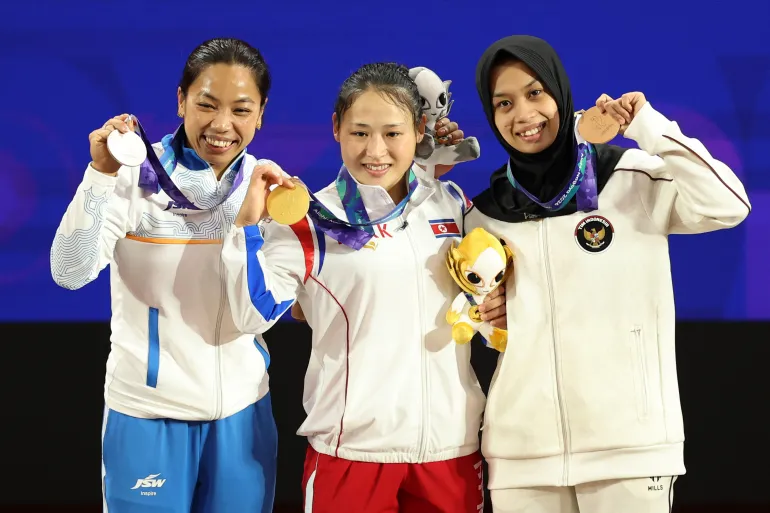
North Korean weightlifter Ri Song Gum has broken three world records en route to winning gold in the women’s 49kg (108lbs) competition, which saw India’s Mirabai Chanu win an elusive Asian Games medal by finishing second.
Ri gave North Korea its first gold of the games in Nagoya, Japan, on Wednesday, joining an elite club of four weightlifters who have won three Asian Games gold medals.
The 28-year-old hauled 94kg above her head in the opening snatch discipline – the first official segment of the competition where athletes lift a barbell from the floor to an overhead position in a single motion. The lift was 1kg heavier than the previous world record of 93kg.
Ri followed it up by breaking the world record twice in the 115kg clean and jerk – a two-part movement where a barbell is lifted from the floor to the shoulders and then pushed overhead. The 4ft-7in (139.7cm) weightlifter hoisted 116kg and 121kg above her head.
Ri’s total lift of 215kg obliterated the old world record total by 7kg.
She is the fourth lifter, and first woman, to win three Asian Games weightlifting golds and joined Iran’s Mohammad Nassiri (1966-74), South Korea’s Kim Tae-hyun (1990-98) and Iran’s Behdad Salimi (2010-18), who all won three gold medals. No athlete has won four weightlifting gold medals.

In the same category, India’s Chanu finally won an Asian Games medal at the third time of asking. She won a silver medal at the Tokyo Olympics in 2021.
The 32-year-old is India’s most decorated weightlifter, with three Commonwealth gold medals and a silver to her name, along with multiple global titles.
She lifted a total of 198kg after a snatch of 87kg and a clean and jerk of 111kg, while Indonesia’s Diana Tri Wijayana took bronze with a total of 191kg, comprising 88kg and 103kg.
Chanu’s silver also ended India’s 28-year wait for a weightlifting medal at the games since Karnam Malleswari won silver in 1998.

(Aljazeera)
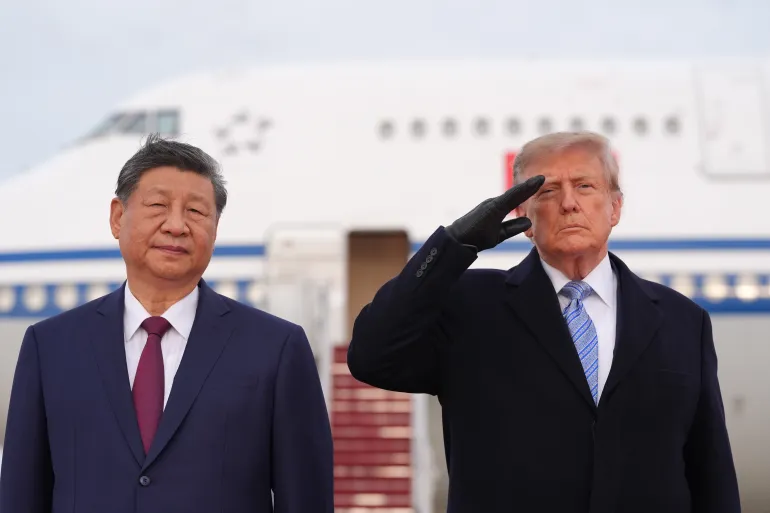
United States President Donald Trump has welcomed Chinese President Xi Jinping as he arrived in the US for a three-day trip focused on issues such as security, trade and technology.
Trump took the rare step of meeting the Chinese leader in person at Joint Base Andrews in the state of Maryland on Wednesday, the first president to do so in recent memory.
The US president and First Lady Melania Trump greeted Xi and his wife on the tarmac during a welcoming ceremony, where a red carpet was rolled out and the couples exchanged handshakes. Trump and Xi then walked side by side, flanked by US soldiers, before standing for a gunfire salute and the US national anthem
The in-person greeting is a sign of the significance that Washington ascribes to its relationship with Beijing, whose meteoric economic rise over the last several decades has transformed it into a global superpower capable of rivalling the United States.
Despite tense relations that worsened after the Trump administration placed high tariffs on Chinese goods – a move that was met with retaliatory measures from Beijing – Trump has expressed personal affinity for Xi and his desire for strong ties with China.
The Chinese president’s trip to the US will include a state dinner, attended by leaders of the country’s powerful tech industry, a military ceremony at the White House, and a visit to the National Archives, home to documents of historical and cultural significance such as the US Constitution and the Declaration of Independence
But both countries remain wary of the other as they compete for political and economic influence. The trip is likely to include discussion of issues such as the US war on Iran, trade, technology, rare-earth minerals and US ties to Taiwan, the self-governing island that China claims as part of its territory
(Aljazeera)

Showerss above 100 mm are likely at some places in the Western, Sabaragamuwa, Central and North-western provinces and in Galle and Matara Districts

Mirabai Chanu wins Asian Games silver as Ri breaks weightlifting record

Trump greets China’s Xi Jinping on arrival for three-day US

BASL calls for conscience vote on 22nd Amendment

IMF: Sri Lanka on course for 2027 market return

President appoints three new judges to High Court

‘Dates have the highest sugar content to fight Coronavirus’

Sunday Island 27 December – Headlines

#SundayIsland 17th December – Headlines

Sunday Island – 28th March

Sunday Island Headlines – 21 March

Sunday Island – 21st February – Headlines
-

 News5 days ago
Shanakiyan urges urgent action over reported death sentence for Lankan in Saudi Arabia
-

 News6 days ago
Bid for Basil’s extradition nears final stage: Police
-

 News4 days ago
Namal Rajapaksa Buddhist gambit fails, bail denied
-

 Features4 days ago
Why the spelling Sri Lankan names in English vary
-

 Features4 days ago
Three bands, a new identity: Sri Lankan wolf snake recognised as distinct species
-
 Business4 days ago
SLIIT holds largest-ever convocation
-

 News4 days ago
Govt monitors reported Saudi death sentence – Foreign Ministry
-

 Business4 days ago
All-new Bolero MaXX Pik-Up unveiled in Lanka