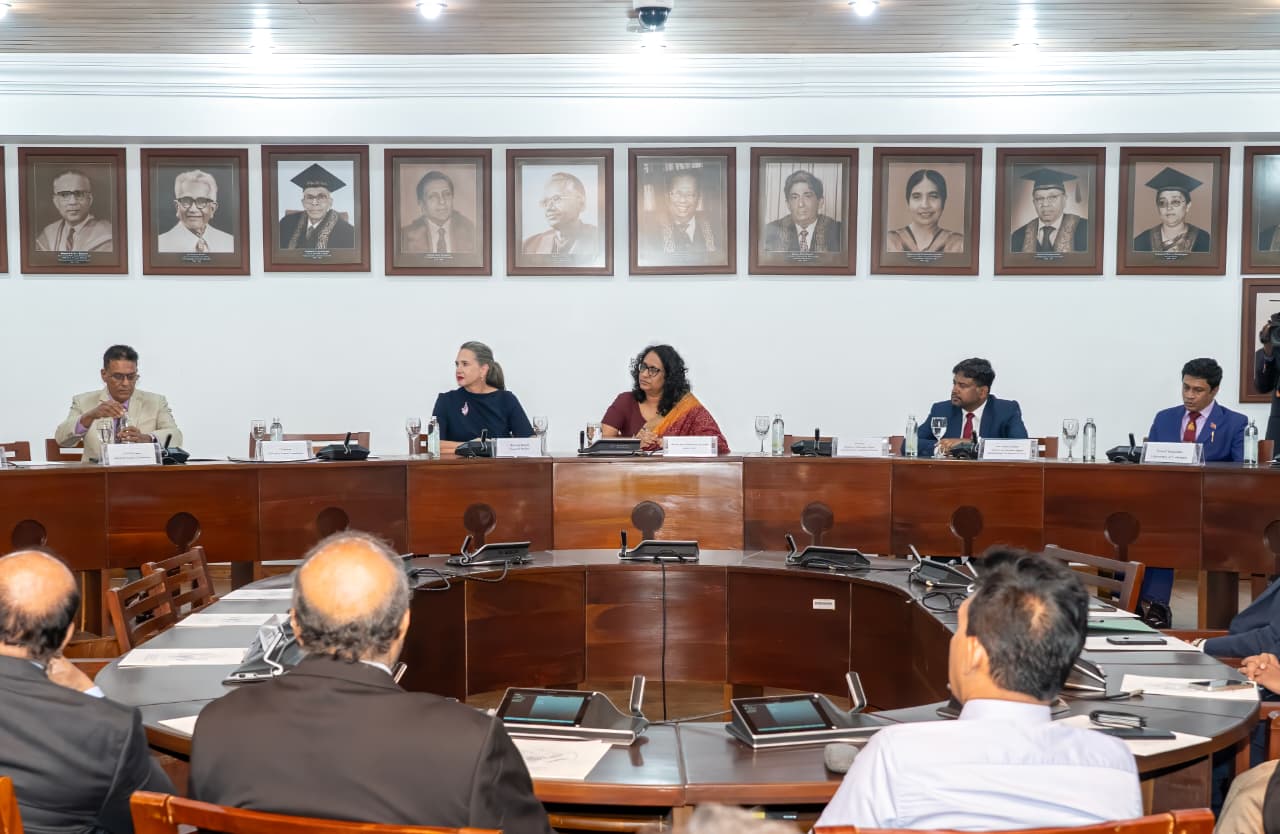
The initiative, led by the University Grants Commission in partnership with the U.S. Embassy in Sri Lanka, focuses on developing a policy framework to guide the responsible, ethical, and inclusive use of artificial intelligence within Sri Lanka’s state university system.
The event brought together academic leaders, policymakers, and AI specialists to present the framework and outline its implementation. The programme included a welcome address by UGC Chairman Senior Professor Kapila Seneviratne, followed by presentations on the policy framework and its key highlights by a panel of AI experts. The Vice Chairman of the UGC, Professor K. L. Wasantha Kumara, presented the proposed implementation plans.
Addressing the gathering, the Prime Minister noted that the rapid pace of technological change, particularly in artificial intelligence, presents both opportunity and risk. “We are dealing with a technology that is evolving faster than our ability to fully understand it, and that makes it essential to have strong systems of policy, governance, and implementation in place,” the Prime Minister stated.
The Prime Minister further observed that the impact of AI on higher education is particularly profound, as universities are spaces where knowledge is produced, shared, and challenged. She stressed that the framework must take into account discipline-specific implications, noting that fields such as the social sciences and humanities face unique challenges in the context of AI-driven change.
Highlighting broader policy considerations, the Prime Minister underscored the importance of ensuring that AI does not deepen existing inequalities within the education system. She noted that the framework should actively seek to bridge gaps and create more inclusive learning environments, including through the use of technology to support students with disabilities and address language barriers.
The Prime Minister also emphasised the need for a consultative approach in implementing the framework, encouraging continued engagement with academics and students. She noted that meaningful adoption would depend on inclusive dialogue and responsiveness to the concerns of the academic community.
In her remarks, the Prime Minister also drew attention to the need for strengthening research capacity and ensuring that Sri Lanka remains proactive rather than reactive in responding to global technological shifts. She highlighted that building local expertise and staying ahead of emerging trends would be critical to effectively harnessing the benefits of artificial intelligence.
The launch of the AI Policy Framework reflects a growing recognition of the need for a structured and forward-looking approach to artificial intelligence in Sri Lanka’s higher education sector, with a focus on balancing innovation with responsibility, equity, and long-term societal impact.
[Prime Minister’s Media Division]