
Features
A time for reflection: what was achieved and remains to be achieved

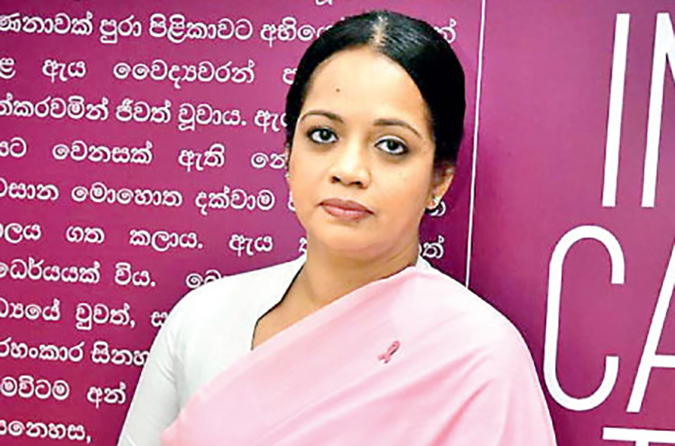
(Concluding instalment of Padmani Mendis’ autobiography focused on her global work on Community Based Rehabilitation of the disabled that took her to many parts of the world)
These are my memories as I have lived them. Memories of opportunities that came to me in many parts of the world including my own, to touch the lives of disabled people, their families and their communities. Reading my memories again as I have recalled them for you, I see that, by and large, they are mostly good and happy memories. Am I an optimist in pessimistic times?
Or is it that, while I journeyed, any hopelessness that I may have experienced on my journey in disability has now, in my memory, been overtaken by what was made possible for disabled people? Made possible by facing head on the challenges of introducing change in a world resistant to change. Made possible by the people I met and worked with on my journey who were unafraid to venture into the unknown.
I recall the happy times and times filled with hope I spent in Yemen, in Syria, in Palestine and in Lebanon not so long ago. Seeing flowers blossom for disabled people there. I have written elsewhere about my experiences in these and in other countries. Some like these four countries have since been embroiled in conflict. Many are in a varying state of disorder and ruin.
This includes equally times filled with hope – times spent in Venezuela and in Iran, countries facing economic disaster as is my own. The flowers that bloomed for disabled people in such countries may now be scarce, or may have faded or even gone completely. In other countries that I have described in my memories, flowers blossom, flowers of vivid colours. Seeds are spread and take root. And yet more flowers bloom.
I fear not for those countries where hope has waned or faded. This is but temporary. Globally, a positive pathway for disabled people has been cleared through Community Based Rehabilitation (CBR). Seeds lie dormant. The world we live in goes round and round. And with those cycles, opportunities for disabled people that have faded will blossom and come round again. With economic and social rebirth those seeds that lie dormant will germinate and grow. Other good times will come in time for disabled people everywhere. And there will be many to help them on their way.
In the departure lounge: from memories to permanence
And now I have come to settle down in what would be my departure lounge on the final leg of my journey. Some of those steps I have described more recently were taken from here, my present home. These have added continuity to my journey. And with that continuity they have also created, in my departure lounge, a sense of permanence.
One aspect of that permanence is personal. It comes from the fact that my lounge is situated in my home in an Apartment Block which a property developer had named Prince Alfred Tower (PAT). It is located in Alfred House Gardens.
I would like for a moment to take you back to the earliest memories I shared with you, that concerning my heritage. Alfred House was the name my mother’s grandfather gave to his home. He had named it Alfred House after Alfred, the Prince of Wales who he had entertained in that house. PAT was built in my great-grandfathers back garden on a small portion of what had been his property. The personal permanence stems from there.
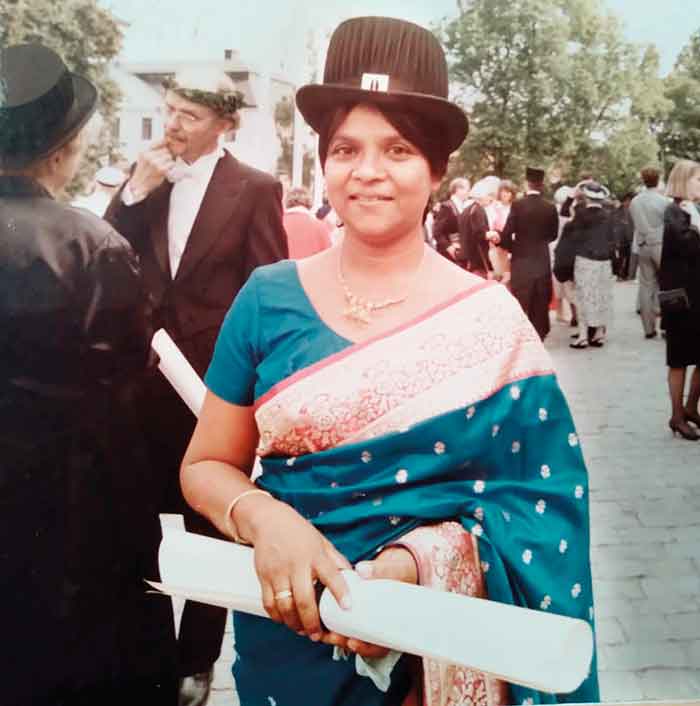
Padmani Mendis after receiving her Honorary Doctorate (Doctor of Medicine Honoris Causa) from the University of Uppsala in Sweden. Honorary degrees in medicine are very rare.
A permanence greater than that however stems from the continuity of the many, many relationships that I have been blessed with all my life, relationships with friends and family. These are deeper than personal if such can be.
These relationships have taken my good fortune out to the world and connected me with all that surrounded me. Many are friendships that have grown from my earliest schooldays to my preparation for a profession; and to my work in that profession in many parts of the globe as in my own. I have made mention of some, but by no means all those friendships.
Here I must add a few to those I have already mentioned. Don Chandrasinghe, who together with his wife Radha, are both also favourite students and among the first I taught. They now live in faraway London. But call me at least every fortnight just to ask how I am doing.
Then there is Camilla Dissanayake, a colleague from the 1970s, who lives but a couple of kilometres away as the crow flies, who will often spend hours on the phone with me talking about the past and the present with some stuff to be sad about and much to laugh about. And Rohana Perera, a student only for a short time, but with whom grew a friendship that has lengthened forever.
More recently has come into my life again Leonie Fernando; she with always a smile on her face and full of laughter; who knew me when she was a student occupational therapist nearly 50 years ago and now in frequent communication. And Sharmini Sinniah, whom I remember I first worked with when she was at Christoffel Blinden Mission or CBM the primary source of support to Disability NGOs; later when she moved to the US Embassy and now continuing that relationship on the phone. All these, permanence.
Then there is the permanence of the work I have contributed to for disabled people, Community Based Rehabilitation. CBR is still evolving and will continue to do so. In the last country I visited, Zambia, I hear that the strategy is now called “CBR for Inclusive Development”. Sounds very promising. I love that terminology.
Come the day, however distant, when disabled people will be completely and comprehensively included as a final and total recognition of their rights, their humanity. Then it will only be one “Development” for all. Not just the words “CBR” but even the word “Inclusive” will be obsolete. Oh, come the day!
A time when every man will be as one,
A time to reach out and touch the sun,
Come the day.
Freedom’s still a thought within your mind,
The fleeting thing that some may never find,
It may still be a million miles away.
Can you hear the bells ringin’?
Voices singin’,
Far away?
Song by the Seekers, 1966
Adding permanence to my work is the recognition of it over the years. I have shared with you my experience of receiving an Honorary Doctorate from the University of Uppsala three decades ago. Seven years ago, the World Confederation of Physical Therapy, WCPT, awarded me the “Leadership in Rehabilitation” award. The award is given every four years, not only to physiotherapists; it is available also to other individuals and organisations who have contributed to international rehabilitation and global health.
And just three years ago, Lincoln College University in Malaysia awarded to me two honorary titles in recognition of my global work – a Professorship and a Doctorate in Physiotherapy. An added honour was that the Vice Chancellor of the University, Prof. Dr. Amiya Bhaumik came to Sri Lanka to award me the two honours himself, personally at a convocation held in Colombo.
And then there is that other permanence which makes life so worthwhile. The Wonderful World that we live in. The beauty of it that is around us.
When I look immediately down from my bedroom window on the seventh floor, I see a multi-coloured sheet of Araliya flowers not once, but twice a year. To the green, green garden beyond comes a kingfisher every morning to perch on a favourite branch and search for possibilities. Perhaps not finding any, it flies away.
Daily a flock of parrots hop from tree to tree, taking cover as it were from those eyes like mine. I believe it is the same flock of parrots that go to my friend Mino’s home perhaps a kilometre away measured on their flight path. She always has for them hanging on her verandah a bowlful of rice and a basin of water. They are there every day as sure as the day follows the night, at ten in the morning and at four in the evening.
And just as sure as it ever is, the two flamboyant trees within my range of vision change themselves into an umbrella of orange every year, in May. Or if they so decide to, they keep us waiting until June or maybe even July.
As I stand at dawn on my balcony with my early morning cup of coffee, on a clear day, I have a beautiful and unique view of the sacred Adams Peak with the sun rising behind it in the east. If I get to the same spot of an evening, I see the sun set behind the western horizon. I stand there transfixed with the beauty of the sky over our coastline at dusk.
Often from the same balcony I have seen soft rainbows lengthen themselves, each in an unending arc with God’s unending promise for tomorrow. Once I was so fortunate as to have seen two rainbows at the same time. A double promise for tomorrow for this our island home. And I believe also for this, our wonderful world.
With all this, what more can I ask for as I journey on at home in my departure lounge. Journey on and wait for His call. Singing with Louis Armstrong the great Satchmo himself,
I see skies of blue
and clouds of white.
The bright blessed day,
the dark sacred night.
And I think to myself
what a wonderful world.











By Ifham Nizam
Sri Lankan scientists have uncovered a remarkable long-distance migration route used by seabirds, linking the island’s shores with the Arctic—an achievement that is expected to reshape global understanding of bird movement and highlight Sri Lanka’s importance in the natural world.
The discovery, led by Professor Sampath S. Seneviratne of the University of Colombo, shows that Heuglin’s Gulls travel nearly 8,000 kilometres from Sri Lanka to breeding grounds in northern Russia, following a carefully chosen path that combines coastal travel with long inland journeys.
Prof. Seneviratne told The Island that the finding challenges the long-standing belief that seabirds depend mainly on ocean routes.
“For a long time, we assumed seabirds would stay close to the sea throughout their migration. What we are seeing here is very different. These birds are moving across land as well, using a route that connects Sri Lanka directly with the Arctic,” he said.
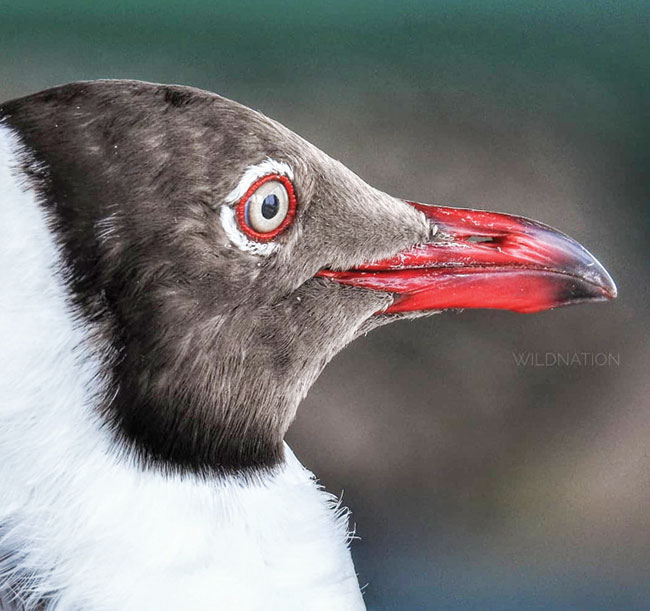
Brown headed gull- migrating from Himalayas to Mannar
The birds begin their journey from the northwestern coast of Sri Lanka, especially around Mannar—an area known for its rich birdlife and coastal habitats. From there, they cross over to India and move along the western coastline before turning inland.
Their journey then takes them through Pakistan and Afghanistan, across parts of Central Asia, and onwards to the Arctic region, where they breed during the northern summer.
What has drawn particular attention from scientists is the route chosen by the birds.
Instead of attempting to cross the world’s highest mountain ranges, or taking a much longer path over the open ocean, the gulls appear to follow a middle course that allows them to avoid harsh conditions while still maintaining a steady journey.
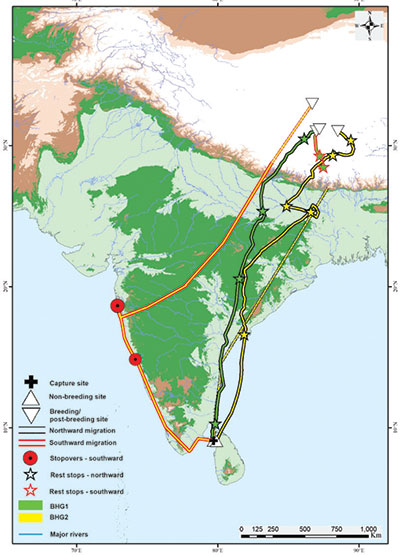
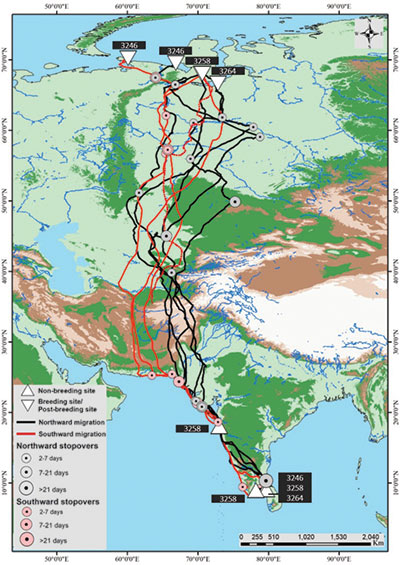
Map 1 &2 birds moving through the continent to reach the Artctic
“They are not simply taking the shortest distance,” Prof. Seneviratne explained. “They are choosing a route that gives them the best chance of survival. Along this path, they are able to find food, rest, and avoid extreme environments.”
The birds travel long distances each day, covering hundreds of kilometres, but they do not do it all in one stretch. Their journey depends heavily on stopovers—places where they pause to rest and rebuild energy.
“These stopovers are critical,” Prof. Seneviratne said. “If the birds cannot find suitable places to feed and recover, they will not be able to complete the journey.”
Co-researcher Dr. Gayomini Panagoda said the discovery sheds light on a route that had remained largely hidden until now.
“We always knew these birds were leaving Sri Lanka during certain times of the year, but we did not fully understand where they were going or how they got there,” she said. “Now we have a much clearer picture of their journey.”

Awareness among schoolchildren
She added that the findings show how closely connected different parts of the world are through nature.
“A bird that spends part of its life in Sri Lanka ends up in the Arctic. That tells us how linked these ecosystems really are,” she said.
The findings also underline the importance of Sri Lanka’s coastal areas, which serve as vital feeding and resting grounds for migratory birds before they begin their long journey north.
Veteran ornithologist , Professor Emeritus Sarath Kotagama said these habitats are of international importance and must be protected.
“These coastal regions, especially places like Mannar, provide the food and shelter these birds need before migration. If those areas are damaged, it will affect bird populations far beyond Sri Lanka,” he said.
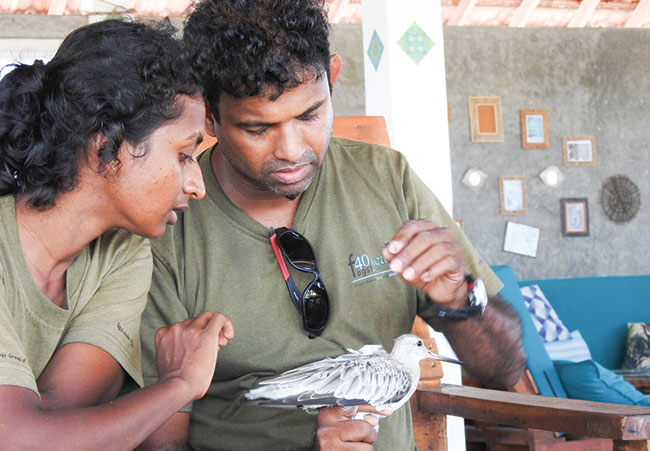
Professor Seneviratne with Dr. Gayomini Panagoda
Kotagama warned that increasing pressure on coastal ecosystems—from development, pollution, and climate change—could pose serious risks.
“We are already seeing changes in many of these birds. If we are not careful, we could lose habitats that are essential not just for local wildlife, but for species that travel across continents,” he said.
The discovery also draws attention to the wider network of migration routes that connect countries across Asia and beyond. Birds do not recognise national borders, and their survival depends on conditions in many different places along their journey.
Prof. Seneviratne stressed that protecting these birds will require cooperation between countries.
“These birds travel across several regions, and each of those regions plays a role in their survival. Conservation cannot be done by one country alone,” he said.
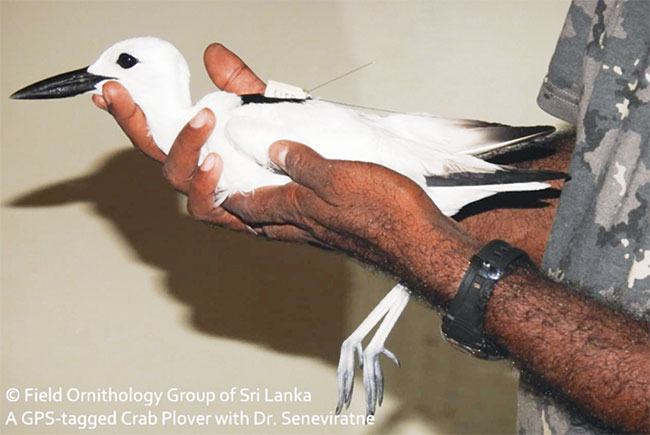
A GPS tagged Crab Plover
He added that more work is needed to understand how other species use similar routes and how changes in climate and land use may affect migration patterns in the future.
“There is still much we do not know. This is just one piece of a much larger picture,” he said.
Environmentalists say the findings should encourage stronger action to protect wetlands and coastal ecosystems in Sri Lanka, many of which are under increasing threat.
“These areas are not just important for birds,” Dr. Panagoda said. “They support fisheries, protect coastlines, and are part of our natural heritage. Protecting them benefits both people and wildlife.”
She noted that conserving these habitats will also help ensure that future generations can continue to witness the arrival and departure of migratory birds.
For Sri Lanka, the discovery is both a moment of pride and a reminder of responsibility.
It highlights the role the island plays in supporting wildlife that travels across vast distances and connects different parts of the world.
It also shows that even a small country can have a big impact when it comes to global biodiversity.
As Prof. Seneviratne put it, “What happens in Sri Lanka does not stay in Sri Lanka. These birds carry that connection across continents.”
The discovery is expected to encourage further research into bird migration in the region, as scientists continue to explore how different species move across landscapes and adapt to changing conditions.
It also reinforces the need to protect the natural environments that make such journeys possible.
In the end, the story of these birds is not just about distance. It is about survival, connection, and the delicate balance of nature.
From the shores of Sri Lanka to the frozen Arctic, their journey is a powerful reminder that the natural world is far more connected than we often realise—and that protecting one part of it helps protect the whole.

 For the morally-conscious, the tendency among some sections in Sri Lanka to promote the production of drones for national defence purposes could be deeply worrying. Besides, this proposition flies in the face of common sense and disregards the relentlessly increasing harsh economic realities coming in the wake of the current wars that could push many a southern country into beggary. In fact even the West is facing an economic recession.
To begin with the latter issues, it is a proved reality that the majority of Southern countries are descending further into poverty at present. The FAO has the ‘bleeding statistics’ . For instance, food insecurity in Asia is of such disquieting proportions that the region accounts for ‘ approximately half of the world’s 370.7 million undernourished people’.
It is against such a bleak economic backdrop that countries of the South are being called on to pump money into the production or importing of drones. Pointed reference needs to be made here to the South because drones are peddled as cutting-edge defence systems that are comparatively economical to acquire and relatively easy to operate. It is even voiced that with time drones could enable even smaller countries of the South to acquire ‘strategic parity’ with the major powers of the North and middle level powers.
Meanwhile, no thought is spared for the poor of the South who would sink steadily into poverty and powerlessness. Because more defence spending by southern countries only entrenches the ruling classes of those countries, and in some cases their military high commands, further in the systems of governance and repression.
This has essentially been the experience of the majority of post-colonial states. As aptly phrased by economic and political analyst Susan George in the seventies, it has always been a case of ‘The Other Half Dying’.
Accordingly, it cannot be perceived as to how more defence spending by the South on drones could help alleviate the latter’s principal problem of deepening poverty. As for the perceived escalating insecurities of the South, these problems are of such complexity that drones could never be seen as offering a quick fix for them. They need patient, multi-pronged managing, mainly at the negotiating table with the powers that matter. These are long- gestation projects that need to be compulsorily undertaken in view of the fact that the alternative could be indefinite conflict and war.
Since Sri Lanka too is mentioned as one of those countries that needs to look at the drone proposition with some seriousness, it is relevant to underscore that Sri Lanka is second in a list of countries that are described as facing acute material hardships at present in the wake of the economic instability bred by the Hormuz crisis. The source of such information is no less than the respected Kiel Institute for the World Economy. The first 10 such gravely affected countries are: Zambia, Sri Lanka, Taiwan, Pakistan, Equatorial Guinea, Kenya, Bangladesh, Vietnam, the Philippines and Thailand.
It is thought-provoking that among the above countries are not only those that have been traditionally seen as experiencing severe underdevelopment but also up-and-coming middle income countries that have been hitherto described as being on a fast track to development. The interesting mix proves that no country at present could consider itself immune to current economic shocks originating mainly in the Middle East that could plunge it dramatically into acute poverty virtually overnight.
We are left to conclude that ‘Bread’ or the economic well being of people could in no way be sacrificed for ‘Drones’ in democratic countries whose governments are obliged to be accountable to the people. Considering the phenomenal hardships that could be waiting to happen worldwide, the world could very well do without more ‘Guns’ or ‘Drones’.
However, if southern governments in particular opt for ‘Drones’ or an accumulation of ‘Guns’, the chances are that there could be overwhelming tides of social discontent in their countries, bred by economic want, that could then ignite indefinite war and repression. That is, a ‘No-Win’ situation for all concerned.
Ukraine has been spiritedly and admirably taking the fight back to the invading Russian forces over the past few years but its skillful use of sophisticated drones of its own making has in no way decreased the human costs the war has been incurring for itself. Ukraine has no choice but to continue with all the weaponry at its command to beat back the Russian invader but sooner rather than later it would need to take into account the immense suffering the war has been inflicting on its people and focus on the fact that the Russians are not backing down but using equally lethal weaponry against it.
The above are some of the dilemmas of the present wars that call for urgent resolution. Warring countries are obliged to address on a priority basis the misery and destruction their actions incur for their publics and consider deploying diplomacy, preferably under the aegis of the UN, to work out peaceful solutions to their enmities and differences. Considering the futility of their war Russia and Ukraine are obliged to think on these lines.
No less a power than the US should be considering deeply right now the advisability of continuing with its military interventions in the South in particular to achieve its self interests. The rising loss of American lives and the economic costs of war in the Middle East will be weighing heavily with the Trump administration and it shouldn’t come as a surprise if negotiations are given a serious try, going ahead. Ground realities in the region moreover indicate that the US ‘has bitten off more than it could chew’ and that Iran is remaining hostile and unyielding despite being bloodied.
For both sides to the war what should be inescapable is the harsh reality of continuing human suffering on a chilling scale. Sophisticated and increasingly destructive weaponry such as drones and missiles are being used but they have not brought either side any closer to victory. Instead human misery is being perpetrated mindlessly with a steady deadening of consciences and a flagrant abandoning of reason.
Accordingly, what perceived legitimate aims could drone warfare, for instance, help achieve? It is quite some time since sections of the world community came to realize the futility of violence and war. There is no choice but for humans to recognize and revere the principle of the sacredness of life. A return to fundamentals is imperative.

 Singer Rajiv Sebastian has the unique ability to woo an audience and he did just that on his recent trip to London, performing at the Funky ’70s Bash Dinner Dance.
This particular event of music, nostalgia, and celebration, was organised by the Ananda Balika Vidyalaya Old Girls’ Association – UK, and held at the DoubleTree by Hilton London Elstree, in Borehamwood, on 28th February.
They say the success of the evening was made possible through the dedication and hard work of President Devika Arrawwalage and the committed committee members of the Ananda Balika Vidyalaya OGA – UK.
Rajiv Sebastian was in top form, delivering an engaging performance that took the audience on a nostalgic musical journey through the iconic sounds of the’70s.

Doing the first set in full suit, with a fan joining in the action
He did three sets, appearing in three different outfits – suit, the normal shirt and trouser, and the sarong – and the crowd loved it.
Adding to the energy of the event, I’m told, was the music provided by the band Hasthi, made up of Sri Lankan musicians based in the UK.
At the end of a truly enjoyable and memorable event, the organisers had this to say about Rajiv Sebastian’s performance:
“On behalf of the entire team, I want to extend our heartfelt thanks to you for travelling all the way from Sri Lanka to perform at our first ever ABV dinner dance in the UK.
-

- Superb talent for captivating an audience
-

- Rajiv Sebastian
“Your performance was truly the highlight of the night. You have a superb talent for captivating an audience; from the moment you took the stage, your vibrant energy and incredible vocal range completely transformed the atmosphere.
“It was wonderful to see how effortlessly you engaged the crowd, keeping the dance floor packed and everyone in high spirits throughout the evening. You have graced the stage as a guest artiste on three separate occasions, delivering exceptional performances that set you apart from your peers.
“We feel incredibly privileged to have had an artiste of your calibre and charisma join us. You didn’t just provide music; you created an unforgettable experience that people are still talking about.
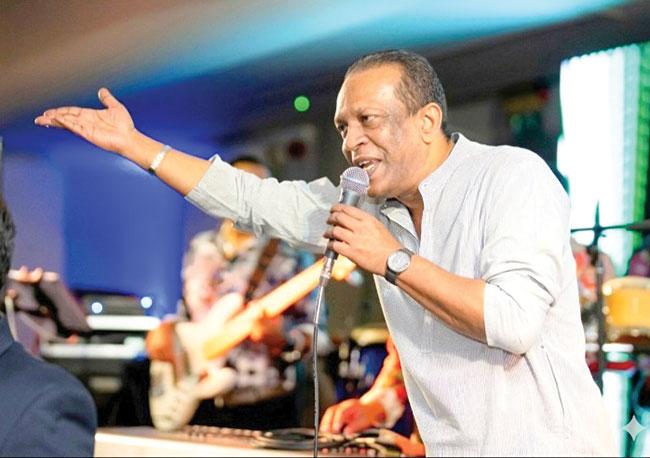
Surprises for his fans in Sri Lanka, as well
“Thank you for sharing your immense gift with us. Hope to see you back on a UK stage very soon!”
Yes, and it’s happening soon; Rajiv says he is off to London again, in mid-April, and will be performing at four different venues.
He also mentioned that he has some surprises for his fans in Sri Lanka, when he and his band, The Clan, present their 35th Anniversary concert … in June, this year.

Brook, Bethell receive warnings from Cricket Regulator after Wellington incident

Former Minister Mahinda Wijesekara passes away aged 83

Navy seize 323kg of heroin from fishing vessel in southwestern seas

Magnitude 7.4 quake hits off Indonesia’s Ternate, tsunami warning lifted

NASA successfully launches historic Artemis II moon mission

Sameer Rizvi arrives in the IPL to guide Delhi Capitals home in low-scoring chase

‘Dates have the highest sugar content to fight Coronavirus’

Sunday Island 27 December – Headlines

#SundayIsland 17th December – Headlines

Sunday Island – 28th March

Sunday Island Headlines – 21 March

Sunday Island – 21st February – Headlines
-

 Features6 days ago
A World Order in Crisis: War, Power, and Resistance
-

 News7 days ago
Energy Minister indicted on corruption charges ahead of no-faith motion against him
-

 Sports7 days ago
SLC to hold EGM in April
-
 Opinion7 days ago
When elephants fight, it is the grass that suffers
-

 Features7 days ago
Lest we forget
-

 News3 days ago
Tariff shock from 01 April as power costs climb across the board
-
 Business7 days ago
Pan Asia Bank empowers export sector as Strategic Partner of NCE Export Awards
-
 News6 days ago
Minister Jayakody indicted in Colombo High Court over alleged corruption