
News
Aragalaya failed for want of proper leadership, Rajapaksas regained power through Wickremesinghe – JVP

…won’t join coalitions ever again, calls for relentless struggle
By Shamindra Ferdinando
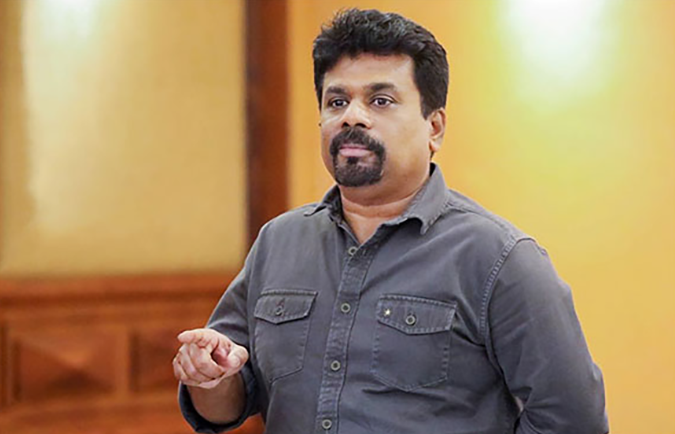
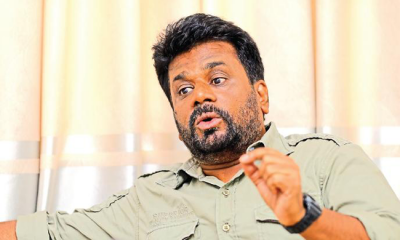
JVP leader Anura Kumara Dissanayake has said that ‘Aragalaya’ failed for want of proper leadership and planning though it compelled Gotabaya Rajapaksa to give up executive powers.
Appearing on ‘Salakuna’ on Hiru, Monday (17) night, MP Dissanayake pointed out that though the Rajapaksas’ power collapsed, as a result of the protest campaign, they were able to quickly regain, and consolidate political power, by installing UNP leader Ranil Wickremesinghe to complete the remainder of Gotabaya Rajapaksa’s term.
Responding to interviewers Chamuditha Samarawickrema, Madushan de Silva and Kalindu Vithanage, MP Dissanayake alleged that the incumbent Wickremesinghe-Rajapaksa administration was as corrupt as successive Rajapaksa administrations.
Speaking on behalf of the Jathika Jana Balavegaya (JJB), a coalition that includes the JVP, lawmaker Dissanayake faulted those who spearheaded ‘Aragalaya’ for bringing the project to an early end.
Having forced Gotabaya Rajapaksa to flee, the protest should have been diverted towards the Parliament.
Protesters’ ultimate objective should have been to force the then government to dissolve Parliament and call for a fresh election, the JVPer said, pointing out that they pressed for the appointment of Speaker Mahinda Yapa Abeywardena as the President temporarily to pave the way for early parliamentary polls.
The JVP leader acknowledged as a result of shortcomings on the part of those who directed ‘Aragalaya,’ the Rajapaksas succeeded in regaining political power. Alleging that President Wickremesinghe, too, had been responsible for the overall deterioration of the national economy, over the past several decades, MP Dissanayake stressed that the public shouldn’t expect him to save the country.
Commenting on Field Marshal Sarath Fonseka’s recent assertion that the ongoing struggle may lead to an armed rebellion, the JVP leader emphasized that his party wouldn’t go on that path again. The JVP launched insurgencies in April 1971 and 1987. Mrs. Sirimavo Bandaranaike’s government crushed the 1971 insurgency within days while the second lasted over four years.
Asked to explain their strategy, MP Dissanayake said that they believed that the government should be relentlessly pressed until it called a general election. “We’ll secure power through elections,” MP Dissanayake said, warning the electorate not to be deceived by the Rajapaksas and Wickremesinghe again.
MP Dissanayake alleged that Samagi Jana Balavegaya (SJB) leader Sajith Premadasa, who is also the Leader of the Opposition, was also part of the utterly corrupt political party system that ruined the country. The SJB leader, as well as the vast majority of those around him, couldn’t absolve themselves of waste, corruption, mismanagement and irregularities though they now pretended to be paragons of virtue.
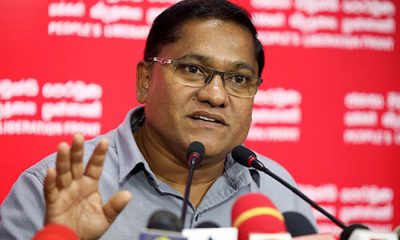
When the interviewers pointed out that the JJB parliamentary group comprised just three members (Anura Kumara Dissanayake, Vijitha Herath and Dr. Harini Amarasuriya), lawmaker Dissanayake said that it would be a grave mistake, on the part of the electorate to believe the SJB genuinely represented their interests.
Declaring that they were the real Opposition, MP Dissanayake said that the SJB backed the policies of the Wickremesinghe-Rajapaksa government. There couldn’t be a better example than the SJB skipping the vote on the Social Security Contribution Levy to highlight Premadasa’s despicable strategy. Nearly 50 SJB members, including Sajith Premadasa, skipped the vote, though Ajith Mannapperuma, Ashok Abeysinghe and Chief Opposition Whip Lakshman Kiriella were exceptions. Only 10 MPs voted against the Bill whereas 123 skipped the vote. The Parliament ratified the Social Security Contribution Levy in the second week of September, this year, with a majority of 81 votes. The Bill received 91 votes.
MP Dissanayake said that the formation of the SJB should be examined against the backdrop of the split in the UNP, caused by the belief the party couldn’t win under Ranil Wickremesinghe.
The JVP leader said that a major difference between those now exercising power, as well as the SJB and the JVP, was the composition of the Cabinet of Ministers. The JVP believed the Cabinet of Ministers should be restricted to 25 and an equal number of Deputy Ministers whereas the rest were hell bent on expanding the Cabinet of Ministers and accommodating as many State Ministers as possible, at taxpayers’ expense.
Acknowledging the role played by the Tamil National Alliance (TNA), MP Dissanayake, in an obvious reference to the rebel SLPP groups, alleged that they distanced themselves from the government after failing to achieve their objectives, and agendas.
The JVP leader dismissed the interviewers’ assertion that whatever the allegations directed at the incumbent President, he was the most qualified to handle the economy, as baseless. Lawmaker Dissanayake challenged interviewers on the basis that of the USD 15.5 bn loans obtained by way of ISB (International Sovereign Bonds), during the 2007-2020 period, the yahapalana administration had taken USD 12 bn between 2015 and 2019, in addition to USD 1.1 bn received for handing over the Hambantota Port, to China, on a 99-year-lease. President Wickremesinghe owed an explanation in that regard.
Referring to the Colombo High Court, in June this year, sentencing Chief Government Whip Prasanna Ranatunga to two years rigorous imprisonment, suspended for five years, after he was found guilty of one of the charges in a case filed over threatening a businessman, MP Dissanayake said that Sri Lanka’s reputation had been ruined by some of those represented in Parliament. The JVPer said that the recent declaration at the Geneva-based United Nations Human Rights Council (UNHRC) that economic crimes had been perpetrated in Sri Lanka was a warning that the international community wouldn’t recognize Sri Lanka as long as the country didn’t honour its own laws.
Responding to a spate of questions on the JVP’s readiness to form a government of its own, MP Dissanayake insisted that the party wouldn’t, under any circumstances, join other political parties. Referring to the JVP joining the CBK government, in 2004, and backing Sarath Fonseka and Maithripala Sirisena at the 2010 and 2015 presidential elections, MP Dissanayake said that they wouldn’t repeat that strategy.
Commenting on several high profile corruption cases, including reduction of Rs 50 per kilo duty on imported white sugar, to 25 cents, in Oct 2020, Treasury bond scams perpetrated in 2015 and 2016, lawmaker Dissanayake said that those responsible would never be punished. The JVPer claimed that the corrupt would be safe as long as the people failed to elect a JVP-led government.
MP Dissanayake flayed ministers who lived luxurious lives at taxpayers’ expense at a time the vast majority of people struggled to make ends meet. Responding to accusations directed at the JVP by Johnston Fernando, MP Dissanayake alleged that the MP brought a woman suicide cadre to Colombo with a view to assassinating the then President Mahinda Rajapaksa. The attack was to be mounted when the President visited a certain house at Gregory’s Road, MP Dissanayake alleged, claiming that the file pertaining to that particular case disappeared from the Attorney General’s Office. An aide to MP Fernando, while denying the JVP leader’s accusation, said that making unsubstantiated allegations was part of their strategy.
Lawmaker Dissanayake said that those who exercised political power never allowed the police and the Attorney General to proceed with high profile cases. Referring to the Malwana case in which Basil Rajapaksa had been investigated for building a bungalow and the ongoing inquiry into fraudulent activities of Thilini Priyamali, the JVP leader said that politicians didn’t allow the law to take its course. Declaring the Money Laundering Act as a very powerful law, MP Dissanayake claimed that it was not properly implemented in respect of those near and dear to the powers that be.






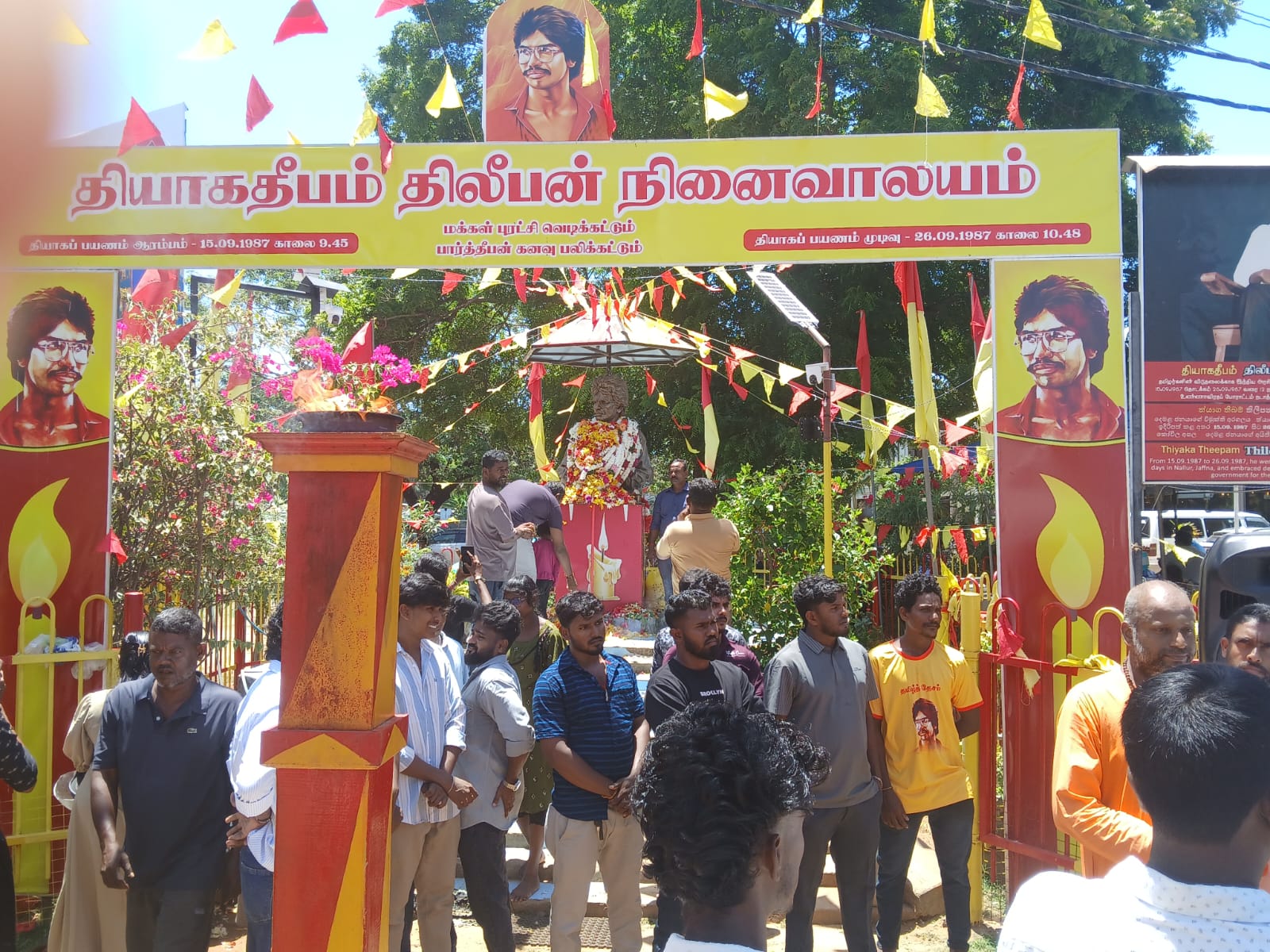
A commemorative service was held in memory of Rasaiah Parthipan commonly known by the nom de guerre ‘Thileepan’ in Nallur Jaffna this morning (26).
Parthipan a revolutionary member of the LTTE and a student of the University of Jaffna, commenced a hunger strike on 15th September 1987 untill his death on 26th September 1987. He was 23 years old at the time of his demise.
Latest News
Landslide Early Warnings issued to the districts of Colombo, Galle, Gampaha, Hambanthota, Kalutara, Kandy, Kegalle, Kurunegala, Matara, Nuwara Eliya and Ratnapura


The National Building Research Institute has issued landslide early warnings to the districts of Colombo, Galle, Gampaha, Hambanthota, Kalutara, Kandy, Kegalle, Kurunegala, Matara, Nuwara Eliya and Ratnapura from 16:00 hrs on 25.09.2026 To 16:00 hrs on 26.09.2026
Accordingly,
LEVEL III [RED] landslide early warnings have been issued to the Divisional Secretaries Divisions and surrounding areas of Neluwa, Nagoda, Niyagama and Thawalama inthe Galle district, Ganga Ihala Korale, Udapalatha, Doluwa and Pasbage Korale in the Kandy district, and Kothmale West, Ambagamuwa, Kotmale East and Norwood in the Nuwara Eliya district.
LEVEL II [AMBER] landslide early warnings have been issued to the Divisional Secretaries Divisions and surrounding areas of Elpitiya, Baddegama and Karandeniya in the Galle district, Walallawita in the Kalutara district, Deltota, Udunuwara, Gangawata Korale, Yatinuwara and Panvila in the Kandy district, Aranayake, Dehiowita, Mawanella, Deraniyagala and Yatiyanthota in the Kegalle district, Thalawakelle in the Nuwara Eliya district and Ratnapura and Pelmadulla in the Ratnapura district.
LEVEL I [YELLOW] landslide early warnings have been issued to the Divisional Secretaries Divisions and surrounding areas of Seethawaka and Padukka in the Colombo district, Attanagalla and Mirigama in the Gampaha district, Katuwana and Walasmulla in the Hambanthota district, Ingiriya and Bulathsinhala in the Kalutara district, Hatharaliyadda, Poojapitiya, Medadumbara, Kundasale, Ududumbara, Thumpane, Akurana, Pathadumbara, Harispattuwa and Pathahewaheta in the Kandy district, Warakapola, Bulathkohupitiya, Galigamuwa, Kegalle and Ruwanwella in the Kegalle district, Mallawapitiya, Alawwa, Polgahawela and Mawathagama in the Kegalle district, Pitabeddara, Kotapola and Pasgoda in the Matara district, Nuwara Eliya in the Nuwara Eliya district and Elapatha, Ayagama, Nivithigala, Kuruwita and Kalawana in the Ratnapura district

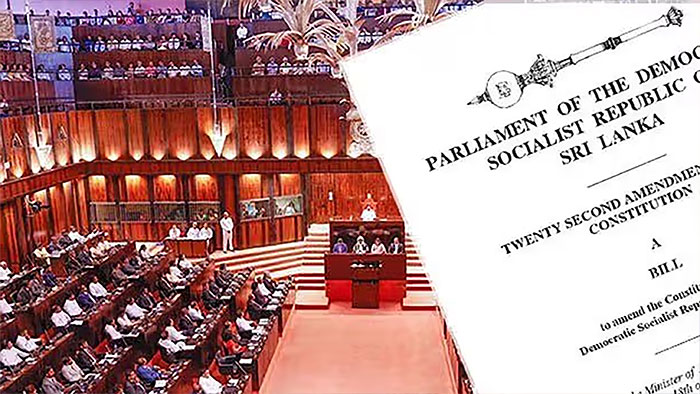
Parliament yesterday passed the Twenty-Second Amendment to the Constitution Bill and the Judicature (Amendment) Bill with two-thirds majorities, with 158 MPs voting in favour and 63 against each Bill.
The Illankai Tamil Arasu Kadchi (ITAK) and Sri Lanka Muslim Congress (SLMC) voted with the SJB against the Bills.
NDF MPs Ravi Karunanayake and Faizer Musthapha and SJB Badulla District MP Nayana Wasalathilaka were not present when the votes were taken.
The final vote on the Judicature (Amendment) Bill was announced at around 8.08 p.m. after Opposition MPs called for divisions on its clauses during the Committee Stage.
The votes followed a two-day debate which commenced on Thursday (24), after Justice and National Integration Minister Harshana Nanayakkara presented the Bills for their Second Reading.
The Supreme Court’s determination on the Bills was presented to Parliament on Tuesday (22) by Speaker Dr Jagath Wickramaratne. The Court determined that the 22nd Amendment Bill did not require approval at a referendum and could be passed by a special two-thirds majority in Parliament.
The amendment provides for raising the mandatory retirement age of Supreme Court judges from 65 to 67 and that of Court of Appeal judges from 63 to 65. It also provides for the Chief Justice to retire at 67 or after completing six years in office, whichever comes earlier.
The Speaker informed Parliament that the Judicature (Amendment) Bill could be passed by a simple majority.
The SJB opposed the legislation and its MPs attended Parliament dressed in black yesterday. The party also staged a protest at Polduwa Junction, Battaramulla, under the theme “No to 22, which destroys democracy”, with Opposition Leader Sajith Premadasa and several SJB politicians participating.

Thileepan rembered on 39th death anniversary

Landslide Early Warnings issued to the districts of Colombo, Galle, Gampaha, Hambanthota, Kalutara, Kandy, Kegalle, Kurunegala, Matara, Nuwara Eliya and Ratnapura

Showers in the Western, Uva and Sabaragamuwa provinces and in Galle, Matara, Kandy, Nuwara-Eliya, Batticaloa and Ampara districts.

22A, Judicature Amendment Bills passed with 2/3 majority

TIN mandatory for key transactions from Nov. 1

Navy brings 25 Indonesian fishermen ashore after trawler capsizes

‘Dates have the highest sugar content to fight Coronavirus’

Sunday Island 27 December – Headlines

#SundayIsland 17th December – Headlines

Sunday Island – 28th March

Sunday Island Headlines – 21 March

Sunday Island – 21st February – Headlines
-

 News7 days ago
Namal Rajapaksa Buddhist gambit fails, bail denied
-

 Features7 days ago
Why the spelling Sri Lankan names in English vary
-

 Features7 days ago
Three bands, a new identity: Sri Lankan wolf snake recognised as distinct species
-

 Business7 days ago
SLIIT holds largest-ever convocation
-

 News7 days ago
Vehicle prices drop by up to Rs. 1 mn, says importers’ body
-
 News7 days ago
Govt monitors reported Saudi death sentence – Foreign Ministry
-
 Business7 days ago
Lanka’s famed beach shack battles demolition
-

 Business7 days ago
All-new Bolero MaXX Pik-Up unveiled in Lanka