
Business
Fitch unit warns Adani Group may be careering into a debt trap


BY S VENKAT NARAYAN
Our Special Correspondent
NEW DELHI, August 27: Indian billionaire Gautam Adani’s ports-to-power conglomerate is “deeply overleveraged,” with the group investing aggressively across existing as well as new businesses, predominantly funded with debt, CreditSights, a Fitch Group unit, said in a report. The aggressive expansion pursued by the Adani Group, led by Asia’s richest person, has put pressure on its credit metrics and cash flow, CreditSights said in the report Tuesday. It cautioned: “In the worst-case scenario,” it may spiral into a debt trap and possibly a default.
“We see little evidence of promoter equity capital injections into the group companies, which we feel is needed to reduce leverage in their stretched balance sheets,” the agency said. It was referring to fund infusions from the Adani Group’s founders, known as “promoters” in India.
All seven listed Adani firms declined by 2% to 7% in trading Tuesday. A representative for the Group did not immediately respond to a request for comment on the report.CreditSights’ report comes after a big few years for Adani, who’s been on a rapid diversification spree, expanding an empire centred on ports and coal mining to include airports, data centres and cement as well as green energy. The group recently pledged to plow $70 billion into renewable projects.
These moves have not only boosted Adani’s stature in India, but his fortune, with his net worth surging past $135 billion this year. He’s also increasingly moving into spheres dominated by the man he replaced as Asia’s richest man, compatriot Mukesh Ambani of Reliance Industries Ltd.
The report puts a spotlight on the multiple fault lines that may impede Adani’s ambitions and the stratospheric surge in the shares of his firms. CreditSights’ analysts, however, said they draw “comfort” from the group’s strong relationships with banks as well as the administration of Indian Prime Minister Narendra Modi.
Some other highlights from the report, authored by CreditSights’ Lakshmanan R, Rohan Kapur and Jonathan Tan are:
The Adani Group is entering new and unrelated businesses, which are highly capital intensive, raising concerns over execution oversight;
Potential strong competition between the group and Ambani’s Reliance to achieve market dominance could lead to “imprudent financial decisions;”
Adani Group is also exposed to moderate levels of governance and ESG risks
The group has a “strong track record of churning out strong and stable companies” through its flagship, Adani Enterprises Ltd., and has built a portfolio of “stable infrastructure assets tied to the healthy functioning” of the Indian economy;
Its founder “enjoys a strong relationship” with the Modi government and has benefited from “policy tailwinds;”
CreditSights remain “cautiously watchful” of the group’s growing appetite for expansion, which is largely debt-funded.
A self-made billionaire who started his business as an agri-trading firm in late 1980s, Adani has also been a busy dealmaker this year. The Adani Group acquired the Haifa port in Israel in July for $1.2 billion and Swiss firm Holcim’s Indian cement units for $10.5 billion in May, besides almost three dozen big and small acquisitions. It’s also expanding into media, health care and digital services.
The group owns India’s largest private sector port operator, coal miner, city gas distributor and airport operator and is aiming to create the world’s largest renewable power generator.
Investors have cheered the tycoon’s ability to rapidly scale up his businesses, spurring massive share rallies in Adani firms even during the pandemic, when most businesses suffered. Adani Enterprises and Adani Green Energy Ltd. have surged more than 1,300% since the beginning of 2020. Adani Total Gas Ltd. has rallied about 1,900% and Adani Transmission Ltd. over 900%, while the benchmark S&P BSE Sensex surged almost 42% over this period.
But it’s this breakneck growth that’s making credit watchers, including CreditSights, uneasy. The research firm acknowledges that the Adani founding family’s status as a majority shareholder in most of their listed group companies means they will go all out to support them.
The family’s “entire fortune and reputation is tied to the Adani Group companies,” it said. “Having such major ‘skin in the game’ could imply that the family would pull all stops to avoid default in any of the entities, since any material liquidity or solvency issue in one company would likely have a contagion effect on the valuation of the remaining companies, too.”

Business
Aitken Spence concludes FY26 on a strong note, recording a 18% growth in PBT to Rs. 12.8 bn


Aitken Spence PLC, a leading conglomerate with a diverse regional presence, recorded a strong Profit Before Tax (PBT) of Rs. 12.8 billion for the year ended March 31, 2026. The strength of the Group’s diversified portfolio was clearly demonstrated during the financial year, with overseas operations contributing 61% of total profits. This growing international presence continues to enhance earnings resilience, reduce concentration risk, and unlock multiple avenues for growth across markets and sectors.
The Group’s share of profits from equity-accounted investees increased significantly, by 46%, to Rs. 2.3 billion, driven by stronger contributions from the Port City BPO venture, as well as improved performance in the Group’s plantation and bunkering operations.
Profit after tax rose to Rs. 9.1 billion, representing a 27% increase over the corresponding period last year, with Rs. 6.8 billion attributable to equity holders of the Company.
The Group’s Tourism sector demonstrated a substantial improvement, recording a PBT of Rs. 7.9 billion for the year ended March 31, 2026. It is noteworthy that the Group’s Tourism sector emerged as the key contributor, accounting for 61% of the Group’s total contribution. The improvement in the Tourism sector’s performance was supported by stronger tourist arrivals across destinations, higher occupancy levels, and improved room rates during the year. The sector also benefited from lower interest costs, which contributed to the growth in profitability. The destination management segment also delivered a strong performance, navigating a challenging local industry environment during the financial year, while benefiting from the continued recovery in global travel and increased inbound tourism.
The Group’s Maritime & Freight Logistics sector achieved a PBT of Rs. 4.7 billion for the year ended March 31, 2026, driven primarily by the maritime and port segment. The sector operated in a challenging global environment, with escalating pressures toward the latter part of the year impacting overall performance. Despite these headwinds, port operations demonstrated healthy growth in both revenue and earnings, supported by increased operational activity. The integrated logistics segment recorded stable revenue levels, and the newly commissioned warehouse complex demonstrated encouraging progress in its initial phase of operations. However, these gains were partially offset by softer performances in the transport and distribution segments.
The Services sector delivered a marked improvement in profitability during the year, with profit before tax rising sharply to Rs. 1.2 billion, supported by the continued scaling and maturity of the portfolio. The Group’s BPO services segment recorded strong growth, driven by expanded operations and a growing client base, while the Group’s elevator agency improved volumes, and the property management segment delivered a steady performance. However, this was moderated by weaker outcomes in the Group’s insurance and money transfer segments.
Business
Value Network Ventures’ USD 4 mn carbon investment puts SL’s mangroves on global climate map
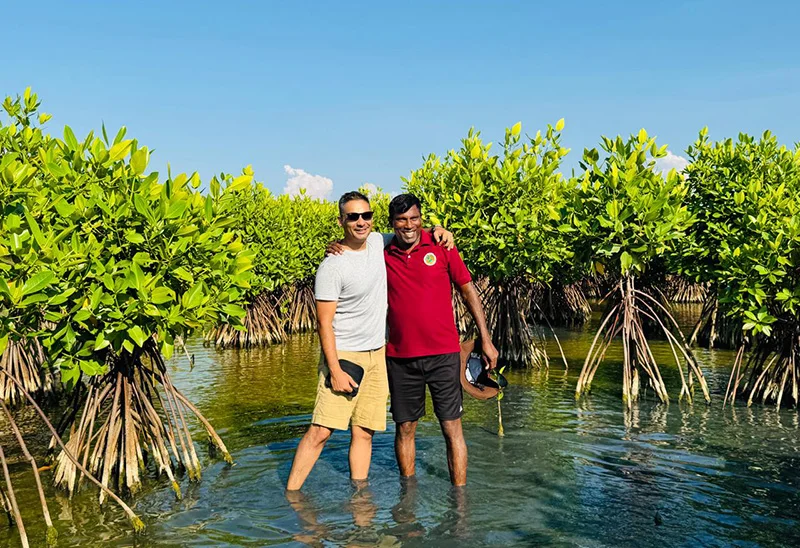
At a time when Sri Lanka was grappling with economic uncertainty, dwindling foreign reserves and an urgent need for foreign investment, a little-publicised environmental initiative quietly attracted nearly USD 4 million into the country through an innovative carbon-financing mechanism centred on mangrove restoration.
The project, implemented by TCP Lanka (PVT) Ltd. under the leadership of conservationist Thushan Kapurusinghe, has already restored approximately 3,000 hectares of mangrove ecosystems across Sri Lanka’s coastal belt, making it one of the largest nature-based carbon sequestration initiatives undertaken in the country.
Kapurusinghe, chairman of TCP Lanka (PVT) Ltd, said the investment originated from VNV, a Singapore-based project development company specialising in carbon-financing ventures linked to ecosystem restoration.
According to him, VNV sought a credible local partner capable not only of planting mangroves on a large scale but also of maintaining them over decades to ensure the generation of verifiable carbon credits.
“This is not a conventional tree-planting programme where saplings are planted and forgotten. Carbon-financing projects require long-term commitments because the trees must survive, grow and continue absorbing carbon dioxide from the atmosphere if carbon credits are to be generated and traded internationally, he explained.
The project commenced in 2021, during a period when Sri Lanka was facing severe economic challenges compounded by the lingering effects of the COVID-19 pandemic.
In 2021, TCP Lanka (PVT) Ltd. signed an MoU with the State Ministry of Coast Conservation and Low-Lying Lands Development (CCLD). The Secretary of the Coast Conservation Ministry officially requested the Director General of the Coast Conservation Department to appoint a liaison officer to coordinate this project with TCP.
Prematilake (the appointed CCD officer) organized several meetings in the districts of Kalpitiya, Mannar, Jaffna, Trincomalee, Batticaloa, and Ampara to create awareness about this project and seek their assistance. These meetings were attended by officers from government agencies such as the Forest Department, Coast Conservation Department, Central Environmental Authority (CEA), Department of Wildlife Conservation, Department of Fisheries, and others. Furthermore, the Secretary of the State Ministry of Coast Conservation organized several meetings in 2021 and 2022 with officials from the relevant ministries and departments.
It represented a rare example of climate finance flowing directly into large-scale ecosystem restoration while simultaneously creating employment opportunities and strengthening environmental resilience.
Initially conceived as a 500-hectare initiative, the project rapidly expanded following consultations with government agencies. Officials encouraged the expansion of the programme after recognising its potential to attract foreign investment while restoring degraded coastal habitats.
Following discussions between TCP and the VNV, the project was progressively enlarged first to 1,000 hectares and eventually to 3,000 hectares, significantly increasing the scale of investment.
The restored areas span several districts, including Puttalam, Kilinochchi, Mullaitivu, Trincomalee, Batticaloa and Ampara, covering some of Sri Lanka’s most ecologically significant coastal landscapes.
What makes the initiative particularly noteworthy is its registration under VERRA, one of the world’s leading carbon standards organisations. VERRA certification is regarded as a critical prerequisite for projects seeking access to international carbon markets, as it provides globally recognised methodologies for measuring, monitoring and verifying carbon sequestration.
Kapurusinghe noted that carbon financing differs fundamentally from traditional donor-funded environmental projects. Investors provide capital upfront for restoration activities with the expectation that future carbon credits generated by the restored ecosystems will eventually offset their investment and generate returns.
“The concept is straightforward. Investors provide the funds needed to restore degraded ecosystems. As the mangroves grow, they remove carbon dioxide from the atmosphere and store it. That stored carbon can then be converted into certified carbon credits that are sold in international markets,” he said.
Mangroves are among the most efficient natural carbon sinks on Earth, capable of storing several times more carbon per hectare than many terrestrial forests. Beyond carbon sequestration, they provide critical ecosystem services including shoreline protection, fisheries enhancement, biodiversity conservation and climate adaptation benefits for vulnerable coastal communities.
The project’s significance extends beyond environmental restoration. It also demonstrates how natural ecosystems can become economic assets within the emerging global carbon economy.
By Ifham Nizam
Business
Toastmasters across Sri Lanka unite for a conference of transformation, inspiration and progress
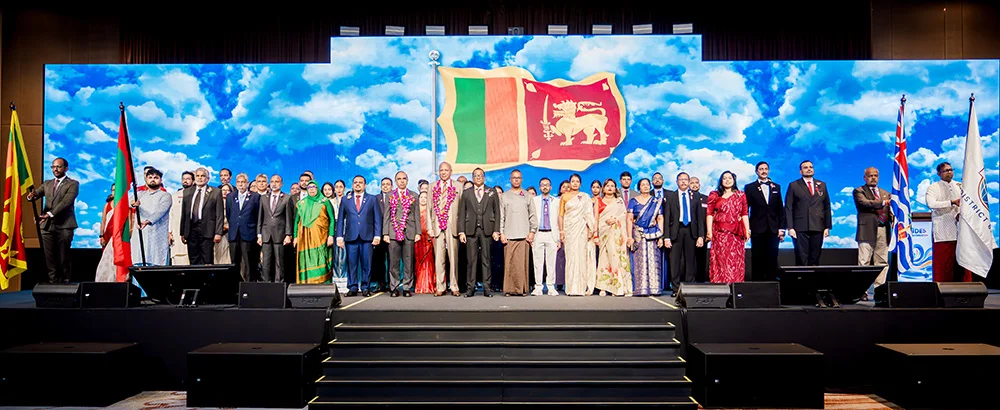
District 82 Toastmasters International concluded its flagship annual conference, Ovation 2026, on 16th and 17th May at Shangri-La Colombo. Themed “Tides of Transformation,” the two-day event brought together communicators, leaders, professionals, entrepreneurs, educators, and change-makers from across Sri Lanka and the wider region, marking what many attendees described as one of the most energising gatherings the district has seen in recent years.
Recognised as one of the highest-performing Toastmasters districts globally, District 82 represents Sri Lanka, the Maldives, and the British Indian Ocean Territory. Ovation 2026, chaired by DTM Mario de Silva, served as the district’s premier platform for celebrating excellence in communication, personal growth, and leadership. The conference was powered by Home Lands, with support from a strong lineup of corporate partners including Janatha Steels, Nestlé, Maliban Biscuit Manufactories, A J Medichem International, New Anthoney’s Farms, Jayes Investment, and Zorro Tapes.
The conference opened with a keynote from K R Ravindran, Past President of Rotary International, who spoke on character-driven leadership and the importance of integrity in today’s world. The programme continued with impactful sessions from Rasini Bandara on resilience and mental strength, and Michelle de Silva on authenticity and purposeful leadership. A panel discussion titled “The Human Touch in a Digital Age,” featuring Sanali Kaushalya, Mevan Peiris, and Sanjaya Elvitigala, moderated by DTM Gayathri Liyanage, explored what it means to lead with empathy in an increasingly technology-driven world.

SLC name squads for Tri-Nation ‘A’ series and Four-Day series
SLC name squads for West Indies Emerging Tour of Sri Lanka 2026

ICC delegation visits Bangladesh to ‘review developments linked to the BCB’

Indonesia’s rupiah falls to record low against US dollar

INS Airavat makes port call in Colombo

Netanyahu downplays US-Israel rift after Trump confirms criticism

‘Dates have the highest sugar content to fight Coronavirus’

Sunday Island 27 December – Headlines

#SundayIsland 17th December – Headlines

Sunday Island – 28th March

Sunday Island Headlines – 21 March

Sunday Island – 21st February – Headlines
-

 News6 days ago
IMF urges Lanka not to meddle with exchange rate
-

 News3 days ago
Lankan duo emerge winners in Latin dance championship held in Blackpool, UK
-
 Business7 days ago
Sri Lanka’s construction industry losing ground while no one watches
-

 Business4 days ago
IMF’s unstated rate:Sri Lanka’s $695m loan costs about 5.33% per annum
-

 News6 days ago
State of emergency extended
-

 Features7 days ago
The Division Bell Mystery
-

 Features5 days ago
Are threats to Buddha Sasana external or from within?
-

 News4 days ago
UNP challenges NPP move to amend Vihara – Devalagam Act