
Features
Volume Two of the Sarath Amunugama Autobiography


(First Edition 2022, 488 pgs. -Vijitha Yapa)
Reviewed by Nigel Hatch P.C.
In volume II of his autobiography “TO PARIS AND BACK” Dr. Sarath Amunugama (SA) covers the period 1977 to 1990 aptly sub titled “The JRJ Years”. He covers a momentous period in the nation’s history and in his own career: JR Jayewardene’s (JRJ) landslide victory in 1977 and the Second Republican constitution which established the executive presidency, the introduction of the open economy, his appointment at 37 as the youngest Permanent Secretary in 1977 and his enduring contributions to the development of broadcasting and the introduction of TV and tourism including the investment by international hotel chains.
Amunugama who worked closely with President Jayewardene (JRJ) as permanent secretary to the Ministries of Information and Broadcasting and State, says that as a social scientist he was fascinated by the JRJ persona and wishes to present “a sympathetic portrayal” of JRJ who he correctly identifies as an important political leader. His breakdown of JRJ’s zeitgeist is a fascinating read-
“Sri Lanka has not seen a leader of the calibre of JRJ” – the public and private faces of this enigmatic politician. SA tells his readers that JRJ and his brother Harry (HWJ) read every book on their heroes Disraeli and Napoleon. The reviewer recalls that when apprenticing with Sam Kadirgamar QC the latter and HWJ would phone each other and indulge in one upmanship about their latest acquisitions on Napoleon! But SA does not view JRJ through rose tinted glasses and states “a cynical interpretation of legal provisions led JRJ and his supporters to many undemocratic acts and violations of human rights…. Amendments to the Constitution to solve parochial political issues led to the debasement of the constitution and the presidency”.
Amunugama takes the reader through the deprivation of Mrs. Bandaranaike’s civic rights in 1980 which pushed the SLFP into an extreme Sinhala nationalist position and the emasculation of the opposition (“a blunder which changed the political landscape of this country”), the rise of Cyril Matthew with JRJ’s blessing and the July 1983 riots which worsened ethnic tensions in the country which inevitably led to disenchantment in India under Indira Gandhi and the rise of Tamil militancy in the wider context of the vicissitudes in Indo-Lankan relations culminating in the Indo-Lankan Accord of 1987 and the 13th Amendment which devolved power, and the violence unleashed by the JVP. JRJ’s tactics led to “the country slipping into a quagmire of regional misunderstandings and domestic ethnic conflict which finally destabilized the country for three decades and blunted the trajectory of economic growth which had stared with much promise in 1977”. Whilst the Singapore model animated policy makers SA wryly notes that the Singapore leadership looked upon SL as a failed State.
He knew and writes about the other leading personalities in the UNP cabinet of JRJ post 1977 and opines that it was “the most competent cabinet of ministers in modern times”–inter alia R. Premadasa who became Prime Minister, Ronnie De Mel in Finance, Lalith Athulathmudali in Trade and Shipping, Gamini Dissanayake in Mahaweli development and Anandatissa de Alwis as Minister of State. In appointing Premadasa as PM, JRJ “sent a strong signal that the UNP was merit based and not kinship and caste based as it was under the Senanayakes”.
But he stoically notes that after the LTTE assassinated many of these leaders, the UNP “fell into the hands of mediocrities”. SA also documents the ‘revenge’ factor in Sri Lankan politics -JRJ against Mrs. B for having briefly imprisoned his son during the 1971 insurrection, Gamini Dissanayake’s (GD) contretemps with Gamini Athukorala who snitched to JRJ that the former secretly met Hector Kobbekaduwa in an attempt to stave off the deprivation of Mrs. B’s civic rights and GD/Ranil Wickremesinghe (RW) conflict after the latter was defeated by one vote in the leadership contest in the UNP consequent upon the assassination of President Premadasa; and the sabotage of GD’s presidential election bid. Readers are also given insights into the background of many causes celebres which were hitherto not in the public domain. Profiles of leading advisors to JRJ including GVP Samarasinghe and Esmond Wickremesinghe add to the memoir.
Nevertheless this aspect of the memoir, to the reviewer, compels a reappraisal of the executive presidency introduced by JRJ in the Second Republican Constitution 1978. As SA reminds us JRJ himself saw the presidency as a continuation of a long line of a Sinhalese Buddhist monarchy of over 2500 years. But as a modernist he told the Buddhist clergy (sangha) who wanted to discuss ethnic relations with him “to mind their own business just as he did not advise then on sangha matters”. The rationale of this political construct namely, executive stability unaffected by the vicissitudes of parliamentary change, rapid economic growth with an open economy, and managing of ethnic tensions has proved elusive.
Apart from the initial growth spurt of 8-9% between 1977 to 1980 the anticipated economic takeoff did not materialize primarily due to the protracted war with the LTTE which ended with its military defeat in 2009. Despite the intransigence of the LTTE in arriving at a negotiated settlement an omnipotent presidency was incapable of finding a solution. Ethnic tensions still remain particularly due to the triumphalist posturing post 2009 and attacks directed at the Muslim minority, an extremist section of which inexplicably attacked churches in 2019. To date, the Catholic church has been critical about the failure to ascertain the mastermind behind this and a concomitant lack of accountability.
The national economy has been beggared due to incompetent leadership by Gotabaya Rajapaksa who was ousted from office by a mass movement against rampant corruption and cronyism and a clamour for a systemic change. Financial scandals and corruption are legion – e,g. the bond scandal, corpulent commissions by Ministers with little or no accountability despite specialized Commissions to investigate them. Like the mafia there is “omerta” or a wow of silence with no state or private sector official prepared to expose corruption. Anandatissa de Alwis once nonchalantly stated in the old Parliament (now the Presidential Secretariat) that the magnitude of corruption would inevitably rise under an open economy!
The abolition of the Executive Presidency which Amunugama notes many presidential aspirants undertook but never delivered on is topical again. Ironically Ranil Wickremesinghe a kinsman of JRJ who was inducted into national politics in 1977 is now ensconced as President reliant on a parliamentary majority of the Rajapaksa family dominated SLPP which has lost political legitimacy. The country crippled under the yoke of a lack of foreign exchange, fuel, and medicines and crippling inflation yearns for accountability for economic mismanagement and the return of allegedly stolen billions, parked in foreign safe havens. Will Wickremesinghe enjoying the presidential levers of power be able to deliver on forging a government of national unity, restoring economic stability, accountability and recovery of stolen assets?
A striking feature of this memoir is Amunugama’s recounting of his experiences in foreign countries. He was part of a delegation to China led by Esmond W as the post 1977 Chinese leadership were keen on close relations with the JRJ regime despite close ties with Mrs. B’s governments from 1960-65 and 1970-77. There is a discernible sense of admiration for the CCP during this era who were moving away from the failed “cultural revolution” and the “Great Leap forward” under Mao.
Amunugama’s insights are fascinating as the reviewer around the same time as a student contributed an article to the STC magazine eulogizing Chou-en-Lai. Amunugama’s interactions with the political, business and media elite in India after Rajiv Gandhi became PM in an attempt to find a solution to the ethnic crisis are also a compelling read.
SA’s love of books and culture is reflected strongly. Apart from his promotion of local artistes on the airways he writes poignantly of witnessing the maestro Ravi Shankar’s last performance in Washington. He records the appreciation received from Ediriweera Sarachchandra, Pandith Amaradeva and the farewell from the staff of the left oriented Government Press when he retired prematurely from public service in 1982 to accept overseas assignments. But, whilst he takes his reader through many cities that he travelled and worked in, Paris was his true love and the memoir will delight even the most jaded traveler as did his reflections of Berlin in Volume I.
A good memoir can be difficult to accomplish. Oft times after reading an autobiography one is left with no real sense of the spirit, which is the life, of the subject. This cannot be said of SA’s memoir. His erudition, professionalism, integrity and strong work ethic as a results oriented individual comes across seamlessly. He provides a deeper contextual insight into leading political personalities and events, including their misadventures which he does not fail to record, reflecting his academic training in sociology and economics. He writes lucidly with a wry wit ( e.g.- a senior grandee of the UNP was moved out from the cabinet to Speaker “a post which had much prestige but no tenders” !; later describing self-flagellation with birch branches whilst experiencing an authentic Finnish sauna “though fearful at first I found this invigorating and the body was made ready for large gulps of Finnish beer which was sucked up by my tormented body”) and an unerring eye for detail. In these pages I found references to many whom the reviewer has known – including Sam Wijesinha who SA identifies as a trusted advisor of R. Premadasa, Gamini Dissanayake who in fact introduced me to SA (recounted more fully in my article in the Sarath Amunugama ‘Festschrift’ in 2010), Lalith Athulathmudali and Ronnie de Mel.
This volume builds on volume I and is a rich tapestry of the life and times of a brilliant and now preeminent elder statesman whose sagacity and involvement in national affairs is sorely missed. This autobiography will undoubtedly be an indispensable reference for the contemporary history of Sri Lanka.

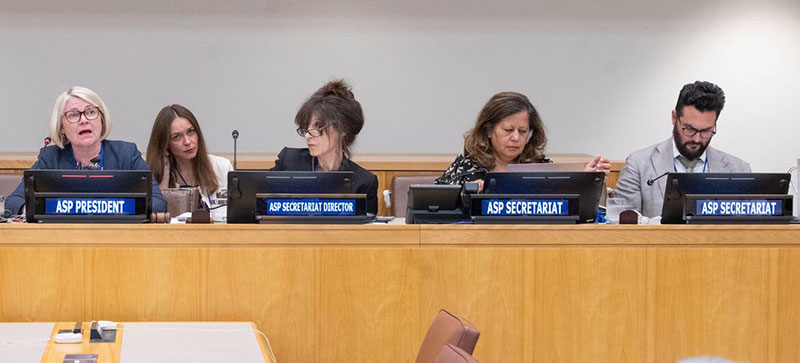
 US Secretary of State Marco Rubio’s warning to the International Criminal Court (ICC) was stark: ‘Either the ICC will end its threats, or we will end the ICC.’ It followed US central administration accusations that the court was unfairly targeting Americans on the basis of trumped-up war crimes charges.
However, a new plethora of sanctions has been clamped on the ICC by the US, which in turn has spurred accusations by sections of the world that the latter has unleashed an ‘assault’ on the international legal order.
What some of the sanctions would mean for the ICC was outlined by Rubio: ‘We will ban transactions with this rogue court, cutting off their resources and crippling their ability to operate against us.’
The ICC has shown consistency of purpose over the years. Despite some operational constraints it has indicted a large number of political strongmen from around the world, accused of war crimes and other governance excesses that come under its purview. Two such recent figures are: Russian President Vladimir Putin and Israeli Prime Minister Benjamin Netanyahu.
Rather than enjoy a mere nominal presence in the world community, the ICC has proved its effectiveness by detaining and bringing to justice scores of VIP politicians and others of their ilk who have been found guilty of human rights abuses and kindred excesses that come within the terms of reference of the ICC.
Accordingly, the international justice system would be stymied considerably as a result of the ICC being dis-empowered, particularly financially. Needless to say, potential and real perpetrators of the species of crime coming under the jurisdiction of the ICC would stand to gain most from such anarchic tendencies. That is, political repression globally would be enabled to enjoy a new lease of life.
A detailing of the types of crime coming under the purview of the ICC provides an idea of what it would cost the international community if the ICC’s operations are gravely hampered. They are mainly: genocide, war crimes, crimes against humanity and the crime of aggression.
That is, the part of the world to be worst affected would be the global South, since the latter is awash with the mentioned crimes. Needless to say, a chronically-disaffected South will sooner rather than later undermine the well being of the world dangerously. The world is already being put through these paces.
At the time of writing, ‘illegal migrants’ from the South, for example, are aggravating many a Western economy’s woes, besides creating for them acute law and order issues. The fact that these migrants’ presence goes on to become a virtual test of the migrant receiving states’ ability to forge domestic social inclusion in the face of jingoistic protests by mainly white supremacist groups is evidence of the latter. As is known, the US, to take just one example, has been up against this crisis for quite a while.
Accordingly, it will be in the best interests of the West if ‘illegal’ migrant arrivals on their shores are stemmed. If the socio-political and economic problems assailing the South are effectively managed through North-South collaborative, ‘trouble-shooting’ efforts the causes leading to ‘illegal’ migration and connected issues could be resolved at source as it were. For, it is the aggravation of the South’s material questions that lays the basis for the emergence of repressive and anti-democratic regimes in the hemisphere.
Until such time that the aforementioned issues in North-South relations are visited afresh and addressed urgently, a vibrantly functioning ICC would be needed. For, the latter would prove a deterrent to Southern political and military strongmen, highly prone to power abuse and like excesses, from coming into being in the wake of the South’s chronic material woes and the wars and conflicts that result from them.
It stands to reason then that the US would be acting in its own interests by enabling the ICC to perpetuate its mandate without hindrance. For a crop of issues that impinges negatively on internal law and order would be defused.
Meanwhile, there needs to be a meeting of minds among the rest of the West to put back in place a North-South dialogue process aimed at reducing some of the economic pressures that are weighing on the South.
Since economics usually drives politics it will be in the interests of the world community to scrutinizingly re-visit North-South issues of the past and put in place economic relief packages for Southern publics that would enable them to tide over their material hardships rather than permit the latter to aggravate into social disaffection and eventually armed militancy. It is the latter juncture that paves the way for the emergence of authoritarian rulers in the South who then go on to be a blight on their publics.
Accordingly, the Southern-based global development thinking of the past that envisaged a more equitable world economic order needs to be seen as an urgent need. That is, NAM’s international development paradigms need to be resuscitated to the extent possible.
It is unlikely that rightist governments of the West, such as the current Republican administration in the US, would find these projects feasible, but democratic states of Europe, led by perhaps the UK, are likely to think otherwise. For it would not be beneficial for the democratic world to be having on their hands repressive governments in the South who would be gravitating towards the major military and economic actors of the South, such as Iran and North Korea, who tend to be in constant power struggles with the West.
However, until such time that the mentioned, pro-people initiatives are given serious thought the ICC would need to be enabled by the international community to be in place comfortably and carry on with its mandate of bringing repressive rulers to book. Besides the ICC should pave the way for the peoples of the developing world to enjoy some substantial respite from the political repression and even terror which tend to be their lot.
Meanwhile, the wars of West Asia are relentlessly aggravating the economic hardships of people everywhere, driving the point home to enlightened sections that there is no alternative to peacemaking. A challenge is to convert the US under President Trump to this line of thinking.

 This week, I give you five simple, time-tested homemade remedies that help reduce the appearance of blemishes, control excess shine and leave your skin feeling softer and smoother.
The Honey and Lemon Brightening Dab:
For stubborn blemish marks, this is a classic. Mix one teaspoon of pure bee honey with three to four drops of fresh lemon juice. Apply gently, only on the affected spots, and leave for 10 minutes before rinsing with lukewarm water. While honey soothes and softens, lemon helps to brighten naturally. Use twice a week in the evening.
Besan and Rose Water Oil-Control Pack:
An ideal remedy to combat shine, especially on the T-zone. Take two teaspoons of besan (gram flour) and mix with sufficient rose water to form a smooth paste. Add a pinch of turmeric for its antiseptic goodness. Apply evenly, keep for 15 minutes and wash off. It absorbs excess oil without over-drying, leaving a beautiful matte finish.
Aloe Vera and Cucumber Ice Soother:
Blend fresh aloe vera gel with the juice of a grated cucumber and freeze the mixture in an ice tray. Each morning, wrap one cube in a soft muslin cloth and gently rub over a cleansed face for 30 seconds. It calms, tightens pores and imparts a baby-soft smoothness.
Oatmeal and Curd Gentle Polish:
Roughness and old blemish marks need gentle exfoliation. Combine one tablespoon of finely powdered oatmeal with one tablespoon of fresh curd (yoghurt). Massage very gently, in circular motions, for one minute, leave for five minutes and rinse. It removes dead cells and unveils softer, clearer skin.
Multani Mitti and Green Tea Magic Mask:
Brew some green tea and allow it to cool completely. Mix one and a half teaspoons of Multani Mitti (Fuller’s Earth) with the tea water to make a fine paste. Apply for 10 to 12 minutes – do not let it dry and crack completely – and wash off. It draws out impurities, fades blemishes and bestows a fresh, shine-free glow.
A Gentle Reminder:
As with any natural remedy, always do a patch test on your inner arm first. For those with oily or combination skin, avoid heavy coconut oil application and harsh scrubbing, as they tend to aggravate shine and blemishes.

 Dream of performing on a world stage? Well, here is your unique, golden opportunity!
The World Championships of Performing Arts (WCOPA) — the one and only official “Talent Olympics” — is the world’s premier global platform for aspiring singers, dancers, actors, models, instrumentalists, etc., to compete, shine and be discovered!
And, yes, this world stage is open to YOU, Sri Lankans living in Sri Lanka and overseas!
Held annually in glittering Las Vegas, WCOPA brings together over 70 countries, all competing for Gold, Silver and Bronze Medals, just like the traditional Olympics.

Lakisha Bernard: Will represent Team Sri Lanka at WCOPA 2027
Outstanding performers vie for the coveted titles of Junior and Senior Grand Champion Performer of the World, with winners and standout participants awarded over $500,000 in scholarships, cash awards and prizes to catapult their education and careers!
Sri Lanka is already making waves! At WCOPA 2026, Natharie Wickramasinghe, representing Team Sri Lanka, made the nation proud by winning a Bronze Medal in the Ethnic/Folklore Dance category!

Lakisha: Accomplished freelance Model and Fashion Design graduate
Recruitment for this prestigious competition is handled through a system of scouts and licensed National Directors — and this is where our very own Chris Rajendra, now based in Las Vegas, and National Director for Team Sri Lanka, comes into the scene.
If you are a singer, dancer, actor, model, instrumentalist — if you have talent burning inside you — contact Chris Rajendra today for registration and, who knows, you may find yourself in Las Vegas, and proudly draped in the Sri Lankan flag, at WCOPA 2027!
The contact address is: Chris Rajendra, wcopa.nationaldirector.sl@gmail.com
or chris.rajendra@gmail.com
Meanwhile, a star is born for 2027, in the form of Lakisha Bernard who is all set to represent Team Sri Lanka at WCOPA 2027.
Originally hailing from the sun-drenched coastal city of Colombo and now carving out her creative career in Canada, 22-year-old Lakisha is stepping into the international spotlight.
This accomplished freelance Model and Fashion Design graduate has officially been appointed as the Team Sri Lanka Promoter for Canada as she prepares to represent Team Sri Lanka at WCOPA in Las Vegas.
Lakisha brings a unique blend of high-fashion sensibility, captivating camera presence and expert garment design to the Team.
Having built her career, from local college shoots to high-glamour concepts, Lakisha’s inspiring journey embodies the true spirit of cultural bridge-building and creative resilience, bringing immense pride and recognition to Sri Lanka on the global stage.
WCOPA 2027 will be held at the legendary Westgate Hotel & Casino, Las Vegas, from 12th to 20th July – the very same iconic arena where the late, great Elvis Presley himself performed!
Your moment is now. Your stage is Las Vegas, so hurry and contact Chris Rajendra.

AgriConnect Sri Lanka’ to be launched on 30 October to Modernise the Agricultural Sector Through Digitalisation

57th Annual Saints’ Quadrangular Tournament on Saturday and Sunday

Showers or thundershowers will occur at most parts of the island

Prison rules to be revised over monks’ attire

AC President recuses himself from hearing prison attire case pertaining to Gnanasara Thera

Court orders steps to obtain INTERPOL Red Notice against Basil

‘Dates have the highest sugar content to fight Coronavirus’

Sunday Island 27 December – Headlines

#SundayIsland 17th December – Headlines

Sunday Island – 28th March

Sunday Island Headlines – 21 March

Sunday Island – 21st February – Headlines
-

 News7 days ago
NDB fraud Rs 60mn more than reported
-

 News7 days ago
Removing monk’s robes matter for Sangha to decide: Mahanayake Theras
-

 News6 days ago
NPP govt. reminded of its responsibilities as US warship leaves Colombo
-

 News5 days ago
Sri Lanka escalates anti-graft drive with Shiranthi’s jailing
-

 Latest News6 days ago
Farhan, Sadaqat help Pakistan ace 183 chase to go 1-0 up
-
 News7 days ago
BHC, Colombo: “LTTE remains a proscribed org. in the UK”
-

 Latest News4 days ago
Farhan and Sadaqat help Pakistan seal series in style
-

 News5 days ago
Iranian ships stranded, Lanka fears US sanctions