Connect with us

Sports

Susal, Theekshana, Ranindu record draws to earn half a point each

Published

on

Asian Continental Hybrid Chess Championship

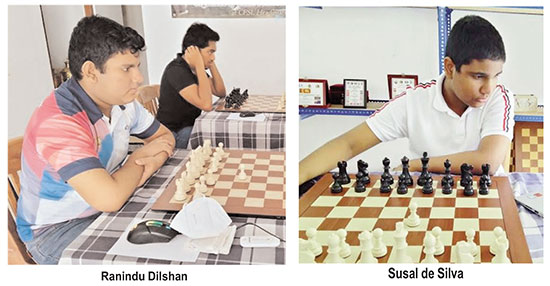
Susal de Silva, Theekshana Denuwan and Ranindu Dilshan scored half a point each as they drew their fourth round games on day four of the Asian Continental Hybrid Chess Event on Monday.

In the championship played on the Tornelo platform FIDE Master L.M.S.T. de Silva of Nalanda College started off with an early draw against Kazakhstan International Master Assaubayeva Bibisara.

Theekshana Denuwan of Ananda College earned a half a point when he drew with Marticio Jerramy(1695) of Philippines.

National Champion Ranindu Dilshan Liyanage of Ananda College scored half a point against strong Grand Master Batchuluun Tsegme from Mongolia in a marathon game of almost five hours. In the first round also he defeated a Grand Master.

Meanwhile Minul Doluweera suffered defeat at the hands of Women Grandmaster Gulmira Davuleova from Kazakhstan.

This Championship is organized by the Asian Chess Federation and games are played under the hybrid method via the Tornelo platform. At the end of round four, five Grand Masters, Xu Yinglun and Lu Shanglei both from China, Yakubboev Nodribek of Uzbekistan, Temur Kuybokarov of Australia and Gaem Maghami of Iran shared the lead scoring three and half points each. With the better tie-breaks, the Chinese Grand Master secured the top spot.

The fifth round of the championship was scheduled for yesterday.



Continue Reading
Click to comment

Leave a Reply

Your email address will not be published. Required fields are marked *

Sports

Sri Lanka’s fans, its establishment, and the growing distance between them

Published

on

By

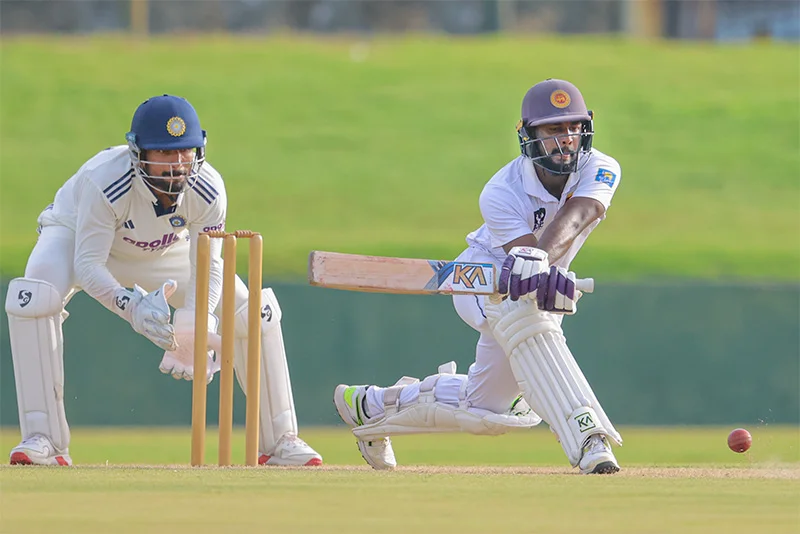
The Khettarama faithful had plenty to cheer until New Zealand's seventh-wicket stand got going [Cricinfo]

As Sri Lanka were tanking their must-win Super Eights match of the men’s T20 World Cup 2026 at Khettarama, fans in a packed Khettarama stadium began ironically chanting for New Zealand.

Irony tends to come naturally to Sri Lanka fans, like sarcasm, and self-deprecation, as well as supporting other teams now, because for 12 years no senior national side from Sri Lanka has made a global tournament final, and if you like watching cricket you have no choice but to find another outlet for your hopes. “I’m happy, obviously,” said one woman leaving Khettarama when she was asked how she felt after Sri Lanka’s humbling at the hands of New Zealand. “Why, I’m a New Zealand supporter, no?” She and her group were decked out in Sri Lanka gear and she was speaking entirely in Sinhala. She laughed as she slipped out of frame.

Sri Lanka fans could switch off cricket entirely. This would be the rational choice. And yet they are helplessly, addictedly, devoted.

Other sports, bless them, have tried to break through on the island. As a spectator experience, Premier League football has infiltrated the urban English-speaking classes, but on the playing front Sri Lanka’s own football remains as modestly-supported as it has always been. Rugby – always popular among Sri Lanka’s wealthy – had a flutter in the 21st century, when it was patronised by the once-powerful Rajapaksa political dynasty. But its fandom mostly remains locked in the higher echelons of Sri Lankan society.

On almost any journey through Sri Lanka, you are likely to find 50 softball cricket games to every tap-rugby or football match. You’ll find kids who can mimic Jasprit Bumrah’s action, but don’t so much as know who Cristiano Ronaldo or Richie McCaw is. Cricket is, without question, the game of Sri Lanka’s masses.

Through the course of the three successive Sri Lanka defeats that saw them crash out of the World Cup, many Sri Lanka fans claimed to television news reporters that they will never spend money to come to another match as they angrily left stadiums. Social media was rife with disavowals of Sri Lankan cricket.

But we have the long-view data on Lankan fans. Whenever the men start to win, the stadiums pack out. When in 2024, the women made a charge to the Asia Cup final,  a raucous full house exulted in Dambulla when they won. In this tournament, a single win over Australia was enough for Sri Lanka fans to buy out all three of their Super Eight fixtures.

Where West Indies’ decline in the longer formats has partially been put down to the infiltration of American sports in the Caribbean, Sri Lanka’s public loves cricket to such an extent that it has shown no serious ambition to develop an alternative passion. Their problem is there is no way to turn their anger at the national teams’ failures into change at the administrative level. They have no means through which to hold this system accountable.

****

Sri Lankan cricket’s financial reality is that on a global scale, a country of 22 million (the population is possibly shrinking) barely registers in comparison to its neighbours’ economic heft. This is especially true in the last few years, when Sri Lanka has run into cataclysmic economic trouble, the 2022 meldtown depressing advertising revenues for years.

But geographically the island sits in the most-profitable time zone for cricket. Broadcasters know that even if the Sri Lankan market is limited, they can sell ads from Sri Lanka matches in Indian prime time, where revenue streams are strong. Sri Lanka’s cricket board has been awake to this shift in the past dozen years, and now understands that it is foreign viewership that generates the majority of its income. This is partly why, over the last several years, Sri Lanka Cricket (SLC) has leapt into the lap of the BCCI, when as recently as 2014, SLC had been a dissenter to the Big Three programme at the ICC. Looking after the home market is useful, if only to maintain the perception of cricketing health to a global audience. But it is the neighbour who looks after the bottom lines.

This dynamic lets SLC treat Sri Lankan cricket with surprising disdain. Take their extraordinary suspension from the ICC in late 2023,  for instance. Soon after Sri Lanka’s men crashed out of the 2023 World Cup, SLC president Shammi Silva had asked for his own board to be temporarily be cast out by the ICC due to political intereference, in order to win a domestic battle against then sports minister Roshan Ranasinghe. Silva never admitted that he himself had asked for the suspension, but he never denied it either, joking only that if his powers of diplomacy were so impressive, he deserves a higher position than just Sri Lanka cricket’s head honcho.

That this move cost Sri Lanka hosting rights to the Under 19 Men’s World Cup in early 2024 caused little distress at the board, but did create problems for Sri Lanka’s Under-19 cricketers, who had trained for months for a home World Cup, only to have to eventually travel to South Africa for the event. The Sri Lankan spectators that may have turned up to this World Cup were barely an afterthought. Local businesses also had potential revenue whisked away. But in having the sports minister sacked through the course of all this high-level hijinx, SLC achieved its major objective, however.

There is also the Lanka Premier League (LPL) in which, incredibly, home audiences have also been an afterthought.  What is supposed to be SLC’s flagship T20 product has been little more than franchise-owner roulette, owners almost uniformly uninterested in sticking around for more than a couple of seasons, and even less bothered with developing local fanbases, as any number of IPL, or PSL teams have done.

In the first season of the LPL, Jaffna Stallions had begun to engage fans in the northern city which for decades had been cut off from Sri Lankan cricket by war. By the beginning of the next season, Stallions – who had won the first tournament – had been tossed out by SLC largely for business reasons with a higher bidder poised to come in. The Dambulla franchise has been Dambulla Viiking one year, Dambulla Giants the next, Dambulla Aura for two years, then rebranded as Dambulla Thunders until one of its potential owners was arrested under Sri Lanka’s sports corruption law, and then Dambulla Sixers the last time the LPL was played.

Building a tournament brand season-on-season, ensuring a high level of competition through which players may hone skills, attracting quality overseas talent both on the coaching and playing fronts – these are all secondary and tertiary considerations to picking up the next franchise cheque. This tournament has now not been played since July 2024, SLC’s official reason for cancelling it in 2025 having been the unavailability of grounds, which were getting upgrades ahead of this T20 World Cup. Even by SLC’s own logic this is an admission of dizzying incompetence. SLC had known it was hosting this World Cup years ago. On top of which, canceling the nation’s top men’s T20 competition precisely in the same season the team is due to compete in a home World Cup is almost glorious in its stupidity.

Among the public, the Sri Lankan board has long been among the most reviled public-facing institutions in the country, a consensus having developed that SLC is little more than a den of sycophants and profiteers, and that only root-and-stem removal will bring lasting positive change. But why should their ire matter to the board?

In fact, stadium upgrades were not the real reason for the LPL’s cancellation – grounds at Khettarama and Pallekele did not require substantial overhauls, and venues in Dambulla and Hambantota (which were not used in this T20 World Cup, but have both hosted LPL games in the past), were unused in any case. The real reason for its cancellation is perhaps more embarrassing: the tournament’s brand had become so toxic, that it was struggling to attract even the substandard franchisees it had previously drawn. No firm dates have been announced for a 2026 LPL.

SLC has also crowed about its financial health over the past several years, publishing audited accounts while holding press conferences to advertise its solvency. And yet the men’s Test team has only four matches on its schedule this year. The women’s team (who while the men have crashed out of the World Cup, have just won a bilateral series in the Caribbean), had also seen their schedule obliterated during the Covid-19 years, Sri Lanka’s one remaining superstar cricketer – Chamari Athtapaththu – losing 24 prime run-making months from her career.

In the 12 years since a senior Sri Lanka team last reached the knockouts of an ICC final (the men didn’t even qualify for last year’s Champions Trophy), there has been significant turnover in coaching personnel – Marvan Atapattu, Graham Ford, Chandika Hathurusingha, Mickey Arhtur, Chris Silverwood, and now Sanath Jayasuriya now all having failed in various attempts to return the men’s side to a modicum of its former glory. In that stretch, Sri Lanka has had at least 10 T20I captains, ranging from Lasith Malinga, to Charith Asalanka, to Angelo Mathews, to Kusal Mendis. Selectors, like players, have been tried and discarded.

At the highest levels of the board, Silva is currently serving his fourth consecutive term as president of SLC, having been voted in uncontested yet again by a compliant body of members. The board’s key positions continue to be filled by Silva loyalists, while CEO Ashley de Silva has been in situ for more than a decade.

Among the public, the Sri Lankan board has long been among the most reviled public-facing institutions in the country, a consensus having developed that SLC is little more than a den of sycophants and profiteers, and that only root-and-stem removal will bring lasting positive change. But why should their ire matter to the board? Even on the financial front, the local cricket supporter is increasingly irrelevant to Sri Lanka’s cricketing governance.

****

“No matter how we as cricketers try to stay positive, there is negativity outside” said Sri Lanka captain Dasun Shanaka, after his team collapsed against New Zealand and became the first Super Eight team to be eliminated from the T20 World Cup. “That’s a big loss for Sri Lankan cricket. This is the only sport we have, and I don’t know if we’ll be able to protect it. If you look outside the stadium, you’ll see how many people are standing outside with mics, and people will say stuff without having watched the match.”

Having complained about how fans were treating the team, he went on to make a suggestion that was astoundingly tone-deaf: “We will play and leave, but if for the players who will come in the future, if the government can even stop it [the negativity] that’s better for their mental health.”

Shanaka is merely the latest log to be fed into the woodchipper of Sri Lankan cricket, so perhaps his comments do not deserve to be taken especially seriously, particularly as Sri Lanka cricketers face significantly fewer challenges in their day-to-day lives than do cricketers elsewhere in South Asia, and the media environment is not especially malicious by global standards. But the comments do reveal something else: so long has the men’s team been in decline, that some players have begun to develop loathing towards their own supporters.

Supporters, meanwhile, have also begun to clock that top cricketers’ lifestyles – often as advertised on social media – are out of step with their achievements for the national side. Comments sections bear this out. A classic top comment on a player’s post about the restaurant he visited, or a watch he has just bought might go, in Sinhala lokka, velaavak thibunoth vitharak cricketuth poddak gahanna. Essentially: “boss if you have some time between all this, please also play some cricket”. Irony, as mentioned up top, comes naturally.

It might be simpler for all parties if they merely refused to show up to these matches. Players will still earn their salaries and match fees, the source of these monies now increasingly foreign, particularly if they play in the leagues. SLC can continue to strike lucrative deals without having to contend with the island’s own hurting audiences.

And still, kids still race home from school to play cricket at the local ground with their friends, parents around the island still load up kit-bags into trishaws to take kids to training, and the moment either the men’s or women’s team shows even a glimmer of promise, the nation finds itself hopelessly gripped.

They will likely turn up to Pallekele for their final match of the World Cup,  having bought out the fixture soon after Sri Lanka qualified for the Super Eight. What will they do there? Hate-watch? This particular fanbase-board-cricketer dynamic is perhaps unlike anything else in the cricketing world, and in the past Pallekele crowds have not been shy to make their displeasure felt. We are in uncharted territory on this one.

Whatever happens on Saturday, both players and board will fear the crowd’s ire, because for one more night at least, the world’s eyes are here. The players will have to show up of course, but Silva, the SLC president, may not ask to be shown on television and talked about, as he often does when the team is winning. Through their unyielding affection for the game, Sri Lanka’s fans have become a thorn in the establishment’s side.

[Cricinfo]


Continue Reading

Sports

Six balls that changed the night

Published

on

By

Glenn Phillips conceded 22 runs in the 18th over [Cricbuzz]
For most of the evening, Glenn Phillips looked like the safest investment on the field.

He batted with clarity. Against spin, anything too full was driven straight, anything too short pulled with control. He finished as New Zealand’s top-scorer without appearing to force the pace.

With the ball, he delivered a crucial breakthrough. Harry Brook looked to make room but Phillips, bowling his offbreaks from round the wicket, drifted the ball away. It meant the shot travelled much straighter into the hands of long-off instead of much squarer, where Brook’s intention had been to clear the 62-metre boundary.

Minutes later, Phillips sprinted in from the deep and dived forward to take a low catch inches above the turf. It was sharp, instinctive, and got rid of Jacob Bethell, who was set and posing a threat.

It felt like the making of one of those complete T20 nights for Phillips, the kind where one player seems to sit at the centre of the action and the game appears to move in rhythm with him. Runs, wickets, catches. Influence in every phase.

Then came the inflection point.

England needed 43 from three overs. The decision to hand Phillips the ball was not casual. It was a call built on evidence gathered through the evening. The pitch had rewarded spin. England had bowled 16 overs of it in the first innings, the most they have sent down in a T20I, and had even turned to Will Jacks for the 18th over earlier in the night, when he removed Phillips. The match had already shown how a part-time offspinner could tilt its direction.

With two right-handers at the crease, Phillips’ offbreaks would spin into them and, in theory, invite hits to the longer part of the ground, where batters had been caught in the deep. The dimensions mattered. The surface mattered. The match-ups mattered. It was the sort of decision that feels right in the moment because it has logic layered into it.

There were fewer obvious alternatives than hindsight suggests. Ish Sodhi had already conceded 21 in two overs. The seamers had been used in defined bursts and had not found exaggerated assistance at the death in the previous match on this strip. In fact, Sri Lanka had bowled three of the last four overs with pace and paid the price, with Santner putting the bowlers to the sword over the short boundary.

Santner’s thinking was about control and geometry, about forcing England to hit against the turn and into the bigger side of the ground, about backing the bowler who had influenced the night in multiple ways already.

“Yeah, I guess the toss-up was whether you bowled seam at some stage,” the New Zealand captain later said. “In the first innings, obviously, Brookie (Brooks) in England bowled a lot of seam at the end as well, and I guess it probably wasn’t doing as much as it was the other night, where we bowled a lot of spin. It was still obviously a challenging wicket, but yeah, you can always look at those things in hindsight.”

For a brief moment, it felt aligned with the script. Rehan Ahmed, playing his first-ever match in a T20 World Cup, charged down the track and wasn’t quite to the pitch of the ball, but managed to clear long-on. It was not just six runs. It shifted the mood. Will Jacks sensed it.

“I think that ball that Rehan hit, a six-second ball, that gave me energy as well,” Jacks said. “And I thought, right, we’ve got a chance here. And then obviously I finished over 6-4-4, and we were on. I think small moments like that is so important and not just the runs but the way it happens, hitting a big six and really showing the bowler that you’re on here and we believe that we can win this is really crucial and from that moment I think the mindset changed,” Jacks said.

22 runs came off Phillips’ over. 6, 4, 4 to close it from Jacks. The required rate shrank. The belief grew.

The defining image of Phillips’s night is not the dismissal of Brook or the catch to remove Bethell. Or of looking untroubled even against the guile of Adil Rashid on a slow pitch assisting big turn. Instead, it of Jacks standing tall and hitting straight, once over the larger boundary and again with enough conviction to make field settings feel secondary.

“I think as soon as he came in, we needed 12, maybe 13 and over, so we knew we had to put some impetus into the game,” Jacks said. “Even though there was a big side, we knew off spin to us was a good matchup and we had to take a risk there, knowing Santner was probably going to bowl the next over and it might be harder. And then that 19th over, the second-to-last ball, I said to him, I’ll get a single here and you have a free hit. And that six, obviously, needing five off the last over. It’s pretty much won us the game and that’s brilliant.

“That 18th over was a massive turning point, but you still have to do a lot of work to get to that point,” Jacks added.

Santner did not retreat from the logic. “GP [Glenn Phillips] bowled a good length and he charged and he wasn’t quite there, but great swing of the bat, goes for six,” he said. “And then you’re kind of thinking, is that the option or should I change or with the big boundary it was still trying to get hit to that side and then you could probably think about changing the field a little bit but it’s again it’s even Jacksey absolutely smoking that one just for six over the big side.

“On another day, that could be called or that’s the options we want them to take. Obviously, square was the bigger boundary versus straight. So I think as a bowler, it’s how do you keep getting it square versus down the ground,” Santner added.

Tim Seifert, who stood behind the stumps and watched the over unfold, put it bluntly: “You’ve got to take your hats off. One of them went straight over that big boundary. Sometimes you’ve got to tip your head.”

For 37 overs, Glenn Phillips had influenced the match in small, decisive ways. In the 38th, one over, built on a decision that made sense at the time, was met by three shots that were struck cleaner. In T20 cricket, that is often the difference.

[Cricbuzz]

Continue Reading

Latest News

Pakistan face stiff but straightforward equation for semi-final qualification

Published

on

By

Will Khawaja Nafay get a game?

Pakistan’s habitual desperate net-run-rate calculations towards the tail-end of a group stage have thrown up another classic. In what is a dead-rubber for already-eliminated hosts Sri Lanka, Pakistan have been given a faint shot at staying alive in the T20 World Cup,  thanks to a surprise comeback win for England over New Zealand. New Zealand boast a vastly superior net run rate (1.390) to Pakistan’s (-0.461), so for Salman Agha’s men to progress to the semi-finals, they must win today [Saturday]  by around 64 runs, or chase any Sri Lankan target in about 13.1 overs. Those, for Pakistan, are the only numbers that matter in Pallekele.

That should, in theory, change the somewhat conservative approach they have taken through the middle overs. Frankly put, Babar Azam’s place in this T20I set-up was getting hard enough to argue for in regular T20I circumstances, but within these constraints is borderline unjustifiable. He, however, is not the only player whose strike-rate ceiling is limited, with captain Salman Agha similarly struggling this tournament, and indeed over the broader span of his T20I career.

However, Pakistan are yet to show any evidence of an ability to rack up a win of that sort of scale at this tournament so far. Indeed, Pakistan have never won by that margin against a Full Member at a T20 World Cup when batting first, and only once – in 2009 – when chasing. The slower surfaces of Sri Lanka compared to the flatter pitches in India make a path to such a victory more complicated, as does a Pakistani middle order that doesn’t boast elite power hitting, and Saim Ayub’s faltering form. But it’s a chance nonetheless, and at ICC events, sometimes that’s all Pakistan ask for.

There’s little other than pride at stake for Sri Lanka, whose tournament started with such promise, only to peak and fall away after a glorious win over Australia. They have lost their last three matches, and were the first side to be knocked out in the Super Eight. Pakistan’s qualification scenarios mean little to them, and they’ll want to demonstrate they are more than foil for Pakistani glory, or a roadblock to their progression.

The story, though, is of what Pakistan can possibly achieve, and whether they can thwart New Zealand’s progress to yet another ICC tournament semi-final.

A lot of Sri Lankan players will invariably be moved on after this T20 World Cup, but one who is set to form the core of the side for the next generation is Dunith Wellalage. The 23-year old left arm spinner’s competitive attitude makes him one of a short list of Sri Lankan players to have come out of this tournament with his reputation bolstered, and he has an ever-improving skill-set to go with it. He is yet to play a T20I against Pakistan, having missed their Asia Cup clash, flying home for a family bereavement. But with a surfeit of right-hand batters in Pakistan’s top order, he could find himself deployed early on as he was against New Zealand, perhaps to nip Sahibzada Farhan in the bud at the outset.

Salman Agha should perhaps be under more scrutiny than he is, having endured an indifferent tournament with the bat and an uninspiring one as captain. The questions swirling around his fitness for the format will only intensify after he let games drift with the ball against India and England, while his attempted aggression with the bat at No. 3 continues to feel feigned rather than organic. He has scored 60 runs in five innings at this tournament, 38 in one innings against Namibia. If Pakistan exit tamely, it is hard to envision him hanging on to the armband, and perhaps even his role in the side. However, Saturday perhaps represents one final chance for him to take control of his destiny.

Sri Lanka faced plenty of criticism for their meek capitulation against New Zealand, but as the tournament closes out, wholesale changes are not likely. Kusal Mendis suffered hamstring stiffness against New Zealand and is unlikely to play, with Kamil Mishara returning as wicketkeeper-batter.

Sri Lanka (probable): Pathum Nissanka, Kamil Mishara (wk), Charith Asalanka,  Pavan Rathnayake,  Kamindu Mendis, Dasun Shanaka (capt), Dushan Hemantha, Dunith Wellalage,  Dushmantha Chameera, Maheesh Theekshana,  Dilshan Madushanka

Shaheen Afridi’s performance against England makes it likely he will keep his spot. If Pakistan are to stick to two specialist seamers on this surface, it makes it a straight shootout between Naseem Shah and Salman Mirza. What’s less certain is how the equation changes Pakistan’s batting line-up. So far, they have been reluctant to drop Babar Azam, or play Khawaja Nafay. Any caution needs to go out of the window as they battle to stay alive.

Pakistan (probable): Sahibzada Farhan, Saim Ayub, Salman Agha (capt),  Babar Azam/Khawaja Nafay, Fakhar Zaman,  Shadab Khan,  Usman Khan (wk), Mohammad Nawaz/Faheem Ashraf, Shaheen Afridi,  Salman Mirza/Naseem Shah,  Usman Tariq

[Cricinfo]

Continue Reading

Trending