
Foreign News
How dark web agent spotted bedroom wall clue to rescue girl from years of harm

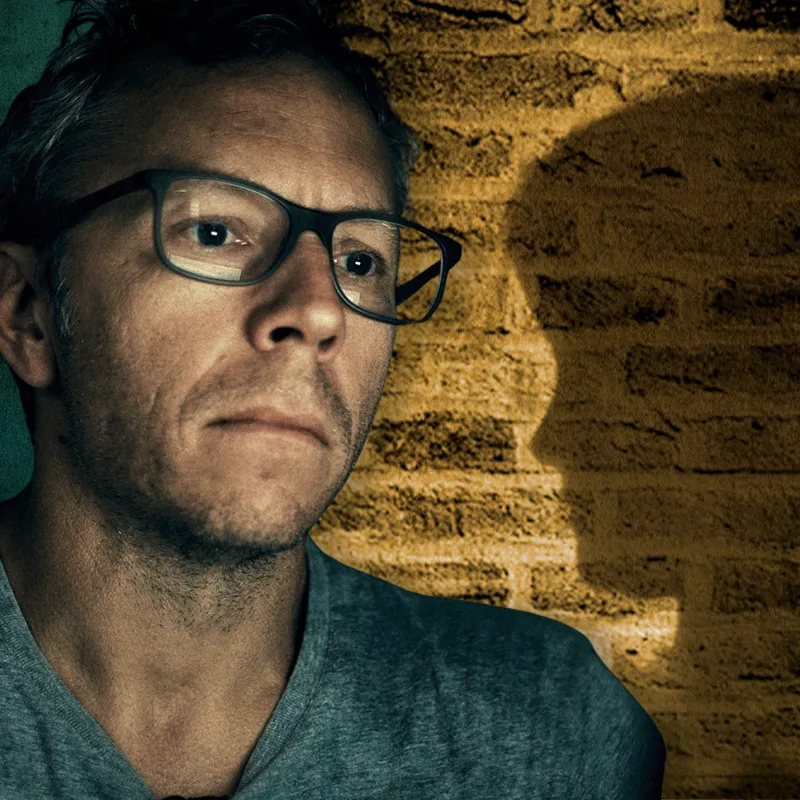
Specialist online investigator Greg Squire had hit a dead end in his efforts to rescue an abused girl his team had named Lucy.
Disturbing images of her were being shared on the dark web – an encrypted corner of the internet only accessible using special software designed to make owners digitally untraceable.
But even with that level of subterfuge, the abuser was conscious of “covering their tracks”, cropping or altering any identifying features, says Squire. It was impossible to work out who, or where, Lucy was.
What he was soon to discover was that the clue to the 12-year-old’s location was hidden in plain sight.
Squire works for US Department of Homeland Security Investigations in an elite unit which attempts to identify children appearing in sexual abuse material.
A BBC World Service team has spent five years filming with Squire, and other investigative units in Portugal, Brazil, and Russia – showing them solving cases such as that of a kidnapped and presumed-dead seven-year-old in Russia, and the arrest of a Brazilian man responsible for five of the biggest child-abuse forums on the dark web.
The unprecedented access shows how these cases are often cracked, not through state-of-the-art technology, but by spotting tiny revealing details in images or chat forums.
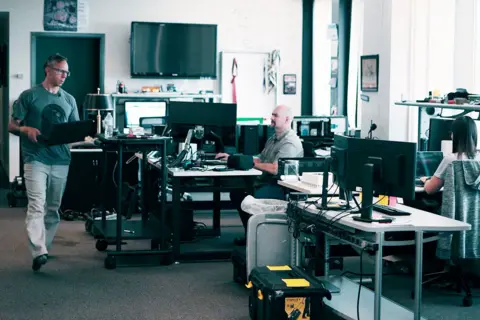
Squire cites Lucy’s case, which he tackled early in his career, as the inspiration for his long-term dedication.
He found it especially disturbing that Lucy was about the same age as his own daughter, and new photos of her being assaulted, seemingly in her bedroom, were constantly appearing.
Squire and his team could see, from the type of light sockets and electrical outlets visible in the images, that Lucy was in North America. But that was about it.
They contacted Facebook, which at the time dominated the social media landscape, asking for help scouring uploaded family photos – to see if Lucy was in any of them. But Facebook, despite having facial recognition technology, said it “did not have the tools” to help.
So Squire and his colleagues analysed everything they could see in Lucy’s room: the bedspread, her outfits, her stuffed toys. Looking for any element which might help.
And then they had a minor breakthrough. The team discovered that a sofa seen in some of the images was only sold regionally, not nationally, and therefore had a more limited customer base.
But that still amounted to about 40,000 people.
“At that point in the investigation, we’re [still] looking at 29 states here in the US. I mean, you’re talking about tens of thousands of addresses, and that’s a very, very daunting task,” says Squire.
The team looked for more clues. And that is when they realised something as mundane as the exposed brick wall in Lucy’s bedroom could give them a lead.
“So, I started just Googling bricks and it wasn’t too many searches before I found the Brick Industry Association,” says Squire.
“And the woman on the phone was awesome. She was like, ‘how can the brick industry help?'”
She offered to share the photo with brick experts all over the country. The response was almost immediate, he says.
One of the people who got in touch was John Harp, who had been working in brick sales since 1981.
“I noticed that the brick was a very pink-cast brick, and it had a little bit of a charcoal overlay on it. It was a modular eight-inch brick and it was square-edged,” he says. “When I saw that, I knew exactly what the brick was,” he adds.
It was, he told Squire, a “Flaming Alamo”.
“Our company made that brick from the late 60s through about the middle part of the 80s, and I had sold millions of bricks from that plant.”

Initially Squire was ecstatic, expecting they could access a digitised customer list. But Harp broke the news that the sales records were just a “pile of notes” that went back decades.
He did however reveal a key detail about bricks, Squire says.
“He goes: ‘Bricks are heavy.’ And he said: ‘So heavy bricks don’t go very far.'”
This changed everything. The team returned to the sofa customer list and narrowed that down to just those clients who lived within a 100-mile radius of Harp’s brick factory in the US’ south-west.
From that list of 40 or 50 people, it was easy to find and trawl their social media. And that is when they found a photo of Lucy on Facebook with an adult who looked as though she was close to the girl – possibly a relative.
They worked out the woman’s address, and then used that to find out every other address connected with that person, and all the people they had ever lived with.
That narrowed Lucy’s possible address down further – but they didn’t want to go door to door, making enquiries. Get the address wrong, and they could risk the suspect being tipped off that he was on the authorities’ radar.
So Squire and his colleagues began sending photos of these houses to John Harp, the brick expert.

Flaming Alamos were not visible on the outside of any of the homes, because the properties were clad in other materials. But the team asked Harp to assess – by looking at their style and exterior – if these properties were likely to have been built during a period when Flaming Alamos had been on sale.
“We would basically take a screenshot of that house or residence and shoot it over to John and say ‘would this house have these bricks inside?'” says Squire.
Finally they had a breakthrough. They found an address that Harp believed was likely to feature a Flaming Alamo brick wall, and was on the sofa customer-base list.
“So we narrowed it down to this one address… and started the process of confirming who was living there through state records, driver’s licence… information on schools,” says Squire.
The team realised that in the household with Lucy was her mother’s boyfriend – a convicted sex offender.
Within hours, local Homeland Security agents had arrested the offender, who had been raping Lucy for six years. He was subsequently sentenced to more than 70 years in jail.
Brick expert Harp was delighted to hear Lucy was safe, especially given his own experiences as a long-term foster parent.
“We’ve had over 150 different children in our home. We’ve adopted three. So, doing that over those years, we have a lot of children in our home that were previously abused,” he said.
“What Squire’s team do day in and day out, and what they see, is a magnification of hundreds of times of what I’ve seen or had to deal with.”
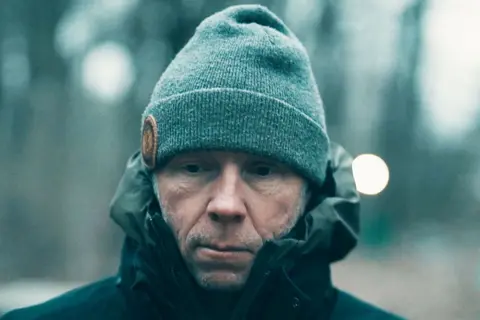
A few years ago, that pressure on Squire started to take a real toll on his mental health, and he admits that, when he wasn’t working, “alcohol was a bigger part of my life than it should have been”.
“At that point my kids were a bit older… and, you know, that almost enables you to push harder. Like… ‘I bet if I get up at three this morning, I can surprise a perpetrator online.’
“But meanwhile, personally… ‘Who’s Greg? I don’t even know what he likes to do.’ All of your friends… during the day, you know, they’re criminals… All they do is talk about the most horrific things all day long.”
Not long afterwards, his marriage broke down, and he says he began to have suicidal thoughts.
It was his colleague Pete Manning who encouraged him to seek help after noticing his friend seemed to be struggling.

“It’s hard when the thing that brings you so much energy and drive is also the thing that’s slowly destroying you,” Manning says.
Squire says exposing his vulnerabilities to the light was the first step to getting better and continuing to do a job he is proud of.
“I feel honoured to be part of the team that can make a difference instead of watching it on TV or hearing about it… I’d rather be right in there in the fight trying to stop it.”
Last summer Greg met Lucy, now in her 20s, for the first time.

She told him her ability to now discuss what she went through was testament to the support she has around her.
“I have more stability. I’m able to have the energy to talk to people [about the abuse], which I could not have done… even, like, a couple years ago.”
She said at the point Homeland Security ended her abuse she had been “praying actively for it to end”.
“Not to sound cliché, but it was a prayer answered.”
Squire told her he wished he had been able to communicate that help was on its way.
“You wish there was some telepathy and you could reach out and be like, ‘listen, we’re coming’.”
The BBC asked Facebook why it couldn’t use its facial recognition technology to assist the hunt for Lucy. It responded: “To protect user privacy, it’s important that we follow the appropriate legal process, but we work to support law enforcement as much as we can.”
[BBC]

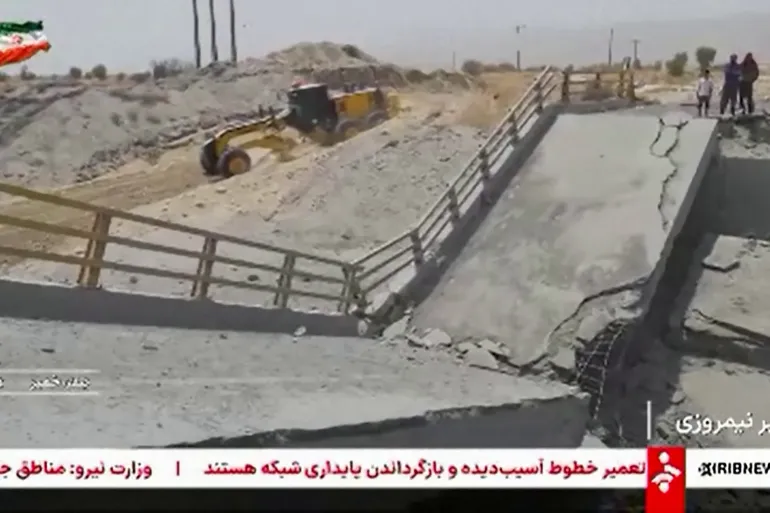
A seventh consecutive night of attacks by United States forces on targets across Iran has left 10,000 people without water after a desalination plant was hit, with Iran retaliating by launching another wave of drones and missiles at US-allied Gulf states.
Hamzeh Pour, chief executive of the Hormozgan Water and Wastewater Company, was quoted by the Tasnim news agency on Saturday as saying that a seawater pumping station and a power transformer at the Bunji desalination plant in Jask in southern Iran were “completely destroyed”, depriving 20 villages of water.
Iran’s retaliation also targeted civilian infrastructure, a war crime under international humanitarian law.
In the early hours of Saturday, Kuwait announced the closure of its airspace and said two power and water desalination plants were hit by Iranian attacks. Several Kuwaiti firefighters were wounded while responding to a fire sparked by the strikes, the country’s firefighting force said.
Air raid sirens also sounded repeatedly in Bahrain, where authorities urged residents to seek shelter.
In Jordan, authorities said they intercepted 10 Iranian ballistic missiles.
Iran’s Islamic Revolutionary Guard Corps (IRGC) said its naval forces had targeted a US military fuel pier at Kuwait’s al-Ahmadi port and a US warplane assembly site at Bahrain’s Sheikh Isa Air Base. The IRGC also said it attacked a US base in Azraq in Jordan, claiming to have destroyed two American fighter jets.
The Iranian attacks came after the US military’s Central Command, or CENTCOM, announced it had carried another wave of overnight strikes targeting “surveillance sites, military logistics infrastructure, underground weapons storage, and maritime capabilities” in Iran.
[Aljazeera]
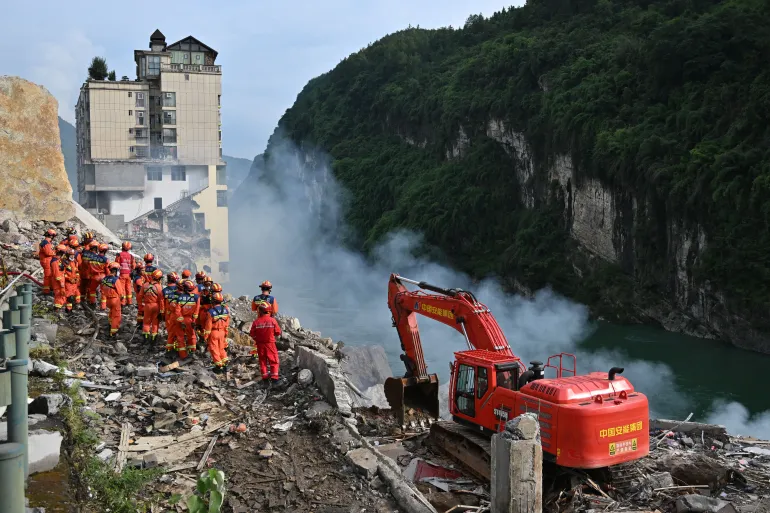
Rescuers are rushing to locate dozens of people missing in the southwestern Chinese city of Chongqing, after a deadly landslide buried homes in the area, according to Chinese authorities.
The landslide took place around 9:10am (01:10 GMT) on Friday in Chongqing’s Pengshui county, killing eight people, leaving 34 unaccounted for and displacing more than 1,100, reported state media.
Footage shared by China’s CCTV broadcaster showed a huge buildup of rocks and dirt covering part of a residential and commercial street at the bottom of a mountain in the region.
Ten people have been rescued from the debris, including two who are seriously injured, reported China’s state-run Xinhua news agency.
Water, electricity and gas supplies were cut off within a one-kilometre (0.6-mile) radius of the landslide to prevent further disruptions. More than 800 rescuers have gone to the site, reported CCTV.

Authorities said they sent more than 8,000 disaster relief items to Chongqing, including tents, folding beds and family emergency kits.
Pengshui county is located in the southeast part of Chongqing, bordering the provinces of Hubei and Guizhou.
The area where the landslide happened is known for “unpredictable” steep terrain, a local official told a news conference, adding that dangerous rocks remain along the sides of the cliff.
The government has allocated 50 million yuan ($7.36m) in natural disaster relief funds to support the rescue and relief operations and to provide assistance to affected residents, the Ministry of Finance and the Ministry of Emergency Management said.
[Aljazeera]

Almost 5,000 people are known to have died in two earthquakes that devastated Venezuela in June, but the United Nations estimates that as many as 50,000 people may still be missing – with many feared buried under rubble.
The number of confirmed deaths is now higher at 4,930, lawmaker Jorge Rodriguez announced on Thursday
The disaster almost a month ago impacted tens of thousands of others. Nearly 17,000 people are wounded, and 21,120 are living in shelters.
Venezuelan teams have been operating since the earthquake struck, but locals say their response has been slow.
“From the very first moment, from when the earthquake happened, there was an immediate response, but from civilians. Civilians and independent people. The state’s response is only being seen now,” Cinthia Pulido, a Venezuelan displaced by the earthquakes, told Al Jazeera. “We’re watching and waiting for some kind of answer.”
International rescue teams sent in the immediate aftermath of the disaster have left as the focus moves to providing humanitarian relief.
“The little I can get is just for me to survive, support my children, and help my mum,” Louismarez Paez, who has also been displaced, told Al Jazeera.
Her mother, she said, does not receive any assistance other than that which she herself provides.
Venezuela has ‘crucial resources’ it cannot access
Venezuela has faced tight US sanctions since 2015, which experts say is making the government’s job even harder.
“Venezuela has crucial resources that it is not being allowed to access,” Mark Weisbrot, senior economist and co-director at the Center for Economic and Policy Research, said.
That includes $11bn blocked by the US and European countries that Venezuela “should legally have”, Weisbrot said.
Earlier this week, a group of 14 Democratic lawmakers in the US sent a letter urging the White House to ease economic sanctions on Venezuela to aid recovery efforts, according to a report from Spanish newspaper El Pais.
The sanctions, they wrote, are “severely hampering urgent relief efforts” and have “severely undermined the country’s response and reconstruction efforts”.
The UN estimates that the recovery efforts in Venezuela could cost the country $37bn.
[Aljazeera]

MIWAYZ redefines Sri Lankan urban mobility with landmark launch

Iran accuses US of striking critical infrastructure as war intensifies

President meets with Department of Prisons Officials

Prioritize Vocational Education in future Education Planning – President

Davis cup Asia/Oceania Group IV 2026 to be held in Colombo from 20th to 25th July

Navy brings fisherman in distress off Pothuvil, ashore

‘Dates have the highest sugar content to fight Coronavirus’

Sunday Island 27 December – Headlines

#SundayIsland 17th December – Headlines

Sunday Island – 28th March

Sunday Island Headlines – 21 March

Sunday Island – 21st February – Headlines
-
 Features7 days ago
Prison riots and politics: NPP’s biggest challenge and Sri Lanka’s biggest opportunity
-

 Features4 days ago
Dirty Money
-

 Sports7 days ago
The banker who rescued Sri Lankan cricket
-

 Editorial7 days ago
Much ado about crime: Fish or cut bait
-

 News23 hours ago
Dengue outbreak gallops ahead: Infections surpasses 73,455, leaving 50 dead
-

 Features7 days ago
More on Saudi Arabia: ARAMCO and beyond
-

 News23 hours ago
Evidence recorded in money laundering case against Yoshitha Rajapaksa
-

 News2 days ago
Money laundering case against Yoshitha, fixed for pre-trial conference