
Foreign News
How dark web agent spotted bedroom wall clue to rescue girl from years of harm

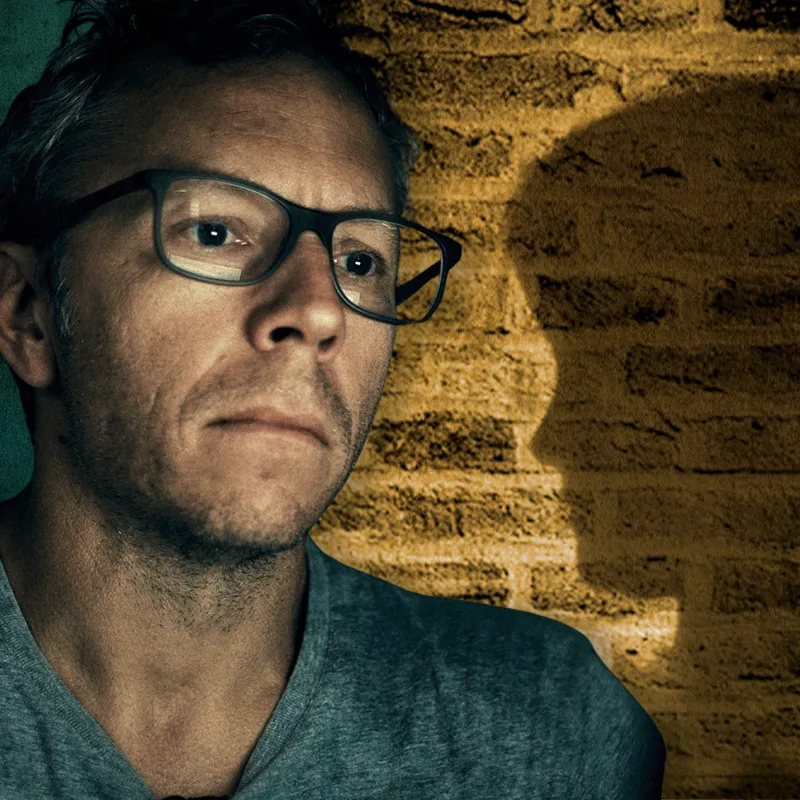
Specialist online investigator Greg Squire had hit a dead end in his efforts to rescue an abused girl his team had named Lucy.
Disturbing images of her were being shared on the dark web – an encrypted corner of the internet only accessible using special software designed to make owners digitally untraceable.
But even with that level of subterfuge, the abuser was conscious of “covering their tracks”, cropping or altering any identifying features, says Squire. It was impossible to work out who, or where, Lucy was.
What he was soon to discover was that the clue to the 12-year-old’s location was hidden in plain sight.
Squire works for US Department of Homeland Security Investigations in an elite unit which attempts to identify children appearing in sexual abuse material.
A BBC World Service team has spent five years filming with Squire, and other investigative units in Portugal, Brazil, and Russia – showing them solving cases such as that of a kidnapped and presumed-dead seven-year-old in Russia, and the arrest of a Brazilian man responsible for five of the biggest child-abuse forums on the dark web.
The unprecedented access shows how these cases are often cracked, not through state-of-the-art technology, but by spotting tiny revealing details in images or chat forums.
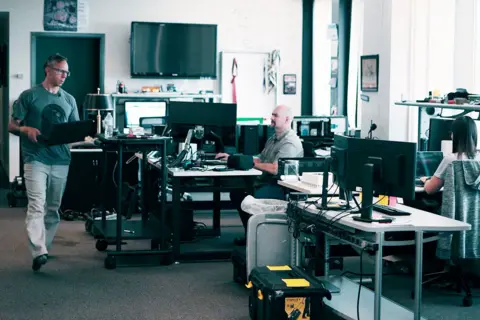
Squire cites Lucy’s case, which he tackled early in his career, as the inspiration for his long-term dedication.
He found it especially disturbing that Lucy was about the same age as his own daughter, and new photos of her being assaulted, seemingly in her bedroom, were constantly appearing.
Squire and his team could see, from the type of light sockets and electrical outlets visible in the images, that Lucy was in North America. But that was about it.
They contacted Facebook, which at the time dominated the social media landscape, asking for help scouring uploaded family photos – to see if Lucy was in any of them. But Facebook, despite having facial recognition technology, said it “did not have the tools” to help.
So Squire and his colleagues analysed everything they could see in Lucy’s room: the bedspread, her outfits, her stuffed toys. Looking for any element which might help.
And then they had a minor breakthrough. The team discovered that a sofa seen in some of the images was only sold regionally, not nationally, and therefore had a more limited customer base.
But that still amounted to about 40,000 people.
“At that point in the investigation, we’re [still] looking at 29 states here in the US. I mean, you’re talking about tens of thousands of addresses, and that’s a very, very daunting task,” says Squire.
The team looked for more clues. And that is when they realised something as mundane as the exposed brick wall in Lucy’s bedroom could give them a lead.
“So, I started just Googling bricks and it wasn’t too many searches before I found the Brick Industry Association,” says Squire.
“And the woman on the phone was awesome. She was like, ‘how can the brick industry help?'”
She offered to share the photo with brick experts all over the country. The response was almost immediate, he says.
One of the people who got in touch was John Harp, who had been working in brick sales since 1981.
“I noticed that the brick was a very pink-cast brick, and it had a little bit of a charcoal overlay on it. It was a modular eight-inch brick and it was square-edged,” he says. “When I saw that, I knew exactly what the brick was,” he adds.
It was, he told Squire, a “Flaming Alamo”.
“Our company made that brick from the late 60s through about the middle part of the 80s, and I had sold millions of bricks from that plant.”
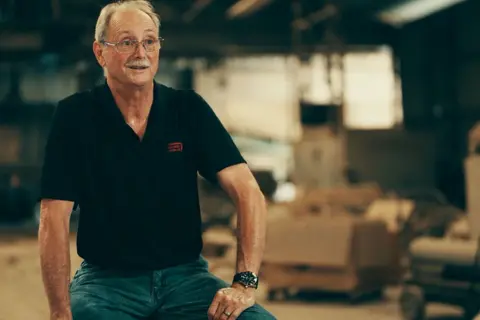
Initially Squire was ecstatic, expecting they could access a digitised customer list. But Harp broke the news that the sales records were just a “pile of notes” that went back decades.
He did however reveal a key detail about bricks, Squire says.
“He goes: ‘Bricks are heavy.’ And he said: ‘So heavy bricks don’t go very far.'”
This changed everything. The team returned to the sofa customer list and narrowed that down to just those clients who lived within a 100-mile radius of Harp’s brick factory in the US’ south-west.
From that list of 40 or 50 people, it was easy to find and trawl their social media. And that is when they found a photo of Lucy on Facebook with an adult who looked as though she was close to the girl – possibly a relative.
They worked out the woman’s address, and then used that to find out every other address connected with that person, and all the people they had ever lived with.
That narrowed Lucy’s possible address down further – but they didn’t want to go door to door, making enquiries. Get the address wrong, and they could risk the suspect being tipped off that he was on the authorities’ radar.
So Squire and his colleagues began sending photos of these houses to John Harp, the brick expert.

Flaming Alamos were not visible on the outside of any of the homes, because the properties were clad in other materials. But the team asked Harp to assess – by looking at their style and exterior – if these properties were likely to have been built during a period when Flaming Alamos had been on sale.
“We would basically take a screenshot of that house or residence and shoot it over to John and say ‘would this house have these bricks inside?'” says Squire.
Finally they had a breakthrough. They found an address that Harp believed was likely to feature a Flaming Alamo brick wall, and was on the sofa customer-base list.
“So we narrowed it down to this one address… and started the process of confirming who was living there through state records, driver’s licence… information on schools,” says Squire.
The team realised that in the household with Lucy was her mother’s boyfriend – a convicted sex offender.
Within hours, local Homeland Security agents had arrested the offender, who had been raping Lucy for six years. He was subsequently sentenced to more than 70 years in jail.
Brick expert Harp was delighted to hear Lucy was safe, especially given his own experiences as a long-term foster parent.
“We’ve had over 150 different children in our home. We’ve adopted three. So, doing that over those years, we have a lot of children in our home that were previously abused,” he said.
“What Squire’s team do day in and day out, and what they see, is a magnification of hundreds of times of what I’ve seen or had to deal with.”
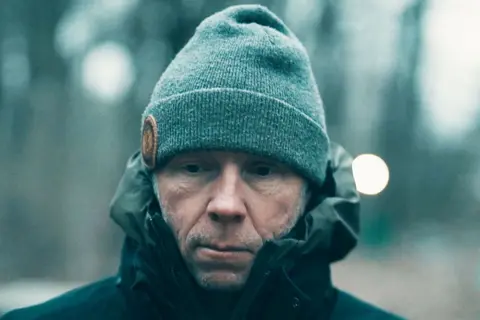
A few years ago, that pressure on Squire started to take a real toll on his mental health, and he admits that, when he wasn’t working, “alcohol was a bigger part of my life than it should have been”.
“At that point my kids were a bit older… and, you know, that almost enables you to push harder. Like… ‘I bet if I get up at three this morning, I can surprise a perpetrator online.’
“But meanwhile, personally… ‘Who’s Greg? I don’t even know what he likes to do.’ All of your friends… during the day, you know, they’re criminals… All they do is talk about the most horrific things all day long.”
Not long afterwards, his marriage broke down, and he says he began to have suicidal thoughts.
It was his colleague Pete Manning who encouraged him to seek help after noticing his friend seemed to be struggling.
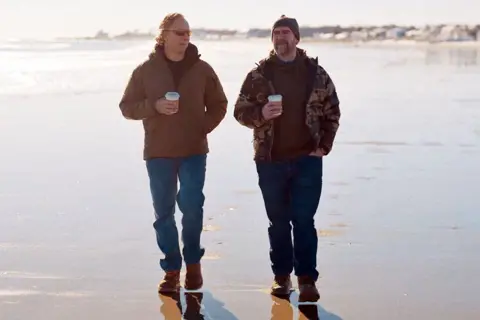
“It’s hard when the thing that brings you so much energy and drive is also the thing that’s slowly destroying you,” Manning says.
Squire says exposing his vulnerabilities to the light was the first step to getting better and continuing to do a job he is proud of.
“I feel honoured to be part of the team that can make a difference instead of watching it on TV or hearing about it… I’d rather be right in there in the fight trying to stop it.”
Last summer Greg met Lucy, now in her 20s, for the first time.
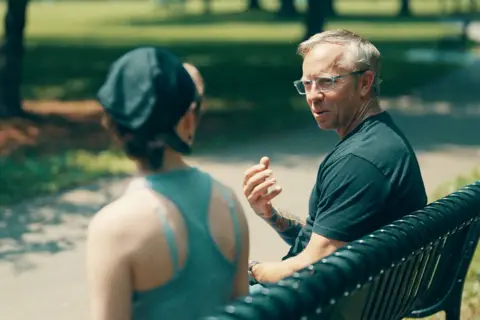
She told him her ability to now discuss what she went through was testament to the support she has around her.
“I have more stability. I’m able to have the energy to talk to people [about the abuse], which I could not have done… even, like, a couple years ago.”
She said at the point Homeland Security ended her abuse she had been “praying actively for it to end”.
“Not to sound cliché, but it was a prayer answered.”
Squire told her he wished he had been able to communicate that help was on its way.
“You wish there was some telepathy and you could reach out and be like, ‘listen, we’re coming’.”
The BBC asked Facebook why it couldn’t use its facial recognition technology to assist the hunt for Lucy. It responded: “To protect user privacy, it’s important that we follow the appropriate legal process, but we work to support law enforcement as much as we can.”
[BBC]

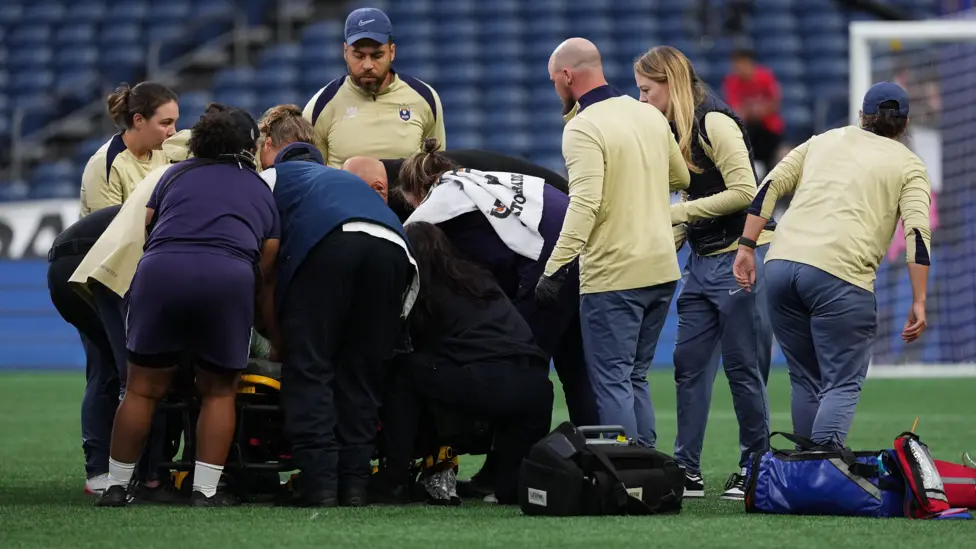
United States women’s national team player Savannah DeMelo is suing a hospital and two doctors after she suffered a cardiac arrest on the pitch last year.
Midfielder DeMelo, who has seven senior caps for the USA, has filed a lawsuit against University of Louisville Health (UofL Health) for negligence.
The 28-year-old, who plays for Racing Louisville, collapsed in the first half of a National Women’s Soccer League (NWSL) match on 14 September 2025.
According to documents seen by BBC Sport, the case was filed on Tuesday morning with Jefferson Circuit Court in Kentucky, where her club is based – a year and a day after her on-field collapse.
DeMelo’s filing claims UofL Health and two doctors, Dr Sarabjeet Suri and Dr Jennifer Daily, “failed to act as a reasonably prudent and competent medical practice, and such negligence was a substantial factor in causing DeMelo to suffer severe physical injuries, including, but not limited to, her cardiac arrest”.
Dr Daily, according to her online UofL biography, is Racing Louisville’s chief medical officer. The lawsuit states DeMelo was under the care of Dr Daily from January 2024 to July 2026.
It states that in March 2025, Dr Daily referred DeMelo to Dr Suri for “evaluation and treatment” after she had been complaining of chest pain, dizziness and shortness of air; Dr Suri obtained a history, performed a physical examination and ordered diagnostic tests.
Nearly six months later, DeMelo suffered the cardiac arrest.
“She was subsequently diagnosed and treated for ventricular tachycardia [an abnormal heart rhythm],” the suit states.
DeMelo, who has spent her entire professional career with Racing Louisville, has not played since her collapse.
In a post to her instagram page on Tuesday, De Melo – who was picked in the USA squad for the 2023 Women’s World Cup and started their first two games – marked the anniversary of the incident.
“A year ago today, while playing soccer, I collapsed due to an undiagnosed cardiac arrhythmia, that caused me to go into cardiac arrest,” she wrote.
“I respect and appreciate the privacy everyone has met me with while going through everything I have this year. I’ll never be able to fully put into words how emotionally hard this year has been. There has been a lot of uncertainty and emotions intertwined with it all.”
[BBC]

The Philippine Coast Guard says it has recovered 41 bodies from the wreckage of a ferry that caught fire this week, bringing the total death toll to 76.
More than 130 people were on board the MV June Aster when the blaze erupted on Wednesday as it neared its destination at the tourist hotspot of Coron, after departing from Manila.
The coast guard said on Saturday the number of survivors remained 43, with many receiving treatment in hospital, but 13 people remain unaccounted for.
Recovery of bodies had been hampered due to toxic fumes and lingering heat, which meant authorities were unable to board until Friday.
Geronimo Tuvilla, an official for the Philippine Coast Guard, said the priority was identifying victims and determining the cause of the blaze.
Kristine Ablana, a tourism official in Coron, said relatives were being asked to help identify family members through personal items and DNA testing.
“Once someone is able to verify that this photo or these belongings are indeed those of their relative, they will be asked to provide a DNA sample,” she said.
Coast Guard spokesperson Commodore Noemie Cayabyab said the fire began in a cargo hold before spreading.
She said survivors had described hearing a loud explosion, “the appearance of smoke and then fire. It spread very quickly”. She added that those who had made it off the ship did not have time to put on lifejackets.
A survivor who was hauled to safety on a rescue boat told the BBC he had heard frantic cries onboard when the fire erupted, and was trampled by panicked people as he tried to escape.
The ferry, built in 2002, held valid safety certificates and passed an enforcement inspection in March, but investigators are looking into potential manifest discrepancies, cargo loading integrity, and crew emergency response protocols, the Palawan Daily reported.
The vessel was carrying 117 passengers and 17 crew members.
Atienza Interisland Ferries, the vessel’s operator, has pledged full co-operation with the inquiry.
[BBC]

A dress worn by Princess Diana to a party in London hours after a documentary was televised in which the then-Prince Charles admitted to committing adultery during their marriage is going up for auction.
Her dramatic arrival at the Serpentine Gallery in 1994 in a custom-made black silk evening dress by designer Christina Stambolian became an iconic pop-culture moment.
The media dubbed her outfit the “revenge dress”.
Auction house Sotheby’s expects the dress to sell for up to £220,000 ($300,000) when it goes under the hammer on 9 December.
A press release from Sotheby’s said it is the first time the dress has been offered at auction since 1997, when the late princess sold 79 of her dresses to raise money for charities.
Morgane Halimi, Sotheby’s Global Head of Handbags and Fashion, said in a statement that Princess Diana “understood instinctively” that fashion can be a language in its own right.
“On her own terms, Princess Diana turned the dress into one of the most powerful messages she ever made, during one of the most scrutinised and emotionally charged episodes of her life,” Halimi said.
“She walked into a moment in which so much of her story was being told for her and, through what she chose to wear, reclaimed the narrative for herself.”

According to Sotheby’s, Anna Harvey, her stylist at the time, said Diana “wanted to look a million dollars”.
The princess made a last-minute wardrobe change for the fundraising dinner and chose the strapless evening dress by the Greek designer Christina Stambolian – which she accessorised with a royal jewel, a black clutch and black heels.
The vintage Jaguar XJ40 car that Diana arrived in at the event was sold at auction earlier this year for £66,250.
The revenge dress is expected to fetch a considerably higher price.
If it does, it will not be the first time an item from the princess’s wardrobe has sold for a significant sum.
Princess Diana’s sweater featuring a black sheep among rows of white ones was sold for £920,000 at an auction by Sotheby’s in New York in 2023.
[BBC]

Charani, Shafali power India past Japan and into Asian Games semi-finals

Athapaththu and Dilhari muscle Sri Lanka past Malaysia in mismatch

Abhishek Sharma hits record T20 ton as India beat Afghanistan by 127 runs

Trump administration approves sale of F-35 jets to Saudi Arabia

Banton steers England into unassailable 2-0 series lead

Showers expected in the Western, Norrh-western and Sabaragamuwa provinces and in Galle, Matara, Kandy and Nuwara-Eliya Districts.

‘Dates have the highest sugar content to fight Coronavirus’

Sunday Island 27 December – Headlines

#SundayIsland 17th December – Headlines

Sunday Island – 28th March

Sunday Island Headlines – 21 March

Sunday Island – 21st February – Headlines
-

 News6 days ago
Gnanasara Thero absconding after SC ruling
-

 Latest News7 days ago
Sri Lanka thwart Fatima Sana challenge to secure Asia Cup final spot
-

 News7 days ago
Ammunition cache found in old Kandy bungalow
-

 News7 days ago
Green Climate Fund (GCF) Regional Dialogue for East and South Asia will be held from 14 to 17 September 2026 at Cinnamon Life at City of Dreams Hotel, Colombo
-

 News7 days ago
Prof. Pieris says Buddha Dhamma recognised as source of law under Constitution
-

 Opinion5 days ago
From Galkissa (Mount Lavinia) to Tambuttegama
-

 Latest News6 days ago
ITS Giuseppe Garibaldi’ departs Colombo
-

 Business6 days ago
HNB Finance strengthens Board with four independent directors