
News
New anti-terrorism law a threat to political dissent, civil disobedience: NPC

The National Peace Council (NPC) has warned that the Protection of the State from Terrorism Act (PSTA) may allow the government to categorise acts of dissent and civil disobedience as terrorism. The NPC made its assessment pointing out that the broad definition of terrorism under the draft law may allow disproportionate and excessive responses by the state. Such provisions replicate the logic of the PTA rather than mark a clear break from it, the civil society group said.
The following is the text of the statement issued by the NPC: “The National Peace Council welcomes the government’s decision to allow a two-month period of public consultation on the proposed Protection of the State from Terrorism Act, intended to replace the Prevention of Terrorism Act. Given Sri Lanka’s long and painful experience with national security legislation, this consultation period will provide a valuable opportunity to prevent the repetition of past mistakes. Meaningful public engagement prior to the enactment of a new anti-terrorism law is essential if the promise of system change is to be realised and if Sri Lanka is to avoid entrenching yet another draconian law whose consequences may be felt for decades to come.
When in opposition and in their election manifesto, the JVP and NPP pledged to repeal repressive laws such as the PTA, citing its repeated misuse against ethnic and religious minorities, political activists and journalists. The continued application of the PTA, where individuals have been detained for prolonged periods even for non-terrorism related reasons, such as in the Eastern Province in Valachchenai over alleged forest land encroachment demonstrates how easily exceptional powers are extended to ordinary disputes.
A preliminary review of the draft PSTA indicates that it retains core features of the PTA that have enabled serious abuse over decades. These include provisions permitting detention for up to two years without a person being charged before a court of law. In addition, the broad definition of terrorism under the draft law allows acts of dissent and civil disobedience to be labelled as terrorism, thereby permitting disproportionate and excessive responses by the state. Such provisions replicate the logic of the PTA rather than mark a clear break from it.
The PTA itself was enacted as a temporary law, intended to operate for only six months, yet it has remained in force for forty six years. This history shows how difficult it is to remove national security laws once they are enacted. For this reason, special care needs to be taken with regard to the new law on two counts. The first is the observation that power corrupts. The second is that laws must protect citizens from future governments, not only the current one. Institutions and laws are designed to endure beyond the lifespan of any one government and need to safeguard the public interest when political circumstances change.
The two month consultation period on the PSTA therefore carries special responsibility. The National Peace Council urges civil society organisations, the legal community and in particular the Bar Association of Sri Lanka to study the draft law carefully, to draw on Sri Lanka’s experience and international standards, and to place their considered views before the government to incorporate in a well-balanced law. These would include provisions for speedy judicial actions to release those improperly and unfairly arrested under its provisions and compensation to those who are discharged without legal action after many months or years.”

News
China, Lanka intensify cooperation to fight cross-border crimes spreading across Asia and beyond


China and Sri Lanka have intensified joint law enforcement efforts to combat cross-border online gambling and telecom fraud, crimes that authorities warn are increasingly spreading across Asia and beyond.
The Chinese Embassy in Colombo said both countries are working closely to dismantle scam centres and fraud networks that have relocated to Sri Lanka from other parts of Southeast Asia. The Embassy noted that such operations often intertwine with human trafficking and other serious crimes, posing grave risks to public security and social stability.
China’s position on cross-border gambling remains firm: Chinese capital is prohibited from investing in overseas casinos, citizens are barred from operating them, and foreign casinos are forbidden from soliciting Chinese nationals. The Embassy stressed that gambling “almost invariably leads to financial ruin,” with tens of thousands of Chinese citizens suffering losses and harm. Recent amendments to China’s Criminal Law have criminalised cross-border gambling activities.
The Embassy pointed out that Sri Lankan authorities have carried out multiple raids in recent months, dismantling gambling and fraud dens and arresting suspects from several countries. Several Chinese nationals, involved in fraud-related crimes, have been handed over to Chinese authorities, producing what officials described as a strong deterrent effect.
The Chinese Embassy praised the efforts of Sri Lanka’s ministries of Foreign Affairs, Finance, and Public Security, particularly immigration and police officials, for their cooperation.
It warned that without firm and immediate measures, the spread of illegal gambling and fraud could damage Sri Lanka’s international image, undermine social stability, and harm the safety and security of its people.
China has already conducted similar law enforcement cooperation with countries including Spain, the UAE, Myanmar, and Cambodia, leading to arrests and repatriations of overseas fraud suspects. It has also proposed the creation of an international alliance against telecom and online fraud to coordinate global efforts, it said.
Going forward, China pledged to actively implement the Global Security Initiative and Global Civilization Initiative, while continuing to deepen law enforcement and security cooperation with Sri Lanka.
The Embassy said these efforts aim to safeguard lives and property, protect financial security, and build a “clean, safe, and beautiful Sri Lanka,” while contributing to a new global framework for combating transnational crime.

An assistant manager and a security officer, attached to a state bank branch in Horana, have been arrested in connection with the robbery of more than Rs. 30 million that was being transported to replenish automated teller machines (ATMs), Police said.
The two suspects were taken into custody on Friday after statements were recorded from them regarding the incident, which occurred on Wednesday afternoon at the Horana branch of the People’s Bank.
According to Police, a bank employee was carrying two bags containing cash through the rear entrance of the bank at around 2.45 p.m. when an individual, who had arrived on foot, allegedly snatched the bags and fled the scene.
The stolen money, amounting to approximately Rs. 30.5 million, had been prepared for distribution to ATM machines and transportation to other bank branches. Earlier reports had estimated the loss at around Rs. 35 million.
Investigators subsequently arrested a suspect believed to have been directly involved in the robbery and recovered Rs. 17 million of the stolen cash.
Police have not disclosed the exact circumstances that led to the arrest of the assistant manager and security officer but said investigations uncovered information linking them to the incident.
The Western Province North Crime Division is conducting further investigations to determine whether additional suspects were involved and to recover the remaining stolen money.
The daring daylight robbery has raised concerns over security procedures employed during transportation of large sums of cash to/from banking institutions.Further investigations are continuing.
by Norman Palihawadane
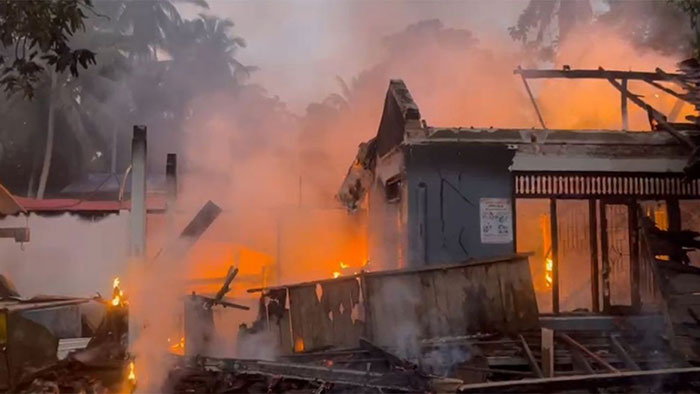
The death toll from the fire at an elders’ home in Batagoda, Anguruwatota, has risen to 13 after another resident succumbed to injuries while receiving treatment at the Horana Hospital, Police said yesterday.
Six others remain hospitalised with serious injuries.
The fire, which broke out on June 3 at the facility housing nearly 70 elderly residents, left 10 people dead on the spot after they were trapped inside the building, according to Police. A total of 51 occupants were rescued as firefighters brought the blaze under control.
Following the incident, approximately 50 survivors were initially accommodated at Batagoda Junior School before being relocated, with the assistance of Sri Lanka Army personnel, to another branch of the same care organisation in Galpatha.
Police said a Magistrate’s inquiry was conducted at the scene on June 4, during which burnt remains were recovered, under judicial supervision.
Meanwhile, the director of the elders’ home was arrested in connection with the incident and produced before the Horana Magistrate’s Court. He was remanded until June 11.Investigations are continuing into the cause of the fire.
by Norman Palihawadane

Anthropic urges AI labs to pause, warns humans risk losing control

Iran footballers issued US visas for World Cup, says White House

Showers will occur at times in the Western, Sabaragamuwa and North-western provinces and in Galle, Matara, Kandy and Nuwara-Eliya districts

China, Lanka intensify cooperation to fight cross-border crimes spreading across Asia and beyond

Asst. Manager, security officer arrested over Rs 30 mn snatch at Horana PB branch

Anguruwatota elders’ home fire death toll rises to 13

‘Dates have the highest sugar content to fight Coronavirus’

Sunday Island 27 December – Headlines

#SundayIsland 17th December – Headlines

Sunday Island – 28th March

Sunday Island Headlines – 21 March

Sunday Island – 21st February – Headlines
-

 News4 days ago
Lankan duo emerge winners in Latin dance championship held in Blackpool, UK
-

 Business5 days ago
IMF’s unstated rate:Sri Lanka’s $695m loan costs about 5.33% per annum
-

 Latest News2 days ago
Kusal Mendis, Pathum Nissanka, bowlers put Sri Lanka 1-0 up
-

 News2 days ago
New US tariffs proposed on 60 countries, including Sri Lanka
-

 Business5 days ago
Sri Lankan scientist-innovator Milinda Edirisinghe introduces AI-integrated gem testing system to gemological world
-

 Features6 days ago
Are threats to Buddha Sasana external or from within?
-

 News5 days ago
UNP challenges NPP move to amend Vihara – Devalagam Act
-

 News4 days ago
Sri Lankan teen killed in Chennai clash; three arrested