
Latest News
Sri Lanka pull off a heist after Bangladesh collapse in magnificent fashion

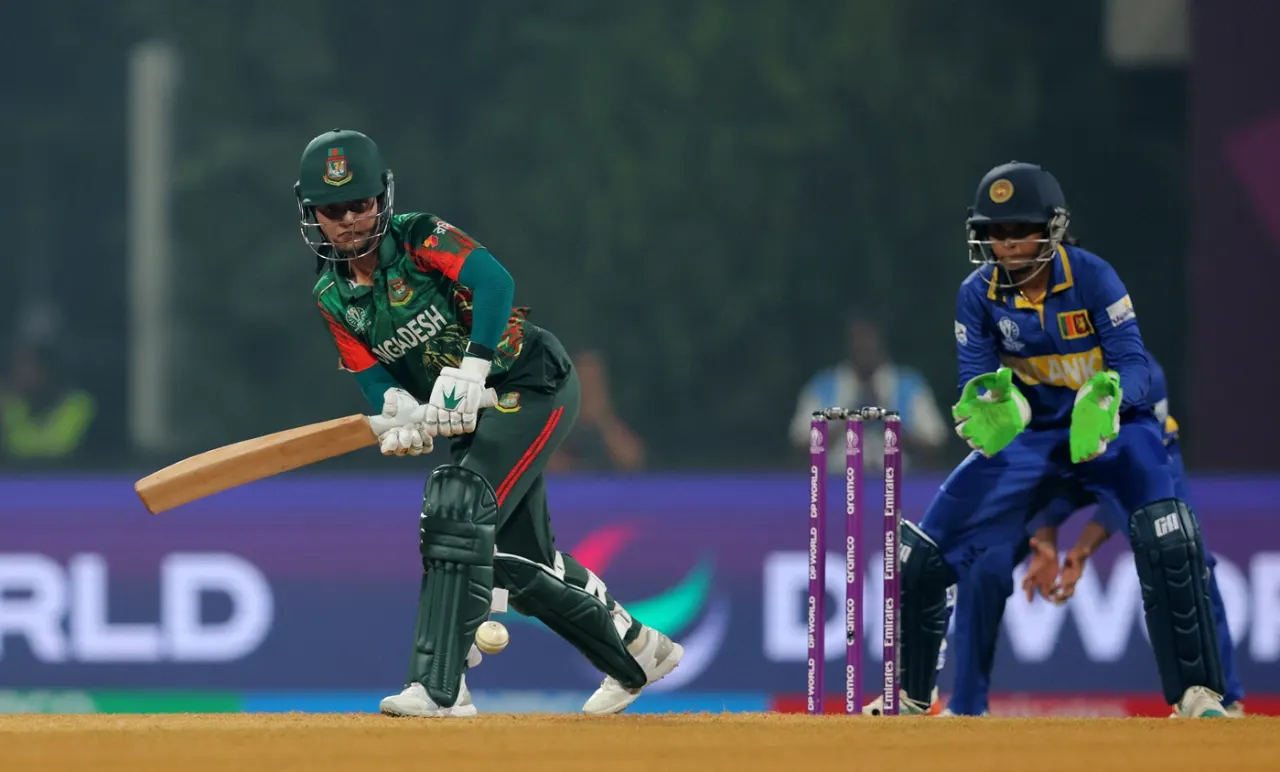
A tournament lacking in genuine tight finishes has now produced two in two days, as Bangladesh and Sri Lanka played out a low-scoring thriller in Navi Mumbai. But in truth this game should have never got to that stage, as Bangladesh nursed their chase of 203 only to stumble at the last and fall to a seven-run defeat. The result means, Bangladesh are eliminated from semi-final contention, while Sri Lanka live to fight another day.
This was a chase that Sri Lanka were behind for around 48 overs, but in a tantalising final dash they picked up five wickets and gave away two runs off the final nine deliveries, as Bangladesh were unable to close out a game that they had controlled for large parts.
The final scorecard will read that Chamari Athapaththu picked up figures of 4 for 42, but three of those came in a game-stealing final over, where Bangladesh lost four wickets off the first four deliveries – a run-out in the middle ensuring it wasn’t an Athapaththu hat-trick.
Up until then Nigar Sultana had anchored the chase, if not expertly then at least safely. Her 77 off 98 came mostly as part of two major partnerships – the first 82 off 120 with Sharmin Akhter and the second 50 off 58 with Shorna Akter – during which Sri Lanka were like passengers aboard a rudderless ship, just merely on for the ride.
To stick with the analogy, this was not a ship moving particularly swiftly. With a pretty chaseable target of 203 on the board, Bangladesh were guilty of being overly cautious – perhaps bearing in mind their poor batting efforts earlier in the tournament – as they inched along.
On a pitch, not offering much for the many spinners they picked, Sri Lanka were resigned to simply keeping things tight, unable to really impose themselves on the game with the ball until the dying moments when everything seemed to happen all at once.
Earlier however, it was Sri Lanka who had been slowed to a crawl, after a stunning mid-innings collapse had halted them. Hasini Pererfa struck a maiden international fifty in her 143rd match, a shining light (85 off 99) in and otherwise disjointed batting effort and was one of only three batters – Athapaththu (46) and Nilakshika Silva (37) the other two – to reach double-digits.
Both Athapaththu and Hasini brought up milestones – 4000 and 1000 ODI runs, respectively – during their knock as well, while Hasini was eventually named Player of the Match.
Shorna once more proved decisive – despite only being introduced at the halfway point of the innings – as she picked up figures of 3 for 27, including the crucial wickets of both Hasini and Nilakshika. The rest of the wickets were spread out, with only Ritu Moni going wicketless.
Bangladesh were sloppy in the field, missing several chances, including run-outs and stumpings, but they were also spot on with their reviews. Despite this, Sri Lanka had at several points been on the up – in control, even. There was the 72-run stand between Athapaththu and Hasini after the fall of that first wicket, which had Sri Lanka romping along at nearly run-a-ball.
On a wicket with few demons, Athapaththu’s 46 off 43 included six fours and two sixes. For the most part she looked unfazed by what Bangladesh threw at her so when she was trapped lbw by one that snuck past her forward defence, it was against the run of play.
After this point Sri Lanka were both unfortunate and architects of their own demise. A fledgling partnership of 15 between Harshitha Samarawickrama and Hasini was brought to an end after the former called for a non-existent second run and found herself a metre short.
If that was self-inflicted, the next wicket was pure unadulterated bad luck. Kavisha Dilhari chopped an attempted cut into the ground, as the ball promptly bounced past the stumps, struck keeper Sultana, and bobbled on to the stumps. Bangladesh went about their business after this, the fielders even getting back into their positions, but the third umpire was alert and used the Smart Replay system in effect at this tournament to inform the on-field umpires of a possible stumping.
And as it turned out, Dilhari’s back foot had momentarily lifted off the ground as she searched for balance. It was in that moment the bails had lit up – a fitting tribute to the Diwali celebrations around the stadium.
As Bangladesh celebrated wildly, Sri Lanka had suddenly stumbled from 72 for 1 to 100 for 4, a worrying blip with them being a batter light after replacing allrounder Piumi Wathsala with seamer Udeshika Prabodani. Thankfully for the Lankans, in Hasini and Nilakshika they had the exact counterattacking pair the occasion called for.
Together they strung a 74-run stand off just 75 deliveries. It was a period in which batting seemed the easiest, with both players finding boundaries with regularity. If there was one criticism – and this would be one across Sri Lanka’s innings – it would be their lack of strike rotation.
Despite the pair hitting nine boundaries (including three sixes) across their partnership lasting a shade over 12 overs, they were unable to usher in a run rate above six an over. This was a problem that would plague Bangladesh’s innings as well, later on.
Perhaps it was their awareness of the lack of batting to follow that kept them in check, but it was unusual to see so many tossed up deliveries of spin dead-batted away. As it transpired, Nilakshika’s innings came to an end prematurely, as she shanked an on-side heave off Shorna to short third.
This wicket proved to be a catalyst for Sri Lanka’s most devastating collapse, losing their next three wickets for just eight runs – Shorna getting two of them.
From then on, Sri Lanka’s innings slowed to a trickle as they sought to bat time, before eventually being bowled out with eight deliveries remaining. Their final 103 balls saw 28 runs scored and six wickets fall, a feat somehow surpassed by Bangladesh.
Brief scores:
Sri Lanka Women 202 in 48.4 overs (Chamari Athapaththu 46, Hasini Perera 85, Nilakshika Silva 37; Shorna 3-27, Rabeya Khan 2-39) beat Bangadesh Women 195 for 9 in 50 overs (Sharmin Akhter 64*, Nigar Sultana 77; Sugandika Kumari 2-38, Chamari Athapaththu 4-42) by seven runs
[Cricinfo]


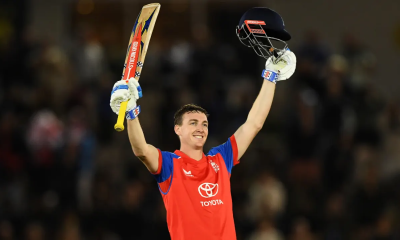


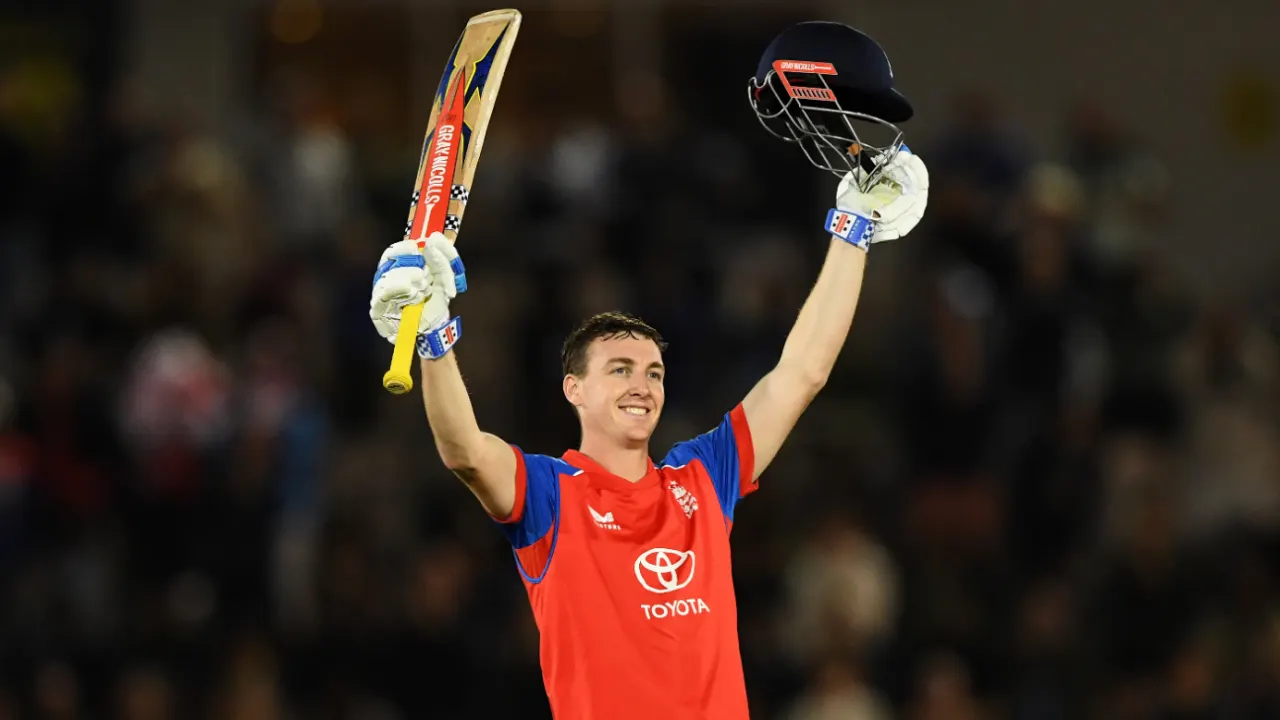
Harry Brook led from the front with his second and fastest T20I century as England sent Sri Lanka swirling down the Utilita Bowl with victory by 119 runs in the first T20I.
The limited-overs skipper’s 42-ball effort – quicker than every Englishman bar Phil Salt’s 39 baller almost a year ago to the day against South Africa – took England to 254 for 4, compelling former Test captain Ben Stokes to wax lyrical on social media.
Stokes’ post sounded as confused as Sri Lanka’s bowling plans. But the underlying sentiment was that Brook’s unbeaten 114 showed he possesses more genius than Kevin Pietersen.
It is a sketchy claim. But perhaps tonight, England’s new mentor will happily cede to the 27-year old after his third white-ball century of the year, and second in T20Is after his maiden effort against Pakistan at the T20 World Cup. In reply, Sri Lanka mustered just 21 more than Brook’s new career-best between them, bowled out for 135 with an over to spare.
England’s first innings fell three runs short of the total they made in their last T20I against India on this very ground. The similarities between this evening and that July afternoon included the opposition skipper – on this occasion, Charith Asalanka – inserting England after winning the toss.
Shreyas Iyer had made that mistake two months earlier, and likewise, he was also made to pay by Brook and Jos Buttler, who this time had to settle for 80 from 44 deliveries, rather than consecutive hundreds.
Captain and former captain combined in a stand of 128 from 60 deliveries, the first part of which included England’s second-highest powerplay of 90 for 1. That was kicked off by a breezy 12 from 5 for debutant Aneurin Donald, who became the first Glamorgan product to feature for England since Simon Jones in 2005.
Things were getting away from Sri Lanka as early as the fifth over when Dunith Wellalage was taken for 30 by Brook. And when Buttler was dropped on 45 three overs later, by Eshan Malinga – over-running a sliced heave down the ground at long off – it was clear, not even a quarter of the way through, that this match was only going one way.
England’s superior power and fitness was never going to be matched. More impressive than their total of 19 fours and 12 sixes were the number of twos. Brook did most of the running; nine of his own along with 12 for his three partners.
Sri Lanka’s chase began with a maiden, bowled by Sonny Baker who went on to take 3 for 12. After struggling on debut across all three formats – including a Test bow earlier this summer against New Zealand – the 23-year old polished his overall numbers with his first limited-overs dismissals at his home ground.
The Hampshire quick got off the mark with a 90mph rasper that beat opener Kamil Mishara, before adding Lahiru Udara four deliveries later when the right-hander’s attempted scoop found Adil Rashid at short backward square. A return from the Pavilion End then saw a 92mph delivery nip away and knock back Theekshana’s off stump.
All six of England’s bowlers registered in the wicket column, feasting on a line-up that – barring Wellalage’s 33 from 21 at No.8 – were all utterly woeful.
In Aneurin Donald, England may well have their answer to Vaibhav Sooryavanshi when it comes to monster strike-rates. Perhaps the quirkiest aspect about that is Donald, as the follower, is technically old enough to be Sooryavanshi’s father.
The 14-year age gap speaks to a difference of cultural attitudes towards the game, particularly in the T20 format: more venerated in India, reluctantly accepted over here. At the age of 29, Donald is England’s oldest T20I debutant in nine years, and was playing his first international match after 112 regular T20s.
With Phil Salt out injured, Donald had big boots to fill, but Brendon McCullum believed he had found the right understudy when watching Donald carve a remarkable 31 from eight deliveries for England Lions at Chelmsford in Sri Lanka’s first warm-up.
The man who capped his assault then – Wellalage – did so here for a more contained 12 off 5. Donald, though, had done his job in his first four balls, closing the the first over of the match by smashing Maheesh Theekshana’s offspin over the midwicket fence, then through cover, and setting England on course for a mammoth score.
The Utilita Bowl is the most criticised of England’s international venues, and it has come under greater scrutiny with the “hows” and “whys” of its allocation of an Ashes Test next year at the expense of Headingley (or anywhere else north of Nottingham).
It is not the easiest ground to get to. And visiting players note how quickly it has aged since opening in 2001. But if there is anyone who will espouse its virtues, it is Buttler.
Following his 131 against India, Buttler now has 211 runs across his last two T20I innings, both in Southampton. By comparison, he had managed a grand total of 212 runs across his first 14 innings in the format at the start of the year.
That run included a torturous T20 World Cup campaign, the kind that made many wonder if we were in the end days for one of English cricket’s most gifted batters.
This time, Buttler was closed to his devastating best. The four boundaries off Dushmantha Chameera to end the second over – the usual stride-and-thwacks over the bowlers’ heads and the trademark wristy, top-spin carve through cover off wide yorkers – were all very familiar.
Buttler turned 36 this time last week. But, as the team around him continues to push the envelope, the chance to focus on his own game, at his own pace – which today meant bringing up 50 from 29 deliveries as the anchor! – should ensure he and England get the most out of what time he has left.
Sri Lanka lacking Plan B
Everyone’s got a plan until they get Brook-ed and Buttler-ed in the face. And unfortunately for Sri Lanka, the plan thumped out of them was leaning on Theekshana to close out a chaotic innings
Few bowlers, let alone slow ones, take as much pride as Theekshana in their thankless tasks in the powerplay and at the death. But after Donald got hold of his first over, and then Buttler found 13 from his second, Asalanka seemingly forgot about the 26-year-old.
You could understand why the stand-in captain would look beyond someone conceding 13.5 an over. The problem, however, was his attempt to make up the difference proved more expensive. Wellalage’s last over (the 14th) went for 16, and Dasun Shanaka’s (17th) 19.
Wellalage looked particularly wayward, his slowness through the air – whether deliberate or not – left him exposed on an ugly surface that skidded rather than gripped. His economy rate of 17 from three overs was comfortably the worst of his career.
Scores:
England 254 for 4 in 20 overs (Jos Buttler 80, Aneurin Donald 12, Harry Brook 114*, Tom Banton 10, Will Jacks 21; Dushmantha Chameera 1-53, Dunith Wellalage 1-51, Eshan Malinga 1-41, Wanidu Hasaranga 1-34) beat Sri Lanka 135 in 19 overs (Pathum Nissanka 12, Kamil Mishara 10, Charith Asalanka 10, Dasun Shanaka 24, Dunith Wellalage 33, Eshan Malinga 13*; Sonny Baker 3-12, Josh Tongue 1-25, Will Jacks 1-21, Liam Dawson 2-23, Adil Rashid 1-31, Jamie Overton 2-20) by 119 runs
[Cricinfo]
Latest News
Cabinet approves aditional Rs. 2,500 million to the Paddy Marketing Board to purchase 2026 Yala harvest

The Cabinet of Ministers has approved the resolution furnished by the Minister of Agriculture, Livestock, Land and Irrigation to provide an additional Rs. 2,500 million to the Paddy Marketing Board on a reimbursable basis from the Rs. 7,500 million additional allocations granted to the Ministry to implement
the expedited paddy purchasing program for the 2026 Yala harvest.
Latest News
Cabinet nod to host the 8th Asian Regional Conference of the Commonwealth Parliamentary Association and the 3rd Joint Asian and South-East Asian Regional Conference of the Commonwealth Parliamentary Association
The 8th Asian Regional Conference of the Commonwealth Parliamentary Association (CPA) and the 3rd Joint Asian and South-East Asian Regional Conference of the CPA are planned to be held over three days in Colombo during April/May 2027.
Approximately 90 delegates including speakers, Deputy Speakers, Member of Parliamentarians, and Parliamentary officers representing member countries of the Commonwealth Parliamentary Association, in the Asian and South-East Asian regions, are expected to participate in these conferences.
The Cabinet of Ministers has approved the resolution furnished by the Prime Minister of the Parliament of Sri Lanka to host the said conferences considering the opportunities to strengthen parliamentary diplomacy and regional cooperation, as well as to enhance international recognition of the Parliament of Sri Lanka within the Commonwealth Parliamentary Association.

Showers about 75 mm are likely at some places in the Western, Sabaragamuwa, Central and Southern provinces

Brook, Buttler, Baker star as Sri Lanka slump to 119-run rout

Where is Gnanasara Thera?Police pass buck to court

Russian citizens in Lanka to vote in State Duma elections

Euro 110,000 research drive to tackle plastic waste in food sector

New SAU-RCSS pact to boost South Asian dialogue

‘Dates have the highest sugar content to fight Coronavirus’

Sunday Island 27 December – Headlines

#SundayIsland 17th December – Headlines

Sunday Island – 28th March

Sunday Island Headlines – 21 March

Sunday Island – 21st February – Headlines
-

 Sports5 days ago
DDS set to lose Test captaincy
-

 News5 days ago
Sri Lanka faces new grid challenge as rooftop solar surges: former CEB GM
-

 Latest News5 days ago
Shafali, Deepti power India into sixth T20 Asia Cup final
-

 Latest News4 days ago
Sri Lanka thwart Fatima Sana challenge to secure Asia Cup final spot
-

 News3 days ago
Gnanasara Thero absconding after SC ruling
-

 Features6 days ago
Lost for 90 years: Rare Goby resurfaces in Jaffna
-

 News4 days ago
Ammunition cache found in old Kandy bungalow
-

 Latest News6 days ago
Italian Naval Vessel ‘ITS Giuseppe Garibaldi’ arrives in Colombo