
Foreign News
‘Unparalleled’ snake antivenom made from man bitten 200 times


The blood of a US man who deliberately injected himself with snake venom for nearly two decades has led to an “unparalleled” antivenom, say scientists.
Antibodies found in Tim Friede’s blood have been shown to protect against fatal doses from a wide range of species in animal tests.
Current therapies have to match the specific species of venomous snake anyone has been bitten by.
But Mr Friede’s 18-year mission could be a significant step in finding a universal antivenom against all snakebites – which kill up to 14,000 people a year and leave three times as many needing amputations or facing permanent disability.
In total, Mr Friede has endured more than 200 bites and more than 700 injections of venom he prepared from some of the world’s deadliest snakes, including multiple species of mambas, cobras, taipans and kraits.
He initially wanted to build up his immunity to protect himself when handling snakes, documenting his exploits on YouTube.
But the former truck mechanic said that he had “completely screwed up” early on when two cobra bites in quick succession left him in a coma.
“I didn’t want to die. I didn’t want to lose a finger. I didn’t want to miss work,” he told the BBC.
Mr Friede’s motivation was to develop better therapies for the rest of the world, explaining: “It just became a lifestyle and I just kept pushing and pushing and pushing as hard as I could push – for the people who are 8,000 miles away from me who die from snakebite”.
Antivenom is currently made by injecting small doses of snake venom into animals, such as horses. Their immune system fights the venom by producing antibodies and these are harvested to be used as a therapy.
But venom and antivenom have to be closely matched because the toxins in a venomous bite vary from one species to another.
There is even wide variety within the same species – antivenom made from snakes in India is less effective against the same species in Sri Lanka.
A team of researchers began searching for a type of immune defence called broadly neutralising antibodies. Instead of targeting the part of a toxin that makes it unique, they target the parts that are common to entire classes of toxin.
That’s when Dr Jacob Glanville, chief executive of biotech company Centivax, came across Tim Friede.
“Immediately I was like ‘if anybody in the world has developed these broadly neutralising antibodies, it’s going to be him’ and so I reached out,” he said.
“The first call, I was like ‘this might be awkward, but I’d love to get my hands on some of your blood’.”
Mr Friede agreed and the work was given ethical approval because the study would only take blood, rather than giving him more venom.
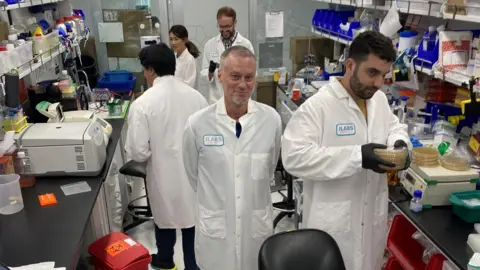
The research focused on elapids – one of the two families of venomous snakes – such as coral snakes, mambas, cobras, taipans and kraits.
Elapids primarily use neurotoxins in their venom, which paralyses their victim and is fatal when it stops the muscles needed to breathe.
Researchers picked 19 elapids identified by the World Health Organization as being among the deadliest snakes on the planet. They then began scouring Mr Friede’s blood for protective defences.
Their work, detailed in the journal Cell, identified two broadly neutralising antibodies that could target two classes of neurotoxin. They added in a drug that targets a third to make their antivenom cocktail.
In experiments on mice, the cocktail meant the animals survived fatal doses from 13 of the 19 species of venomous snake. They had partial protection against the remaining six.
This is “unparalleled” breadth of protection, according to Dr Glanville, who said it “likely covers a whole bunch of elapids for which there is no current antivenom”.
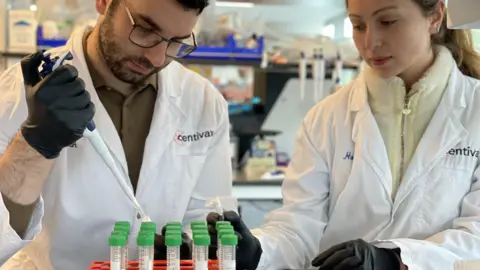
The team is trying to refine the antibodies further and see if adding a fourth component could lead to total protection against elapid snake venom.
The other class of snake – the vipers – rely more on haemotoxins, which attack the blood, rather than neurotoxins. In total there are around a dozen broad classes of toxin in snake venom, which also includes cytotoxins that directly kill cells.
“I think in the next 10 or 15 years we’ll have something effective against each one of those toxin classes,” said Prof Peter Kwong, one of the researchers at Columbia University.
And the hunt continues inside Mr Friede’s blood samples.
“Tim’s antibodies are really quite extraordinary – he taught his immune system to get this very, very broad recognition,” said Prof Kwong.
The ultimate hope is to have either a single antivenom that can do everything, or one injection for elapids and one for vipers.
Prof Nick Casewell, who is the head of the centre for snakebite research and interventions at the Liverpool School of Tropical Medicine, said the breadth of protection reported was “certainly novel” and provided “a strong piece of evidence” that this was a feasible approach.
“There is no doubt that this work moves the field forwards in an exciting direction.”
But he cautioned there was “much work to do” and that the antivenom still needed extensive testing before it could be used in people.
But for Mr Friede, reaching this stage “makes me feel good”.
“I’m doing something good for humanity and that was very important to me. I’m proud of it. It’s pretty cool.”
[BBC]


As large language models take over more and more cognitive tasks, researchers are warning this mental outsourcing comes with a cost.
When research scientist Nataliya Kosmyna was looking for interns, she noticed that cover letters she received were suspiciously similar. They were long, polished and after introductions would often jump to an abstract and arbitrary connection to her work.
It was obvious to her that applicants were using large language models (LLMs) – a form of artificial intelligence that powers chatbots such as ChatGPT, Google Gemini and Claude – to write the letters.
At the same time, during lessons on campus at Massachusetts Institute of Technology (MIT), Kosmyna, who studies the interaction between humans and computers, noticed that numerous students were forgetting content more easily compared to a few years ago.
With the increasing reliance on LLMs, she had a hunch that this could be affecting her students’ cognition and sought to understand more.
The concern that researchers like Kosmyna have is that if we become too reliant on AI, it could affect the language we use and even our ability to do basic cognitive tasks. There is now a growing body of research suggesting that this “cognitive offloading” to AI can have a corrosive effect on our mental abilities. The consequences could be alarming and may even contribute to cognitive decline.
“The ChatGPT group showed notably less brain activity – it was reduced by up to 55%”
It’s well known that the tools we use can change how we think. With the advent of the internet for instance, tasks that once required deep research could be found by plugging a simple query into a search box. As the use of search engines increased, research found we became less likely to remember details, something dubbed “the Google effect”. (Some argue, however, the internet also serves as an external memory system that frees up our brain to do other tasks)
But there is now growing alarm that as we offload even more of our thinking to LLMs and other forms of AI, the effects on our memories and ability to solve problems could get worse. Artificial intelligence tools can write convincing poetry, give financial advice and provide companionship. Students are increasingly outsourcing their own work to AI tools as well.
Studies have already shown that young people might be particularly vulnerable to the negative effects that using AI can have on key cognitive skills like critical thinking. Kosmyna, however, wanted to dig deeper into the potential effects.
Reduced mental effort
She and her colleagues at MIT Media Lab recruited 54 students to write short essays and split them into three groups. One was instructed to use ChatGPT. A second could use Google search, with AI-generated summaries turned off. The third didn’t use technology. Each student’s brainwaves were measured while they worked.
The essay topics were deliberately open-ended, meaning little research was needed for the task, with prompts including questions around loyalty, happiness or our daily life choices.
The results haven’t been published in a scientific journal yet, but they were none-the-less eye-opening, according to Kosmyna. Those who used their own minds had a brain that was “on fire”, showing widespread activity across many parts of the brain, she says. The search engine-only group still showed strong activity in the visual parts of the brain, but the ChatGPT group showed notably less brain activity – it was reduced by up to 55%.
“The brain didn’t fall asleep, but there was much less activation in the areas corresponding to creativity and to processing information,” says Kosmyna.
ChatGPT also affected people’s memories. After submitting their essays, people in the AI group were unable to quote from their essays, and several felt they had no ownership over the work. Other studies have also shown that people become less able to retain and recall information when they use AI tools such as ChatGPT.
While the findings are still undergoing peer review, they echo those from other studies. One study by researchers at the University of Pennsylvania suggests that some people undergo something they term “cognitive surrender” when using generative AI chatbots. This means they tend to accept what the AI tells them with minimal scrutiny and even allow it to override their own intuition.
Similar effects can be found outside the world of AI chatbots too – even in life-or-death situations. A recent multinational study team found that medical professionals who used an AI tool to screen for colon cancer for three months were subsequently worse at spotting the tumours without it.
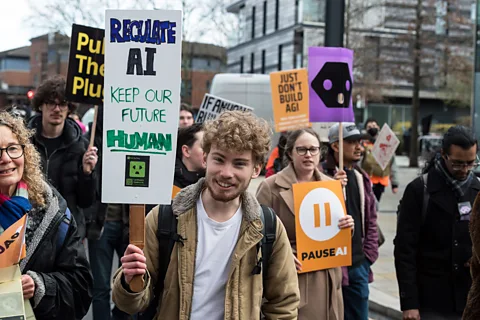
Outsourcing work to AI also risks losing much of the creativity that produces original work, warns Kosmyna. The essays that students in her study wrote with ChatGPT looked very similar and were described by the teachers marking them as “soulless”, lacking originality and depth, Kosmyna says. “One of the teachers asked if students were sitting next to each other because the essays were so similar.”
While studies such as these illustrate the short-term effects LLMs can have on the brain, the long-term impacts are far less clear. The study by Kosmyna and her colleagues provides a glimpse. Four months after the initial study they asked the students to write another essay, but this time those who had used ChatGPT were told to work without LLM support. The neural connectivity in their brains was lower than those who switched the opposite way, perhaps indicating that they had not engaged with the topics properly in the first place.
Cognitive decline
Yet, LLMs can be a positive tool to aid thinking, but only if we don’t rely on them by outsourcing our mental tasks in the process, says computational neuroscientist Vivienne Ming, author of Robot Proof. She’s concerned though that this is not how most people interact with this technology.
Her reasoning comes from research she conducted for her book, during which Ming asked a group of students at the University of Berkeley to predict real-world outcomes, such as the price of oil. She found that the majority of participants simply asked AI and copied the answer.
She measured their brains’ gamma wave activity – a marker of cognitive effort – finding it showed very little activation. Again her research is yet to published, but Ming worries that if her findings are borne out in further studies it could have long-term implications. Other research, for example, has linked weak gamma wave activity to cognitive decline later in life.
“That’s really worrying,” Ming says. “If that is a natural mode for people to interact with these systems – and these are smart kids – that’s bad.” Deep thinking, she says, is our superpower. “If we don’t use it, the long-term implications for cognitive health are pretty strong.”
That’s because when we rely on LLMs it requires very little cognitive effort, Ming adds, which is exactly what’s needed for a healthy brain.
A small subset of participants though – less than 10% – worked differently and used AI as a tool to gather data that they then analysed themselves. These individuals made more accurate predictions than others participants and showed stronger brain activation too.
For long-term brain health we need to continue to challenge ourselves
Almost two decades ago, Ming predicted that within 20 to 30 years we would see a statistically meaningful rise in dementia rates directly related to our overreliance on Google Maps. “I meant it to be provocative,” Ming says. “If you don’t have to think about navigating then there’ll be some detectable effect.”
While we don’t have data on this exact prediction, the increased use of GPS has been linked to worse spatial memory over time, according to one study of 13 people conducted over three years. And poor spatial navigation may be a potential predictor of Alzheimer’s Disease, according to another study.
It’s clear that the more active our brain is, the more protected it is from cognitive decline. LLMs then, Ming says, could not only reduce creativity but could harm cognition and potentially increase the risk of dementia.
As AI tool use increases, we need to work with it in a way that benefits us rather than harms us. Ming suggests that ultimately, the goal could be a form of “hybrid intelligence” where humans and machines “do the hard stuff” together. By this she means we need to think first and use tools to challenge us later, rather than simply letting them answer questions for us. Kosmyna agrees and suggests learning subjects without AI tools first to build a foundation and then think about using LLMs.
Ming recommends using what she calls the “nemesis prompt” to challenge your own thinking. It works by prompting an AI to act as a “lifelong enemy” or nemesis, then ask it to explain in detail why your ideas are wrong and how you can fix them, forcing you to defend and refine your arguments rather than simply accepting the answers it provides.
Another technique she suggest is prioritising “productive friction” and asking the AI to only provide context and ask you questions, rather than supplying answers. When she tested this by fine-tuning an AI bot not to give answers, she found that more individuals were more engaged.
Ultimately, we should all be wary of cognitive shortcuts, which is something “our brains love”, Kosmyna says. Clearly, for long-term brain health we need to continue to challenge ourselves. Our minds, creativity and cognitive health will benefit in the process.
[BBC]
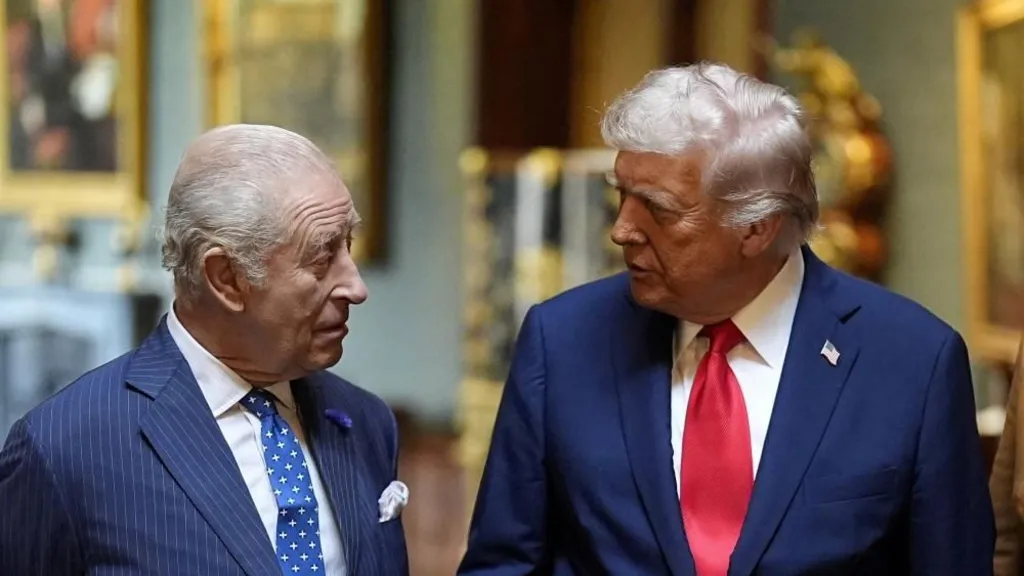
US President Donald Trump has said next week’s state visit from King Charles and Queen Camilla could help repair relations with the UK.
When asked in a phone interview with the BBC whether the visit could help repair the relationship, Trump said: “Absolutely. He’s fantastic. He’s a fantastic man. Absolutely the answer is yes.”
“I know him well, I’ve known him for years,” he said. “He’s a brave man, and he’s a great man. They would absolutely be a positive.”
The president also spoke about his relationship with UK Prime Minister Sir Keir Starmer, who he said could only “recover” if he changed course on immigration.
The King and Queen will travel to the US for a four-day visit beginning on Monday, and will meet with Trump at the White House.
The King will have a private meeting with the president and also deliver an address to Congress.
After two days in Washington DC, they will travel to New York, Virginia and Bermuda before returning to the UK.
The Foreign Office said the trip would mark the 250th anniversary of US independence, and would celebrate a partnership of “shared prosperity, security and history”.
In the five-minute interview on Thursday, Trump was also asked about his relationship with Sir Keir.
The two leaders have appeared at odds over the war in Iran, and the prime minister has faced mounting pressure over his decision to appoint Lord Mandelson as UK ambassador to the US.
In a post on Truth Social on Monday, Trump said Lord Mandelson was “a really bad pick” but the prime minister had “plenty of time to recover”.
When asked what he meant by that post, Trump said: “If he opened the North Sea and if his immigration policies became strong, which right now they’re not, he can recover, but if he doesn’t, I don’t think he has a chance.
Trump has repeatedly called on the UK to increase oil and gas extraction in the North Sea.
“I make my decisions based on what’s in the British national interest and not what other people say or do,” Sir Keir said while talking to broadcasters about the president’s comments on Thursday.
“That is why I took the decision that we would not be dragged into the war in Iran,” he said. “I’m not going to be diverted or deflected from that by what anybody else says.”
(BBC)

Standing on top of a customised van on a hot and humid afternoon in Tirunelveli, about 600km (373 miles) south of Tamil Nadu’s capital Chennai in southern India, C Joseph Vijay tells his supporters his opponents have joined hands to stop him from becoming the state chief minister.
“My rivals might appear different from outside, but they have only one aim: that Vijay should not become the chief minister,” says the 51-year-old actor-turned-politician to a mammoth crowd that begins to chant his name, which means “victory” in Tamil, in unison.
Tamil Nadu, one of India’s most developed states with impressive human development indices, also has a long history of electing film stars as leaders, some of whom are still revered by people as demigods years after their deaths.
As Tamil Nadu votes on Thursday to elect its 234-member state legislative assembly, Vijay’s bid for power is the latest addition to the state’s trend of film star-politicians, turning a traditionally bipolar battle into a triangular contest.

Vijay entered politics with much fanfare when he launched the Tamilaga Vettri Kazhagam (TVK) party in 2024, promising to end the decades-old dominance of the governing Dravida Munnetra Kazhagam (DMK) and the main opposition All India Anna Dravida Munnetra Kazhagam (AIADMK).
Incumbent Chief Minister MK Stalin leads the DMK and its 14-party Secular Progressive Alliance, in which the Indian National Congress is a junior partner. On the other hand, opposition leader Edappadi K Palaniswami of the AIADMK heads the 10-party National Democratic Alliance, which also includes Prime Minister Narendra Modi’s Bharatiya Janata Party (BJP).
The DMK and the AIADMK identify themselves as Dravidian parties, which derive their names from a powerful political and social justice movement in Tamil Nadu that opposed caste inequalities, championed social reforms, and rejected perceived attempts by India’s more dominant north Indian parties to impose Hindi – and upper-caste Hindu values – on the non-Hindi speaking southern states.
Dravidian parties have held power in Tamil Nadu continuously since 1967, with national parties like the Congress and the BJP playing secondary roles. While the BJP is contesting 27 seats in alliance with the AIADMK, the Congress is fighting for 28 seats as part of the DMK-led coalition.
More than 87 percent of Tamil Nadu’s 72 million people are Hindu, followed by Christians at 6.1 percent and Muslims at 5.8 percent, according to the last census conducted in 2011.
Among Hindus, the so-called “backward” or less-privileged castes constitute 45.5 percent, “extremely backward” castes 23.6 percent, while Dalits are at 20.6 percent. Dalits, formerly referred to as “untouchables”, fall at the bottom of India’s complex caste hierarchy and have faced marginalisation and violence for centuries.
Vijay, son of a Christian filmmaker father and a Hindu mother who is a background singer in films, belongs to the Vellalar community, an affluent agrarian group in Tamil Nadu with both Hindu and Christian members.
Vijay started his film career as a child actor in movies directed by his father. His 1992 debut as a hero, however, in Naalaiya Theerpu (Tomorrow’s Verdict), flopped. Following the setback, his father cast him alongside popular star Vijayakanth — who later founded his own political outfit, Desiya Murpokku Dravida Kazhagam (DMDK) — in Senthoorapandi (1993), which gave his career a new lease of life.
It was the 2004 film Ghilli (Gutsy), which carried a subtle political undertone, that catapulted Vijay to superstar status. He dropped hints about his political ambitions in the 2013 hit Thalaivaa (Leader), which was launched with the tagline: “Time to Lead”.
Soon, political messaging became central to many of Vijay’s subsequent films. Even the title of his yet-to-be-released Jana Nayagan (People’s Leader) — which he claims will be his final film — alludes to his political aspirations.
Riding on personal charisma, Vijay has attracted millions of supporters to his rallies, despite allegations of poor crowd management, which caused a stampede at one such gathering in September last year, killing 42 people.
He is expected to draw a share of Dalit and minority Christian votes that would have otherwise flowed to the DMK-led coalition. He is also banking on anti-incumbency votes that could have benefited the AIADMK alliance.
Yet analysts say Vijay’s ambition of becoming the next chief minister will not be as easy as the scripted blockbusters he has built his career on, since he faces two opponents with decades of experience in real politics.
That leads political commentator R Kannan to describe Vijay as “both a blessing and a curse” for the two Dravidian coalitions.
“When the AIADMK joined the BJP-led NDA, many predicted the Dravidian party would lose heavily, with minorities and Dalits flocking to the DMK. Vijay’s entry, however, has offered the AIADMK a ray of hope — he is expected to draw a decent share of votes that would otherwise have gone to the DMK,” he said.
“At the same time, he works in the DMK’s favour by siphoning off anti-incumbency votes that might have gone entirely to the AIADMK. For both Dravidian parties, he is at once a blessing and a curse.”
Vijay is aiming to follow the path of illustrious predecessors: Maruthur Gopalan Ramachandran, popularly known as MGR, and his protege, Jayaram Jayalalithaa – Tamil Nadu’s most beloved on-screen pair.
Born into poverty, MGR’s rise to stardom was nothing short of phenomenal. He captured the imagination of Tamil Nadu’s working class, who idolised him in return. From his first superhit, Rajakumari (Princess) in 1947, his films cast him as a champion of the masses, battling oppression and corrupt authority.
MGR launched the AIADMK in 1972 after breaking away from the DMK and served as Tamil Nadu’s chief minister from 1977 to 1987. He introduced several welfare programmes, the most significant being a free meal scheme for schoolchildren in order to eliminate malnutrition and boost school enrolment.
His political heir, Jayalalithaa, was a six-time chief minister between 1991 and 2016, when she became India’s first female state leader to die in office. She is remembered for launching several women-centric programmes, including all-women police stations and subsidised two-wheelers for working women, apart from her work in curbing female infanticide.

The DMK also has a history of film personalities, including the party’s founder, CN Annadurai, who rose to fame as a pathbreaking scriptwriter with films like Velaikkari (1949), and MGR as the party’s star campaigner and leader before he founded the AIADMK.
Soon, Muthuvel Karunanidhi emerged as another prominent writer, poet and screenwriter with films like Parasakthi (1952), meaning Supreme Power, often cited as a turning point in Tamil cinema. Directed by Krishnan-Panju and written by Karunanidhi, then 28 years old, the film fiercely attacked casteism and social inequality, while propelling the spread of the Dravidian ideology.
Karunanidhi, popularly known as Kalaignar (artist), wrote scripts for more than 75 films that resonated with the struggles of the working class, championing rationalism and social equality.
He won the Tamil Nadu Legislative Assembly election for a record 13 terms and served as the state’s chief minister for five terms between 1969 and 2011. He died at the age of 94 in 2018, with his son, Stalin, taking over as the DMK chief.
Film star-politicians who embraced Tamil identity politics flourished, while those who did not fell by the wayside.
“Successful leaders such as MGR, popularly known as Puratchi Thaalaivar [Revolutionary Leader], Jayalalithaa, who earned the monikers Puratchi Thalaivi [Revolutionary Female Leader] and Amma [Mother], embraced identity politics. Another popular film actor, Sivaji Ganesan, by contrast, could not make the same mark in politics even after he tried,” said Kannan, who has written biographies of MGR and Annadurai.

In 2005, popular actor Vijayakanth added to the starry mix by launching his DMDK party, another Dravidian political outfit. He made every attempt to position his party as an alternative to the DMK and the AIADMK, but failed. The party won just one seat in 2006 — Vijayakanth’s own — and drew a blank in 2009. Though he went on to become the leader of the opposition in the assembly in 2011, the election reverses forced him to seek alliances. The DMDK, now led by his wife Premalatha, is contesting 10 seats in alliance with the DMK.
Which is where, say analysts, Vijay’s pitch for power is unlikely to make an impact in this election. They say his TVK party does not fall in the long line of Dravidian parties that have a distinct political ideology and programme that appeals to their voters.
“Tamil Nadu is an ideologically and politically evolved state. Issues such as social justice, centre-state relations, and linguistic and cultural identity are paramount here. People will not back a politician without a clear ideology,” Ramu Manivannan, former professor of political science at the University of Madras, told Al Jazeera.
Manivannan said large crowds at Vijay’s rallies should not be mistaken for potential votes. “Film stars always attract crowds. To assume all of them will translate into votes is unfair.”
Vijay’s TVK is rooted in his fan clubs, which thrive on masculine aggression, said S Anandhi, retired professor at the Madras Institute of Development Studies.
“Vijay’s populist rhetoric — defying all authority — appeals strongly to the youth. But he never clarifies what he will actually do in power. He frames it as all established forces being arrayed against young men, and youngsters see this as an opportunity for a new kind of collectivisation. I would call it a dangerous class,” she told Al Jazeera.
Vijay appears to be banking heavily on two voter blocs: younger voters between 18 and 39 years, who number 23 million of the state’s 57 million voters, and women, who account for more than half of them.
At his rallies packed with young people and women, Vijay has alleged that Stalin’s true allies are “bribery and corruption”, framing the contest as a personal battle between himself and the chief minister.
Stalin, for his part, has largely brushed off Vijay’s attacks. “Newly-formed parties have a wrong notion that they can survive by criticising DMK,” he said in a recent interview.
Instead, Stalin has focused his attacks on the Modi government, accusing it of depriving Tamil Nadu of its share of federal funds, and framing the election as a contest between Tamil Nadu and New Delhi – a ploy that simultaneously targets the AIADMK for allying with an “adversary”, the BJP.
The AIADMK’s Palaniswami has countered by saying Stalin raises the centre-state issue only because he has “no achievements of his own to show”.
Despite their ideological differences, all parties are competing heavily on welfare promises in a state known for freebies during elections.
The DMK has pledged to double the monthly women’s allowance to 2,000 rupees ($21), offer 8,000 rupees ($85) in home appliance coupons, and build one million homes for the poor over five years. The AIADMK, also promising a monthly allowance of 2,000 rupees for women, has additionally offered free refrigerators to the poor and a one-time family grant of 10,000 rupees ($106).
Vijay’s TVK, hoping to cash in on the ongoing global fuel crisis, has promised six free LPG cylinders annually, 2,500 rupees ($26.5) monthly support for the female heads of a household, 8gm gold and a silk saree for poor women getting married, 4,000 rupees ($42.5) stipend for unemployed college graduates, and interest-free education loans of up to 2 million rupees ($21,257).
Still, Kannan feels Vijay can at best be a disruptor in the three-cornered contest.
“Vijay’s campaign gained momentum in the final lap. He turned what was a bipolar contest into a three-cornered one. But apart from his personal charisma, he lacks proper organisational machinery. Many of his party’s candidates are unknown faces,” he said.
[Aljazeera]

Advisory for Severe Lightning issued For Western, Sabaragamuwa and North-western province

AI chatbots could be making you stupider

‘A remarkable time capsule’: The enchanting history of Oxford University’s 750-year-old medieval library

Kohli, Padikkal hit fifties as Royal Challengers Bengaluru ace the chase against Gujarat Titans

Showers expected in the Western and Sabaragamuwa provinces and in Galle, Matara, Kandy, Nuwara-Eliya and Puttalam districts after 2.00 pm

Heat Index at Caution Level in the Northern, North-central, North-western, Western, Sabaragamuwa and Eastern provinces during the day time

‘Dates have the highest sugar content to fight Coronavirus’

Sunday Island 27 December – Headlines

#SundayIsland 17th December – Headlines

Sunday Island – 28th March

Sunday Island Headlines – 21 March

Sunday Island – 21st February – Headlines
-

 News5 days ago
Rs 13 bn NDB fraud: Int’l forensic audit ordered
-

 Opinion6 days ago
Shutting roof top solar panels – a crime
-

 News3 days ago
Lanka faces crisis of conscience over fate of animals: Call for compassion, law reform, and ethical responsibility
-

 News2 days ago
No cyber hack: Fintech expert exposes shocking legacy flaws that led to $2.5 million theft
-

 News7 days ago
From Nuwara Eliya to Dubai: Isha Holdings markets Agri products abroad
-
 News2 days ago
Whistleblowers ask Treasury Chief to resign over theft of USD 2.5 mn
-

 News6 days ago
Church calls for Deputy Defence Minister’s removal, establishment of Independent Prosecutor’s Office
-

 Life style6 days ago
After dark in Sri Lanka: Tiny wild cats step into the spotlight