
Foreign News
‘Unparalleled’ snake antivenom made from man bitten 200 times


The blood of a US man who deliberately injected himself with snake venom for nearly two decades has led to an “unparalleled” antivenom, say scientists.
Antibodies found in Tim Friede’s blood have been shown to protect against fatal doses from a wide range of species in animal tests.
Current therapies have to match the specific species of venomous snake anyone has been bitten by.
But Mr Friede’s 18-year mission could be a significant step in finding a universal antivenom against all snakebites – which kill up to 14,000 people a year and leave three times as many needing amputations or facing permanent disability.
In total, Mr Friede has endured more than 200 bites and more than 700 injections of venom he prepared from some of the world’s deadliest snakes, including multiple species of mambas, cobras, taipans and kraits.
He initially wanted to build up his immunity to protect himself when handling snakes, documenting his exploits on YouTube.
But the former truck mechanic said that he had “completely screwed up” early on when two cobra bites in quick succession left him in a coma.
“I didn’t want to die. I didn’t want to lose a finger. I didn’t want to miss work,” he told the BBC.
Mr Friede’s motivation was to develop better therapies for the rest of the world, explaining: “It just became a lifestyle and I just kept pushing and pushing and pushing as hard as I could push – for the people who are 8,000 miles away from me who die from snakebite”.
Antivenom is currently made by injecting small doses of snake venom into animals, such as horses. Their immune system fights the venom by producing antibodies and these are harvested to be used as a therapy.
But venom and antivenom have to be closely matched because the toxins in a venomous bite vary from one species to another.
There is even wide variety within the same species – antivenom made from snakes in India is less effective against the same species in Sri Lanka.
A team of researchers began searching for a type of immune defence called broadly neutralising antibodies. Instead of targeting the part of a toxin that makes it unique, they target the parts that are common to entire classes of toxin.
That’s when Dr Jacob Glanville, chief executive of biotech company Centivax, came across Tim Friede.
“Immediately I was like ‘if anybody in the world has developed these broadly neutralising antibodies, it’s going to be him’ and so I reached out,” he said.
“The first call, I was like ‘this might be awkward, but I’d love to get my hands on some of your blood’.”
Mr Friede agreed and the work was given ethical approval because the study would only take blood, rather than giving him more venom.
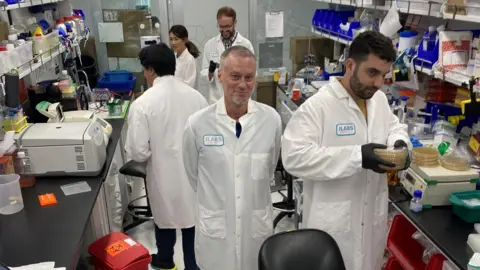
The research focused on elapids – one of the two families of venomous snakes – such as coral snakes, mambas, cobras, taipans and kraits.
Elapids primarily use neurotoxins in their venom, which paralyses their victim and is fatal when it stops the muscles needed to breathe.
Researchers picked 19 elapids identified by the World Health Organization as being among the deadliest snakes on the planet. They then began scouring Mr Friede’s blood for protective defences.
Their work, detailed in the journal Cell, identified two broadly neutralising antibodies that could target two classes of neurotoxin. They added in a drug that targets a third to make their antivenom cocktail.
In experiments on mice, the cocktail meant the animals survived fatal doses from 13 of the 19 species of venomous snake. They had partial protection against the remaining six.
This is “unparalleled” breadth of protection, according to Dr Glanville, who said it “likely covers a whole bunch of elapids for which there is no current antivenom”.
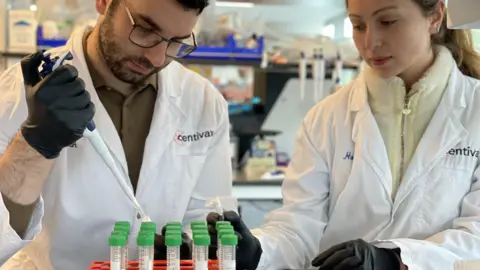
The team is trying to refine the antibodies further and see if adding a fourth component could lead to total protection against elapid snake venom.
The other class of snake – the vipers – rely more on haemotoxins, which attack the blood, rather than neurotoxins. In total there are around a dozen broad classes of toxin in snake venom, which also includes cytotoxins that directly kill cells.
“I think in the next 10 or 15 years we’ll have something effective against each one of those toxin classes,” said Prof Peter Kwong, one of the researchers at Columbia University.
And the hunt continues inside Mr Friede’s blood samples.
“Tim’s antibodies are really quite extraordinary – he taught his immune system to get this very, very broad recognition,” said Prof Kwong.
The ultimate hope is to have either a single antivenom that can do everything, or one injection for elapids and one for vipers.
Prof Nick Casewell, who is the head of the centre for snakebite research and interventions at the Liverpool School of Tropical Medicine, said the breadth of protection reported was “certainly novel” and provided “a strong piece of evidence” that this was a feasible approach.
“There is no doubt that this work moves the field forwards in an exciting direction.”
But he cautioned there was “much work to do” and that the antivenom still needed extensive testing before it could be used in people.
But for Mr Friede, reaching this stage “makes me feel good”.
“I’m doing something good for humanity and that was very important to me. I’m proud of it. It’s pretty cool.”
[BBC]


A strong magnitude 7.5 earthquake has struck off northern Japan, prompting authorities to issue a tsunami warning for waves of up to 3 metres (10 feet).
The quake hit on Monday at 4:53pm local time (07:53 GMT) in waters off Iwate prefecture on Japan’s Pacific coast, according to the Japan Meteorological Agency (JMA). It was felt across a wide area, shaking buildings in Tokyo, hundreds of kilometres (miles) to the south.
The JMA warned that the first tsunami waves could reach parts of the northern coastline immediately. “Evacuate immediately from coastal regions and riverside areas to a safer place such as high ground or an evacuation building,” the agency said.
“Tsunami waves are expected to hit repeatedly. Do not leave safe ground until the warning is lifted.”
Live footage from public broadcaster NHK showed no immediate signs of damage at several ports in Iwate.
Prime Minister Sanae Takaichi said the government had set up a crisis management team and was working to assess the impact of the earthquake.
“For those of you who live in areas for which the warnings have been issued, please evacuate to higher, safer places such as higher ground,” Takaichi told reporters.
[Aljazeera]

Thousands of prisoners in Myanmar have been granted amnesty or had their sentences reduced. The pardon order by Min Aung Hlaing is one of his first official acts since the coup leader became president this month.
The move comes as the lawyer for jailed former leader Aung San Suu Kyi told the Reuters news agency that her sentence has been reduced. Former president Win Myint, detained since the 2021 coup, was also pardoned of his convictions, a statement from the presidency said.
Min Aung Hlaing approved an amnesty for 4,335 prisoners, Myanmar’s state television MRTV reported.
A communique on behalf of Min Aung Hlaing said “those serving death sentences shall have their sentences commuted to life imprisonment”, without naming specific prisoners.
“The President has pardoned Win Myint,” said another statement from Min Aung Hlaing’s office. Win Myint was “granted a pardon and the reduction of his remaining sentences under specified conditions”, MRTV said.
Suu Kyi, 80, is serving a 27-year sentence on charges her allies describe as politically motivated. Her sentence was cut by one-sixth, her lawyer told Reuters, but it remains unclear whether the Nobel Peace Prize winner will be allowed to serve the rest of her sentence under house arrest. Min Aung Hlaing placed Suu Kyi under arrest after the coup.
Amnesties typically happen as Myanmar marks Independence Day in January and its New Year in April.
Among those to be released are 179 foreign nationals, who will be deported. The amnesty also includes the commutation of all death sentences to life imprisonment, life sentences reduced to 40 years, and a one-sixth reduction in term lengths for all other prisoners.
[Aljazeera]

Several armed men robbed a bank in broad daylight in Naples, holding 25 people hostage before making their escape via a tunnel.
Police surrounded a branch of Crédit Agricole in the southern Italian city shortly after the robbery began around midday local time (10:00 GMT).
Local outlets reported that they negotiated with the robbers before the hostages could be released, about two hours into the robbery.
Firemen could be seen smashing in a window with battering rams and helping people climb out from inside in videos shared on social media.
Some hostages simply shook off the shards of glass and walked on.
But others looked visibly shaken, crying and hugging their relatives. Six people, who were in a state of shock, were offered medical assistance.
One man later told local news site Fanpage.it that the robbers had locked them into a room and that, while they were armed, “they did not use violence”.
Nobody was seriously injured. “Thanks to the swift response… all the hostages were freed shortly after 13:30 without serious injuries,” regional official Michele di Bari said in a statement.
A large crowd of bystanders, local residents and firefighters gathered in the square waiting for developments, while ten of thousands of people tuned into a livestream from the scene of the crime.
Members of the special forces of the carabinieri armed police were urgently flown in from Tuscany.
It was not until several hours later that they stormed the bank by breaking a window.
Several shots and the loud noises of stun grenades could be heard on the live feed shortly after.
But by then, the robbers had reportedly escaped through a tunnel, local media reported. It was thought they could have vanished into the sewer system.
The video feed later showed a number of carabinieri and firefighters peering into a manhole nearby as a crowd continued to mill about the square.
Fanpage.it reported that it was not yet possibly to quantify the value of the loot taken because the robbers had seized personal safety deposit boxes rather than cash.
(BBC)

IRGC seizes two vessels in Strait of Hormuz amid US blockade

Cabinet approves establishment of Activity-Based Learning Centers at Regional Level for Commerce Education
M/s. Resources Development Consultants (Pvt) Ltd appointed to prepare Feasibility Study and detailed plans for the extension of the Kelani Valley Railway Line from Avissawella to Ratnapura
Import and Export (Control) Regulations No. 01 of 2026, issued under the Imports and Exports (Control) Act, No. 1 of 1969, to be submitted for concurrence of the Parliament

Cabinet nod to establish ‘Sri Lanka Industrial Transformation and Innovation Authority ‘
Iraj Chaminda Pathiraja appointed Controller General of Immigration and Emigration

‘Dates have the highest sugar content to fight Coronavirus’

Sunday Island 27 December – Headlines

#SundayIsland 17th December – Headlines

Sunday Island – 28th March

Sunday Island Headlines – 21 March

Sunday Island – 21st February – Headlines
-
 News2 days ago
Rs 13 bn NDB fraud: Int’l forensic audit ordered
-

 Business5 days ago
Harnessing nature’s wisdom: Experts highlight “Resist–Align” path to resilience
-

 News5 days ago
Gratiaen Trust announces longlist for the 33rd Annual Gratiaen Prize
-

 Opinion3 days ago
Shutting roof top solar panels – a crime
-

 News4 days ago
From Nuwara Eliya to Dubai: Isha Holdings markets Agri products abroad
-

 Latest News6 days ago
Singapore Zoo’s first Sri Lankan leopard cubs make their public debut
-
 News5 days ago
Heroin haul transported on 50-million-rupee contract
-

 News3 days ago
Church calls for Deputy Defence Minister’s removal, establishment of Independent Prosecutor’s Office