
Latest News
Enforcing the law against bribery and corruption is not an act of political revenge but a profound human responsibility – President

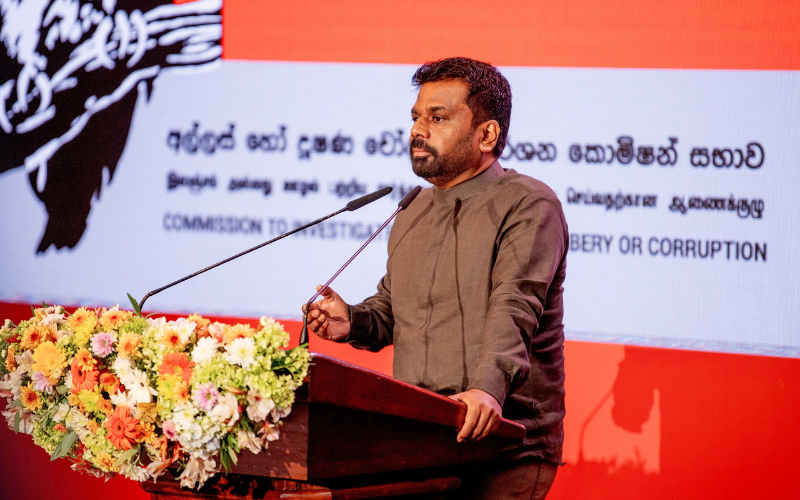
President Anura Kumara Disanayake emphasized that since assuming office, the current government has taken decisive steps to free the process of combating bribery and corruption from political interference. He reiterated that while the political mechanism has been liberated from engaging in such crimes, it is now the responsibility of the administrative machinery operating beneath that political structure to fall in line and correct its course without delay.
He explained that a grace period of six months has already been provided for the state officials to adjust to this new direction. The President firmly warned that if the public service mechanism fails to act appropriately within this period, the government will not hesitate to take firm legal action against those officials from May onwards.
President Disanayake expressed these views on Wednesday (09), participating in the launch of the National Anti-Corruption Action Plan 2025–2029, held at the Bandaranaike Memorial International Conference Hall (BMICH) in Colombo.
Bribery and corruption have proliferated, undermining the integrity and values of the country’s state institutions .He observed that over the past six months of the present government, no section of the public service has been allowed to collapse and that if officials continue to resist change, the government will proceed to remove and replace them after May.
The President pointed out that bribery and corruption have caused the nation to fall behind for decades in the eyes of the world. He reiterated that enforcing the law against these crimes is not an act of political revenge but a profound human responsibility.
The President stressed the need to build a society that respects the law and fears wrongdoing, adding that conducting lectures or workshops alone would not suffice in achieving this goal. He emphasised that people must practically witness that any person who commits a crime will be subjected to punishment under the law.
President Disanayake noted that corruption in Sri Lanka ranges from minor bribery, from the village level to bringing poor quality medicinal drugs. Bribery and corruption have escalated from minor instances to grave financial crimes, extending from local councils to looting the Central Bank.
The President further said that previous rulers safeguarded and protected those engaged in corrupt activities.
He also revealed the emergence of a network of thieves within several state administrative institutions and certain bodies responsible for enforcing the law, comprising underworld elements involved in bribery and corruption. He confirmed that these criminal networks have already been identified and assured that measures will be implemented in the future to dismantle and eliminate them.
President Disanayake solemnly pledged that the responsibility of eradicating bribery and corruption will not be passed on to the next generation but will be resolved within this generation itself, under the leadership of the present government.
Drawing a comparison with India, which gained independence a year before Sri Lanka, the President noted that through a consistent national policy framework, India has successfully achieved space exploration and built a massive workforce in the software industry. In stark contrast, he pointed out that Sri Lanka, due to poor decisions made by its political leadership, was declared a bankrupt state in 2022.
He further stated that the current government has taken on the responsibility of leading Sri Lanka towards the international stage through a national policy framework that ensures transparency and accountability for every rupee spent from public funds.
The President added that by implementing this framework, it is possible to build public trust in law enforcement and judicial institutions and that it must be made clear to the people that there will be no mechanism available for anyone to escape the law after committing a crime.
He stated that the purpose of the National Anti-Corruption Action Plan 2025-2029 is to guide the country towards becoming a nation of integrity. The government plans to establish Internal Affairs Unit within all state institutions including the Presidential Secretariat and implement a system for monitoring these units through digital technology to ensure accountability and transparency.
The Action Plan has been designed around four key strategic priority areas: prevention and public participation, institutional strengthening and the enforcement of law along with reforms in law and policy.
The President highlighted that eliminating bribery and corruption is one of the most decisive factors in a country’s development and progress. In Sri Lanka, the Commission to Investigate Allegations of Bribery or Corruption (CIABOC) has been identified as the leading state institution entrusted with strengthening this mechanism. Accordingly, it was recognised that a robust national anti-corruption policy that operates across all sectors is essential to creating a corruption-free society.
In preparing this Action Plan, CIABOC engaged all relevant stakeholders by conducting extensive programmes at both national and provincial levels. A broad public consultation process was carried out, including a comprehensive survey to assess public opinion on corruption through media announcements in all three languages and via social media networks.
This process gathered proposals from a diverse range of participants, including Members of Parliament, judges, state officials, the private sector, international organisations, civil society organisations, community-based organisations, religious groups, persons with special needs, media professionals, youth, children and the general public. Additionally, foreign state experiences and suggestions from various groups across all provinces were taken into consideration when formulating the Action Plan.
By implementing this National Anti-Corruption Action Plan, the government hopes to foster a committed citizenry determined to combat corruption, a political will fully supportive of this effort, a comprehensive legal framework and a disciplined, transparent public service across all sectors, with the shared vision of building a country of integrity for future generations.
Addressing the event, the Japanese Ambassador to Sri Lanka, Hideaki Mizukoshi, stated that Corruption remains a great challenge for many countries, including Sri Lanka as it undermines economic growth, weakens public trust in government institutions and discourages foreign investment. However, he noted that due to the reform initiatives of the present government, investors are once again showing increasing interest in Sri Lanka.
Ambassador Mizukoshi further stated that Japan has always believed that transparency and good governance are fundamental pillars for sustainable economic development and therefore, has supported anti-corruption initiatives globally for over a decade.
Meanwhile, the UNDP Resident Representative in Sri Lanka, Ms. Azusa Kubota, stated that according to Sri Lanka’s first-ever National Taxpayer Perception Survey conducted last year, 84% of respondents indicated that corruption directly affects their willingness to pay taxes.
She further noted that corruption deters investment, increases the cost of doing business, undermines sustainable development and human security, and causes an estimated annual loss of USD 1.3 trillion for developing countries.
Referring to the Budget Speech delivered by the President, Ms. Kubota emphasised that the State must be accountable for every cent of taxpayers’ money and stated that this Action Plan would serve as a roadmap for transforming Sri Lankan society.
The event was attended by the Chief Justice, Supreme Court Justice Murdu Nirupa Bidushinie Fernando; the Attorney General, Parinda Ranasinghe PC; the Secretary to the President, Dr. Nandika Sanath Kumanayake; the Chairman of CIABOC, former High Court Judge Neil Iddawela; the Director General of CIABOC, R.S.A. Dissanayake; the Commanders of the Tri-Forces; the Inspector General of Police; senior officials from the security forces and a large number of state officials.




Latest News
Advisory for Severe Lightning issued For Western, Sabaragamuwa and North-western province
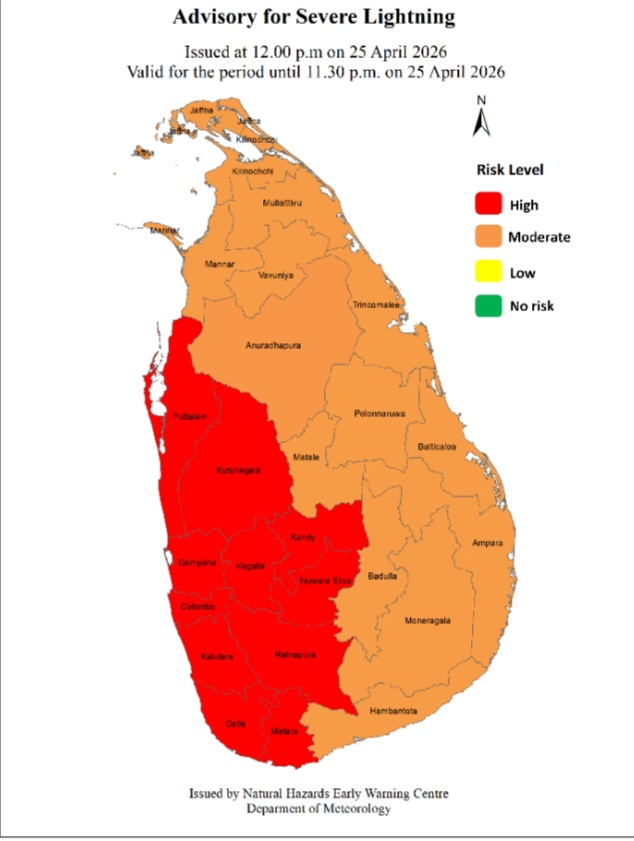
Advisory for Severe Lightning
Issued by the Natural Hazards Early Warning Centre
Issued at 12.00 noon 25 April 2026 valid for the period until 11.30 p.m. 25 April 2026
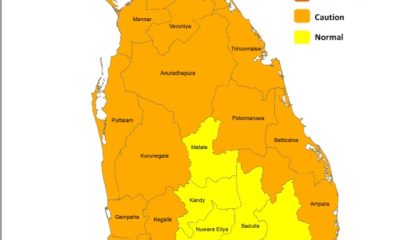
Thundershowers accompanied with severe lightning are likely to occur in the Western, Sabaragamuwa and North-western provinces and Galle, Matara, Kandy and Nuwara-Eliya
districts after 1.00 p.m.
There may be temporary localized strong winds during thundershowers. General public is kindly requested to take adequate precautions to minimize damages caused by lightning
activity.
ACTION REQUIRED:
The Department of Meteorology advises that
people should:
• Seek shelter, preferably indoors and never under trees.
• Avoid open areas such as paddy fields, tea plantations and open water bodies during thunderstorms.
• Avoid using wired telephones and connected electric appliances during thunderstorms.
• Avoid using open vehicles, such as bicycles, tractors and boats etc.
• Beware of fallen trees and power lines.
• For emergency assistance contact the local disaster management authorities.
Latest News
Kohli, Padikkal hit fifties as Royal Challengers Bengaluru ace the chase against Gujarat Titans
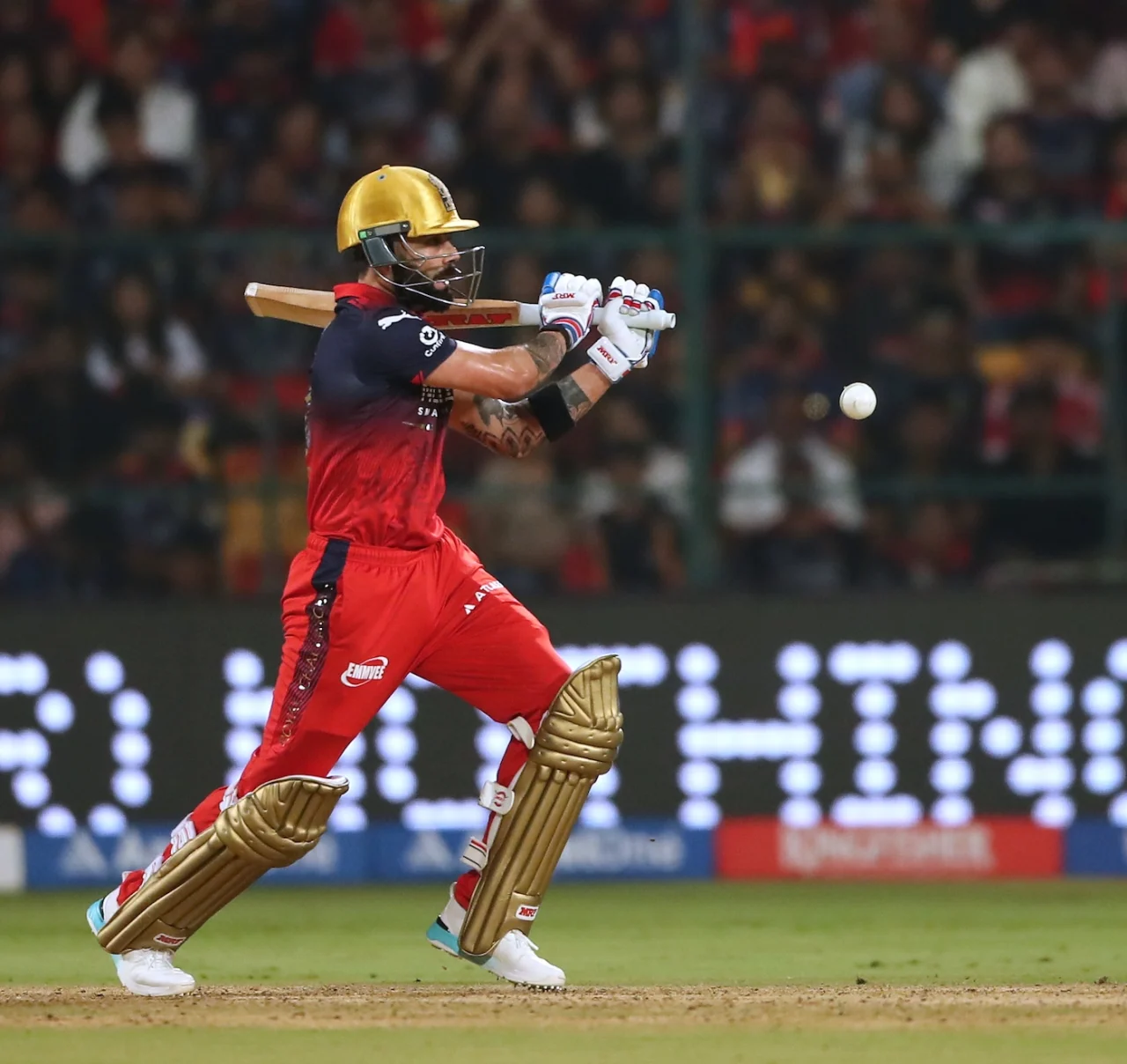
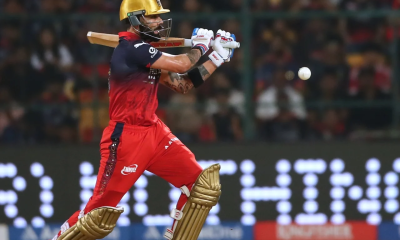
An exhibition of clean hitting by Virat Kohli and Devdutt Padikkal ensured Sai Sudarshan’s measured 100 off 58 balls ended in a losing cause as Royal Challengers Bengaluru (RCB) beat Gujarat Titans (GT) by five wickets at the Chinnaswamy Stadium.
After winning the toss, RCB captain Rajat Patidar had no hesitation in putting GT in. Sudharsan laid a strong foundation on a pitch he described as “two-paced and sticky to start with”. But even when the surface became easier to bat on, GT could not get into overdrive. They scored only 35 in the last four overs and finished on 205 for 3.
In response, Kohli, who was dropped on zero, smashed 81 off 44 balls and Padikkal blasted 55 off just 27. They put on 115 in 9.5 overs for the second wicket, and despite a bit of wobble towards the end, RCB romped home with seven balls to spare.
The GT openers prefer to take as few risks as possible and it was no different on Friday. Sudharsan was circumspect at the start and was on 17 off 16 after three overs. But he found his timing after that and moved to 41 off 27 by the end of the fifth. Gill had faced just three balls till then. GT finished the powerplay on 57 for no loss.
Sudharsan went inventive after the powerplay, scooping Romario Shepherd for a six. When Krunal Pandya bowled a bouncer, he uppercut him over deep third. Later in the over, he slog-swept the spinner for another six, reaching 2000 runs in the IPL. Taking 47 innings, he was the fastest to get there, bettering Chris Gayle’s record by one.
He and Gill added 128 in 12.4 overs, with Gill contributing 32 off 24 balls. The GT captain was starved of strike throughout his stay and holed out to long-on off Suyash Sharma. Sudharsan brought up his hundred off 57 balls, the slowest of the six so far this season. There was no cutting loose after reaching the milestone either. He was out on the very next ball he faced.
GT were 170 for 2 after 16 overs but Suyash, Bhuvneshwar Kumar and Hazlewood gave away only 17 in the next three. At 187 for 3, Rasikh Salam ran in to bowl the final over but he stopped even before he could bowl a delivery. It looked like cramps and despite the physio working on him, he had to walk off the field. Krunal replaced him and was hit for a six by Jason Holder off the first ball. After another ball, Krunal too pulled out of his delivery stride holding his groin. But after a bit of medical attention, he completed the over, but ended up leaking 18 runs.
With Phil Salt injured, Jacob Bethell finally got a chance to play this season. Opening the innings after coming in as Impact Player, he had a close shave in the second over. He got an inside edge to a length ball from Kagiso Rabada but it missed the stumps and beat Buttler for four. In the next over, he shuffled across and hit Mohammed Siraj for a four on either side of the wicket. But when he tried the same trick later in the over, he hit it straight to the backward point. He made 14 off ten.
Kohli was dropped off the first ball he faced. It was a length delivery from Siraj that he flicked uppishly towards short midwicket but Washington Sundar grassed a regulation chance. Kohli made his intentions clear in the following over when he hit Rabada over mid-on for a four.
Padikkal was even more ruthless. He opened his account with a first-ball six, picking up a 153.6kph length ball from Rabada over square leg. The GT bowlers didn’t help themselves by bowling onto his pads, and he kept flicking them fine for boundaries.
Rashid Khan wasn’t spared either. He dropped one short to Kohli and the batter duly pulled it over deep midwicket for a six before cutting the following delivery for four. In the spinner’s second over, Padikkal hit him for two sixes, the second one taking him to his fifty off just 20 balls. It made Kohli’s 30-ball fifty look pedestrian.
Rashid bowled Padikkal with a googly from around the wicket, and Kohli played Holder on but not before hitting the allrounder for back-to-back sixes.
Rajat Patidar and Jitesh Sharma kept the attack going. They hit a six each off Rashid but fell in quick succession. Suddenly, RCB were five down with 31 required from four overs. Krunal, though, bashed Manav Suthar for two fours and a six in the 18th over, bringing the equation down to seven needed from 12. In the penultimate over, he swatted Holder through midwicket for four before wrapping up the game with a gentle pull to fine leg.
Brief scores:
Royal Challengers Bengaluru 206 for 5 in 18.5 overs (Jacob Bethell 14, Virat Kohli 81, Devdutt Padikkal 55, Jitesh Sharma 10, Tim David 10*, Krunal Pandya 23*; Mohammed Siraj 1-25, Jason Holder 1-35, Rashid Khan 2-49, Manav Suther 1-19) beat Gujarat Titans 205 for 3 in 20 overs (Sai Sudharsan 100, Shubman Gill 32, Jos Buttler 25, Washington Sundar 19*,Jason Holder 23*; Bhuvneshwar Kumar 1-31, Josh Hazelwood 40, Suyash Sharma 1-36) by five wickets
[Cricinfo]
Latest News
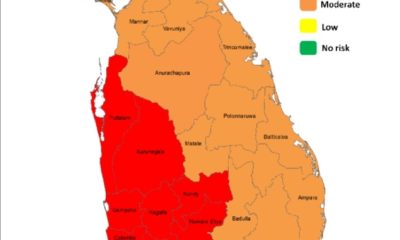
Heat Index at Caution Level in the Northern, North-central, North-western, Western, Sabaragamuwa and Eastern provinces during the day time
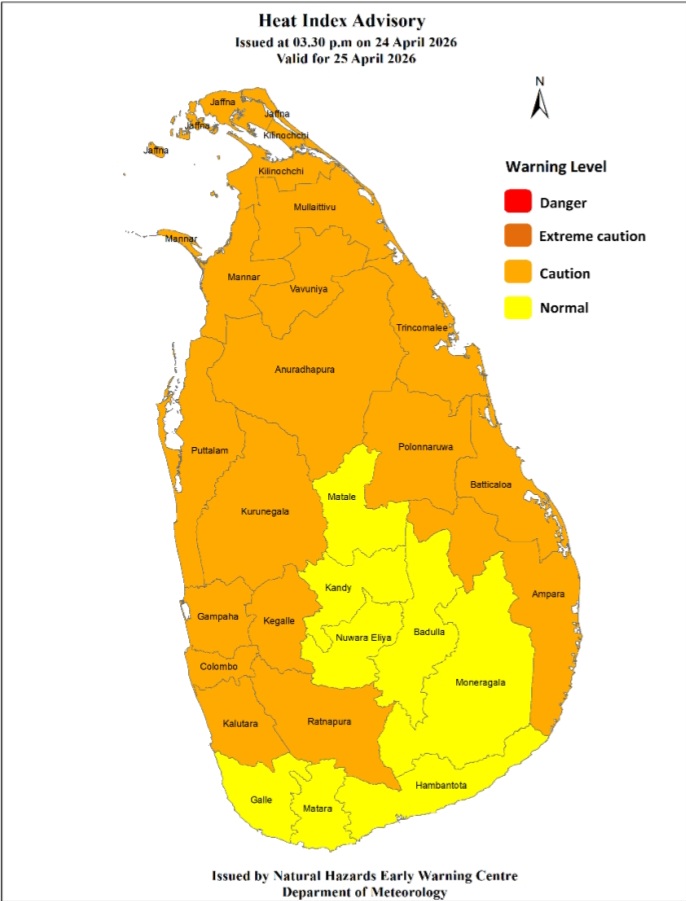
Warm Weather Advisory
Issued by the Natural Hazards Early Warning Centre
Issued at 3.30 p.m. on 24 April 2026, valid for 25 April 2026.
Heat index, the temperature felt on human body is likely to increase up to ‘Caution level’ at some places in Northern, North-central, North-western, Western, Sabaragamuwa and
Eastern provinces during the day time.
The Heat Index Forecast is calculated by using relative humidity and maximum temperature and this is the condition that is felt on your body. This is not the forecast of maximum temperature. It is generated by the Department of Meteorology for the next day period and prepared by using global numerical weather prediction model data.
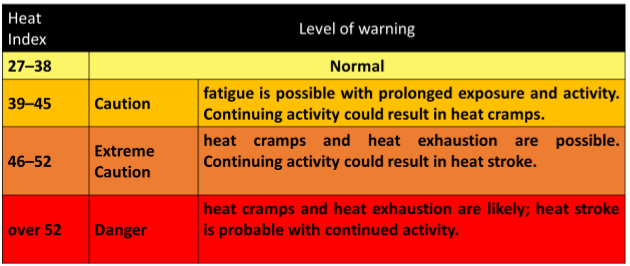
Effect of the heat index on human body is mentioned in the above table and it is prepared on the advice of the Ministry of Health and Indigenous Medical Services.
ACTION REQUIRED
Job sites: Stay hydrated and takes breaks in the shade as often as possible.
Indoors: Check up on the elderly and the sick.
Vehicles: Never leave children unattended.
Outdoors: Limit strenuous outdoor activities, find shade and stay hydrated.
Dress: Wear lightweight and white or light-colored clothing.
Note:
In addition, please refer to advisories issued by the Disaster Preparedness & Response Division, Ministry of Health in this regard as well. For further clarifications please contact 011-7446491.

Advisory for Severe Lightning issued For Western, Sabaragamuwa and North-western province

AI chatbots could be making you stupider

‘A remarkable time capsule’: The enchanting history of Oxford University’s 750-year-old medieval library

Kohli, Padikkal hit fifties as Royal Challengers Bengaluru ace the chase against Gujarat Titans

Showers expected in the Western and Sabaragamuwa provinces and in Galle, Matara, Kandy, Nuwara-Eliya and Puttalam districts after 2.00 pm

Heat Index at Caution Level in the Northern, North-central, North-western, Western, Sabaragamuwa and Eastern provinces during the day time

‘Dates have the highest sugar content to fight Coronavirus’

Sunday Island 27 December – Headlines

#SundayIsland 17th December – Headlines

Sunday Island – 28th March

Sunday Island Headlines – 21 March

Sunday Island – 21st February – Headlines
-
 News5 days ago
Rs 13 bn NDB fraud: Int’l forensic audit ordered
-

 Opinion6 days ago
Shutting roof top solar panels – a crime
-

 News3 days ago
Lanka faces crisis of conscience over fate of animals: Call for compassion, law reform, and ethical responsibility
-

 News2 days ago
No cyber hack: Fintech expert exposes shocking legacy flaws that led to $2.5 million theft
-

 News7 days ago
From Nuwara Eliya to Dubai: Isha Holdings markets Agri products abroad
-
 News2 days ago
Whistleblowers ask Treasury Chief to resign over theft of USD 2.5 mn
-
 News6 days ago
Church calls for Deputy Defence Minister’s removal, establishment of Independent Prosecutor’s Office
-

 Life style7 days ago
After dark in Sri Lanka: Tiny wild cats step into the spotlight