
News
World Bank: South Asia is a promising economic landscape with untapped potential


South Asia is emerging as the fastest-growing region for emerging markets and developing economies, with growth projections surpassing earlier estimates, according to the World Bank. Strong domestic demand in India and quicker recoveries across most South Asian nations have contributed to this optimistic outlook.
However, experts believe that the region could achieve even faster growth by addressing two critical areas of untapped potential: increasing women’s participation in the workforce and enhancing openness to trade and investment.
Currently, only one-third of working-age women in South Asia are part of the labour force, a stark contrast to the three-quarters of men and the 54 percent average for women in other emerging markets. While the region has made strides in providing equal educational opportunities for women, many still remain outside the workforce after graduation or marriage. Factors such as unsafe transport, lack of childcare, and restrictive legal frameworks hinder women’s economic mobility, forcing them into informal jobs with poor pay.
Legal structures in South Asia are among the least favourable to working women globally, and the region is known for conservative gender attitudes. As a result, female labour force participation rates are significantly lower—by 5 to 25 percentage points—than in countries at similar economic development levels, with Bhutan being the only exception.
Boosting female labour force participation to match that of men could potentially raise per capita incomes in South Asia by as much as 51 percent. To realize this potential, collaborative efforts from all sectors of society are essential. Governments can implement and enforce legal reforms aimed at improving gender equality, businesses can create job opportunities for women, and communities can challenge harmful gender norms to foster acceptance of women in the workforce.
In addition to gender integration, South Asia stands to benefit from ongoing shifts in global value chains. Investors are increasingly seeking locations with low geopolitical risks and strong economic fundamentals, positioning the region—especially India—to capitalize on these trends. However, trade and investment policies must evolve to support this potential.
Currently, South Asia has some of the highest tariff and non-tariff barriers, along with the lowest shares of trade in aggregate output. Protective policies may shield certain domestic firms from competition but also prevent others from accessing essential foreign inputs, raising costs and delaying technological advancements.
Experts advocate for a more open approach, suggesting that by embracing both gender equality in the labour market and liberalizing trade and investment policies, South Asia could unlock significant opportunities for sustainable growth. In the words of the World Bank, “An open palm can hold more rice than a closed fist,” highlighting the need for a collaborative effort to maximize the region’s economic potential.


Marikkar claims coal losses more than twice Treasury bond scam
By Shamindra Ferdinando
The SJB has accused the NPP government of trying to create an environment conducive for the re-appointment of Kumara Jayakody who resigned on 17 April 2026 over a coal scam perpetrated in 2025.
Colombo District MP S.M. Marikkar Tuesday (13) alleged that Jayakody’s successor Anura Karunathilaka was spearheading the efforts at the behest of President Anura Kumara Dissanayake.
Addressing the media at the Opposition leader’s Office at No. 30, Sir Marcus Fernando Mawatha, Colombo 07, Marikkar said that the NPP was busy propagating a lie that the losses amounting to Rs 15.68 bn could be entirely recovered by way of penalties and funds held as deposits in line with the supplier. The Opposition MP placed the amount held by the government at Rs 16.48 bn.
Marrikar claimed that the NPP’s propaganda project to whitewash Jayakody was meant to bring Jayakody back into the Cabinet of ministers in January next year. The top SJB spokesman said that the findings of the Sectoral Oversight Committee (SOC) on Infrastructure and Strategic Development report on the losses suffered by the use of substandard coal had been used to back the government move.
The inquiry was held into procurement for 2025/2026 seasons made from Trident Chemphar, an Indian company whose selection was questioned by the National Audit Office in a special report submitted to parliament before the vote on no faith motion against Jayakody.
Marikkar said that the NPP in its haste to build a case for Jayakody’s return to the cabinet had conveniently forgotten that six of the 25 shiploads of coal ordered from Trident Chemphar were never delivered. In a desperate bid to cover the shortfall, the government paid Rs. 2,284 million above the market price in emergency procurement. As the SOC had rejected the tests conducted by an Indian company and ordered fresh tests on substandard coal, an additional Rs 26.6 mn had been paid to an Australian lab, MP Marikkar said, explaining other losses caused by the corrupt deal.
Marrikar explained how the procurement of substandard coal altogether cost the taxpayer nearly Rs 20 bn while the government engaged in a project to clear Jayakody. The former minister is also indicted in the Colombo High Court in an earlier corruption case.
Marrikar emphasized that the government should accept responsibility. Comparing the action taken in respect of 2015 and 2016 Treasury bond scams and the coal scam, MP Marikkar said that the losses caused by Trident Chemphar fraud was double the Treasury bond scam. A future government would investigate the coal scam and punish all those responsible. The NPP under any circumstances couldn’t bring back Jayakody to the cabinet as he was directly responsible for the fraud, the Colombo District lawmaker said.
At the time the UNP perpetrated Treasury bond scams, Marikkar represented the UNP parliamentary group which made desperate bids to protect the bond thieves.
The SJBer refused to answer questions regarding any other issue. Marikkar reacted angrily when a journalist sought to raise a group of SJB MPs meeting the Most Ven Thibbatuwawe Sri Sumangala Mahanayake Thera of the Malwathu Chapter in Kandy. Then the MP accused a section of the media of trying to suppress the coal scam by raising other issues. Marrikar vowed that they wouldn’t allow Jayakody’s return to the cabinet. The NPP government’s reputation had been devastated by the coal scam and current efforts to cover up the direct involvement of Minister Jayakody would not succeed, he said, warning the NPP should be prepared to face the consequences.
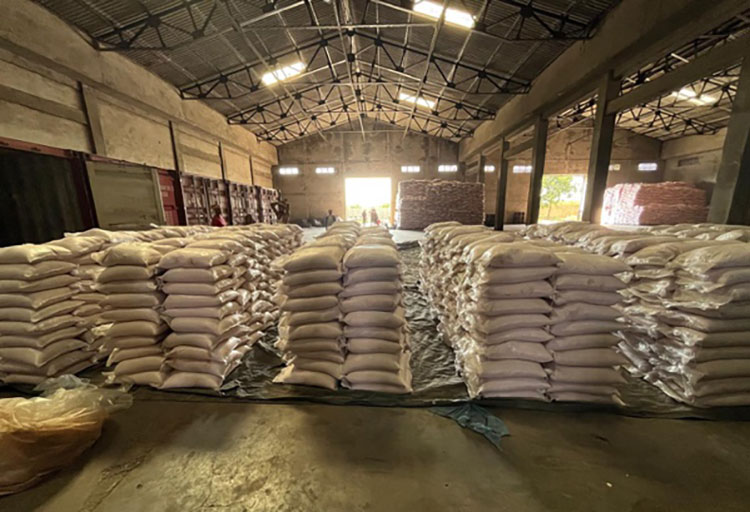
India’s Directorate of Revenue Intelligence (DRI) has busted a transnational smuggling network that illegally imported more than 7,300,000 kilos of Pakistan-origin rock salt by routing shipments through Sri Lanka and using forged trade documents to conceal their origin, India Today reported yesterday.
Four people had been arrested in connection with the case, the Ministry of Finance said on Wednesday.
Under Operation Deep Manifest, the DRI detected 295 containers carrying 7,311 metric tons of industrial and Himalayan rock salt, with an estimated value of Rs. 104.5 million in Sri Lankan currency.
The consignments were routed through Colombo port in Sri Lanka, while fabricated certificates of origin and invoices issued by United Arab Emirates-based entities were allegedly used to disguise the goods as originating elsewhere.
The imports violated India’s prohibition on goods originating in or exported from Pakistan, the ministry said.
Acting on specific intelligence, the DRI conducted a coordinated operation between September 26 and October 11, searching premises linked to the suspected network in Gandhidham, Adipur, Veraval, Panipat, Pune, Patiala, Delhi and Mumbai.
The investigation found that nine importers had brought in the 295 containers through Mundra and Kandla ports since March 2026.
Of the total consignments detected, five containers carrying 140 metric tons of industrial and Himalayan rock salt, valued at Rs. 8.48 million in Sri Lankan currency, were seized at Kandla port. The agency also seized sales proceeds worth Rs. 7.3 million in Sri Lankan currency held in the importers’ bank accounts.
… stage sit-in protest near Presidential Secretariat
by Nishan S. Priyantha
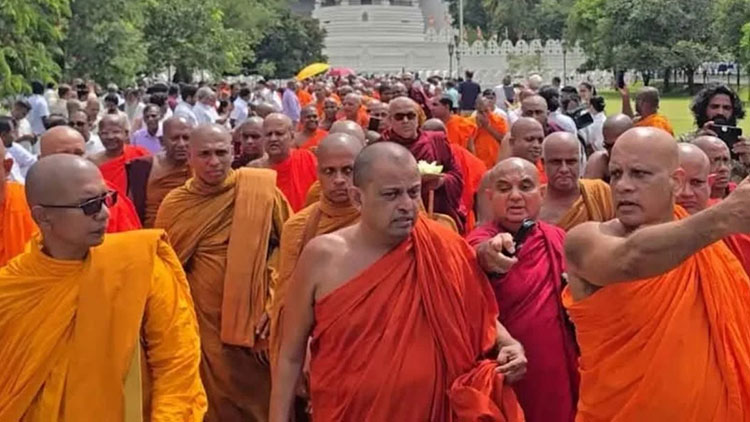
Buddhist monks who marched to Colombo demanding the release of imprisoned Ven. Galagoda Aththe Gnanasara Thera continued their sit-in protest outside the Presidential Secretariat yesterday, as discussions between their representatives and Presidential Secretary Dr. Nandika Sanath Kumanayake were underway.
The protesting monks said they would not leave the site until the authorities gave a positive response to their demand for the release of Gnanasara Thera. The discussions were continuing at the time this edition went to press.
The monks arrived in Colombo despite heavy rain, completing the six-day “Nidahase Pada Yathra” (Freedom March), which began in Kandy on October 10. The final leg of the march commenced from Kadawatha yesterday morning, proceeding through Kiribathgoda, Peliyagoda, Maligawatta and Maradana before reaching the area near the Presidential Secretariat at Galle Face.
Ven. Ulapane Sumangala Thera, commenting on the protest, urged the government to take immediate steps to secure Gnanasara Thera’s release, saying the participating monks expected a favourable response to their demand.
“Today is our final day. The Maha Sangha came from all four directions not to return empty-handed. We strongly urge the government to grant freedom to Gnanasara Thera, which is the expectation of all, including the respected chief prelates,” he said.
Ven. Sumangala Thera said the monks were prepared to meet President Anura Kumara Dissanayake at any location designated by him, including Pelawatte, Parliament or the President’s House.
“We are waiting to receive that message. If that does not happen, we are prepared to come wherever the President is. We are prepared to settle this matter one way or another today,” he said, warning that if their peaceful appeals continued to go unanswered, the monks would consider alternative ways of conveying their demands to the government.
The march, which began in Kandy on October 10, passed through Kadugannawa, Kegalle, Warakapola and Nittambuwa before reaching Kadawatha on October 14. The procession was organised to demand the release of Gnanasara Thera and advocate for the religious rights of Buddhist monks.
Heavy police security was deployed around the Presidential Secretariat and nearby roads as the monks gathered in the area. Galle Road near the Secretariat was also closed to traffic during the march.

Showers in the Western, Southern, Central, Sabaragamuwa, North-Western and Northern provinces and in the Anuradhapura District

SJB: Govt. trying to reappoint Jayakody, who resigned from Cabinet amidst coal scam

India busts Pakistani salt smuggling via Sri Lanka

Monks brave heavy rains to press for Gnanasara Thera’s release

Naval officer testifies Yoshitha received Rs. 5.15 mn in salaries during SLN service

TISL tells govt. to withdraw Protection of State from Terrorism Bill, citing its draconian provisions

‘Dates have the highest sugar content to fight Coronavirus’

Sunday Island 27 December – Headlines

#SundayIsland 17th December – Headlines

Sunday Island – 28th March

Sunday Island Headlines – 21 March

Sunday Island – 21st February – Headlines
-

 News5 days ago
Sri Lanka escalates anti-graft drive with Shiranthi’s jailing
-
 News6 days ago
NPP govt. reminded of its responsibilities as US warship leaves Colombo
-

 Latest News6 days ago
Farhan, Sadaqat help Pakistan ace 183 chase to go 1-0 up
-

 Latest News4 days ago
Farhan and Sadaqat help Pakistan seal series in style
-
 News5 days ago
Iranian ships stranded, Lanka fears US sanctions
-

 Latest News3 days ago
Nissanka’s return headlines Sri Lanka’s Test squad against Pakistan
-
 News6 days ago
Interdicted top House official Kularatne receives special recognition in Mexican Parliament
-
 Features4 days ago
Intake 16: 45 years of duty and honour