
News
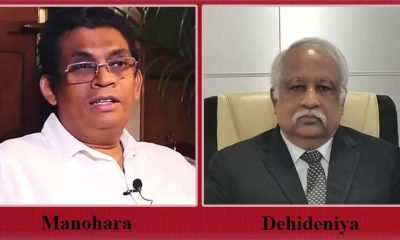
Manohara makes strong case for draft Constitution, responds to criticism


By Shamindra Ferdinando
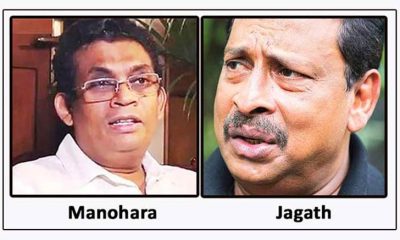
President’s Counsel Manohara de Silva has strongly defended the retaining of the controversial 13th Amendment introduced at the behest of India in the new draft Constitution formulated by a 9-member committee appointed by former President Gotabaya Rajapaksa.
Manohara, one of the members of the committee headed by Romesh de Silva, PC, emphasised that the controversial Amendment enacted in the wake of the Indo-Lanka Accord signed in July 1987 had been diluted by the draft Constitution therefore Provincial Council system no longer posed a threat to the country’s unitary status.
An outspoken critic of foreign intervention, Manohara said so at a symposium organized by the Buddhasasana Karyasadaka Mandalaya at Sri Lanka Foundation (SLF) recently.
The constitutional expert challenged those skeptical of the draft Constitution to prove the committee wrong. The lawyer appreciated the Buddhist grouping taking the lead in educating the public on the proposed Constitution in the absence of the Wickremesinghe-Rajapaksa government taking any interest in the ex-President’s project.
However, on behalf of the Coalition Against Partition of Sri Lanka, its Convener retired Lt. Gen. Jagath Dias sought an explanation from the committee regarding the representations made by the Tamil National Alliance (TNA), one-time LTTE ally, pertaining to new constitutional proposals.
The Gajaba Regiment veteran also asked whether the discourse on the draft Constitution initiated on Oct. 12 would continue and the availability of an opportunity to make suitable amendments having considered fresh views in that regard.
Lt. Gen. Dias, who has declared that the full implementation of the 13th Amendment would undermine Sri Lanka’s unitary status, stressed the need for wider consultations regarding constitutional amendments.
President’s Counsel Romesh de Silva declined to reveal the submissions made by the TNA delegation, led by its leader R. Sampanthan. De Silva received the backing of four members of his committee, namely Manohara de Silva, Sanjeewa Jayawardena, PC, Samantha Ratwatte, PC and Navin Marapana, PC.
The team leader said that the dialogue between them and the TNA or any other party couldn’t be discussed publicly though necessary amendments could be effected following discussions. The committee explained that their responsibility was to produce a draft Constitution and further actions should be the prerogative of the government in power. The committee acknowledged that since the handing over of the draft Constitution to the then President, nothing has been done. The gathering was told that based on further discussions on the subject matter the process could be advanced in consultation with relevant parties.
Manohara de Silva said that in the absence of the Gotabaya Rajapaksa government and the Wickremesinghe-Rajapaksa government sleeping on it, Buddhasasana Karyasadaka Mandalaya, invited them to educate the public of the initiative. “We are only invitees here. Perhaps, they’ll continue this process,” the top lawyer said.
Ven. Athureliye Rathana, MP, threw his weight behind the effort. The MP monk asserted that the draft Constitution cleverly proposed a way out of a sensitive issue as it involved India and couldn’t be dealt with haphazardly. The monk stressed the need to further improve the section that dealt with waste, corruption and irregularities and closer look at economic policies. The former JHU heavyweight pointed out how Sri Lanka handled the power sector without adhering to tender procedures, thereby causing enormous loss to the national economy.
In his speech, Manohara de Silva responded to criticism directed at their draft Constitution. Declaring that what had been proposed was not the 13th Amendment that was already in the Constitution now, the lawyer said that they opposed it because the Provincial Council exercised more powers than the government.
The crux of the matter is in case Provincial Councils enacted a law in terms of the current Constitution, the Parliament has no say. The 13th Amendment to the Constitution has been enacted at the expense of Parliament, Manohara said, adding that the Supreme Court that was sharply divided on the issue allowed the law to be passed on the basis the Parliament with a two-thirds majority could do away with it.
Therefore, the 13th Amendment diluted the power of Parliament, the lawyer said, declaring that draft Constitution proposed that though the Provincial Councils could enact laws relevant, Parliamentary laws wouldn’t be undermined by them. De Silva explained that the 13th Amendment compelled the Governors of the Provinces appointed by the President to work in consultation with the provincial ministers. Alleging it dented the executive authority pertaining to what he called provincial subjects, Manohara said that they proposed measures to be taken against in case Provincial Councils resorted to wrong executive decisions.
Perhaps one of the most significant proposals was to do away with elections to the Provincial Councils, the lawyer said, explaining how the required number of PC members could be elected at the Local Government polls, thereby saving quite a considerable amount of funds. Manohara de Silva stressed that what was proposed by them were not the PCs established under the current law.
“Some asked why the whole thing was not scrapped altogether. We discussed this matter. We could have formulated the draft constitution without the relevant section on Provincial Councils,” he said, referring to various constitution making attempts with the focus on the project undertaken by M.A. Sumanthiran, MP, and the then UNP National List Member Dr. Jayampathy Wickremaratne during the Yahapalana administration.
Warning the audience of the threat posed by President Ranil Wickremesinghe’s declaration that he intended to build on the Yahapalana constitutional project, De Silva said that political parties represented in Parliament, and outside, wanted the PC system to continue. Those who had appeared before the committee sought the continuation of the PCs as they wanted their offspring and henchmen to use them as launching pads for parliamentary careers. Therefore, the only option available was to dilute the PCs as the Parliament wouldn’t allow abolition of PCs, the lawmaker said, declaring no government would do so. An irate de Silva said that those represented in Parliament wanted the expansion and strengthening of the system.
Manohara said that members of the nine-member committee could have produced nine different drafts. But, they decided to sink whatever the differences to produce one document that took into consideration views expressed by political parties represented in Parliament and outside.







Latest News
Flood warning issued to the Divisional Secretariat Divisions of Ganga Ihala Korale, Udapalatha, Doluwa, Udunuwara, Yatinuwara, Gangawata Korale, Harispattuwa, and Pathadumbara


Due to heavy rainfall received in the upper catchment areas of the Mahaweli River over the past few hours, there is a risk of minor flooding in the low-lying areas surrounding the Mahaweli River within the Divisional Secretariat Divisions of Ganga Ihala Korale, Udapalatha, Doluwa, Udunuwara, Yatinuwara, Gangawata Korale, Harispattuwa, and Pathadumbara.Residents living in the above mentioned areas and motorists using roads passing through these areas are urged to exercise extreme caution and remain highly vigilant regarding the prevailing situation.
Furthermore, residents living in close proximity to the Mahaweli River in these areas are advised to remain highly alert to the situation and take all necessary precautions to protect themselves from any potential flooding.The relevant disaster management authorities are requested to take all necessary measures in response to this situation.

The National Building Research Organisation [NBRO] has issued landslide Red Alerts to the districts of Kandy, Kegalle and Nuwara Eliya effective from 14:00 hrs on 20.09.2026 To 14:00 hrs on 21.09.2026
Accordingly,
LEVEL III [RED] Land Slide early warnings have been issued to the Divisional Secretaries Divisions and surrounding areas of Pasbage Korale in the Kandy district, Dehiowita, Aranayake, Deraniyagala, Mawanella and Yatiyanthota in the Kegalle district and Kothmale West, Kotmale East, Ambagamuwa and Norwood in the Nuwara Eliya district
LEVEL II [AMBER] Land Slide early warnings have been issued to the Divisional Secretaries Divisions and surrounding areas of Padukka in the Colombo district, Nagoda, Thawalama and Neluwa in the Galle district, Bulathsinhala, Palindanuwara, Walallawita and Agalawatta in the Kalutara district, Ganga Ihala Korale in the Kandy district, Bulathkohupitiya and Kegalle in the Kegalle district, Akuressa and Pitabeddara in the Matara district, Thalawakele in the Nuwara Eliya district and Pelmadulla, Ratnapura, Ayagama, Kuruwita and Ratnapura in the Ratnapura district.
LEVEL I [YELLOW] Land Slide early warnings have been issued to the Divisional Secretaries Divisions and surrounding areas of Seethawaka in the Colombo district, Niyagama and Baddegama in the Galle district, Mirigama in the Gampaha district, Ingiriya in the Kalutara district, Udapalatha and Yatinuwara in the Kandy district, Galigamuwa, Warakapola and Ruwanwella in the Kegalle district, Kotapola, Pasgoda and Athuraliya in the Matara district, and Eheliyagoda, Kalawana and Elapatha in the Ratnapura district.
News
Development projects can deliver results to the people more quickly when the political authority and the public service work together towards a common goal – PM
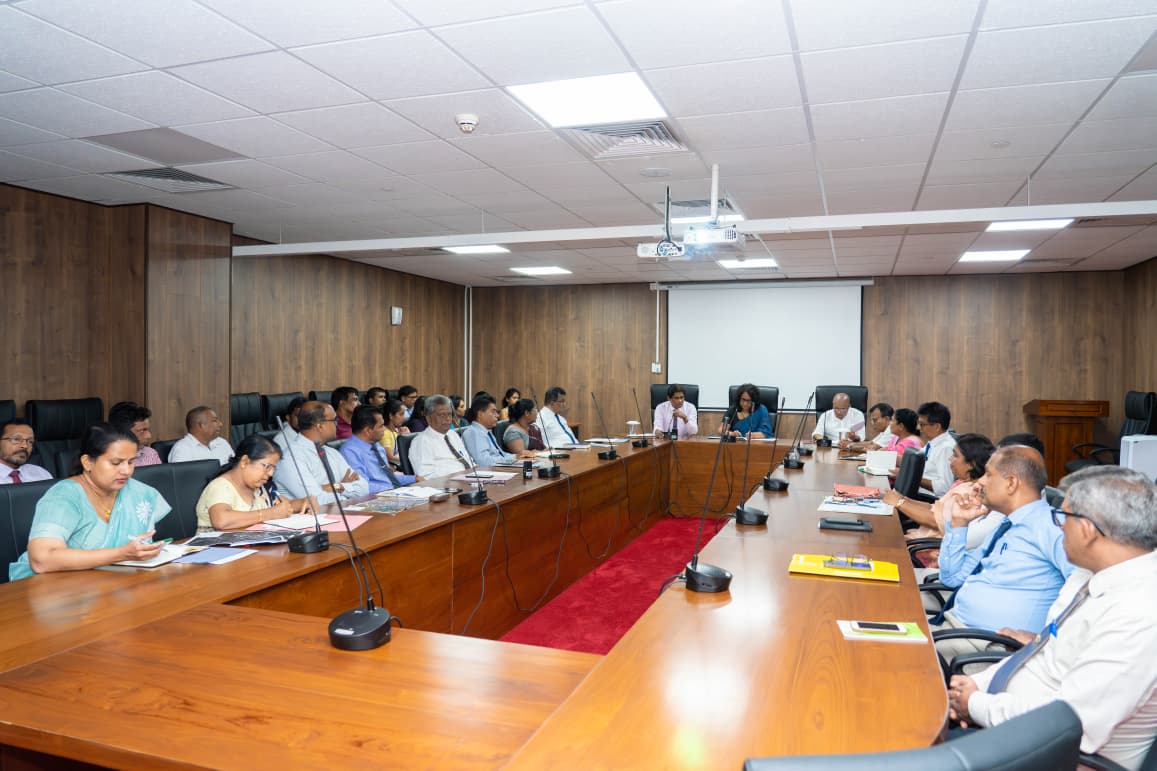
Prime Minister Dr. Harini Amarasuriya stated that development projects can deliver results to the people more quickly when the political authority and the public service work together towards a common, people-oriented objective.
The Prime Minister made these remarks while participating in a discussion held on Friday [September 18] at the Western Province Council Auditorium to review the progress of the development project to rehabilitate Rathmalana Kandawala Road and the drainage system on either side of the road, within the Dehiwala–Mount Lavinia Municipal Council limits in the Colombo District.
The project, which commenced on September 10, 2026, is scheduled to be completed before June 30, 2027. Implemented by the Provincial Road Development Authority (PRDA), the project includes the construction of a bridge at a cost of Rs. 64 million, the rehabilitation of the drainage system at a cost of Rs. 930 million, and the rehabilitation of the road at a cost of Rs. 115 million.
The Prime Minister also paid special attention to the progress of the responsibilities assigned to the Western Province Council, the Irrigation Department and the Ratmalana Divisional Secretariat in accordance with decisions taken at the previous committee meeting. Attention was also given to the current status of the plans being carried out by the Sri Lanka Land Development Corporation (SLLRDC), as well as the construction and maintenance activities being undertaken by the Provincial Road Development Authority (PRDA).
Commending the expedite and commendable progress of the project, the Prime Minister particularly appreciated the commitment demonstrated by officials of the relevant government institutions to work in close coordination with one another and in collaboration with the political authority.
The Prime Minister also emphasised the importance of taking measures well in advance to control flooding and minimise its impact on Colombo and several other districts in view of the rainy weather that may affect the Western Province during the latter part of this year.
The meeting was attended by the Chairman of the Colombo District Coordinating Committee and Member of Parliament Lakshman Nipuna Arachchi, Chairperson of the Ratmalana Divisional Coordinating Committee and Member of Parliament Samanmalee Gunasinghe, Chairman of the Roads Sub-Committee of the Colombo District Coordinating Committee Dewananda Suraweera, Mayor of the Dehiwala–Mount Lavinia Municipal Council Parakum Shantha, Chief Secretary of the Western Province K.G. Pradeep Pushpakumara, along with a number of government officials.
[Prime Minister’s Media Division]

Flood warning issued to the Divisional Secretariat Divisions of Ganga Ihala Korale, Udapalatha, Doluwa, Udunuwara, Yatinuwara, Gangawata Korale, Harispattuwa, and Pathadumbara

Landslide Red Alerts issued to the districts of Kandy, Kegalle and Nuwara Eliya

Shafali dazzles with 49-ball unbeaten 100 and India march into Asian Games final

Development projects can deliver results to the people more quickly when the political authority and the public service work together towards a common goal – PM

Landslide Early Warnings issued to the Districts of Colombo, Galle, Kalutara, Kandy, Kegalle, Matara, Nuwara Eliya and Ratnapura

Chamari Athapaththu’s unbeaten 83 leads Sri Lanka into final

‘Dates have the highest sugar content to fight Coronavirus’

Sunday Island 27 December – Headlines

#SundayIsland 17th December – Headlines

Sunday Island – 28th March

Sunday Island Headlines – 21 March

Sunday Island – 21st February – Headlines
-

 Opinion6 days ago
From Galkissa (Mount Lavinia) to Tambuttegama
-

 News3 days ago
US embassy won’t comment on IGP’s probe into joint drug raid
-

 Features5 days ago
The emptying university: why are academics leaving?
-

 Features6 days ago
Sri Lanka’s university crisis: Brain drain and union action demand urgent reform
-

 Business3 days ago
All-new Bolero MaXX unveiled in Sri Lanka
-

 News2 days ago
Bid for Basil’s extradition nears final stage: Police
-

 Opinion6 days ago
Ashraff: From the SLMC towards the National Unity Alliance
-

 Editorial6 days ago
Muscle flexing, astroturfing and dog-and-pony shows