
Features
Trump indicted, Aragalaya in Israel, and IMF in Sri Lanka


by Rajan Philips
Halfway through my writing this piece news broke out that a Grand Jury in New York has voted to indict former President Donald Trump on reportedly more than 30 counts in connection with his alleged role in a hush money payment scheme and cover-up of his affair with an adult film star. The sordid affair was before Trump began his presidential run; the crime of payment was committed when he was the Republican candidate. The Grand Jury in the US criminal justice system is a group of citizens who hear evidence from a prosecutor and other witnesses against an accused person and votes in secret to decide if there is enough evidence to charge that person with a crime.
That the Grand Jury in Manhattan, New York, believes that there is enough to charge a former president with a crime is unprecedented in US history, but it should be considered par for the course when it involves Donald Trump. A separate criminal trial with another jury awaits the indicted Trump, but the legal theatre that the Manhattan District Attorney has opened in New York will preoccupy US society and politics for months, even years, to come. America will trundle along with no dramatic changes internally because as a highly federated leviathan it is too cumbersome for swift overhauls. Externally, the US President will have the necessary autonomy to plough ahead, but only with impaired credibility and not without universal derision.
Besides the case in New York, Trump is facing the real possibility of a separate indictment in the State of Georgia over election interference, and the growing possibility of indictments by a federal prosecutor for his involvement in the January 6 (2021) violence at the Congress in Washington and over his handling of confidential government documents and obstructing the course of justice. Trump is still bluffing and believing that the indictments will boost his campaign for another shot at the presidency, but the only ones falling for his bluff are those in the Republican Party – those who believe like him and others who do not have the backbone to call his bluff. Trump has been calling out on his faithful to come out and protest for him, but no one seems to be falling for his demagoguery anymore.
Israel’s Aragalaya
Global protests now are against those in power and for throwing them out. They are not for reinstating someone like Trump who didn’t deserve to get power in the first place, the first time. There will be a lot of drama but nothing like what is going on in France and Israel, or what happened in Sri Lanka last year. Israel is having its own version of aragalaya with nearly a three-quarter million people storming the streets of Tel Aviv last Sunday to protest against Prime Minister Netanyahu’s political scheming to subordinate the country’s judiciary to its legislature. The pretext theory for Netanyahu in Israel, as with others of his ilk elsewhere, is that unelected judges should not be allowed to frustrate the so called will of the people that is conveniently expressed through the governing majority of their elected representatives in parliament. Mr. Netanyahu’s real purpose, however, is to prevent the courts from finding him guilty on charges of fraud, corruption and potentially sending him to jail.
The scale and persistence of protests in Israel are not unlike the explosion of aragalaya in Sri Lanka. But both are different from the protests in France in that they are not about government corruption or an authoritarian President. Also, the judiciary is not implicated in the French standoff between President Macron and the people protesting over the working life span of ordinary French people, especially women and wage workers. Sri Lankan governments and Presidents, like colonial Governors before them, have had their monkeying moments with the judiciary, but the judiciary has been spared of political ignominy for some time after the cowardly impeachment of Chief Justice Shirani Bandaranayake by Rajapaksa bullies.
Now there are rumblings that Supreme Court Judges might be hauled before a Parliamentary Privileges Committee to clear up just who the bosses are when it comes to disbursing government funds. This is President Wickremesinghe’s tit-for-tat response to a divisional bench of the Supreme Court directing the Treasury not to withhold funds needed for local government elections that are now past their due date. This is not the same situation that Netanyahu has stirred up in Israel, and it is not likely to stir up the same level of protests as in Israel. Put another way, there will be no aragalaya for the judges in Sri Lanka.
But the judges should feel free to stage their own form of silent protest and rebuff any highhanded call to attend a parliamentary committee meeting. They can take a leaf from Justice TS Fernando’s playbook when he stood up to Felix Dias’s tricks and entreaties to drop the curtain on the proceedings of Sri Lanka’s first Constitutional Court in the 1970s. Such a judicial pushback against a clever-by-half executive will command huge public support and sympathy, even if the people may not take to the streets (or Galle Face) as they did during aragalaya, or as it is going on now in Israel. There are other differences too.
The protests in Israel against Netanyahu’s scheming against the judiciary are also a manifestation of simmering differences between secular Jews and orthodox religious Jews over the future direction of Israel, the status of Palestinian citizens of Israel, and the provocative Jewish settlements in the Israeli-occupied West Bank. The orthodox religious Jews of Israel generally of Middle Eastern descent are hostile to the courts which often rule against ultranationalist Jewish claims and agendas. The courts are seen to be dominated by liberal judges who are Jews of mostly of European origin.
Israel’s ultranationalist and religious Jews have largely been a fringe force in Israeli politics until Netanyahu reached a Faustian pact with them after the elections last November to become Israel’s Prime Minister for the sixth time in his checkered political career. He cobbled together a coalition comprising rightwing and religiously conservative parties, all of them more conservative than Netanyahu’s Likud Party, to form the most rightwing government in Israel’s history. Their aim is to expand Jewish settlements on the West Bank, subordinate the courts to the will of the governing coalition, and transform the state of Israel to become more religious and less secular.
Netanyahu calls his era Israel’s golden age to the dismay of the country’s moderates and its overseas benefactors. The country including the military is gravely divided, and the protests have been successful in forcing Mr. Netanyahu to call for ‘a pause’ to his legislative scheming, to have more dialogue with his opponents. But he has given no indication that he will scale down the changes that he is pursuing. However, the PM’s pause has becalmed sections of the protesters. Histadrut, the country’s largest trade union with 800,000 members, has now called off a general strike after successfully staging a token strike that even included Israeli officials in foreign missions walking out of their embassies.
In France, on the other hand, the unions are demanding that their President follow Israel and call for a pause on the retirement age! The Macron government has responded that it is prepared to dialogue with the unions on any and all of their other grievances except the age of retirement. So, the standoff continues with no end in sight. But neither in France nor in Israel, is there any attempt to clampdown on protesters or declare emergency rule. That happens to be only in Sri Lanka, thanks to President Wickremesinghe and his political machinations.
The IMF and its Discontents
It has been clear that after the tumultuous exit of Gotabaya Rajapaksa, President Wickremesinghe has been the beneficiary of a protest fatigue in the country. Strangely enough, it is the President who seems to be bent on poking the protest tiger to give himself the excuse to impose a clampdown. His poking is all political; for on the more critical issue of the economy, the President is shadow boxing because there is no real opposition to his economic initiatives including his ‘pre-historical’ (inasmuch as Sri Lanka’s economic history is just beginning with Ranil at ’74) deal he signed with the IMF. While the Sri Lankan protest universe is mad as hell with the President on specific issues – taxes, LG election etc., no one has the stomach for a general strike over the IMF.
While a strike may have been averted, that was no reason for government bozos to light firecrackers to celebrate the IMF deal. There is nothing to celebrate here. The IMF is not the end of the road, it is only the end of the beginning. At the same time, the old detractors of the IMF seem to be immaturing with age – to borrow Prime Minister Harold Wilson’s classic putdown of Tony Benn, then keeper of the Labour Party’s left-conscience, that “Tony immatures with age!” There is no point in rehashing the rhetoric of the 1960s and 1970s against an IMF deal in 2023. Those who eternally bring up the venerable name of Joseph Eugene Stiglitz and his searing criticisms one time of the IMF, may want to know what The Economist said recently about Mr. Stiglitz and the IMF, that they may have “warmed to each other,” after their earlier differences. All of this is table talk that is not going to help Sri Lanka in any way.
Apart from the details of the Ranil-IMF agreement, what is remarkable now is the openness of the IMF officials to engage directly with the Sri Lankan public. On March 21, after the IMF agreement was finalized, there was an extensive Press Briefing and Q & A session conducted virtually from Washington. Quite a few commentators and journalists participated from Colombo, and the IMF website carries the transcript of the whole briefing and exchanges. Questions and answers were free and frank, and covered, besides details of the agreement, even the timing of local and presidential elections in Sri Lanka. The exchanges were livelier and more informed than one might come across in today’s parliament in Sri Lanka. This was followed by a virtual roundtable meeting with trade union representatives in Colombo, in which the IMF officials indicated that the government might be able to revise the current tax proposals to address some of the union concerns.
The onus is on the government to finally set about revamping the economy. For the opposition, there are parts of the IMF agreement that can and should be used to hold the government accountable and answerable in a very political way. These include eradicating corruption, going beyond the IMF’s goal of “reducing corruption vulnerabilities; strengthening social safety nets; and revisiting the tax concessions currently offered to potential Port City investors. The IMF Staff Report includes a number of Annexes, one of which, Annex VII. The Social Safety Net: Recent Developments and Reform Priorities, could be a technical blueprint for a political manifesto. Annex VII. Colombo Port City Project, provides a sobering account of what the Galle Face venture may or may not bring to Sri Lanka after all the shouting. There is a lot to chew here besides the shouting.

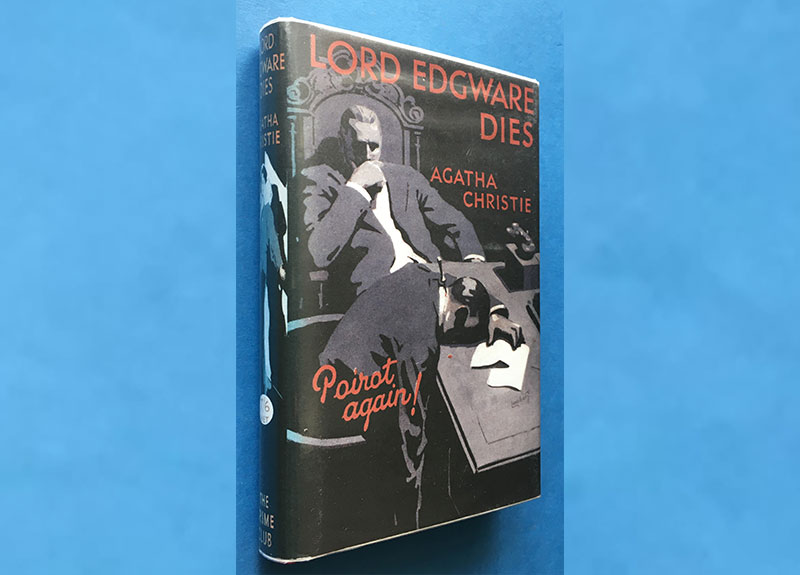
It has been some time since I read an Agatha Christie, the plot of which I cannot remember. So, I was delighted to find on the shelves of a friend Lord Edgware Dies, which I had a vague memory of, but no certainty about who had done it.
When I read it, I found that my memory of who was probably the killer was correct, but I could not be certain and the red herrings Christie threw in were so diverting that until almost the very end I wondered if I had been wrong.
The plot is very simple. Jane Wilkinson, who is married to Lord Edgware, tells him that she is desperate for a divorce since she is in love with a very proper Anglo-Catholic peer, Lord Melton, but Edgware refuses to divorce her. She asks Poirot to talk to him, which he does, and is surprised to find that Edgware has told Jane he is prepared to give her a divorce. This was, after he had categorically refused, through a letter, which Jane said she had not received.
That night Edgware is murdered, after Jane had been to see him, or so the butler said, and also Edgware’s secretary. But Jane had been that evening at a grand dinner many miles away, where a dozen fellow guests could swear to her presence.
There was a solution however to the mystery of two Jane Wilkinsons, namely a skilful impersonator called Carlotta Adams who, in the opening chapter had impersonated Jane Wilkinson, who had also been at the performance. But when Poirot goes to see her, he finds that she had been found dead on the morning after Edgware had been killed, of an overdose. And in her bag was a gold case, with a strange inscription, that contained the drug, along with a pair of pince-nez.
Her maid said she had written a letter to her sister in America and posted it the previous night. Poirot asks Inspector Japp to get the letter, and a transcript is received from America, and in it the name of Edgware’s nephew Ronald Marsh is mentioned; he had taken Carlotta to dinner after her performance, with which the book opens, and had then set her a challenge. Japp arrests Marsh, but Poirot is not happy and asks for the original of the letter, which the sister sends him. That shows that a page is missing, and the tear is obvious, though that raises the question as to why it had not simply been cut.
Matters are further complicated by the fact that Marsh had gone in a taxi to the Edgware house, along with Edgware’s daughter Geraldine, in the interval of an opera which had previously seemed to provide them with cast iron alibis. Geraldine had gone in to fetch her pearls so that Marsh could raise money he needed, and thus had an opportunity to kill Edgware, as did Marsh, for the driver said he had got out of the taxi while waiting and gone into the house.

Agatha Christie
Marsh explained why he had gone to the house on the night of the murder as having followed Bryan Martin, an American actor, who had been in love with Jane, whom he saw go into the house with a key. But there was no one visible when he entered, and Geraldine almost immediately came down and they left together. And Martin too has become an object of suspicion to Poirot, for he had been to see him before the murders were discovered with a story of being followed by a man with a gold tooth – a story Poirot immediately realized was false when he was asked how old the man was, and was told he was young, for young people did not have gold teeth.
A heap of French money Edgware had got for a trip to Paris was missing, but since Marsh had no need for it after his cousin’s offer of help, Poirot deduces that it must have been taken by the butler, who has disappeared. Christie has stressed that he is astonishingly handsome, unusual in a butler, and Poirot notes a resemblance to Martin, so he thinks the mysterious man going into the house must have been him.
Incidentally, later Poirot assumes that Edgware’s change of mind was because he was involved in some scandal, and I believe Christie intends us to see the cause of this in his handsome butler, though this is not specified.
Meanwhile, Poirot has asked Japp to find out the provenance of the case found in Carlotta’s handbag, and it turns out to have been made in Paris, specially commissioned, and collected by a woman with pince-nez.
But then another murder occurs—that of another guest at the grand dinner, which provided Jane with her alibi. The victim is an actor who had been bemused when Jane, at a lunch, thought the Judgment of Paris referred to the city. He told Hastings he wanted to see Poirot, but was killed before he could get to the appointment. Poirot had rushed there when told about his request, but it was too late.
Meanwhile, Poirot has tried out the pince-nez on Edgware’s secretary, but she could not see through these. It was only a chance remark heard outside the theatre that led him to try them out on Wilkinson’s maid Ellis, a spare pair that had been appropriated for the night of the murders.
Poirot then lays things out, having summoned Martin and told him that he probably suppressed Edgware’s letter, as he had been dropped by then and he did not want Jane to marry another. But after teasing Martin, Poirot says that Jane was in fact the murderer, and she got Carlotta to impersonate her at the dinner while she went to the house and killed her husband. After meeting Carlotta later and checking with her through a call that she had not been rumbled, Jane had gone ahead with the murder – she put veronal into her drink and the case with veronal into the handbag. She forgot to take out the pince-nez she had used earlier to imitate an American. Carlotta had registered as the American in a hotel and Jane had gone to see her, and there they exchanged identities. After seen the letter, she made use of it by tearing off the page that referred to her, and the S of She, so that the person who had challenged Carlotta to impersonate her seemed to be a man.
There is a coda in which Jane, condemned to death, writes to Hastings, still full of pride at her ingenuity hoping she will be remembered.
by Prof. O. A. Ileperuma
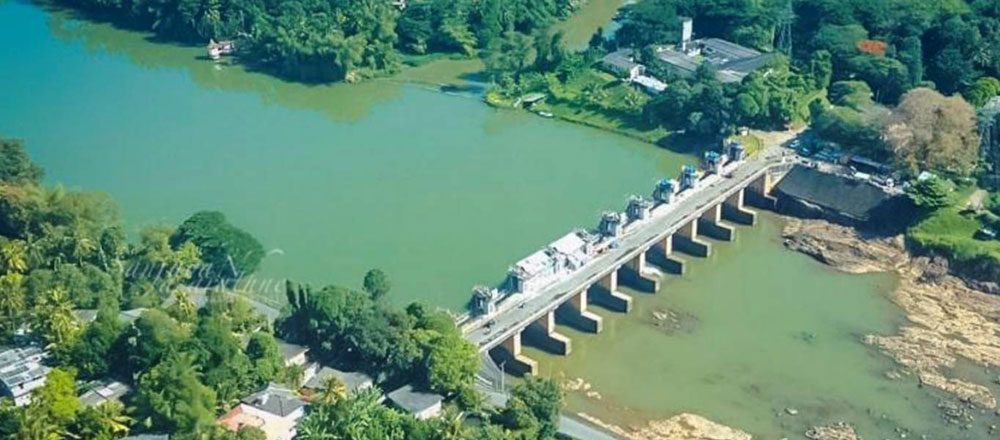
Silting of reservoirs is a major problem today affecting our hydropower production and irrigation systems. The main Mahaweli reservoirs are silted to a considerable extent reducing the water holding capacity of them. Due to poor soil management practices, floodwaters deposit large amounts of silt in these reservoirs. When the Polgolla reservoir was fully drained about two years back, one could see mountains of silt in the lower reaches of the reservoir. A rough estimate is that 50% of the total capacity of these reservoirs has been lost to siltation. This is a serious issue which affects not only power and agriculture but also flood control.
Our ancient irrigation systems ensured that desilting of reservoirs took place under royal decree where all users of the reservoirs were ordered to carry out desilting of reservoirs during the dry season. The clay thus collected was used in making bricks for the construction of great stupas which dot the landscape of our ancient kingdoms. This ensured that the reservoirs had their full capacity filled with water for the next cultivating season. Our ancient kings were clever enough not to construct reservoirs by blocking main rivers such as the Mahaweli. A classic example is the Minipe left canal where they tapped only the surface water of Mahaweli. Even the bigger tanks such as Nuwara Wewa and Parakrama Samudraya were fed with minor rivulets. There were also other ingenious features in the cascade irrigation systems built by the ancient kings, such as mud sluice canals and forest reservations between the reservoirs in the cascade system. These reservations helped trap silt and remove excess nutrients, which could otherwise contribute to increasing salinity as water flowed from one reservoir to another.
-

- Parakrama Samudraya
-

- Kalawewa
-
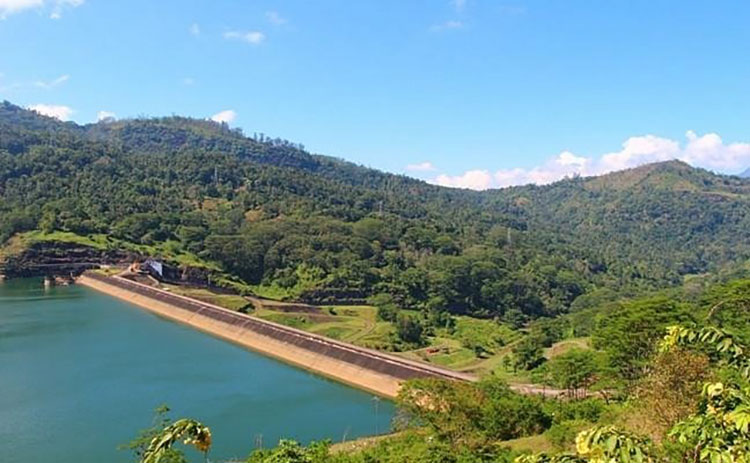
- Kotmale

Victoria
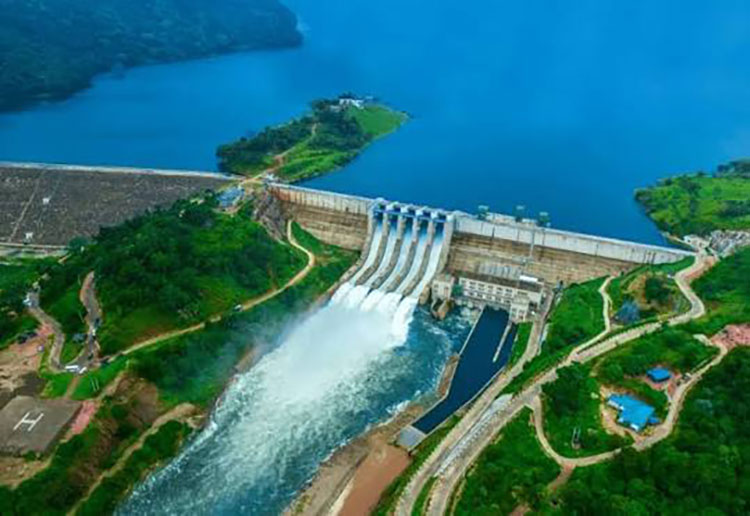
Moragahakanda
A classic engineering marvel is the former Yoda Ela, which carries water from Kalawewa to Nuwara Wewa and Tissa Wewa. It is 87 km long although the straight distance between these points is only about 40 km. The gradient of this canal is about 10 cm per km or 6 inches per mile. Yodha Ela functions as a moving reservoir and feeds about 4,600 hectares of paddy lands. It is a winding canal with about 120 smaller reservoirs on its way. It was constructed during the reign of King Dhatusena around 459 AD and later expanded by King Parakramabahu by connecting more reservoirs to the network. Unfortunately, during the Mahaweli project our modern-day engineers constructed a concrete canal replacing the winding path of this Yoda Ela also called Jaya Ganga. This effectively removed the ability of the old Yoda Ela to remove silt and nutrients. The bank of this Ela has wet zone trees such as jak and areca nut growing well. They take up the nutrients from the flowing stream making the water suitable for irrigation later.
Ancient Mesopotamian civilisations depended on dams constructed along the two main rivers, Euphrates and Tigris. After continuous irrigation of their fields over several thousand years, salinity of the irrigated lands increased making them unsuitable for agriculture. People died due to famine and this clearly illustrates the danger of blocking main rivers for agriculture. There is scientific evidence that the salinity of paddy soils in the Mahaweli C area is increasing.
We saw the devastation caused by Cyclone Ditwah. The sluice gates of the Kotmale Reservoir were opened, and Kandy and Peradeniya were flooded. If the reservoir had had greater storage capacity, couldn’t the opening of the gates have been delayed? This may not be an argument that modern-day engineers would readily accept, and I am not an irrigation expert. These ideas may well be naïve. But most of us tend to think of reservoirs mainly in terms of hydropower generation and irrigation, while their role in flood control receives much less attention. The question therefore deserves serious consideration. Could restoring lost reservoir capacity through desilting help improve our ability to manage extreme rainfall and reduce flood risks?
Desilting our reservoirs should be considered a national priority.
Export diversification – Missing the wood for the trees – Part III
by Gomi Senadhira
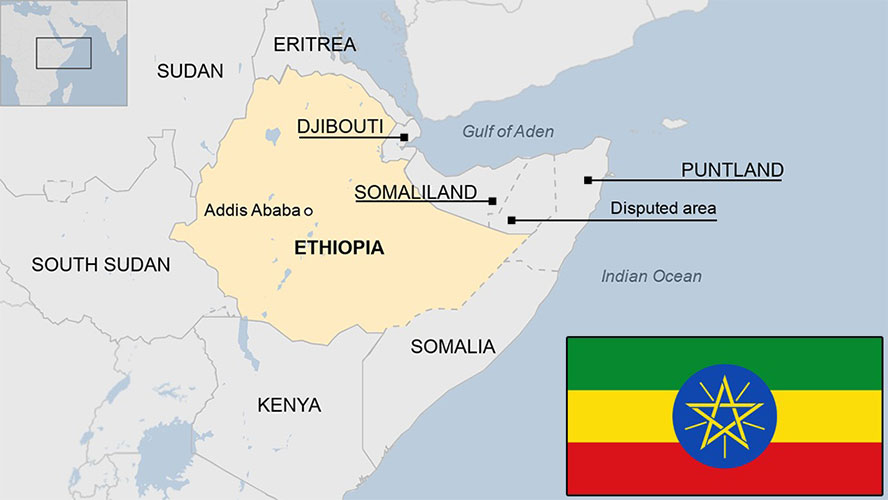
In Sri Lanka, the word “Ethiopia” is often used as disparaging slang to describe individuals or areas experiencing extreme poverty, starvation, or severe economic hardship. This linguistic habit originated in the 1980s with the Western media coverage of the devastating Ethiopian famine of 1983-85. That media coverage shocked the world but also left an outdated and offensive global stereotype that the country is permanently starving. Much has changed since then. By now, with an annual growth rate of around 9%, it is the fastest-growing economy in sub-Saharan Africa. Ethiopia has also emerged as a highly competitive exporter and is challenging not only its competitors in the region but also countries like Sri Lanka. This article is on how Sri Lanka has lost ground to Ethiopia (and a few other countries) in the GCC markets for agricultural and floricultural products.
Sri Lanka – A Pioneer in the Agriculture and Floricultural Market in the GCC
As discussed in Part II of this article, by the mid-1980s Sri Lanka had established a strong foothold in the GCC’s fruit, vegetable, and floricultural market. Geographical proximity and well-established shipping and air links gave Sri Lanka a strong comparative advantage over Southeast Asian and African nations. Thailand, Vietnam, and Kenya were not even in the market. At that time, Ethiopia was experiencing (as BBC news reports described) “a biblical famine”.
The market was not very large, but it was lucrative and growing. Trade Minister Lalith Athulathmudali as well as the Chairman of the Export Development Board, Victor Santiapillai, who visited Kuwait (and the GCC countries), recognised the market potential for these products and encouraged us to continue with our work. The minister was particularly keen to further develop links between the market for these products, exporters, and his Export Production Villages (EPVs). So, it was becoming a successful case not only for export diversification but also for transferring gains from exports directly to rural households.
From Trailblazer to Tailender
As a result, even by the beginning of this century Sri Lanka had a larger market share than most of its competitors from Asia or Africa. But since then, our competitiveness has weakened significantly. The tables below provide a comparative snapshot of Sri Lanka’s performance vis-à-vis Thailand, Vietnam, Kenya and Ethiopia in the GCC market for vegetables, fruits and floricultural products. As illustrated therein, in 2001 Sri Lanka was ahead of Thailand, Kenya and Ethiopia in this small but rapidly growing market. Since then, we have fallen behind Thailand, Kenya and many other countries in that lucrative market. If this trend continues, Sri Lanka will fall behind Ethiopia within the next few years. (See Table 1)
In the GCC market for vegetables (covered in HS chapter 07), Sri Lanka was ahead of most other competitors in 2001. As illustrated in Table 1 , Sri Lanka had failed to develop this market, while Thailand, Kenya, and even Ethiopia had very efficiently increased their market shares. The GCC is a market to which Sri Lanka can supply some vegetables, like cabbages, by sea. It appears Sri Lanka had also failed to exploit this mode of supply.
We can see a similar trend in the market for fruits. Vietnam, Kenya, and Thailand have emerged as major players, while exports from Sri Lanka have staggered on slowly. In this segment, Vietnam has emerged as a leading player during the last twenty years and the GCC imports from Viet Nam have shot up from US$44 thousand in 2001 to US$346 million by 2024. In part one of these articles, I discussed the remarkable increase of jackfruit exports from Vietnam “…just $3 million in 2015 to an impressive $236.8 million in 2023” while most of our jackfruit production rots under the trees. This explains how countries develop their markets, geographically and product-wise. (See Table 2)
Sri Lanka’s performance has been weakest in the market for floricultural products (HS Chapter 06), which groups live trees, cut flowers, and ornamental foliage. When we first entered the market in the 1980s, the market was dominated by the Netherlands, and Kenya and Ethiopia were not even in the market. At that time, we identified the Gulf states as a market where Sri Lanka could have a dominant presence due to geographical proximity. Even in 2001, Sri Lanka was ahead of Kenya, Ethiopia, and Thailand. But by now, Kenya has emerged as the dominant supplier. Ethiopia is also expanding its market share and is the third-largest exporter. (See Table 3)
Missing the Wood for the Trees
In the mid-1980s, Sri Lanka first established its foothold in the GCC market. Since then, Thailand, Vietnam, Kenya, and even Ethiopia have moved well ahead of us and have become leading players. Why did we lag behind in our export diversification efforts in general and, more particularly, in the GCC market?
The reasons are very clear. After the initial attempts in the 1980s and early 1990s, Sri Lanka has not been proactively involved in identifying, developing, and promoting new products and markets, or protecting and further developing new markets already established. The focus has simply been on traditional exports: tea, coconut, cinnamon, and garments, while other products were almost ignored. In essence, we have been and continue to focus intensely on a narrow group of products and markets, and we have lost sight of the bigger picture.
(The writer can be reached at senadhiragomi@gmail.com)

A flight of fancy

No shortcut to building Sri Lanka’s reserves: CBSL Governor

‘Lord Edgware Dies’

Complaint to HRCSL alleges woman framed in heroin case

Judge cautions DSG against pressuring prosecution witnesses in immunoglobulin fraud trial

Namal blows whistle on 120,000 MT of coal that allegedly went missing after being shipped here

‘Dates have the highest sugar content to fight Coronavirus’

Sunday Island 27 December – Headlines

#SundayIsland 17th December – Headlines

Sunday Island – 28th March

Sunday Island Headlines – 21 March

Sunday Island – 21st February – Headlines
-

 News6 days ago
Namal remanded until Sept. 18 over Airbus deal investigation
-

 Latest News5 days ago
Tharanga creates history with Diamond League crown in Brussels
-

 News5 days ago
Dispute which triggered listed company director being detained at BIA resolved
-

 Features4 days ago
After the parade: What a traffic OIC’s walk-out tells us
-

 Editorial6 days ago
Power vs Equality
-
Editorial4 days ago
Arrests as theatre
-

 Latest News7 days ago
SLPP MP Namal Rajapaksa arrested by CIABOC
-

 Latest News4 days ago
Harshitha’s composed knock seals Sri Lanka’s semi-final berth