
News
20A: SLPP rejects criticism, plans to secure its passage next month


By Shamindra Ferdinando
Dismissing criticism of the proposed 20th Amendment that it would pave the way for a dictatorship, Education Minister Prof. Peiris yesterday (7) told the media at the SLPP office, Battaramulla, that it would be presented to Parliament next October ahead of the presentation of Budget 2021.
Prof. Peiris, who is also the Chairman of the ruling SLPP, said that the government wasn’t worried about the Samagi Jana Balavegaya (SJB) moving the Supreme Court against the 20th Amendment as it was gazetted having secured the Attorney General’s approval.
Flanked by Ports and Shipping Minister Rohitha Abeygunawardena and SLPP General Secretary attorney-at-law Sagara Kariyawasam, Prof. Peiris indicated that they didn’t see a requirement to make any changes to the 20th Amendment at the committee stage.
The minister said that the government enjoyed the required parliamentary support necessary for the passage of the 20th Amendment. The SLPP on its own secured 145 seats whereas its allies obtained half a dozen seats to ensure the required two-thirds.
Responding to a query, a smiling Prof. Peiris said SJB’s Lakshman Kiriella or any other party could seek legal recourse against the 20th Amendment. “We are confident the 20th Amendment can be adopted without any hassle,” Prof. Peiris said, pointing out that finding fault with the 20th Amendment seemed ridiculous after the AG endorsed it without subjecting any of its provisions to a referendum.
Prof. Peiris said that the 19th Amendment enacted in the wake of 2015 presidential election, was meant among other things to deprive Namal Rajapaksa an opportunity to contest the presidency, disqualify Basil Rajapaksa and Gotabaya Rajapaksa from contesting either presidency or parliamentary election on the basis of them being dual citizens of US and Sri Lanka and Mahinda Rajapaksa from seeking a third term.
The 20th Amendment has proposed the eligibility of a 30 year –old to contest the presidency in addition to dual citizens the opportunity to contest national level elections.
Prof. Peiris said that those who had been critical of the 20th Amendment had conveniently forgotten it didn’t touch two of the most important features in the 19th Amendment. He emphasized that the two term limit on a President as well as both presidential and parliamentary terms being restricted to five years from the earlier six would remain intact under the 20th Amendment.
Asked why much desired constitutional bar to restrict the number of ministers to 30 and non-cabinet ministers to 40 had been proposed to be abolished, Prof. Peiris pointed out there was provision in the 19th Amendment to make ministerial and other appointments regardless of the restriction by simply forming a National Government. The UNP and the SLFP did form such a government and made appointments beyond the prescribed 30 cabinet and 40 non-cabinet limits, Prof. Peiris said.
Responding to another query, Prof. Peiris side-stepped the issue by pointing out that the SLPP, too, could have finalized such an arrangement by entering into an agreement with the EPDP (Eelam People’s Democratic Party). The EPDP won two seats in the Northern Province at the recently concluded general election.
Prof. Peiris also welcomed the Court of Appeal granting MP elect Premalal Jayasekera an opportunity to attend parliamentary sittings tomorrow (8).
Jayasekera is held at Welikada prison after being found guilty by Ratnapura High Court over a 2015 killing in the Kahawatte police area in the run up to the presidential election of that year. Prof. Peiris said that Jayasekera enjoyed the right to move both the Court of Appeal and the Supreme Court challenging the ruling given against him.
The Education Minister said that the SLPP received two mandates to do away with the 19th Amendment. Gotabaya Rajapaksa, in his capacity as the SLPP candidate won the presidential election by a staggering 1.4 mn votes whereas the SLPP secured a near two-thirds majority at the general election. Therefore, there couldn’t be any issue as regards the SLPP taking tangible measures to drastically alter the 19th Amendment before introducing a new Constitution.
Recently, the government announced a 9-member group led by Romesh de Silva, PC, to formulate the new draft Constitution.
The former Law Professor strongly defended the controversial decision to re-introduce emergency Bills while guaranteeing full immunity to the President. Referring to a Supreme Court case, Prof. Peiris emphasized that the country’s apex court had accepted the right of the President to receive immunity. Prof. Peiris said that emergency Bills were necessary in times of emergency such as the 2019 Easter Sunday attacks which plunged the entire country into crisis.
Prof. Peiris dealt with the continuing controversy over the 20th Amendment proposing a five-member Parliamentary Council in place of the Constitutional Council comprising ten. Of course the method of appointments to seven Commissions as well as key posts had been changed to give the President power to exercise his mandate, Prof. Peiris said, dismissing claims that the Commissions were being abolished. The proposed system reflected the will of the people whereas the 19A empowered the Constitutional Council at the expense of the President elected by the people of the whole country.
Prof. Peiris alleged that the Election Commission member Prof. Ratnajeevan Hoole and Constitutional Council member Javid Yusuf were two persons who abused their positions in the respective outfits to undermine the SLPP. Prof. Hoole once declared in Jaffna not to vote for the SLPP whereas attorney-at-law Yusuf openly campaigned against the SLPP’s push for a two-thirds majority to do away with the 19th Amendment, Prof. Peiris said.
Prof. Peiris said that their plans were on track though nearly ten months were wasted due to the inability on the part of the President to dissolve parliament immediately after winning the presidential election last November due to the shackles placed by the 19A and the subsequent crisis caused by the corona epidemic.
Prof. Peiris emphasized that the people’s President would exercise powers for their betterment.




Latest News
Sun directly overhead Kalpitiya, Talawa, Sinharagama, Galkadawala, Nachchaduwa, Padikaramaduwa, Gomarankalla and Verugal about 12.10 noon today (01)


The sun is going to be directly over the latitudes of Sri Lanka from 28th of August to 07th of September due to its apparent southward relative motion.
The nearest places of Sri Lanka over which the sun is overhead today (01) are Kalpitiya, Talawa, Sinharagama, Galkadawala,
Nachchaduwa, Padikaramaduwa, Gomarankalla and Verugal about 12.10 noon.
… stresses need for action if claims were proved false
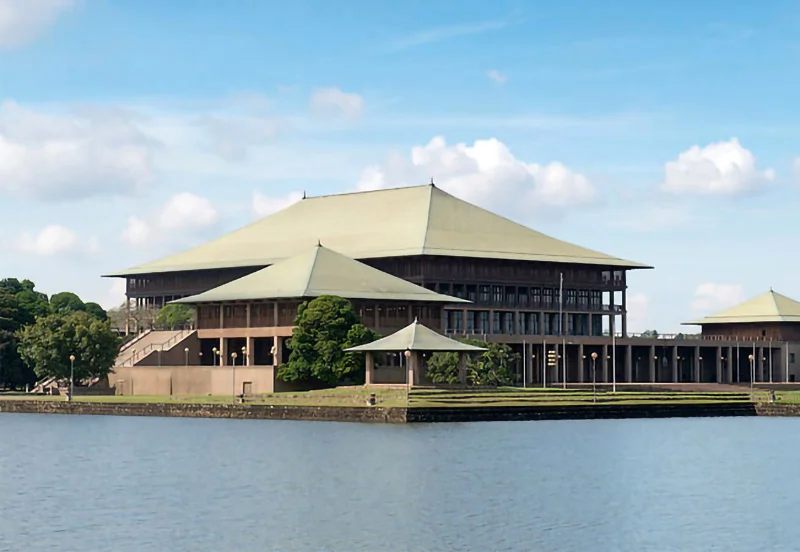
Samagi Jana Balawegaya (SJB) MP Dayasiri Jayasekera has sought a clarification from Speaker Dr. Jagath Wickremaratne regarding several allegations against Chief Justice Preethi Padman Surasena, in Parliament, recently.
In a letter dated 31 August, Jayasekera has asked the Speaker whether he received any documentary evidence from MPs in support of the allegations at issue. The SJB MP has also inquired about the steps taken by the Speaker regarding the allegations and whether the issue had been taken up with the relevant agencies authorised to probe the assets of the CJ and members of his family.
MP Jayasekera confirmed that he had raised the issue with the Speaker, following the accusations relating to the high profile X-Press Pearl case, which received significant public attention in the recent past.
The Kurunegala District MP has also asked the Speaker whether the latter contemplated taking action in case the allegations were proved false to ensure that the dignity of the Chief Justice and the judiciary was safeguarded.
Among the issues raised by MP Jayasekera are the acquisition of valuable property in Colombo by the CJ’s son, the circumstances in which he was able to procure the property, as well as accusations regarding the CJ’s birth certificate, marriage certificate and birth certificates of his children.
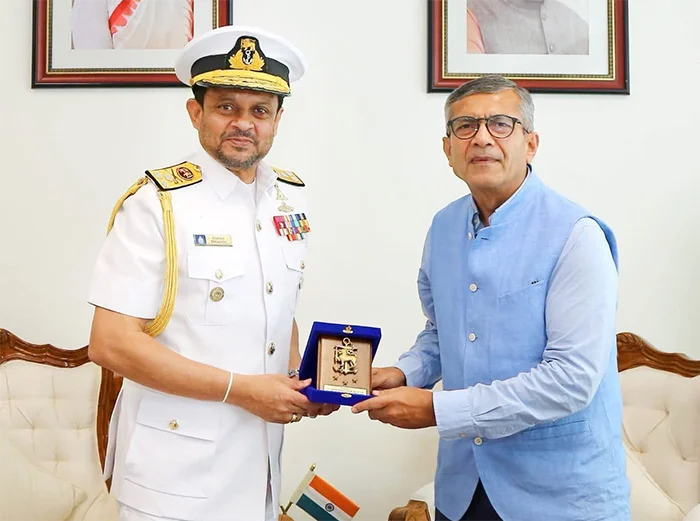
Navy Chief Vice Admiral Damian Fernando held a series of strategic-level discussions with senior Indian defence and military officials during a three-day official visit to New Delhi. He returned on Sunday (30).
Navy Headquarters said that the two sides discussed ways to further strengthen maritime security cooperation between the two Navies in support of security in the Indian Ocean region. They also exchanged views on expanding training opportunities and capacity-building programmes, as well as other areas of bilateral importance.
During his visit to New Delhi, Vice Admiral Fernando also held official discussions with India’s Chief of Defence Staff, General N.S. Raja Subramani, Defence Secretary Rajesh Kumar Singh and Vice Chief of the Air Staff, Air Marshal Ashutosh Dixit and defence industry representatives. Discussions at these meetings focused on bilateral defence cooperation, joint training programmes, and opportunities to enhance air and maritime cooperation in the Indian Ocean Region.
As part of efforts to further expand cooperation in naval training and professional development, Vice Admiral Fernando also met Vice Admiral Sameer Saxena, Flag Officer Commanding-in-Chief of India’s Southern Naval Command, at its headquarters in Kochi, Kerala. The two sides discussed existing naval training exchange programmes and opportunities for introducing and expanding further training initiatives. The meeting followed the Commander of the Sri Lanka Navy’s visit to INS Dronacharya, the Indian Navy’s training establishment where he previously completed the Long Gunnery and Missile Course.

Nahida, Marufa help Bangladesh brush aside Indonesia

Showers will occur in the Western, Sabaragamuwa, Southern and Uva provinces and in Kandy and Nuwara-Eliya districts

Sun directly overhead Kalpitiya, Talawa, Sinharagama, Galkadawala, Nachchaduwa, Padikaramaduwa, Gomarankalla and Verugal about 12.10 noon today (01)

SJB asks what Speaker intended to do about allegations against CJ

Navy Chief attends strategic-level discussions in Delhi

ICRS: Sustained and collective efforts critical to address issue of missing persons

‘Dates have the highest sugar content to fight Coronavirus’

Sunday Island 27 December – Headlines

#SundayIsland 17th December – Headlines

Sunday Island – 28th March

Sunday Island Headlines – 21 March

Sunday Island – 21st February – Headlines
-

 News4 days ago
Eight politicians in drug kingpin probe
-

 Features2 days ago
“Wrap Me Up in My Blazer”— A Gentlemanly Bradby Reminiscence
-

 Business4 days ago
Sri Lanka opens up: A new season of direct connectivity
-

 Features4 days ago
Redefining ageing in Sri Lanka
-
 Features6 days ago
Insights from Chieftains of Uva: Genealogy of two Kandyan Families – Part II
-
 Latest News5 days ago
Nepal-Tibet floods: What happened, what caused them and who is missing?
-

 Editorial6 days ago
Warning of power cuts: El Niño and corruption
-

 Features6 days ago
Export diversification: Missing the wood for the trees – Part I