
News
Who is pouring oil on the flames in Sri Lanka?

By Feng Guoquan
Sri Lanka is in a dire situation. Known as the “Pearl of the Indian Ocean,” the country is facing the worst economic crisis since independence in 1948. Western media has taken this opportunity to hype up the so-called Chinese debt trap, alleging that Sri Lanka is on the verge of economic collapse because it was unable to repay its large loans from China. They add that the Belt and Road Initiative (BRI) has brought a heavy burden to the Sri Lankan economy, and constantly pitting the Sri Lankan government and its people against China, while turning a blind eye to those who are really behind all this.
Caught fire by accumulated debt
There are many causes for Sri Lanka’s economic crisis, among which the foreign exchange crisis is the main factor. Since its independence, Sri Lanka has suffered from internal and external troubles. It has been carrying trade deficits and relying on loans for years. Due to the combined impact of a string of terrorist attacks in April 2019, the COVID-19 pandemic and the Russia-Ukraine conflict, the country’s pillar industries including tourism, overseas remittances, tea and garments have been hit hard and it has rapidly drained its reserves.
What’s worse, Sri Lanka introduced a low tax regime in late 2019, which caused the government a loss of more than $1.4 billion in revenue, further limiting its capability to purchase foreign exchange.
While foreign exchange earnings have plummeted, Sri Lanka’s import payments have continuously increased. Sri Lanka’s production materials and daily necessities are highly dependent on imports, and the armed conflict between Russia and Ukraine has triggered a surge in global commodity prices. Taking energy as an example, 60 percent of Sri Lanka’s electricity is generated from coal and oil, both of which need to be imported. The global oil price increased by six-fold from $18 a barrel in April 2020 to above $100 a barrel now.
At the beginning of 2021, the Sri Lankan government banned the import of chemical to prevent the outflow of foreign exchange, resulting in large-scale crop failures, and the government had to replenish food reserves from abroad, further exacerbating the shortage of foreign exchange.
Sri Lanka’s foreign exchange reserves have plummeted by about 70 percent in the past two years. Its reserves stand at around $1.9 billion at the end of March, while its foreign debt obligations for this year exceed $7 billion. On April 12, the Sri Lankan government officially announced the temporary suspension of foreign debt payments, defaulting on its $50.7 billion foreign debt. On May 19, the government announced that it had failed to repay a total of $78 million in debt, which marked the nation’s first sovereign debt default since it gained independence.
The U.S.-led West have been pouring oil on the flames after setting fire
Although Sri Lanka has been in debt for many years, it has previously maintained a good record of foreign debt repayment. The Russia-Ukraine conflict, which was caused by the U.S.-led Western intervention, had a very serious impact on Sri Lanka’s economy, which was already in bad shape, and leading to its default. It is the hegemony and the greed of capital of the U.S.-led West that are the root causes of the economic crisis faced by Sri Lanka and other developing countries.
The mounting sanctions imposed on Russia by the U.S.-led West have been pushing global food and energy prices to new heights, and there are also restrictions on Russian financial and aviation sectors. The food prices surged in Sri Lanka due to soaring prices of wheat and corn triggered by the Russia-Ukraine conflict.
Sri Lanka exports about $150 million of tea and other commodities to Russia annually. However, as more and more Russian banks are banned from the SWIFT network, Sri Lanka was unable to obtain foreign exchange by exporting to Russia. In January this year, Russia was Sri Lanka’s largest source of tourists, but in March, the state-run national carrier of Sri Lanka suspended its flights to Russia due to the Western sanctions.
In terms of debt structure, most of Sri Lanka’s debts are in the form of international sovereign bonds, and the Asian Development Bank and Japan are its main lenders. According to the Central Bank of Sri Lanka data, as of October 2021, Sri Lanka’s international sovereign bonds reached $11.82 billion, accounting for 34.1 percent of total external debt. In terms of bilateral loans, Japan and India ranked first and second, with $3.54 billion (10.2 percent) and $790 million (2.3 percent) respectively, higher than China.
China’s bilateral loans to Sri Lanka are not the largest. Even with financial market loans (Exim Bank of China) included, it only accounts for 10 percent, and most of the loan interest rates are much lower than the capital markets, among which over 60 percent are concessional loans, and the remaining 40 percent are interest-free loans. So Sri Lanka’s debt repayment problems have very little to do with Chinese loans.
In fact, Sri Lanka is not the only country that suffers from the economic crisis. The Federal Reserve and other major central banks have raised interest rates to quell inflation, which drives up borrowing costs and may bring debt crisis to many developing countries. Turmoil triggered by rising food and energy prices is already gripping countries like Egypt, Tunisia and Peru. Scarcities of food, energy and finance put more than 70 countries at risk of following Sri Lanka into default, says United Nations, according to a recent report by the Wall Street Journal.
The trap of so-called Chinese debt trap
In recent years, governments and media of the U.S.-led West have tied the concept of the “debt trap” to China as a weapon to tarnish China’s reputation and the Belt and Road Initiative in order to counter China’s promotion of BRI, maintain their political and economic hegemony, and prevent the developing countries from participating in the BRI.
The Hambantota Port is a most cited case by the U.S.-led West in hyping up the “Chinese debt trap.” It is falsely claimed that China used the port to drag Sri Lanka deep in debt and would transform it into a military base in the future. But the fact is that the Hambantota Port added $1.12 billion of foreign exchange reserves for Sri Lanka to repay some short-term foreign debts. What’s more, the Hambantota Port is difficult to use as a military base due to water depth limitations, and the Sri Lankan government has explicitly prohibited the use of the Hambantota Port as a foreign military base.
On the contrary, India has recently partially acquired the Trincomalee Port situated on the eastern coast of Sri Lanka, which is a large natural port from a military point of view and used to be a strategic oil terminal for the British army during World War II. Because the United States intended to build an “economic corridor” and highway from Trincomalee to Colombo through the Millennium Challenge Corporation (MCC), which is obviously for military purposes, the United States, India and other countries have played deaf and dumb.
As a close neighbor of Sri Lanka, China has been sincerely helping Sri Lanka develop its economy. Instead of causing any crisis, China has over the years provided selfless help and firm support to Sri Lanka in socio-economic development. Especially since the onset of the COVID-19 pandemic, China and Sri Lanka have supported each other and pulled through together, writing a new chapter of China-Sri Lanka friendship. Chinese Premier Li Keqiang noted that China empathizes with Sri Lanka for its difficulties and challenges, and China is ready to provide much-needed livelihood assistance for Sri Lanka within its capacity.
The Sri Lankan government has explicitly refuted the myth of “Chinese debt trap” time and time again. Recently, Ranil Wickremesinghe, Sri Lanka prime minister and leader of the United National Party, expressed his gratitude to China for assisting Sri Lanka in overcoming difficulties in all aspects and stressed that the government will continue to attach great importance to developing ties with China and push forward BRI projects in the country, accelerate the development of the Colombo Port City, Hambantota Port and other major cooperation projects, make every effort to protect the safety of Chinese institutions and personnel in Sri Lanka.
The international community, especially the developing countries, need to be wary of the trap of “Chinese debt trap” set by the U.S.-led West
,which is a systematic move orchestrated by the U.S. to obstruct the BRI. Countries should endeavor to safeguard their national security and development interests, strengthen international cooperation, including those under the BRI, increase their representation and voice in global economic governance, and promote the establishment of a more just and reasonable international economic order. For developing countries including China, underdevelopment is the biggest trap, and the political, economic, military, and cultural hegemony of the U.S.-led West is the real trap.
(Writer Feng Guoquan is a commentator on international affairs. The article was first published by The People’s Daily, in Chinese, on June 11, 2022. The article reflects the author’s views, and not necessarily those of CGTN (China Global Television Network.)



The computer system at the Department of Registration of Persons has been rectified and the services are back to normal.
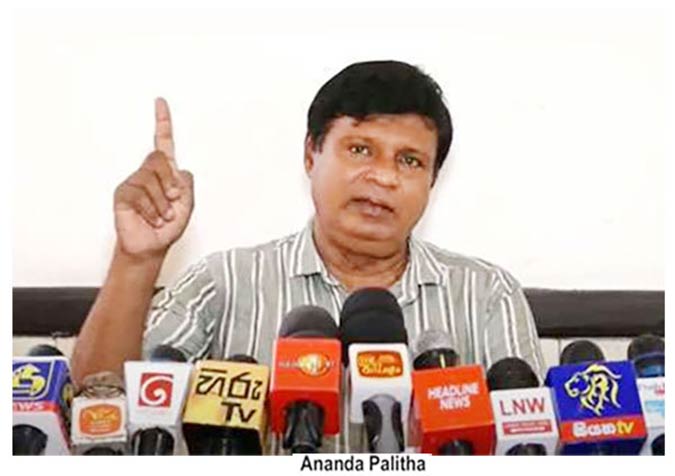
… questions why the price of a by-product like kerosene was jacked up
China Petrochemical Corporation (Sinopec Group) and Indian Oil Corporation Lanka (IOC PLC) have increased the prices of certain products significantly more than the Ceylon Petroleum Corporation (CPC). However, the fourth player in the market R.M. Parks, a US company in collaboration with Shell that launched operations here in late February last year, has increased its prices in line with Ceypetco.
Convener of the Samagi Joint Trade Union Alliance, Ananda Palitha, yesterday (23) told The Island that foreign players had immensely benefited from the latest price revision at the expense of Sri Lankan consumers.
Alleging that Sinopec and Lanka IOC PLC had become a law unto themselves, Palitha pointed out that the failure on the part of successive governments to establish an Independent Commission and Regulatory Authority for the petroleum sector had allowed Ceypetco and all foreign players to do as they please. Palitha said that in the absence of proper regulatory mechanism, CPC/Energy Ministry should ensure genuine competitiveness in the market.
Palitha said that the NPP government had exploited the ongoing Middle East war to earn unconscionable profits at a time the economy was reeling under the impact of the Hormuz Strait blockade. According to him, all four players increased Auto Diesel by Rs. 79 to Rs. 382 per litre, and Octane 92 Petrol by Rs. 81 to Rs. 398 per litre, while Sinopec and Lanka IOC PLC price list differed in respect of other products. At most filling stations Octane 92 was not available and only higher priced Octane 95 petrol was available.
Pointing out that since the eruption of the Middle East conflict, on 28 February, the NPP had twice increased fuel prices on 09 and 22 March, Palitha said that the government could have cushioned the impact by lowering taxes imposed on crude oil and refined petroleum products. Instead, the latest price revisions resulted in further increase of customs duties, VAT and Port and Airport Development Levy. Additional duties often apply, such as a surcharge tax, on diesel and petrol.
Since the entry of Lanka IOC into the market in 2003, Sinopec in 2023 and R.M. Parks in 2025 eroded the CPC share and, at the moment, it was down to about 57%, and the private players accounted for the rest. Palitha placed the number of filling stations players authorised to operate at Ceypetco (836), Lanka IOC (274) and Sinopec and R.M. Parks 150 each.
Palitha said Lanka IOC has increased Petrol Octane 95 to Rs. 487 a litre whereas the CPC priced the same at Rs. 455) a litre. Lanka IOC and Ceypetco have priced a litre of Super diesel at Rs. 572 and Rs. 443, respectively.
LIOC has also revised its premium fuel categories, with Xtra Premium Petrol priced at Rs. 465, Xtra Mile at Rs. 551, and Xtra Green Diesel at Rs. 588.
Claiming that the government had twice increased the prices of old petroleum stocks, procured at a maximum USD 70 a barrel, weeks, if not months, before the new war, Palitha found fault with the Opposition for not launching a sustained campaign against the exploitation of the public. Palitha said that the increase of a litre of kerosene by Rs. 13 on 09 March and Rs. 60 on 22 March was unjustifiable. “The people do not know that kerosene is a by-product in the process of refining crude oil. Sapugaskanda produces LPG, naphtha, petrol, diesel, kerosene and furnace oil.”
The price of a litre of kerosene to had been increased to Rs 255, Palitha said, adding that it could have been provided to the needy at a much lower rate. If those who represent Parliament bothered to study the issues at hand, they would be able to challenge the government on this disgraceful manipulation of the entire country, he said.
Palitha said that the Parliament owed an explanation as to why the Commission to regulate the oil trade hadn’t been appointed and whether some interested parties financially benefited at the expense of the country.
Palitha said that the introduction of the QR code to control fuel sales and the increase of the fuel quota last Sunday night had been used to deceive the public when those in power and their friends in the industry made money at the expense of the public.
By Shamindra Ferdinando
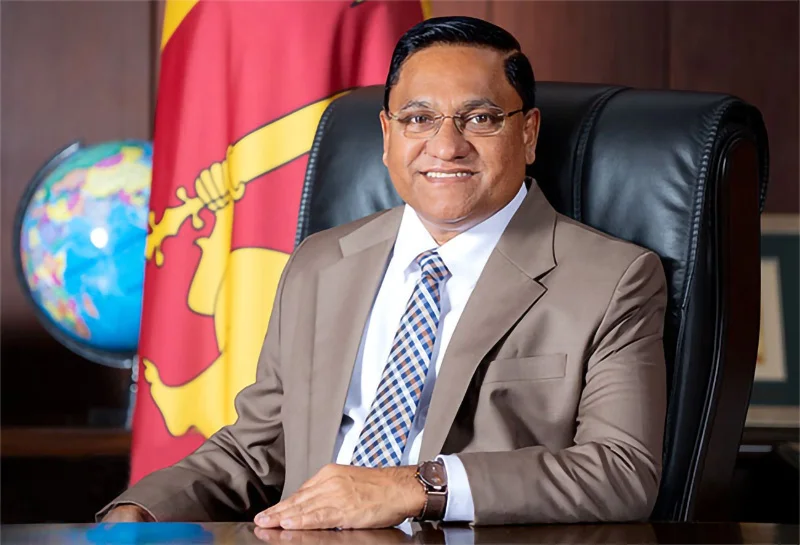
Sri Lanka is planning to fast-track the redevelopment of the Trincomalee oil tank farm as a long-term solution to its ongoing energy crisis, with backing from India and the United Arab Emirates, The Hindu has reported.
Foreign Minister Vijitha Herath said the project, which involves restoring World War II-era oil storage facilities in the eastern district, is seen as a “permanent solution” to managing fuel supply challenges.
“Temporary solutions are not sustainable. We need a long-term strategy to deal with oil storage and distribution, given the global energy situation,” he told The Hindu.
The initiative follows a Memorandum of Understanding signed in April 2025 between Sri Lanka, India, and the UAE to develop Trincomalee as a regional energy hub.
Despite previous delays spanning decades, the project has gained renewed urgency amid the current global energy crisis, which has disrupted supply chains and driven up fuel costs.
Sri Lanka has already submitted a concept proposal to its partners, while technical aspects are being reviewed by the Energy Ministry before moving to the tender stage, according to the report.
The renewed push also marks a notable policy shift, as the ruling administration, led by the National People’s Power, had previously opposed Indian involvement in the project.

‘Dates have the highest sugar content to fight Coronavirus’

Sunday Island 27 December – Headlines

#SundayIsland 17th December – Headlines

Sunday Island – 28th March

Sunday Island Headlines – 21 March

Sunday Island – 21st February – Headlines
-

 News7 days ago
CIABOC questions Ex-President GR on house for CJ’s maid
-
 News6 days ago
Bailey Bridge inaugurated at Chilaw
-

 Features2 days ago
Trincomalee oil tank farm: An engineering marvel
-
 News5 days ago
CIABOC tells court Kapila gave Rs 60 mn to MR and Rs. 20 mn to Priyankara
-

 News6 days ago
Pay hike demand: CEB workers climb down from 40 % to 15–20%
-

 Editorial7 days ago
Couple QR-based quota with odd-even rationing
-
 Features5 days ago
Science and diplomacy in a changing world
-

 News4 days ago
Colombo, Oslo steps up efforts to strengthen bilateral cooperation in key environmental priority areas