
Sports
West Indies go 1-0 up as Hope and Rutherford boss 295 chase

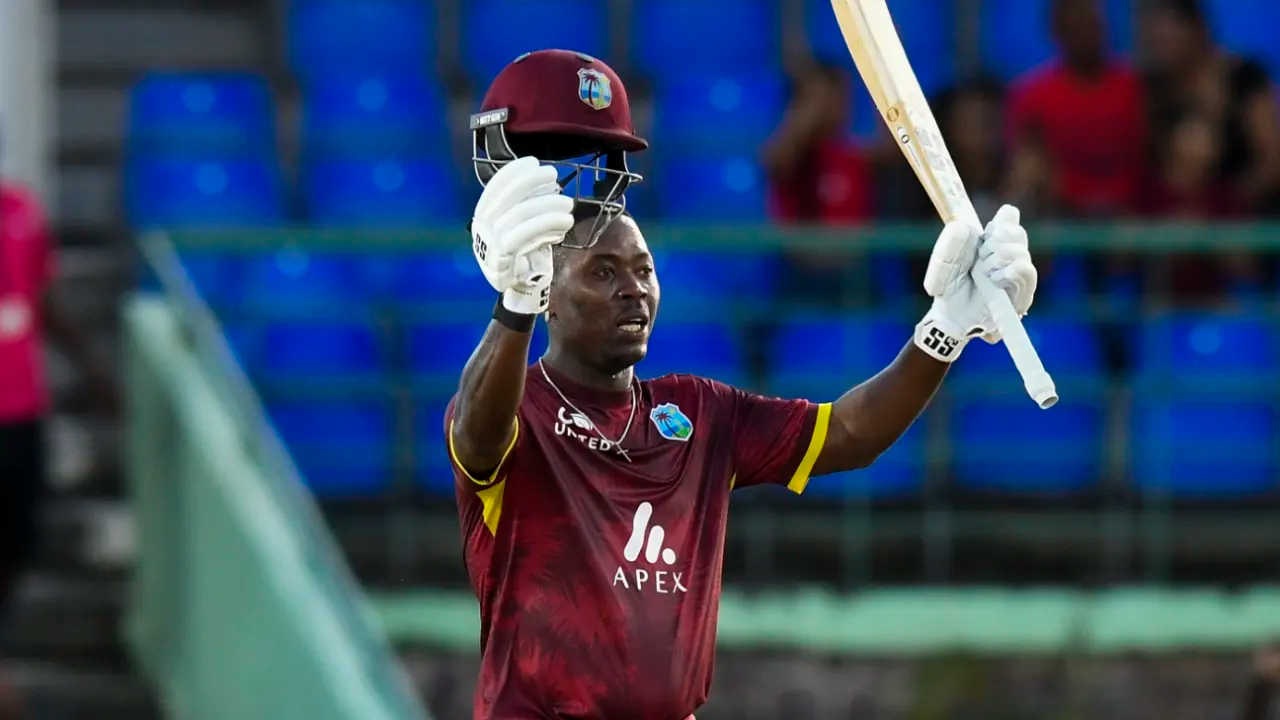
Sherfane Rutherford’s maiden ODI century helped West Indies break their 11-match losing streak against Bangladesh with a five-wicket win in St Kitts. The home side hunted down a target of 295 to take a 1-0 lead in the three-match series, with Rutherford’s 80-ball 113 comprehensively overturning a slow start to the chase. West Indies, who had at one point needed 161 off 114 balls, reached their target with 14 balls remaining.
Rutherford, who was struck twice on his helmet during his innings, reached his century when Bangladesh conceded six runs via overthrows in the 47th over. He celebrated the milestone with consecutive sixes off Soumya Sarkar, over long-off and midwicket. Then he squeezed one to short third man where Nahid Rana completed a catch, but by then West Indies only needed seven more.
Rutherford struck seven fours and eight sixes as he went from 19 off 29 balls in the 32nd over to score a further 94 runs in 51 balls. He now has five consecutive 50-plus scores in ODIs, becoming the fourth West Indian after Gordon Greenidge, Chris Gayle and Shai Hope who have six in a row each, to achieve this feat.
Rutherford added 99 runs for the fourth wicket with captain Hope who contributed an 88-ball 86 after coming in at 27 for 2. Then Rutherford and Justin Graves blasted 95 runs off just 57 balls for the fifth wicket. Greaves scored the winning runs and finished on an unbeaten 41 off 31 balls with five fours.
West Indies were in trouble for much of the first half of their chase. They lost both Brandon King and Evin Lewis in the first powerplay and couldn’t get going against Bangladesh’s fast-bowling trio. Tanzim Hasan Sakib trapped King lbw for 9 off 17 when he tried to pull one that wasn’t short enough, and Nahid Rana struck Lewis’ back pad in front of the stumps with a 148.9 kph delivery in the next over It was then up to Hope and Keacy Carty to consolidate.
They added 67 runs in the following 13.3 overs for the third wicket, with Carty scoring a cautious 21 off 37 balls. Rishad Hossain’s short ball had him caught at short midwicket in a disappointing dismissal for the in-form West Indies batter.
The home side slowed down significantly during this third-wicket partnership, and the required rate reached eight an over with 21 overs remaining in the chase. That’s when Hope slammed his opposite number Mehidy Hassan Miraz down the ground for six. It broke a spell of 28 balls without a boundary.
That hit opened the floodgates as Rutherford struck Mehidy for a four and a six in the 32nd over, before driving Taskin for a boundary in the 33rd. Hope hammered Rishad down the ground for sixes in consecutive overs, and Rutherford, bothered by the short ball until this point, pulled Rana for a six in between. He reached his fifty in the 36th over.
Mehidy then gave Bangladesh a lifeline when he had Hope caught at deep midwicket, but the 99-run fourth wicket stand had already given West Indies much-needed impetus. Greaves then hit three fours in as many overs, and ensured he kept the momentum going.
Rutherford then upped the ante when he pulled Tanzim for his third six, following it up with his fourth in the following over off Mehidy. Rutherford reached his highest ODI score in the 43rd over, with twin sixes off Taskin. When Greaves carved Tanzim through the covers in the following over, West Indies’ required rate came down to a run a ball, with just 37 needed.
Bangladesh’s innings had also revolved around three significant partnerships. They got off to a quick start before Soumya Sarkar fell in the fifth over. Soumya, fresh from becoming the GSL’s Player of the Tournament, struck Alzarri Joseph for consecutive fours before falling caught behind later in the same over. Litton Das followed him shortly afterwards, getting caught behind to Romairo Shepherd.
Tanzid Hasan however had already struck a straight six and three fours. He added 79 runs for the third wicket captain Mehidy, who survived two chances, with Carty dropping him on 1 and 31. Mehidy rode his luck, top scoring with 74. Tanzid looked by far the more confident of the two, hitting two more sixes over long-off and finding boundaries all around the wicket.
Tanzid, however, fell against the run of play in the 24th over when Alzarri Joseph had him caught at point. He made a run-a-ball 60, walking off disappointed at missing out on a bigger score. Mehidy meanwhile continued to rotate the strike with the returning Afif Hossain. The fourth-wicket pair added 54 before Shepherd got Afif caught on the leg-side boundary.
Mehidy eventually made 74 off 101 balls, hitting six fours and a superb whipped six over fine-leg off Jayden Seales. He fell to the same bowler in the 38th over, skying to extra cover where Rutherford took the catch.
Mehidy had laid the perfect foundation for Jaker Ali and Mahmudullah who added 96 runs for the sixth wicket, 84 of which came in the last ten overs. Mahmudullah smashed three sixes on the leg side, and as many fours, in his unbeaten 50 off 44 balls.
Jaker also struck three sixes, one of them off Joseph landing outside the stadium’s premises. He made 48 off 40 balls, falling off the penultimate ball of the innings to Shepherd, who finished with three wickets. Jaker and Mahmudullah struck all their six sixes in the last 6.3 overs of Bangladesh’s innings.
Brief scores:
West Indies 295 for 5 in 47.4 overs (Sherfane Rutherford 113, Shai Hope 86, Justin Greaves 41*) beat Bangladesh 294 for 6 in 50 overs (Mehidy Hasan Miraz 74, Tanzid Hasan 60, Mahmadullah 50*, Jaker Ali 48; Romairo Shepherd 3-51, Alzarri Joseph 2-67) by five wickets
[Cricinfo]



Power World Gyms, Sri Lanka’s leading fitness brand with over 30 years of promoting healthier lifestyles, has partnered with Kings Hospital Colombo as its Official Wellness Partner. This collaboration brings together expertise in fitness and healthcare to introduce a dedicated wellness programme for the hospital’s staff, supporting their physical and mental well-being. Through this partnership, Power World reinforces its commitment to making fitness and preventive wellness accessible, impactful and sustainable for those who care for our communities every day.

With international rugby taking center stage in Sri Lanka, Maliban Biscuits continues to play a pivotal role in advancing the sport, coming on board as the title sponsor of the New Zealand U85kg Rugby Tour 2026, the Official Premium Partner of the New Zealand U85kg team and the Main Sponsor of Sri Lanka Rugby.
This multi-tier partnership reflects the brand’s deep and ongoing commitment to growing rugby in Sri Lanka while supporting meaningful international sporting exchange.
As one of Sri Lanka’s most trusted household brands with a legacy spanning over 70 years, Maliban’s continued involvement with the touring side-marking the second consecutive partnership that highlights its sustained investment in sporting platforms that inspire young athletes and elevate the standard of the game locally.
The tour will feature key matches at the Colombo Racecourse Grounds on 25 April and at Nittawela Grounds on 3 May, promising high-quality rugby action for fans across the island. Beyond the competition itself, the New Zealand side will also engage in community outreach initiatives, contributing to the development of the game and encouraging greater youth participation in sport.

When Gary Kirsten fronted the media for the first time as Sri Lanka’s head coach, he didn’t pad up with clichés. He went straight on the front foot, making it clear that the 2027 World Cup in his own backyard is the big ticket item.
This was no airy-fairy lip service. Kirsten, as methodical during his playing days, mapped out the kind of personnel required for South African conditions, quicks who can make the ball talk and climb awkwardly off a length, batters who won’t flinch when the ball spits at chest height. In short, horses for courses, not square pegs in round holes.
That’s vintage Kirsten. Whether with India or his native South Africa, he has built success brick by brick, not by rolling the dice. His coaching mantra could well be: well prepared is half the battle won.
Sri Lanka have 17 months and roughly 25 ODIs to get their house in order. That’s enough time to build a core, provided they don’t keep shuffling the team like a pack of cards. More importantly, the bowling template needs a rethink. For far too long, Sri Lanka have leaned on spin. But South Africa is no place for gentle tweakers, it’s a quicks’ paradise where seamers earn their bread.
Even at home, where the slow tracks of RPS traditionally favour spin-heavy combinations, there’s a case to start backing seam-bowling all-rounders. It may seem like swimming against the tide, but World Cups aren’t won by playing safe in familiar waters.
The last time South Africa hosted the World Cup was back in 2003, a different era altogether. Nelson Mandela was still a towering presence, while across the border, dictator Robert Mugabe ruled Zimbabwe with an iron fist. Kenya, then more than just makeweights, punched above their weight to reach the semi-finals, a fairy tale that now feels like ancient folklore.
Fast forward to today and Kenyan cricket has fallen off a cliff, replaced in the hosting roster by Namibia.
Sri Lanka have a template from that 2003 campaign, one worth dusting off. They made the semi-finals then, and not by accident. It was a well-oiled machine, driven by sharp minds and strong leadership.
At the helm was Hemaka Amarasuriya, a corporate heavyweight who handled off-field storms like a seasoned captain riding out a bouncer barrage. When the ICC’s ambush marketing clause triggered a global player revolt, with Indian stars leading the charge, Sri Lanka’s dressing room too got restless, nudged by Charlie Austin. But Amarasuriya, unfazed, played it late and under the eyes, guiding matters through choppy waters until contracts were signed.
Selection, meanwhile, was in the safe hands of Guy de Alwis, a man who didn’t blink, even when the heat was turned up. When then Sports Minister Johnston Fernando tried to poke his nose into team affairs, Guy de Alwis stood his ground like a batter refusing to be sledged into submission. No excuses, no conspiracy theories that we see these days from selectors, just accountability. A trait that seems to have gone missing these days.
On the coaching front, Dav Whatmore and Duleep Mendis plotted their moves with chess-like precision, while team manager Ajit Jayasekara ensured discipline didn’t slip through the cracks. A senior Air Force officer, Jayasekara was a god fearing man and a gentle soul off the field, but one who could lay down the law when egos within the dressing room threatened to run riot.
Then there was Sanath Jayasuriya, the captain who led from the front, scoring runs for fun and brooking no nonsense. Legend has it he gave his deputy Marvan Atapattu the cold shoulder for a fortnight after a dropped catch off Brian Lara.
Add to that the wizardry of Aravinda de Silva and the raw pace of Dilhara Fernando, whose bouncer famously floored Ramnaresh Sarwan. It was a side that could dish it out as well as take it, a rarity in those days.
Sri Lanka’s semi-final exit in 2003 still stings. They had Australia on the ropes at Port Elizabeth, restricting them to 212, but fluffed the chase despite batting deep. A missed opportunity, no doubt, but the campaign proved one thing beyond doubt: Sri Lanka could hold their own on seaming, bouncy tracks.
Kirsten would do well to note that Whatmore had a strong support cast, men who knew their roles and didn’t drop the ball. The current set-up, by contrast, doesn’t inspire the same confidence.
Still, hope springs eternal. The South African dream isn’t a pie in the sky just yet. After all, Sri Lanka remain the only Asian side to have conquered South Africa in a Test series, proof that when they get their act together, they can punch above their weight.
by Rex Clementine

Showers expected in the Western, Sabaragamuwa and North-western provinces and in Galle, Matara, Kandy and Nuwara-Eliya districts after 2.00 pm.

Heat Index at Caution Level in the Northern, North-central, North-western, Western, Sabaragamuwa, Southern, and Eastern provinces and in Monaragala district during the day time

Sagarika derailment disrupts coastal rail line; services to resume in two days

PHIs launch Vesak ‘Dansal’ safety registration drive

Measles resurfaces, health officials sound alarm

Hackers steal $3.2 Mn from Finance Ministry

‘Dates have the highest sugar content to fight Coronavirus’

Sunday Island 27 December – Headlines

#SundayIsland 17th December – Headlines

Sunday Island – 28th March

Sunday Island Headlines – 21 March

Sunday Island – 21st February – Headlines
-

 News5 days ago
Rs 13 bn NDB fraud: Int’l forensic audit ordered
-

 Opinion6 days ago
Shutting roof top solar panels – a crime
-

 News3 days ago
Lanka faces crisis of conscience over fate of animals: Call for compassion, law reform, and ethical responsibility
-

 News2 days ago
No cyber hack: Fintech expert exposes shocking legacy flaws that led to $2.5 million theft
-
 News2 days ago
Whistleblowers ask Treasury Chief to resign over theft of USD 2.5 mn
-

 News6 days ago
Church calls for Deputy Defence Minister’s removal, establishment of Independent Prosecutor’s Office
-

 News3 days ago
USD 2 mn bribe: CID ordered to arrest Shasheendra R, warrant issued against ex-SriLankan CEO’s wife
-

 Features6 days ago
The Digital Pulse: How AI is redefining health care in Sri Lanka?