
Features
Understanding social upheavals: Beyond Conspiracy Theories

By Kalinga Tudor Silva
Sociological explanations frequently serve as a counter point to popular conspiracy theories. Historically, sociology evolved as a subject that tried to prove that social reality cannot be reduced to the separate actions of the individuals who make up that society, such individual motivations or what was understood as the standard way persons think and behave in given situations being the dominant analytical frameworks in other social sciences, like economics, psychology, and political science. A key founder of sociology, Frenchman Emile Durkheim, tried to identify the social as external to and in some ways imposed from outside upon the individuals who are included in the social reality. In his unique way, he demonstrated the validity of the social by explaining how even a deeply personal and emotional matter, such as suicide, must be seen as a socially determined phenomenon. Of course, these views have been interrogated by many critics over the years for his single-minded preoccupation with the social by deemphasizing its natural linkages with the psychological and for his denial of the agency of human beings.
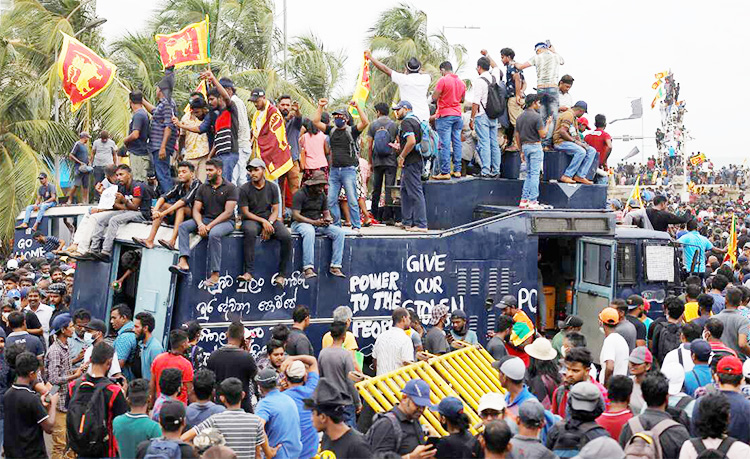
Sri Lanka has always been a hotbed of conspiracy theories. Matters of national importance whether we are talking about collective uprisings against the state such as the JVP uprisings in 1971 and 1987-1989 and the LTTE uprising from 1980s until 2009, and public decisions such as signing of a peace accord between the Government of Sri Lanka and the LTTE, in 2002, were explained by certain observers in terms of conspiracy theories of one kind or another. A secretive nature and lack of transparency often added to public confusion about these events. More recently, the Aragalaya uprising has also triggered a variety of conspiracy theories, despite its openness to the public and explicit accommodation of diverse viewpoints. Nearly always conspiracy theories are ways of explaining away the compounded social and political reality using flimsy evidence by parties with vested interests in keeping with their own political and ideological moorings without making a genuine effort at reaching an objective explanation of the complex reality we are dealing with. As professional social scientists, we have a duty to explain that conspiracy theories in circulation are seriously flawed when it comes to explaining the complex realities fraught with multiple challenges we are dealing with in contemporary Sri Lanka. Conspiracy theories come forward to oversimplify matters, interpret a complex phenomenon in ways that conform with preconceptions and suspicions and deny an evidence-based analysis that is likely to challenge popular assumptions and preconceived ideas and the popular need to find a scapegoat who can be readily blamed for a public disaster that has unfolded. While key decision makers responsible for poor public decisions must be certainly identified and appropriate action taken against them, it should not end up with untenable conspiracy theories as valid explanations for macro social processes with a complex etiology.
Fredric Jameson (1999) considered conspiracy theories as ‘the poor person’s cognitive mapping in the postmodern age’ characterized by insecurities and related paranoia. In other words, conspiracy theories are a questionable way of speculatively making sense of many seemingly unexplainable issues in the postmodern world. However, conspiracy theories often involve blaming a publicly tainted person without investigating his or her specific liability within a larger macro environment characterized by resource constraints and unsurmountable challenges. What is equally problematic is the complete ignorance or blatant neglect of relevant social science perspectives in trying to explain complex social realities attributing them to assumed conspiracy plans of one or more actors to account for events that engage the agency of a multitude of related or unrelated actors as well as the unintended consequences of their action that is social or group generated rather than an aggregated outcome of individual decision making. This is why conspiracy theories are always suspect in social sciences and seen as an epistemological frontier responding to emergencies in a populist manner without going through the rigors of systematic social analysis.
Several social upheavals that happened in Sri Lanka during the recent past can be used to illustrate how conspiracy theories divert attention away from the larger social context relating to these mobilizations requiring systematic investigation. We select the Easter attacks by a cluster of Islamic terrorists on April 21, 2019, to illustrate the specific role of conspiracy theories. In this violent outbreak the country was shocked and taken by surprise with different conspiracy theories looming large in the minds of the affected people and their intellectual leaders. This event involved a serious breakdown of the law-and-order situation in the country. The conspiracy theories tried to understand the attack as the work of some hidden hands that mobilized and instrumentalized the persons involved for achieving their ulterior motives, left unelaborated in these populist explanations.
From what is reported in the media, the Easter attacks were conducted by an apparently religiously motivated secret group of armed actors who were part of a closely knit network. Several official investigations have already been carried out including an enquiry by a parliamentary select committee, two presidential commissions and a judicial investigation. These investigations tried to understand why the police and the security forces failed to prevent the attack while prior information had been received from intelligence sources outside Sri Lanka, who is accountable for the observed security lapses and how the attackers escaped the attention of the intelligence network in Sri Lanka. These are important and valid questions particularly from the law enforcement and national security angles. What is missing, however, is an investigation into the social background of the attackers, how and under what circumstances they became radicalized to the point of having a tunnel vision to end their lives and lives of others and what can be done to prevent a recurrence of such violent outbreaks in future.
Apart from a seemingly pro-government cluster of anti-Islamic conspiracy theories reporting Islamic fundamentalist mobilizations in Sri Lanka for some time, many independent observers were puzzled by an Islamic terror cell targeting their attacks on Christians involved in an important religious congregation on Easter Sunday in April 2019 and some key tourist hotels in Colombo.
The deliberate targeting of Christian places of worship was particularly problematic in the light of the absence of any prior history of tension between Islam and Christianity in Sri Lanka. On the other hand, tensions between Buddhists and Muslims had been escalating with effect from 2012 due to the propaganda work of some anti-Islamic Sinhala nationalist outfits that provoked mob violence against Muslim communities and Muslim-owned businesses in Aluthgama, Ampare, Digana and elsewhere (Haniffa, Amarasuriya, Wijenayake, and Gunatilleke 2014). A potential clue to solve the puzzle about the chosen targets of the Easter violence was provided by an ISIS official declaration through its Amaq news agency on April 23, two days after the Easter attack. It stated that the attackers involved were Islamic state fighters who targeted citizens of coalition states (meaning western tourists staying in the hotels attacked) and the Christians (Amarsingham 2019: 2). This suggested that the Easter attack was connected with an ISIS global campaign targeting suspected agents of westernization in the non-western world rather than any local triggers of conflict in Sri Lanka. As far as we know, the authenticity of this declaration, however, has not been verified or confirmed by any subsequent investigations. So far investigations have not revealed any direct connection between ISIS and the attackers in Sri Lanka even though remote connections and the influence of ISIS online propaganda cannot be ruled out as drivers of a jihadist one track mind.
It raised important questions as to how an Islamist nucleus prepared to die and kill on behalf of an external agency, namely ISIS, was formed in Sri Lanka with an overall history of Islamic tolerance and support for peaceful coexistence though increasingly challenged by infiltrations of Islamic fundamentalism. On the other hand, the Catholic establishment in the country predictably disturbed over many church goers who were killed, mimed and who lost their dear family members during the attack wanted to identify the mastermind (mahamolakaru) behind the attack presumably considering him to be someone other than those who sacrificed their lives during the attack and probe him about why the attack was made and why innocent civilians were targeted.
While this is certainly a legitimate concern, the conspiracy theories that go with it do not help understand the larger social context that produced the network of attackers and why they turned their violence towards a completely innocent party unconnected with them. The view that the attack was strategically designed by yet another party for its own political advantage has been in circulation since the national political crisis unfolded in 2019. While this cannot be ruled out completely, how far such a master plan can instrumentalize deep religious sentiments connected with an established religion to carry out deadly suicide attacks remains a major challenge for such a claim. These contradictory conspiracy theories leave many questions unanswered not only about the Easter attack itself, but also about the larger social context connected with the disaster, including the global scenario where ISIS had been cornered by pro-American alignments and the local scenario of one political crisis followed by another.
There are some unresolved social issues related to the formation of an Islamist extremist group bent on violence in Sri Lanka. Why and how a nucleus of Muslims including some members of a very affluent business family in Colombo became so radicalized during a short period of time to be prepared to kill and die in a jihadist mission for an externally determined cause apparently unconnected with their day-to-day existence in Sri Lanka. Why they targeted innocent civilians who are by no means accountable for the atrocities caused to ISIS is part of a larger puzzle connected with what one analyst referred to as “the ambivalence of the sacred”, particularly after 9/11 (Appleby 2020). While religion continues to remain a key driver of global peace, the tendency on the part of certain religious actors to carry out violent attacks on identified targets is something that requires a systematic social science enquiry outside the purview of individual religious perspectives.
It is also important to note that some of the attackers were well-educated people with established professional careers. For instance, according to media reports there was an aerospace engineer, a lawyer and two leading businesspeople in Colombo among the inner core of attackers who carried out the attack on April 21, 2019 (Srinivasan 2019). Not only do these facts go against the secularization thesis expecting people to become less religious as they gain education and more engaged in technical and business enterprises. It also problematizes any simplistic assumptions about possible connections between economic disadvantage and radicalism. These concerns highlight the need to go beyond simplistic assumptions and popular analytical framings including conspiracy theories in understanding what caused Easter mayhem.
How this small group of faith actors became radicalized possibly through their exposure to ISIS online propaganda, powerful command Sahran was supposed to have on colloquial Tamil and Islamic religious symbols coupled with periodic physical and virtual congregations of the group need to be examined using available empirical evidence also considering potential importance of the wave of anti-Muslim violence escalated since 2012 as a trigger for this mobilization and the progressive radicalization of the nucleus of the attackers (Keethaponcalan 2019).
Finally, in addition to pinpointing security failures contributing to the Easter attack, understanding the underlying social factors and group dynamics is necessary for preventing a possible future recurrence of Islamic radicalization leading to violence. These are some issues calling for thorough social science research in and outside Sri Lanka. Conspiracy theories of various kinds merely serve to accuse an identified public enemy without providing any reliable evidence. Social sciences must bring out the social and ideological factors that account for upheavals like the Easter attack using empirical evidence and sound analytical frameworks to support their explanations. Instead of providing valid explanations of the subject under consideration, the conspiracy theories merely serve to reinforce prejudices of one kind or another at a time of uncertainty and anxiety. Often such theories add to the existing aura of anxieties and conflict dynamics. Conspiracy theories are something to be explained in social analysis rather than a satisfactory framework for explaining an organized violent attack that shocked the whole world, not just Sri Lanka. In some ways conspiracy theories are an inherent aspect of the crisis environment where affected people as well as the key stakeholders in society are constantly looking for answers that suit their interests and deep seated prejudices. Just like gossip and rumour, conspiracy theories serve to spread fake news and false alarms during civil disturbances in ways that divert public anger towards identified targets and contribute towards reinforcing conflict dynamics. This is why debunking conspiracy theories becomes an important challenge for social sciences at times of social upheavals and mass panic. In the official investigations carried out so far, this is a dimension relatively unexplored, and much work needs to be done regarding filling in the gaps.
References
Amarasingam, Amarnath (2019) “Terrorism on the Teardrop Island: Understanding the Easter 2019 Attacks in Sri Lanka,” CTC Sentinel 12, no. 5: 1-6
Haniffa, F. Amarasuriya, H., Wijenayake, V. and Gunatilleke, G. (2014). Where have all the Neighbours Gone? Aluthgama Riots and its Aftermath. Colombo: Law and Society Trust.
Keethaponcalan, Soosaipillai (2019) “Understanding Zahran: Sri Lanka’s Ultra Terrorist.” Colombo Telegraph, 3 May 2019.
Jameson, Fredric (1990) “Cognitive Mapping”. In: Nelson, C./Grossberg, L. [ed]. Marxism and the Interpretation of Culture. Illinois: University of Illinois Press, pp. 347-60.
Srinivasan, Meera (2019) “Inside Story of 9 Suicide Bombers behind Sri Lanka’s Savage Easter Sunday Attacks.” Hindu, May 25, 2019.
An earlier version of this essay was published as an editorial of the Sri Lanka Journal of Social Sciences Vol 45 (2) on April 27, 2023.







 by Kaushalya Perera
Time has, by and large, stood still in the business of academic staff recruitment to state universities. Qualifications have proliferated and evolved to be more interdisciplinary, but our selection processes and evaluation criteria are unchanged since at least the late 1990s. But before I delve into the problems, I will describe the existing processes and schemes of recruitment. The discussion is limited to UGC-governed state universities (and does not include recruitment to medical and engineering sectors) though the problems may be relevant to other higher education institutions (HEIs).
How recruitment happens currently in SL state universities
Academic ranks in Sri Lankan state universities can be divided into three tiers (subdivisions are not discussed).
* Lecturer (Probationary)
– recruited with a four-year undergraduate degree. A tiny step higher is the Lecturer (Unconfirmed), recruited with a postgraduate degree but no teaching experience.
* A Senior Lecturer can be recruited with certain postgraduate qualifications and some number of years of teaching and research.
* Above this is the professor (of four types), which can be left out of this discussion since only one of those (Chair Professor) is by application.
State universities cannot hire permanent academic staff as and when they wish. Prior to advertising a vacancy, approval to recruit is obtained through a mind-numbing and time-consuming process (months!) ending at the Department of Management Services. The call for applications must list all ranks up to Senior Lecturer. All eligible candidates for Probationary to Senior Lecturer are interviewed, e.g., if a Department wants someone with a doctoral degree, they must still advertise for and interview candidates for all ranks, not only candidates with a doctoral degree. In the evaluation criteria, the first degree is more important than the doctoral degree (more on this strange phenomenon later). All of this is only possible when universities are not under a ‘hiring freeze’, which governments declare regularly and generally lasts several years.
Problem type 1
– Archaic processes and evaluation criteria
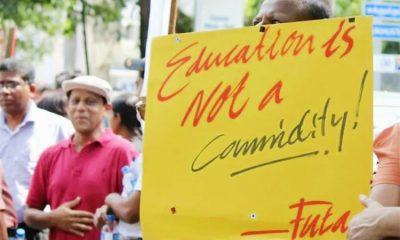
Twenty-five years ago, as a probationary lecturer with a first degree, I was a typical hire. We would be recruited, work some years and obtain postgraduate degrees (ideally using the privilege of paid study leave to attend a reputed university in the first world). State universities are primarily undergraduate teaching spaces, and when doctoral degrees were scarce, hiring probationary lecturers may have been a practical solution. The path to a higher degree was through the academic job. Now, due to availability of candidates with postgraduate qualifications and the problems of retaining academics who find foreign postgraduate opportunities, preference for candidates applying with a postgraduate qualification is growing. The evaluation scheme, however, prioritises the first degree over the candidate’s postgraduate education. Were I to apply to a Faculty of Education, despite a PhD on language teaching and research in education, I may not even be interviewed since my undergraduate degree is not in education. The ‘first degree first’ phenomenon shows that universities essentially ignore the intellectual development of a person beyond their early twenties. It also ignores the breadth of disciplines and their overlap with other fields.
This can be helped (not solved) by a simple fix, which can also reduce brain drain: give precedence to the doctoral degree in the required field, regardless of the candidate’s first degree, effected by a UGC circular. The suggestion is not fool-proof. It is a first step, and offered with the understanding that any selection process, however well the evaluation criteria are articulated, will be beset by multiple issues, including that of bias. Like other Sri Lankan institutions, universities, too, have tribal tendencies, surfacing in the form of a preference for one’s own alumni. Nevertheless, there are other problems that are, arguably, more pressing as I discuss next. In relation to the evaluation criteria, a problem is the narrow interpretation of any regulation, e.g., deciding the degree’s suitability based on the title rather than considering courses in the transcript. Despite rhetoric promoting internationalising and inter-disciplinarity, decision-making administrative and academic bodies have very literal expectations of candidates’ qualifications, e.g., a candidate with knowledge of digital literacy should show this through the title of the degree!
Problem type 2 – The mess of badly regulated higher education
A direct consequence of the contemporary expansion of higher education is a large number of applicants with myriad qualifications. The diversity of degree programmes cited makes the responsibility of selecting a suitable candidate for the job a challenging but very important one. After all, the job is for life – it is very difficult to fire a permanent employer in the state sector.
Widely varying undergraduate degree programmes.
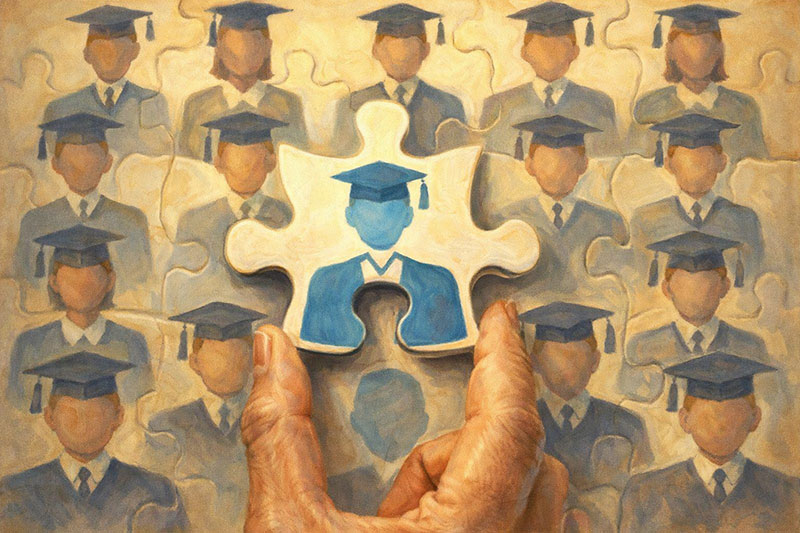
At present, Sri Lankan undergraduates bring qualifications (at times more than one) from multiple types of higher education institutions: a degree from a UGC-affiliated state university, a state university external to the UGC, a state institution that is not a university, a foreign university, or a private HEI aka ‘private university’. It could be a degree received by attending on-site, in Sri Lanka or abroad. It could be from a private HEI’s affiliated foreign university or an external degree from a state university or an online only degree from a private HEI that is ‘UGC-approved’ or ‘Ministry of Education approved’, i.e., never studied in a university setting. Needless to say, the diversity (and their differences in quality) are dizzying. Unfortunately, under the evaluation scheme all degrees ‘recognised’ by the UGC are assigned the same marks. The same goes for the candidates’ merits or distinctions, first classes, etc., regardless of how difficult or easy the degree programme may be and even when capabilities, exposure, input, etc are obviously different.
Similar issues are faced when we consider postgraduate qualifications, though to a lesser degree. In my discipline(s), at least, a postgraduate degree obtained on-site from a first-world university is preferable to one from a local university (which usually have weekend or evening classes similar to part-time study) or online from a foreign university. Elitist this may be, but even the best local postgraduate degrees cannot provide the experience and intellectual growth gained by being in a university that gives you access to six million books and teaching and supervision by internationally-recognised scholars. Unfortunately, in the evaluation schemes for recruitment, the worst postgraduate qualification you know of will receive the same marks as one from NUS, Harvard or Leiden.
The problem is clear but what about a solution?
Recruitment to state universities needs to change to meet contemporary needs. We need evaluation criteria that allows us to get rid of the dross as well as a more sophisticated institutional understanding of using them. Recruitment is key if we want our institutions (and our country) to progress. I reiterate here the recommendations proposed in ‘Considerations for Higher Education Reform’ circulated previously by Kuppi Collective:
* Change bond regulations to be more just, in order to retain better qualified academics.
* Update the schemes of recruitment to reflect present-day realities of inter-disciplinary and multi-disciplinary training in order to recruit suitably qualified candidates.
* Ensure recruitment processes are made transparent by university administrations.
Kaushalya Perera is a senior lecturer at the University of Colombo.
(Kuppi is a politics and pedagogy happening on the margins of the lecture hall that parodies, subverts, and simultaneously reaffirms social hierarchies.)

 This week, too, the spotlight is on an outfit that has gained popularity, mainly through social media.
Last week we had MISTER Band in our scene, and on 10th February, Yellow Beatz – both social media favourites.
Talento is a seven-piece band that plays all types of music, from the ‘60s to the modern tracks of today.
The band has reached many heights, since its inception in 2012, and has gained recognition as a leading wedding and dance band in the scene here.
The members that makeup the outfit have a solid musical background, which comes through years of hard work and dedication
Their portfolio of music contains a mix of both western and eastern songs and are carefully selected, they say, to match the requirements of the intended audience, occasion, or event.
Although the baila is a specialty, which is inherent to this group, that originates from Moratuwa, their repertoire is made up of a vast collection of love, classic, oldies and modern-day hits.
The musicians, who make up Talento, are:
Prabuddha Geetharuchi:

Geilee Fonseka: Dynamic and charismatic vocalist
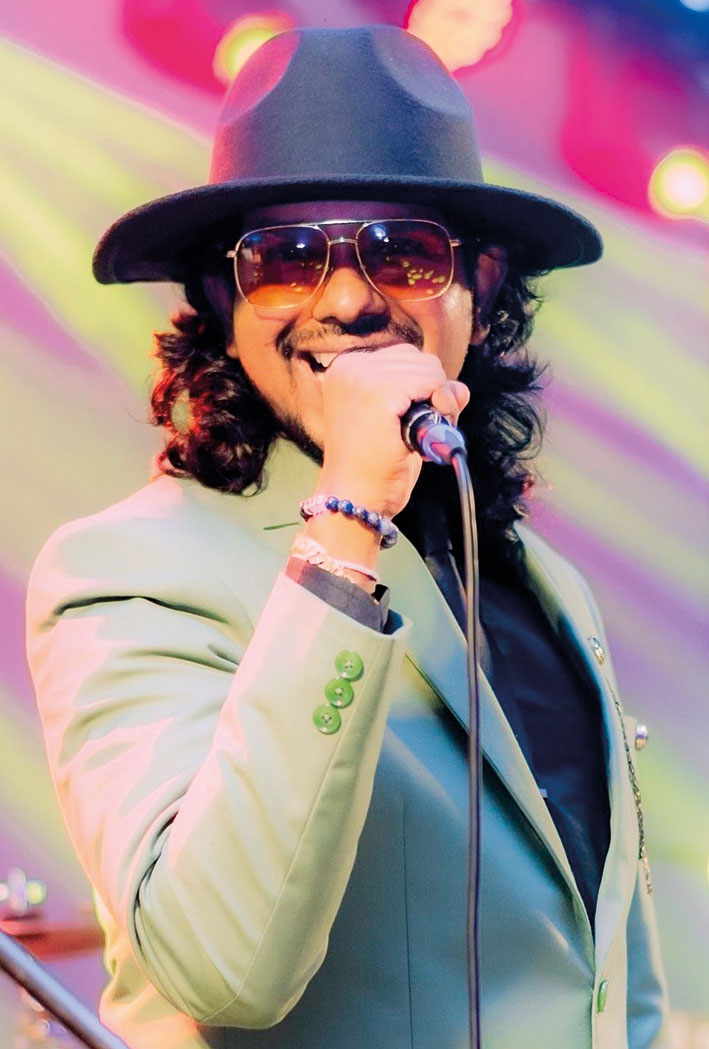
Prabuddha Geetharuchi: The main man behind the band Talento
(Vocalist/ Frontman). He is an avid music enthusiast and was mentored by a lot of famous musicians, and trainers, since he was a child. Growing up with them influenced him to take on western songs, as well as other music styles. A Peterite, he is the main man behind the band Talento and is a versatile singer/entertainer who never fails to get the crowd going.
Geilee Fonseka (Vocals):
A dynamic and charismatic vocalist whose vibrant stage presence, and powerful voice, bring a fresh spark to every performance. Young, energetic, and musically refined, she is an artiste who effortlessly blends passion with precision – captivating audiences from the very first note. Blessed with an immense vocal range, Geilee is a truly versatile singer, confidently delivering Western and Eastern music across multiple languages and genres.
Chandana Perera (Drummer):
His expertise and exceptional skills have earned him recognition as one of the finest acoustic drummers in Sri Lanka. With over 40 tours under his belt, Chandana has demonstrated his dedication and passion for music, embodying the essential role of a drummer as the heartbeat of any band.
Harsha Soysa:
(Bassist/Vocalist). He a chorister of the western choir of St. Sebastian’s College, Moratuwa, who began his musical education under famous voice trainers, as well as bass guitar trainers in Sri Lanka. He has also performed at events overseas. He acts as the second singer of the band
Udara Jayakody:
(Keyboardist). He is also a qualified pianist, adding technical flavour to Talento’s music. His singing and harmonising skills are an extra asset to the band. From his childhood he has been a part of a number of orchestras as a pianist. He has also previously performed with several famous western bands.
Aruna Madushanka:
(Saxophonist). His proficiciency in playing various instruments, including the saxophone, soprano saxophone, and western flute, showcases his versatility as a musician, and his musical repertoire is further enhanced by his remarkable singing ability.
Prashan Pramuditha:
(Lead guitar). He has the ability to play different styles, both oriental and western music, and he also creates unique tones and patterns with the guitar..
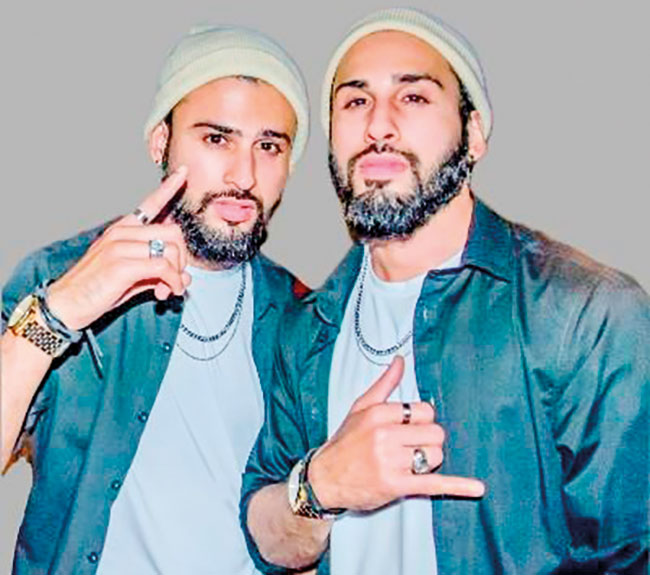
The JJ Twins, the Sri Lankan musical duo, performing in the Maldives, and known for blending R&B, Hip Hop, and Sri Lankan rhythms, thereby creating a unique sound, have come out with a brand-new single ‘Me Mawathe.’
In fact, it’s a very special milestone for the twin brothers, Julian and Jason Prins, as ‘Me Mawathe’ is their first ever Sinhala song!
‘Me Mawathe’ showcases a fresh new sound, while staying true to the signature harmony and emotion that their fans love.
This heartfelt track captures the beauty of love, journey, and connection, brought to life through powerful vocals and captivating melodies.
It marks an exciting new chapter for the JJ Twins as they expand their musical journey and connect with audiences in a whole new way.
Their recent album, ‘CONCLUDED,’ explores themes of love, heartbreak, and healing, and include hits like ‘Can’t Get You Off My Mind’ and ‘You Left Me Here to Die’ which showcase their emotional intensity.
Readers could stay connected and follow JJ Twins on social media for exclusive updates, behind-the-scenes moments, and upcoming releases:
Instagram: http://instagram.com/jjtwinsofficial
TikTok: http://tiktok.com/@jjtwinsmusic
Facebook: http://facebook.com/jjtwinssingers
YouTube: http://youtube.com/jjtwins
Six US soldiers killed in Iranian strike on Kuwait base

Israel attacks presidential office in Tehran as reported death toll in Iran rises to 787

Attorney At Law S K Sangakkara pasess away

SriLankan Airlines Update on Middle East Operations

Trump says Iran war projected to last 4 to 5 weeks, could go ‘far longer’

Qatar downs two Iranian fighter jets as conflict widens

‘Dates have the highest sugar content to fight Coronavirus’

Sunday Island 27 December – Headlines

#SundayIsland 17th December – Headlines

Sunday Island – 28th March

Sunday Island Headlines – 21 March

Sunday Island – 21st February – Headlines
-

 Opinion5 days ago
Jamming and re-setting the world: What is the role of Donald Trump?
-
 Features5 days ago
An innocent bystander or a passive onlooker?
-

 Features6 days ago
Ratmalana Airport: The Truth, The Whole Truth, And Nothing But The Truth
-

 Business7 days ago
Dialog partners with Xiaomi to introduce Redmi Note 15 5G Series in Sri Lanka
-
 Features7 days ago
Building on Sand: The Indian market trap
-
 Opinion7 days ago
Future must be won
-

 Features2 days ago
Brilliant Navy officer no more
-

 Opinion2 days ago
Sri Lanka – world’s worst facilities for cricket fans