
Foreign News
Two dead and several missing in New Zealand landslides

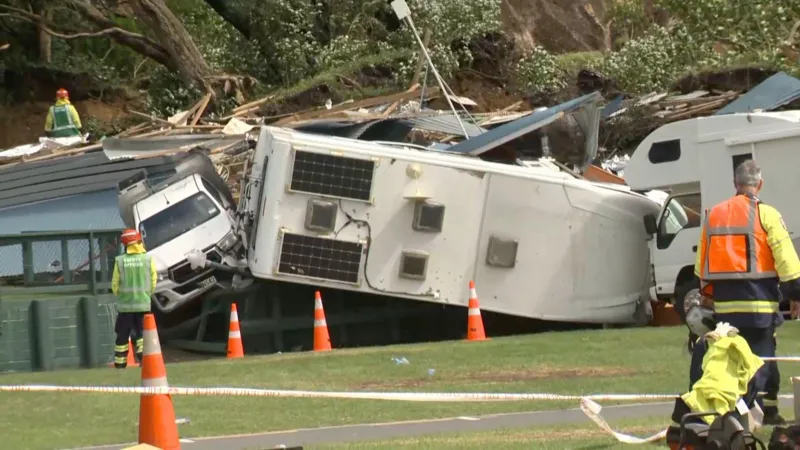
Two people have died and several are feared buried after landslides in New Zealand’s North Island.
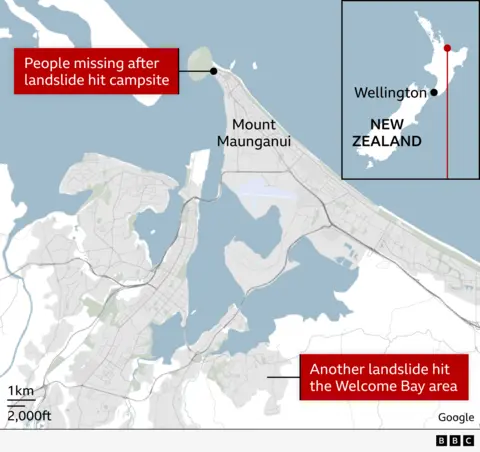
The deaths were reported at Welcome Bay, while rescue workers are still searching through rubble at a different site in a popular campground on Mount Maunganui.
There are no “signs of life”, authorities said, adding that they have a “rough idea” of how many people are missing but are waiting for an exact figure. They provided no other details except that the group includes “at least one young girl”.
The landslides were triggered by heavy rains over the last few days, which led to flooding and power outages across the North Island. One minister said the east coast resembled “a war zone”.
New Zealand is “heavy with grief” after the “profound tragedy” caused by recent weather, Prime Minister Christopher Luxon said on X.
Footage from the campsite on Mount Maunganui, an extinct volcano, shows a huge slip near the base of the volcanic dome, as rescuers and sniffer dogs comb through crushed caravans and flattened tents.
Authorities said that the search would continue through the night. “This is a complex and high-risk environment, and our teams are working to achieve the best possible outcome while keeping everyone safe,” said Megan Stiffler, the deputy national commander for the Urban Search and Rescue team,
The extinct volcano is a sacred Māori site and one of the most popular campgrounds in New Zealand, with a local holiday website describing it as a “slice of paradise”. But it has been repeatedly hit by landslides in recent years.
“I heard this huge tree crack and all this dirt come off, and then I looked behind me and there’s this huge landslide coming down,” Australian tourist Sonny Worrall told local broadcaster TVNZ.
“I’m still shaking from it now… I turned around and had to jump out of my seat and just run,”he added. He saw it happen while swimming in a hot pool.
Hiker Mark Tangney told the New Zealand Herald he heard people screaming from under the rubble. “So I just parked up and ran to help… We could hear people screaming: ‘Help us, help us, get us out of here’,” he said.
Those calls persisted for about half an hour and then went silent, Tangney said.
A surf club in another part of Mount Maunganui has been evacuated following fears of more landslides.
A state of emergency has been declared in the Bay of Plenty where Mount Maunganui sits, and various parts of the North Island, including Northland, Coromandel, Tairāwhiti and Hauraki.
Several areas reported their wettest days on record on Thursday. Tauranga in the Bay of Plenty, for example, received three months worth of rain within a day, according to local media.
Some 8,000 people were without power as of Thursday morning, Radio New Zealand (RNZ) reported.
The wife of a man who was swept away in the Mahurangi River is holding out hope that he will survive.
“I know his personality is strong, wise,” she told RNZ, adding that he was a fisherman back home in Kiribati and knew how to swim and dive.
The man, 47, was driving to work with their nephew when the car they were in fell into the river.
He had pushed the nephew towards a branch so the nephew could hoist himself onto land; but the older man did not manage get back up himself, according to the report.
“It’s been a very big event for us as a country, really hitting almost our entire eastern seaboard of the North Island,” said Minister for Emergency Management Mark Mitchell.
“The good news is that everyone responded really quickly, and there was time to get prepared. That helps to mitigate and create a very strong response,” he told RNZ.
December to February are typically the sunnier months in New Zealand but in recent years heavy rains and storms have become more frequent.
In February 2023, parts of the island were devastated by Cyclone Gabrielle, which is to date the costliest cyclone to hit the Southern Hemisphere, with damage amounting to NZ$13.5bn ($7.9bn; £5.9bn).
This week’s flooding has added to the toll for the local communities that are still rebuilding.
[BBC]


United States President Donald Trump said that Russia has agreed to supply 300,000 tonnes of diesel fuel to global markets amid discussions with Russian President Vladimir Putin.
“I have just concluded a highly successful discussion with President Vladimir Putin, of Russia, wherein it was agreed that Russia will immediately supply over 300,000 Tons of Diesel Fuel to the American and Global Marketplace, another 500,000 Tons during the month of November, and 1,000,000 Tons immediately thereafter,” Trump said in a post on his Truth Social platform.
The president added that Russia would deliver an additional 3 million tonnes of fuel “within a short period of time”. He said that the country would supply 500,000 tonnes in November.
An envoy for Russian President Vladimir Putin, Kirill Dmitriev, praised cooperation between Russia and the United States on diesel and energy in a post on X shortly after.
“Russia-US cooperation on diesel and energy will benefit the world,” Dmitriev wrote on X.
Petrol price pressures
The deal comes despite Ukrainian air strikes, which have taken more than half of the country’s oil refining capacity offline, according to claims made by Ukraine’s Ministry of Defence on Sunday.
The latest announcement comes a week after the G7 countries agreed to release 100 million barrels amid pressure from the White House.
Diesel prices have been elevated in recent months but have started to decline. The average price for a gallon is $6.27 ($1.66 per litre), according to the American Automobile Association (AAA), which tracks daily petrol prices. That’s down $0.10 from this time last week, but up $5.94 from this time one month ago.
[Aljazeera]

United States President Donald Trump has said the US will not attack Iran before the November 3 midterm elections.
The US president said late on Thursday: “we are having productive discussions with the Islamic Republic of Iran,” in a post on Truth Social. “We will not be attacking Iran at any time prior to the midterm elections to be held in the United States on November 3rd.”
Oil prices fell early on Friday as Middle East supply concerns eased somewhat after tensions in the energy-rich Gulf region had mounted in recent weeks.
The possibility of renewed fighting had appeared to drive up oil prices in trading on Thursday. Some analysts believe Trump’s comments were an attempt to try and bring prices back down.
Iran’s Foreign Minister Abbas Araghchi said Tehran is reviewing the US response to its seven day plan to reopen the Strait of Hormuz, and that Iran will respond within the “next few days”.
He added that negotiations are continuing through mediators, Iran’s Tasnim news agency reported.
Iranian media reported “massive explosions” in the southern Strait of Hormuz on Friday, with Fars citing unnamed military sources as saying tankers using “unauthorised” routes may have struck sea mines.
On Tuesday, US Vice President JD Vance said Iran must make a “meaningful” reduction in its uranium enrichment capacity as part of an agreement to end the war. Experts say this demand may signal a softening of Washington’s earlier insistence that Tehran abandon enrichment altogether.
On Monday, Iranian President Masoud Pezeshkian said negotiations with Washington were “futile”, accusing the US of using negotiations to attack Iran.
Russian President Vladimir Putin told Pezeshkian that Russia will “do everything” to help end the US-led war on Iran, Russian news agencies reported on Thursday.
[Aljazeera]
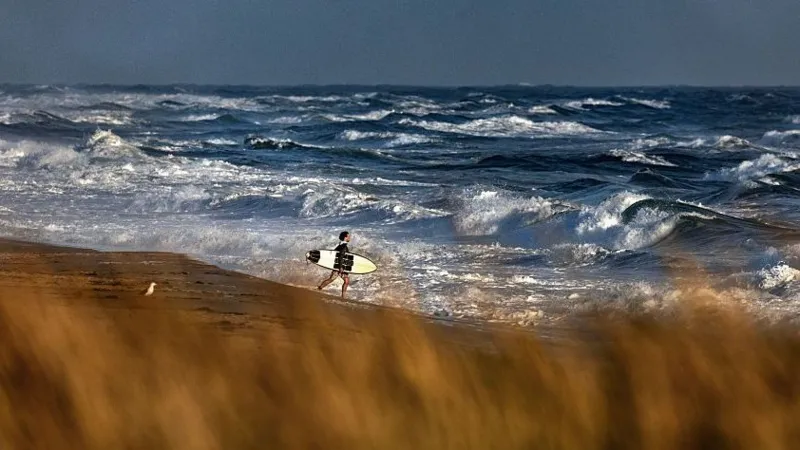
US authorities have found debris from a medical transport aircraft that went missing with six people on board.
The Federal Aviation Administration told the BBC it had lost contact with the Gulfstream G-100 plane just after 01:00 local time (05:00 GMT) on Saturday, while it was travelling from Bermuda to Boston, Massachusetts.
The search for survivors continues off the coast of Nantucket, a Massachusetts island, the US Coast Guard said.
Authorities have notified the next of kin of those on the flight, four Canadian nationals and two Bermudian nationals.
“Search crews located a debris field confirmed to be from the aircraft off the coast of Nantucket,” the US Coast Guard said in an update on Saturday night. It added that ships, helicopters and planes were involved in searches that would through continue the night.
The plane departed from Bermuda’s L.F. Wade International Airport at 23:40 local time, according to flight data from FlightAware, and was due to land at Boston’s Logan International at 01:30 EDT (05:30 GMT).
According to the tail number released by the Coast Guard, the plane belonged to Latitude Air Ambulances, a company that provides international medical flights for patients returning home.
Among those on board were two pilots and two medical staff, both Canadian, Clarence Togeretz, director of flight operations at Latitude, told CBC News.
The crew flew to Bermuda to collect a patient and their relative, who are not Canadian, Togeretz said.
FlightAware’s tracker shows the aircraft significantly dropped in altitude before its communications went dark, plummeting from around 7,300m (24,000ft) to 3,300m (11,000ft).
Radio transmissions shows trouble with communications between the air traffic controller and the pilot, the Boston Globe reported based on transmissions provided by LiveATC.net.
“You’re coming in blind? Is that what you said?,” the air traffic controller asked. “Are you declaring an emergency, or no?”
The pilot’s response was inaudible.
“You’re coming in a little weak so I didn’t hear what your response was, if you were declaring an emergency or not,” the air traffic controller said, according to the Globe.
The air traffic controller later confirmed the pilot had declared an emergency.
An area fire dispatcher asked emergency crews just after 01:00 EDT to prepare to meet a plane with an “electrical issue”.
The dispatcher later said “the aircraft has lost radio and radar”.
The Coast Guard said it would provide an update on Sunday morning local time.
[BBC]

US sanctions International Criminal Court itself in major escalation

Trump announces Russian diesel deal amid soaring US fuel prices

Tsunami warnings across Latin America after 7.7 magnitude earthquake hits

Farhan, Sadaqat help Pakistan ace 183 chase to go 1-0 up

Afghanistan fast bowlers hit back after Bangladesh’s strong start

Sri Lanka chose to bat first in Rawalpindi

‘Dates have the highest sugar content to fight Coronavirus’

Sunday Island 27 December – Headlines

#SundayIsland 17th December – Headlines

Sunday Island – 28th March

Sunday Island Headlines – 21 March

Sunday Island – 21st February – Headlines
-

 Features6 days ago
The first woman in the foreign service or Ceylon Overseas Service it was then called
-

 News5 days ago
Geneva takes up Sallay’s case and govt. ignores opportunity to answer accusations
-

 Editorial7 days ago
Fuelling discontent and protest
-

 Foreign News6 days ago
Ten injured after car crashes into rugby supporters in Australia
-

 News6 days ago
Nearly 20 Iranian tankers stranded off Lanka amid US sanctions
-

 Latest News7 days ago
Tharindu Rathnayake, bowlers secure Asian Games Bronze for Sri Lanka
-

 Features4 days ago
Preventing grievances from becoming communal
-

 Features5 days ago
Sri Lanka Cricket Bill: Governance reform is not yet a cricket strategy