
Latest News
IPL captains’ meeting: What’s on the agenda?



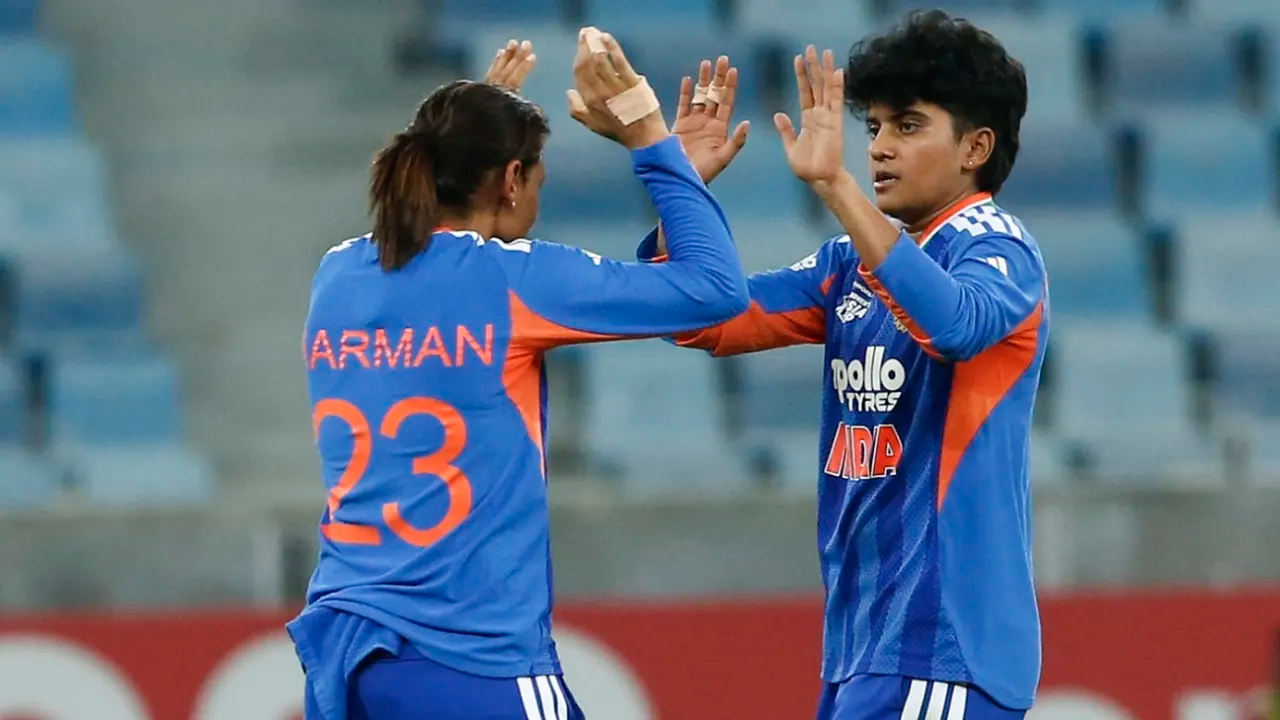
Defending gold-medal winners India overcame hosts Japan by eight wickets in the fourth quarter-final of the women’s cricket competition at the Asian Games in Nisshin on Friday. India chased down 58 in five overs to comfortably secure their place in the semi-finals. They will now face Bangladesh on September 20.
Japan did not exit the competition empty-handed. Their effort to bat as close to the full 20 overs as possible, their running between the wickets and their fielding effort were big positives. But they were bowled out for 57 in 19.5 overs after a solid start, leaving India with little to chase.
India, who opted to field, made the most of a pitch offering turn and bounce, which made stroke-making difficult for Japan. Shree Charani led the attack with another four-wicket haul, continuing an impressive run after taking 4 for 20 in the Women’s T20 Asia Cup final. She struck twice off consecutive balls in the seventh over, removing opener Haruna Iwasaki for 10 before having captain Mai Yanagida caught behind for a duck, but couldn’t convert it into a hat-trick.
Iwasaki and Ayaka Kato Stafford had put on 24 for the opening wicket, but Japan struggled to build partnerships once the stand was broken. Kato-Stafford top-scored with 25 off 47 balls, while Iwasaki made 10 off 22. Japan lost their last eight wickets for just 33 runs.
Charani finished with 4 for 10 from her four overs, while Shafali Verma took 2 for 13 and Deepti Sharma claimed 1 for 14.
Shrevanka Patil, returning to international cricket for the first time in three months after recovering from an ankle ligament injury suffered during the T20 World Cup in June, took 1 for 8 from 3.5 overs. Japan’s innings ended when Patil bowled Nonoha Yasumoto for a duck.
Chasing 58, Shafali opened the innings aggressively, smashing four boundaries in the first over to immediately put Japan under pressure. G Kamalini, who opened in place of Smriti Mandhana, and No. 3 Bharti Fulmali then threw their wickets away to fielders at long-on and point respectively. Left-arm seamer Yasumoto, who dismissed Kamalini, also delivered a wicket-maiden with the new ball.
Shafali finished the game with a six over long-on, staying unbeaten on 40 off just 15 balls. She struck six fours and two sixes at a strike rate of 266.66, as India won with 15 overs to spare.
Scores:
India Women 59 for 2 in 5 overs (Shafali Verma 40*, Richa Ghosh 12*; Nonoha Yasumoto 1-08, Ayaka Kato-Stafford 1-14) beat Japan Women 57 in 19.5 overs (Haruna Iwasaki 10, Ayaka Kato-Stafford 25; Shree Charani 4-10, Shreyanka Patil 1-08, Deepti Sharma 1-14, Shafali Verma 2-13) by eight wickets
[Cricinfo]
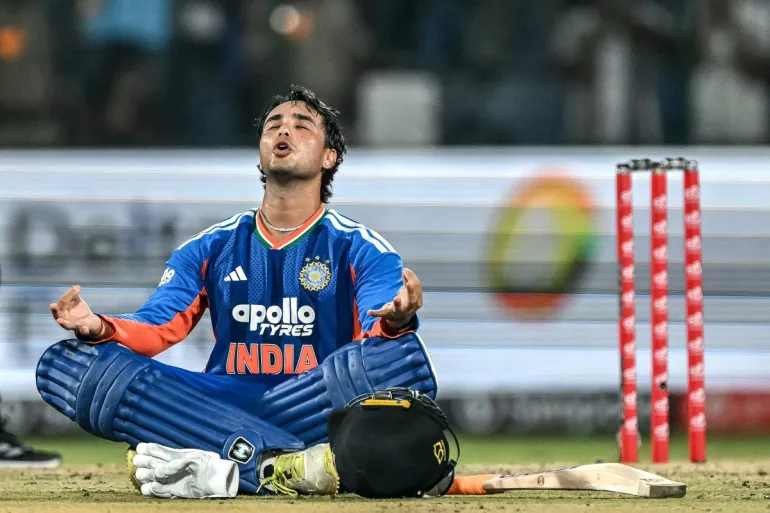
Opener Abhishek Sharma hit a record T20 century off 30 balls to set up a crushing 127 run win for India in the third match against Afghanistan and sweep the series 3-0.
Left-handed Abhishek’s ton on Thursday was the fastest in a T20 international between full Test-playing nations as he guided India to 221-7 at New Delhi’s Arun Jaitley Stadium.
Afghanistan, who were the official hosts for the series, checked the opposition surge after Abhishek departed for 108 off 34 balls and India lost their way from 142-1 in 10 overs.
But the Afghan batters once again disappointed and were bowled out for 94 in 14.1 overs.
Afghanistan had posted 156-8 and 159-8 while batting first in the first two matches.
Left-arm spinner Axar Patel struck twice in his first over to send back Rahmanullah Gurbaz, for 15 and Sediqullah Atal, for one. Afghanistan could never recover from the losses.
Seam bowler Nitish Kumar Reddy also took two wickets in one over to return figures of 3-25.
Leg-spinner Ravi Bishnoi wrapped up the Afghanistan innings with his third strike of the match.
Abhishek stood out with his third T20 century as he surpassed Zimbabwean Sikandar Raza’s ton off 33 balls against Gambia in 2024 and Finn Allen’s effort from the same number of deliveries in New Zealand’s T20 World Cup semi-final win over South Africa earlier this year in India.
The only two faster T20I hundreds came in matches between the lower-tiered associate members of the ICC.
Sahil Chauhan of Estonia holds the overall record of 27 balls after his century against Cyprus two years ago, while Muhammad Fahad needed just 29 balls for his ton for Turkey against Bulgaria in 2025.
Abhishek tore into the Afghanistan bowling attack after India were invited to bat first.
The swashbuckling opener hit a six to reach 99. He completed the hundred with a single and sat in meditation pose to celebrate.
He finally fell for 108 off 34 balls to leg-spinner Rashid Khan. The 26-year-old’s knock was laced with nine fours and 11 sixes.
His opening stand of 142 with Sanju Samson, who hit 50, put India on course for a big total but the Afghan bowlers hit back with regular wickets.
Tilak Varma was run out for two by Rashid and Samson departed after his second successive half-century as he fell to pace bowler Azmatullah Omarzai.
Omarzai struck another blow helped by a stunning catch by Rashid in the deep to send back Shivam Dube for 14.
India raised their 100 in six overs but managed just 79 from the last 60 balls.
India now head to Japan for the Asian Games starting September 19 at Nagoya-Aichi.
Afghanistan will send a largely different team to the Asian Games under Darwish Rasooli.
[Aljazeera]

United States President Donald Trump’s administration has asked lawmakers to clear the sale of 48 F-35 fighter jets to Saudi Arabia for an estimated $24.3bn.
“This proposed sale will support the foreign policy and national security objectives of the United States by improving the security of a major non-NATO ally that is a force for political stability and economic progress in the Gulf region,” the State Department said in a statement on Thursday.
The administration said the sale of the jets, the most advanced fighter aircraft the US has, would “not alter the military balance in the region” in keeping with longstanding US policy that Israel must have a military edge over potential regional adversaries.
The announcement comes after the Houthis in Yemen claimed on Wednesday they shot down a Saudi F-15 fighter jet over Marib, a key city in their battle against Saudi-backed Yemeni government forces. The group released video of fighters in the city standing before burning wreckage of what appeared to be a US-made F-15 fighter jet with Saudi Arabian markings.
The Houthis claim the aircraft was shot down with a “locally made” surface-to-air missile, which would mark a dramatic change in the group’s ability to wage war in the area. Until now, Saudi Arabia’s military has enjoyed relative air superiority in Yemen, and has relied heavily on its ability to carry out air strikes in the neighbouring country.
Intensifying fighting between Saudi Arabia and the Houthis reportedly killed at least five people, including three children, on Thursday.
[Aljazeera]

Advisory for strong winds and rough seas for Multi-day boats in the Bay of Bengal

Showers in the Western, Sabaragamuwa and North-western provinces and in Galle, Matara, Kandy and Nuwara-Eliya Districts

Some NPP manifesto promises may be difficult to fulfil – CIABOC DG

Yoshitha and ex-Navy chief Karannagoda’s case fixed for PTC

Court orders probe into Wimal’s rally speech

Court to rule on Dilith’s writ petition on September 30

‘Dates have the highest sugar content to fight Coronavirus’

Sunday Island 27 December – Headlines

#SundayIsland 17th December – Headlines

Sunday Island – 28th March

Sunday Island Headlines – 21 March

Sunday Island – 21st February – Headlines
-

 News6 days ago
Gnanasara Thero absconding after SC ruling
-

 Opinion5 days ago
From Galkissa (Mount Lavinia) to Tambuttegama
-

 Business6 days ago
HNB Finance strengthens Board with four independent directors
-

 News2 days ago
US embassy won’t comment on IGP’s probe into joint drug raid
-

 Sports6 days ago
Culture within cricket team worrying authorities
-

 Features5 days ago
Sri Lanka’s university crisis: Brain drain and union action demand urgent reform
-

 Features4 days ago
The emptying university: why are academics leaving?
-

 News6 days ago
House to debate 22A, Judicature Bill next week