
News
Trade union says Energy Ministry has regulatory powers to intervene

By Shamindra Ferdinando
The government’s efforts to provide an uninterrupted fuel supply at CEYPETCO pumping stations has suffered a debilitating setback due to theunprecedented heavy demand caused by sharp differences in prices at the CPC-owned and the Lanka India Oil Company (LIOC) managed service stations.
CPC Chairman Sumith Wijesinha yesterday (28) said that with the latest price increase announced by the LIOC, a litre of petrol and diesel, at LIOC service stations, now costs Rs. 27 and Rs 18, respectively, more than at CEYPETO stations.
Wijesinha acknowledged that the difference in prices is the sharpest ever since the entry of LIOC into the Sri Lanka market. A trade union affiliated to the main Opposition Party, the Samagi Jana Balavegaya (SJB) asked the government how the LIOC could increase fuel prices, contrary to the existing agreements.
LIOC entered the Sri Lanka market in 2003 during Chandrika Kumaratunga’s tenure as the President. The Indian state enterprise gradually expanded its operations here and now it operated 202 service stations.
In addition to the oil terminal it managed at Trincomalee, the LIOC owned one-third share in the Ceylon Petroleum Storage Terminals Limited (CPSTL) – a joint venture involving the LIOC and the CPC. The CPSTL operated 13 oil terminals.
Wijesinha admitted that the LIOC had the right to decide on fuel prices on its own. LIOC increased the price of petrol and diesel on Feb 6 and Feb 25, 2022, effective midnight on each day. On Feb 6, LIOC increased the price of a litre of petrol by Rs 7 and diesel by Rs 3. On Feb 25, LIOC jacked up the price of a litre of petrol by Rs 20 and diesel by Rs 15.
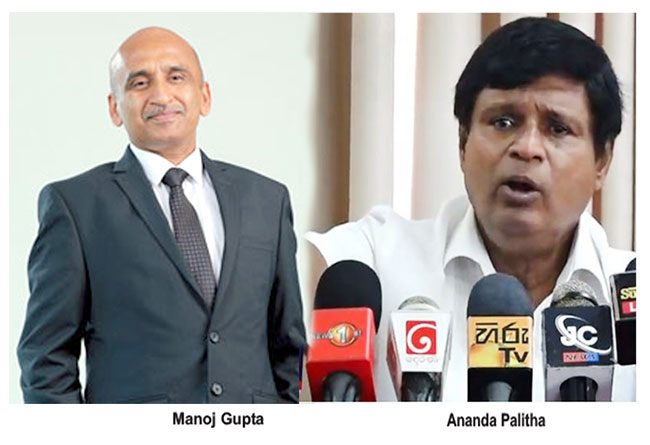
Managing Director of LIOC Manoj Gupta, in a statement issued on the eve of Feb 25 price increase said that the steep rise in international oil markets compelled them to increase the price of petrol and diesel. Pointing out that the Brent crude oil price was now over USD 100 per barrel, Gupta blamed the Russian invasion of Ukraine along with drop in supply by OPEC countries for the situation.
In the wake of Feb 6 price increase, Energy Minister Udaya Gammanpila said that he was informed of the impending price increase by the LIOC. The Minister said so when The Island sought his response to the fuel price hike.
Minister Gammanpila, too, acknowledged that in line with the agreement between Sri Lanka and India, the latter could decide on the pricing formula.
The third retailer Laugfs Petroleum follows the CEYPETCO’s pricing formula. Laugfs entered the market in 2004 also during the Kumaratunga’s presidency.
In spite of the cash-strapped and debt-ridden CPC taking massive losses, the government has delayed matching LIOC pricing formula, thereby drawing the vast majority of consumers to its service stations. CPC Chairman Wijesinha said that their daily losses went up sharply as the sales volumes grew.
During a recent meeting chaired by President Gotabaya Rajapaksa at the Presidential Secretariat, Finance Minister Basil Rajapaksa emphasized that imported pharmaceuticals were the only items subjected to price controls.
Opposition trade union grouping representing oil, port and electricity sector workers yesterday (28) questioned the failure on the part of the government to prevent LIOC increasing oil prices contrary to the existing agreement between the two parties. Having earned massive profits in 2021, the LIOC seemed determined to further exploit hapless Sri Lanka, convener of Samagi trade union grouping Ananda Palitha emphasized that LIOC couldn’t under any circumstances increase prices without specific approval from the Energy Ministry in the absence of a Regulator as envisaged in the agreement between the two parties.
Asked whether the price increases announced by the LIOC on Feb 6 and 25 were illegal in terms of the existing agreements, Ananda Palitha pointed out that would be the case if the Energy Ministry opposed the move. Responding to LIOC claims that oil markets were jittery in the wake of the Russian invasion of Ukraine and other related factors, Ananda Palitha stressed that both the CPC and the LIOC still received stocks ordered 35 days ago.
LIOC MD Gupta has stated that his was the only public limited energy company in business here and was accountable for more than 10,500 local shareholders.
The outspoken trade union leader called for a total review of all agreements between Sri Lanka and India as regards LIOC and Trincomalee oil tank farms. According to him, in the absence of proper energy policy Sri Lanka was at the mercy of India and other foreign powers.
Reference was made to the controversial circumstances under which Sri Lanka has finalized an energy deal with the US-based New Fortress Energy, in September last year. The matter is now before the Supreme Court.
Ananda Palitha said that the government couldn’t absolve itself of the responsibility for ensuring steady supply of fuel at reasonable prices to the consumers.



Latest News
Cabinet approves relief meaures to persons affected due to the War situation in the Middle East


Approval has been granted at the Cabinet Meeting held on 30-03-2026 to provide relief by granting up to rupees 20/- per litre of 92 Octane Petrol, and up to rupees 100/- per litre of Auto Diesel utilized for public transport to minimize the impact on the day today life of the people and the entire economy as a result of escalation of fuel prices due to the war situation in the Middle East region.
Apart from that, the Cabinet of Ministers approved the resolution furnished by the President in his capacity as the Minister of Finance, Planning and Economic Development to grant the following relief for low – income generators, electricity consumers, farmers, fisheries community, and small tea planters who have been exposed to the direct impact of the energy price hike:
(i) Provision of an additional special allowance for April 2026 to low-income generating categories registered under the ‘Aswesuma’ Programme, irrespective of family size: • Providing rupees 7,500/- to a family in the extremely poor category
Providing rupees 5,000/- to a family in the poor category
Providing rupees 2,500/- to a family in the transitional category
(ii) Instead of transferring the additional cost borne for engaging thermal power plants for generating electricity due to the fuel price hike and prevailing dry weather circumstances to the electricity consumers, the additional cost is to be borne by the Government for a period of 03 months so that a relief can be provided to the electricity consumers utilizing below 90 units.
(iii) Increasing the fertilizer subsidiary of rupees 25,000/- per hectare given at present up to rupees 30,000/- per hectare for the Yala season and increasing the fertilizer subsidiary of rupees 15,000/- per hectare given for additional crops that are cultivated in the paddy fields up to rupees 18,000/- per hectare for the Yala season.
(iv) Provide a 50 kg sack of Urea required for the Yala season at a fixed price of Rupees 10,200/- for farmers through Agrarian Services Centres.
(v) Provide a subsidiary of Rupees 50/- per liter for up to 25 liters per day per single-day fishing vessel, for a maximum of 25 days per month, for a period of three (3) months.
(vi) Provide a one-time payment of Rupees 150,000/- per multi-day fishing vessel engaged in fishing activities during the next three (3) months.
(vii) Provide an additional one-time fertilizer allowance of Rs. 5,000 per 50 kg bag of fertilizer to small tea cultivators, in addition to the existing Rs. 4,000 fertilizer subsidy provided by the Sri Lanka Tea Board.

Under the Finance Act No. 35 of 2018 a tax has been imposed on the telecommunication towers and accordingly an annual tax amount of Rs. 200,000/- is levied from mobile network operators who possess telecommunication towers. However, it has been proposed in the Budget for 2026 that the said tax shall not be levied for a period of five (5) years in respect of telecommunication towers newly erected on or after 2026-01-01.
Accordingly, the Legal Draftsman has formulated a draft bill to amend the Finance Act No. 35 of 2018 including the provisions for taking necessary action, and the Attorney General has granted the clearance in the regard.
Hence, the Cabinet of Ministers approved the resolution furnished by the President in his capacity as the Minister of Finance, Planning and Economic Development to publish the said draft bill in the Government Gazette Notification and thereafter submit the same to the Parliament for its concurrence.

The cabinet of Ministers has approved the resolution furnished by the President in his capacity as the Minister of Finance, Planning, and Economic Development to publish the Value Added Tax (Amendment) Bill in the Government Gazette and thereafter submit it for the concurrence of the Parliament.

Cabinet approves relief meaures to persons affected due to the War situation in the Middle East

Amendments to the Finance Act No. 35 of 2018 to be Gazetted

Value Added Tax (Amendment) Bill to be Gazetted

H.M.J.M.Herath appointed Commissioner General of Registration of Persons

Water Resources Board Act, No. 29 of 1964, to be amended

Securing public sector employment opportunities for Athletes demonstrating National-Level sporting excellence

‘Dates have the highest sugar content to fight Coronavirus’

Sunday Island 27 December – Headlines

#SundayIsland 17th December – Headlines

Sunday Island – 28th March

Sunday Island Headlines – 21 March

Sunday Island – 21st February – Headlines
-

 Features3 days ago
Ranjith Siyambalapitiya turns custodian of a rare living collection
-

 News6 days ago
2025 GCE AL: 62% qualify for Uni entrance; results of 111 suspended
-

 News3 days ago
Global ‘Walk for Peace’ to be held in Lanka
-

 Business7 days ago
Hour of reckoning comes for SL’s power sector
-

 Editorial6 days ago
Search for Easter Sunday terror mastermind
-
 Opinion5 days ago
Hidden truth of Sri Lanka’s debt story: The untold narrative behind the report
-
Editorial7 days ago
Ideological confusion and identity crisis
-

 Opinion6 days ago
Is there hope for Palestine?